
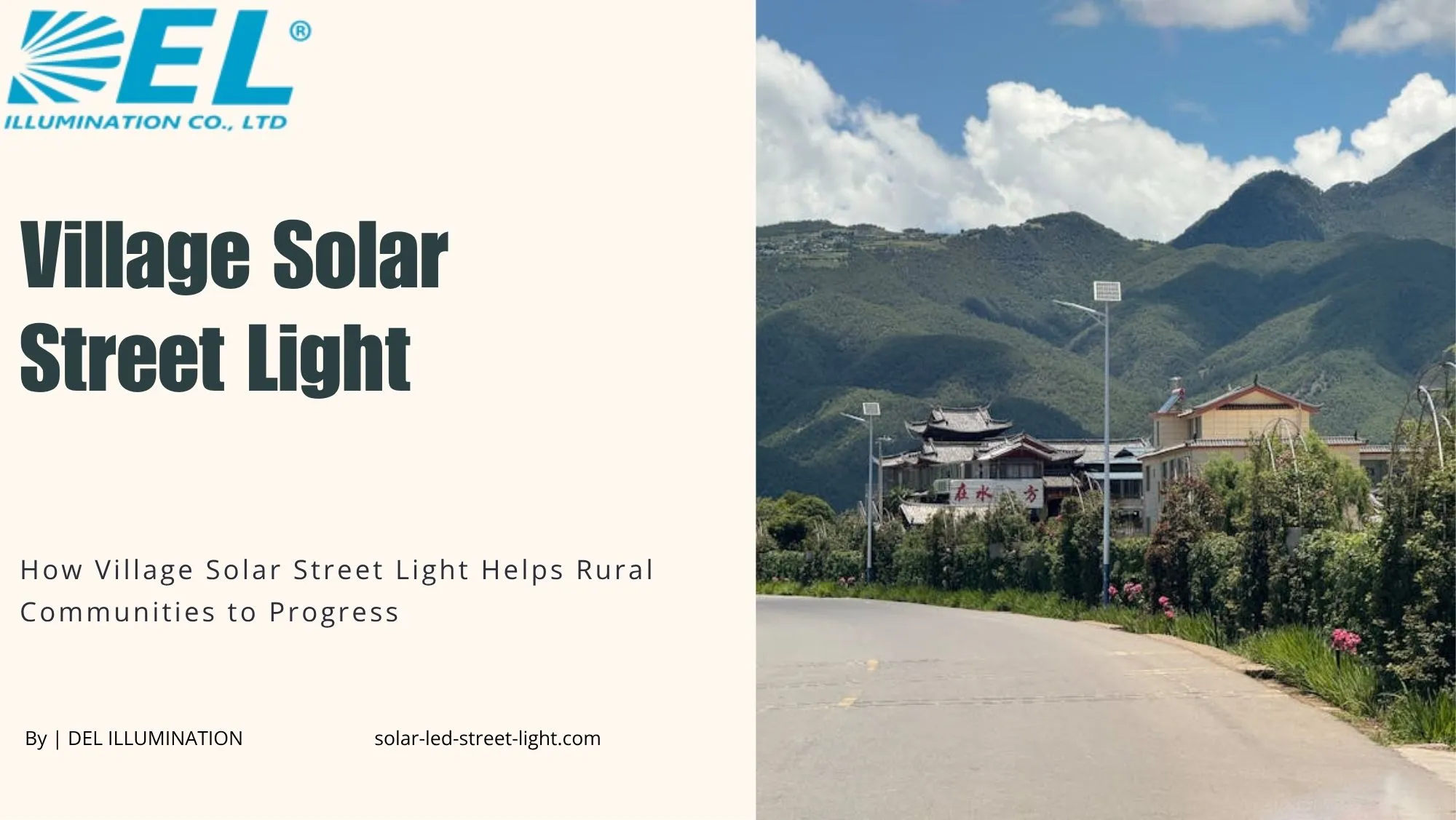
Village solar street light is no longer a luxury it is a modern necessity for millions of people living without reliable electricity. According to the International Energy Agency (IEA), over 730 million people worldwide still lacked access to electricity in 2024, with 84% of them living in rural areas. Sub Saharan Africa accounts for eight out of every ten people globally who remain in the dark. These figures make one thing clear: the need for affordable, off grid lighting solutions in villages has never been more urgent.
Conventional grid electricity remains unaffordable and physically inaccessible for many rural communities. Heavy infrastructure costs, long cable runs, and unreliable grid supply make traditional electrification a slow and expensive process for developing regions. But a proven alternative exists village solar street light systems that harness the power of the sun to deliver safe, reliable, and cost free illumination every single night.
This article explains how village solar street light systems work, what real world impact they have on rural communities, the challenges involved in deploying them, and why they represent one of the most financially sound investments a rural community or local government can make today.
How Village Solar Street Light Works and Its Benefits
Village solar street light operates on the principle of the photovoltaic (PV) effect. Each system consists of a solar panel, a rechargeable battery, and an LED light fixture and in modern deployments, an intelligent charge controller. The solar panel contains photovoltaic cells that capture solar energy during daylight hours and store this energy in the battery. The battery then powers the LED bulbs automatically at night to illuminate roads, pathways, markets, and public spaces in rural localities.
Modern village solar street light systems particularly all in one designs integrate all of these components into a single compact unit that can be installed on a standard pole without any grid connection, underground cabling, or external electrical infrastructure. This design simplicity is precisely what makes them so transformative for off grid communities. For a deeper understanding of this technology, our guide on all in one solar street light technology and its 7 benefits explains the key technical advantages in full detail.
Key advantages of village solar street light systems include:
- Unlike grid connected systems, village solar street lights are sustainable, eco friendly, and renewable emitting zero carbon, zero lead, and zero greenhouse gases during operation.
- They provide a cost effective long term solution. The upfront investment is a one time cost; there are no monthly electricity bills for the operational lifetime of the system, which typically spans 8–12 years for the battery and 15–25 years for the solar panel.
- Their environmentally friendly nature is a standout advantage no harmful gases, no chemical runoff, and no contribution to the greenhouse effect that rural farming communities are acutely vulnerable to.
- Installation requires no heavy wiring, electrical meters, or grid infrastructure. A properly specified all in one village solar street light can be installed by a small local team within hours.
- Advanced models now feature motion sensors, remote monitoring via mobile networks, and programmable dimming enabling communities to further extend battery backup and reduce maintenance needs. Learn more about remote control capabilities in our article on 9 benefits of solar light remote control technology.
The Impact of Village Solar Street Lights on Rural Communities
After installing village solar street light systems, life in rural areas changes in ways that go far beyond simple illumination. The transformation touches safety, health, education, economic activity, and community cohesion simultaneously.
In India, 96% of people surveyed reported that they feel more comfortable walking in the evening after the installation of solar street lights. In rural areas across Asia and Africa, improved nighttime visibility has also reduced accidents caused by encounters with wild animals on unlit paths. Research from communities in Africa found that nighttime theft rates dropped by over 60% after village solar street light systems were installed, with some villages reporting zero theft incidents in the months following installation.
This solar lighting has a profound impact on the social and economic condition of rural society. It enables small businesses shops, food stalls, and repair workshops to operate at night, extending their revenue earning hours and raising household incomes. In Tanzania, factories that extended their production hours using improved street lighting reportedly increased output by 25–30%, while reducing diesel generator imports and the associated costs.
Village solar street light systems also have measurable health benefits. Studies consistently show that rural populations relying on traditional lighting methods kerosene lamps, candles, and open flames suffer higher rates of respiratory disease, eye conditions, and fire related injuries. Replacing these with clean solar LED lighting directly reduces exposure to toxic combustion products.
The educational impact is equally significant. Students who previously could not read or study after dark now use the light from village solar street light systems to complete homework, prepare for examinations, and access educational materials. In Amazon communities in Latin America, solar street lighting was directly associated with improvements in homework quality and school grades. Beyond students, community members use these lights to read newspapers and stay connected to national and international developments reducing the information isolation that affects many rural populations. For guidance on how solar lighting is being deployed specifically in rural settings, see our detailed guide on solar street lights for rural communities.
Challenges and Solutions for Implementing Village Solar Street Lights
According to the IEA’s 2025 tracking report, over 666 million people still lack access to basic electricity globally, and achieving universal access by 2030 would require doubling the current annual rate of progress. This highlights both the enormous scale of the opportunity for village solar street light deployment and the real world obstacles that must be overcome.
The main challenges to implementing village solar street lights include:
- Financing and funding: The upfront cost of purchasing and installing a village solar street light system can be significant for communities with limited financial resources. Rural municipalities in developing countries often cannot fund large scale deployments from local budgets alone.
- Lack of technical expertise: Installing, configuring, and maintaining solar street lights requires specialised skills that may not be readily available in remote rural areas. Without trained technicians, even well specified systems can underperform or fail prematurely.
- Political and regulatory hurdles: Government policies and permit requirements do not always facilitate rapid deployment of solar energy infrastructure, particularly in countries where legacy utility companies resist decentralised energy solutions.
- Social and cultural barriers: In some communities, unfamiliarity with solar technology or scepticism about its reliability can create resistance to adoption, especially when previous low quality generic products have failed to deliver on their promises.
The most effective solutions involve a combination of government grants, NGO co funding, multilateral development bank financing, and community based maintenance training programmes. Manufacturers are also continuously improving the efficiency and affordability of village solar street light systems bringing down the cost per installed lumen year on year. For communities considering their first deployment, our guide on 7 key factors for rural solar street light setup provides practical planning guidance.
It is also worth noting that quality matters enormously in off grid rural deployments. A village solar street light made with inferior components underpowered lead acid batteries, low efficiency polycrystalline panels, or poorly sealed housings will fail within 18–24 months, destroying community trust and wasting scarce resources. Specifying systems with LiFePO4 batteries (rated for 2,000–3,000 charge cycles), monocrystalline panels (21–23% efficiency), and IP67 rated weatherproof housings ensures that the investment delivers its full intended lifespan. Our article on what makes the best solar street lights outlines the 10 most important specification criteria.
How Village Solar Street Lights Are Transforming Rural Areas
The United Nations has set Sustainable Development Goal 7 (SDG 7) universal access to affordable, reliable, sustainable, and modern energy with a target date of 2030. Village solar street light deployment is one of the most direct and measurable contributions that governments, NGOs, and development organisations can make toward this goal.
In practice, the transformation is already underway. By the end of 2024, one government programme alone installed 12,000 solar LED street lights across rural villages in a single district. Malaysia’s national Village Street Lighting Programme has installed over 525,000 village street lights nationwide, with solar LED systems formally adopted as the standard from 2024 onward under its Twelfth Malaysia Plan allocation. In Kenya and Côte d’Ivoire, solar lighting initiatives are among the most significant contributors to the measured decline in energy poverty in recent years.
Village solar street light systems contribute to this transformation across multiple dimensions:
- They reduce energy poverty by providing a sustainable and immediately accessible light source in areas where grid connection may be decades away.
- They enable rural economic activity to extend beyond daylight hours a critical enabler of income growth in agrarian and micro enterprise economies.
- They improve public safety in a measurable, verifiable way one of the most important factors in community acceptance and government support for expansion.
- They reduce carbon emissions and dependence on kerosene and diesel fuels contributing to national climate commitments under the Paris Agreement.
For a closer look at how village solar street light deployment is progressing in specific regions, our regional case study articles cover solar street lights in India, solar street lights in Africa, and solar street light projects in Kenya in detail.
Cost Benefit Analysis: Are Village Solar Street Lights Worth the Investment?
Implementing village solar street light systems is a one time capital investment that generates long term financial returns making it clearly worth the money when evaluated over a full operational lifecycle.
The total cost of a village solar street light deployment covers the fixtures themselves and basic installation labour. There are no underground cable trenches to dig, no electrical meters to purchase, no monthly utility bills to pay, and no fuel costs to sustain. When compared against kerosene lamp expenditure which rural households typically spend USD 120–180 per year on a quality solar street light system pays back its cost within two to four years and then provides free lighting for the remainder of its operational life.
For communities and governments evaluating the numbers:
- A quality village solar street light with LiFePO4 battery technology has an operational life of 8–12 years for the battery and 15–25 years for the solar panel meaning one installation serves a community across multiple budget cycles.
- Maintenance costs are minimal compared to grid connected systems: no cable faults, no meter tampering, and no utility company disputes. The primary maintenance tasks are periodic panel cleaning and an eventual battery replacement.
- Training local community members to perform basic maintenance panel cleaning, visual inspections, battery health checks dramatically extends system life and keeps costs at a community level. Our guide on 10 tips to maintain solar street light batteries provides a practical maintenance checklist suitable for community technicians.
For governments and NGOs comparing installation cost against social outcomes, the return is even more compelling: reduced crime, extended business hours, improved educational outcomes, and better health all reduce the downstream cost burden on public services. The investment in village solar street light infrastructure is one of the most cost efficient public goods a rural local authority can provide.
The Future of Village Solar Street Light
The future of village solar street light technology is bright. Rapid advances in LED efficacy, battery chemistry, solar panel efficiency, and embedded smart controls are making each new generation of systems more capable, more durable, and more affordable than the last.
Modern village solar street light systems increasingly feature:
- Smart motion sensors that dim to 30–50% during low traffic hours and activate to full brightness when movement is detected extending battery life by 30–40% per night without sacrificing safety.
- Remote monitoring via IoT networks that allow municipal authorities or NGO programme managers to track system performance, detect faults, and schedule maintenance across hundreds of lights from a central dashboard.
- Improved battery management systems (BMS) that prevent overcharge and over discharge events the primary causes of premature battery failure in earlier generation village solar street light systems.
- Higher efficiency monocrystalline panels rated at 21–23% conversion efficiency, which generate adequate charge even on partially cloudy days a critical reliability factor for villages in tropical or monsoon climates.
Looking ahead, solar energy in rural settings is not limited to street lighting alone. The same solar infrastructure that powers a village solar street light network can be extended to charge mobile phones, run water pumps, power small refrigeration units for medicines or food, and supply basic household electricity turning a street lighting project into the foundation of a broader rural energy solution.
For those interested in how solar lighting integrates with broader off grid energy infrastructure, our resource on off grid solar street lighting covers the key technical and planning considerations.
Conclusion
No one can argue against the transformative power of village solar street light systems. They are proven, affordable, scalable, and renewable providing lifetime benefits to rural communities that have waited too long for reliable light. With 730 million people still lacking electricity access globally in 2024, and 84% of them living in rural areas, village solar street light deployment is not simply a development project: it is a human necessity.
The three most important takeaways are: first, quality specifications matter enormously in off grid deployments always specify LiFePO4 batteries, monocrystalline panels, and IP67 rated enclosures; second, the long term financial case is overwhelming the investment pays for itself within two to four years and delivers free lighting for a decade beyond that; and third, community training and local maintenance capacity are the single most effective way to maximise system lifespan and return on investment.
For expert guidance on specifying, procuring, and deploying village solar street light systems suited to your community’s exact needs, visit solar led street light.com and speak with our team for a customised consultation.
FAQs
1. How long does a village solar street light last without sunlight? A properly specified village solar street light using a LiFePO4 battery sized with a 3–7 day backup reserve can operate through consecutive overcast or rainy nights without any direct sunlight. The exact backup duration depends on the battery capacity (Ah), the LED wattage, and the programmed operating hours per night. For most rural deployments, a system sized with 3 backup days is sufficient; in monsoon heavy regions or high latitude locations with short winter days, 5–7 days of backup capacity should be specified. Our guide on reliable solar energy street light systems covers backup day calculation in detail.
2. What is the difference between a village solar street light and a standard solar street light? The term “village solar street light” typically refers to systems designed and sized specifically for off grid rural deployment where there is no fallback grid connection, battery reliability is critical, and ease of installation and maintenance by non specialist community members is a priority. These systems tend to prioritise all in one integration, robust weatherproofing (IP67 or above), LiFePO4 battery chemistry for longevity in high heat or cold conditions, and simple pole mounting without the need for trenching or electrical permits. Standard solar street lights for urban use may have different sizing assumptions due to the availability of grid backup.
3. How many solar street lights does a typical village need? The number of village solar street light units required depends on the road length to be lit, the mounting height of the poles, the lumen output of each fixture, and the desired lux level at road surface. As a general rule, fixtures mounted at 6–8 metres with a 30–60W LED output can be spaced 20–30 metres apart while maintaining safe illumination levels on a single lane village road. For a community of 500–1,000 residents with 2–3km of main roads, a typical deployment ranges from 80–150 units. Our spacing and distance calculation guide at how to calculate distance for LED solar area lights provides the full formula.
4. Can village solar street lights work in areas with frequent rain and cloudy weather? Yes a correctly sized village solar street light can sustain reliable nightly operation through periods of cloudy or rainy weather, provided the system includes sufficient battery backup capacity and uses an MPPT (Maximum Power Point Tracking) charge controller. MPPT controllers harvest 20–30% more energy than older PWM controllers in low light and overcast conditions making them essential for deployments in tropical, monsoon, or equatorial climates. Systems using monocrystalline panels also perform better in diffuse light conditions than polycrystalline equivalents. If your lights are already struggling on overcast days, our troubleshooting article on 5 ways to fix a solar light not working covers the most common causes and remedies.5. What funding options are available for village solar street light projects? Funding for village solar street light projects in developing countries is available through multiple channels. Government rural electrification programmes, national renewable energy funds, and local authority infrastructure budgets are the most direct routes. At the international level, the World Bank, Asian Development Bank (ADB), African Development Bank, and United Nations Development Programme (UNDP) all operate financing windows that include off grid solar street lighting as an eligible expenditure category. NGOs focused on energy access including those aligned with SDG 7 targets frequently co fund community scale deployments. The IEA’s 2025 report confirmed that international financial flows to developing economies in support of clean energy reached USD 21.6 billion in 2023, with off grid solar among the fastest growing sub categories. For projects being procured under multilateral development bank frameworks, our article on ADB and World Bank solar street light procurement 2026 is essential reading.