
The landscape of international development financing is shifting dramatically. Beginning January 1, 2026, the Asian Development Bank will mandate Merit Point Criteria evaluation for all internationally advertised contracts, fundamentally changing how solar street light projects are assessed. Simultaneously, the World Bank solar street light procurement has strengthened its procurement framework to emphasize quality, sustainability, and lifecycle value over simple lowest-bid selection. For Engineering, Procurement, and Construction firms competing for these multi-million dollar projects, understanding these new requirements isn’t optional, it’s existential.
This transformation presents both challenge and opportunity. EPCs that master the new evaluation criteria gain competitive advantage in a market where Asia-Pacific infrastructure financing needs exceed several trillion dollars annually. Those who continue to compete on price alone risk disqualification before their technical proposals are even reviewed. This guide provides the complete roadmap for compliance, from understanding weighted scoring mechanisms to demonstrating verifiable sustainability credentials that meet both ADB and World Bank standards.
The World Bank solar street light procurement Revolution: What Changed and Why It Matters
The procurement reforms represent a fundamental shift from cost-minimization to value-maximization in development project financing. ADB President Masato Kanda articulated the philosophy clearly: “The cheapest bridge is not a bargain if it needs rebuilding in ten years.” This principle now extends to all infrastructure, including solar street lighting installations that traditionally saw fierce price competition with little regard for long-term performance.
Merit Point Criteria introduces weighted scoring across multiple dimensions. Quality, experience, technical capability, and innovation now receive quantifiable scores alongside price proposals. For high-risk procurements which includes most solar infrastructure projects in challenging environments technical evaluation carries a minimum 50 percent weighting. This means even a bid that is 20 percent cheaper can lose to a competitor with superior technical credentials and proven lifecycle performance.
The World Bank’s parallel reforms complement this approach. Updated in March 2025 and further strengthened in July 2025, their procurement framework now requires rated criteria for all international civil works contracts. These criteria must evaluate lifecycle costs, innovation potential, sustainability attributes, and local job creation. Additionally, contracts starting September 1, 2025 must ensure 30 percent of labor cost represents local participation, creating new compliance documentation requirements.
These changes eliminate the previous practice of submitting generic technical proposals with rock-bottom pricing. Successful bidders must now demonstrate measurable quality advantages that justify their pricing structure. For solar street light procurement, this means proving that German-engineered systems with LiFePO4 batteries and MPPT controllers deliver superior total cost of ownership compared to cheaper alternatives with recycled lithium-ion cells and basic PWM technology.
Understanding Merit Point Criteria: The New Evaluation Framework
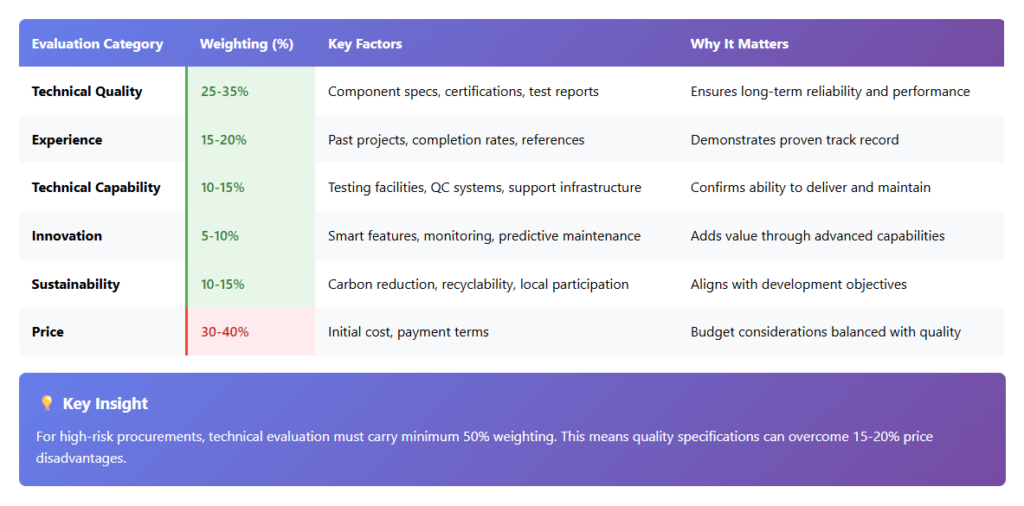
Merit Point Criteria operates through a structured scoring system that assigns numerical values to both technical and financial proposals. The process begins with establishing minimum qualification thresholds typically 70 percent overall technical score with no criterion below 65 percent and no sub-criterion below 50 percent. Proposals failing these minimums are rejected regardless of price.
Technical evaluation examines multiple weighted factors. Quality parameters assess component specifications, manufacturing standards, and third-party certifications. Experience factors review past project performance, including completion rates, defect histories, and client satisfaction data. Technical capability evaluation covers engineering expertise, testing facilities, quality control systems, and post-installation support infrastructure. Innovation criteria reward advanced features like smart controllers, remote monitoring systems, and predictive maintenance capabilities.
Environmental and social performance receives dedicated scoring attention. Proposals must demonstrate carbon footprint reduction compared to grid-connected alternatives, waste management protocols for component disposal, and strategies for local workforce participation. These aren’t checkbox exercises evaluators expect quantified metrics with third-party verification where possible.
The financial evaluation combines with technical scores using predetermined weightings. A common formula applies 60 percent weight to technical merit and 40 percent to price for high-complexity projects, though ratios vary by project risk level. The combined score determines the winner, not the lowest price. This means a bid scoring 95 out of 100 on technical criteria can overcome a 15 percent price disadvantage against a competitor scoring 70 on technical merit.
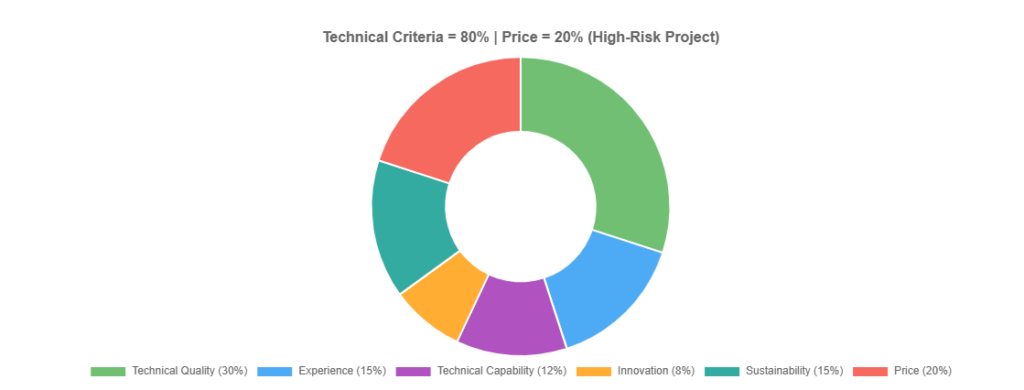
For solar street light EPCs, this framework rewards investment in quality documentation. Detailed test reports showing battery cycle life exceeding 5,000 cycles, thermal chamber testing proving operation from -20°C to 60°C, and IP67 ingress protection verified by accredited laboratories all translate directly into scoring advantages. Generic datasheets and manufacturer claims without independent verification add minimal points.
World Bank Sustainability Requirements: Beyond Environmental Compliance
The World Bank’s sustainable procurement guidance issued in June 2023 and updated through 2025 establishes comprehensive environmental and social framework integration requirements. These extend far beyond basic environmental impact assessments, demanding lifecycle analysis, supply chain transparency, and measurable development outcomes.
Lifecycle cost analysis must encompass the full project timeline, typically 15 to 20 years for solar street lighting installations. This includes initial procurement costs, installation expenses, energy savings, maintenance requirements, component replacement schedules, and end-of-life disposal. The analysis must demonstrate that higher initial investment in quality components produces lower total ownership costs through extended service life and reduced maintenance.
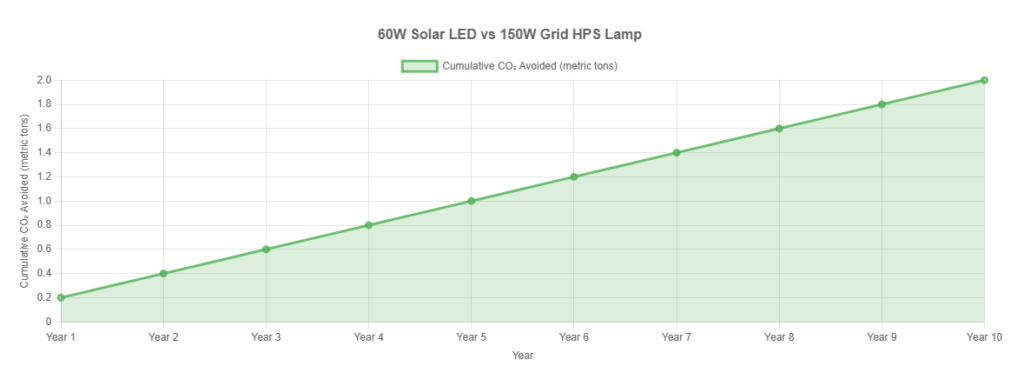
Environmental performance documentation requires specific metrics. Carbon emission reductions must be calculated against baseline grid-connected alternatives, showing cumulative CO2 avoidance over system lifespan. For a typical 60-watt LED solar street light replacing a 150-watt high-pressure sodium grid light, this amounts to approximately 328 kilowatt-hours saved annually per fixture translating to roughly 0.2 metric tons of CO2 avoided per year depending on local grid carbon intensity.
Material sustainability extends to component selection and disposal planning. Proposals must address battery chemistry environmental impact, solar panel recyclability, and aluminum housing reuse potential. LiFePO4 batteries score favorably here due to their non-toxic composition and high recyclability compared to cobalt-based lithium-ion alternatives. Projects must include certified disposal or recycling arrangements for components reaching end-of-life.
Local economic impact receives increasing evaluation weight. The World Bank’s September 2025 requirement for 30 percent local labor participation on civil works contracts creates new documentation obligations. EPCs must demonstrate hiring strategies, skills transfer programs, and subcontracting plans that maximize domestic economic benefit. For solar street light projects, this extends beyond installation labor to include local maintenance capability development and spare parts supply chain establishment.
Social safeguards address community impact and gender-based violence prevention. All procurement processes initiated after January 1, 2021 must incorporate SEA/SH compliance mechanisms where applicable. While less directly relevant to solar street lighting than to civil works, projects must still demonstrate community consultation, safety protocols for construction and maintenance activities, and grievance mechanisms for local stakeholders.
Component Specification Requirements for MPC Compliance
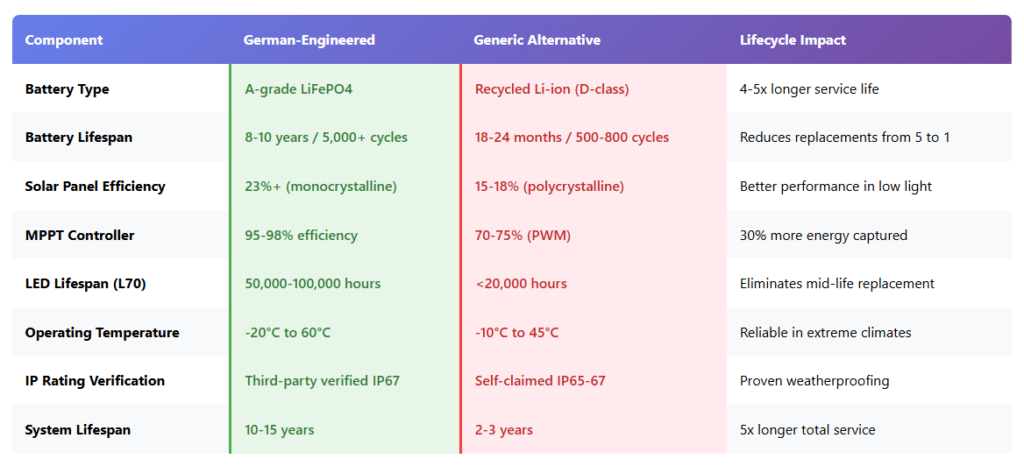
Technical specifications form the foundation of successful MPC bids. Generic component descriptions receive minimal scores evaluators expect detailed specifications with verifiable performance data across all major subsystems.
Solar panel specifications must document cell type, efficiency rating, temperature coefficient, and degradation rate. Monocrystalline panels with 23 percent or higher efficiency under standard test conditions represent current quality benchmarks. Proposals should include accelerated aging test results showing less than 0.5 percent annual degradation and thermal cycling test data proving performance stability across 200 cycles from -40°C to 85°C. Panel sizing must demonstrate 3 to 4 times load power ratio to ensure adequate charging even during winter months with reduced solar hours.
Battery specifications require extensive documentation. Chemistry type, cell grade, capacity rating, cycle life, and operating temperature range all receive evaluation scoring. A-grade LiFePO4 cells with verified 5,000-plus cycle life at 80 percent depth of discharge set the competitive standard. Test reports must show capacity retention of 85 percent or higher after 2,000 cycles and continued operation from -20°C to 60°C ambient temperature. Self-claimed specifications without third-party laboratory verification add minimal points to technical scores.
The battery management system represents a critical but often under-documented component. High-scoring proposals detail overcharge protection, deep discharge prevention, cell balancing algorithms, and thermal management features. BMS specifications should include protection voltage thresholds, balancing accuracy tolerances, and over-temperature shutdown parameters. Systems lacking comprehensive BMS documentation raise reliability concerns that reduce technical scoring.
MPPT controller specifications distinguish quality systems from basic PWM alternatives. Controllers must document tracking efficiency typically 95 to 98 percent for quality MPPT units versus 70 to 75 percent for PWM controllers. Proposals should include conversion efficiency curves across varying input voltages, maximum power point tracking accuracy specifications, and load control algorithms that optimize battery longevity. Temperature-compensated charging algorithms that adjust charge voltage based on battery temperature add scoring value by demonstrating lifecycle optimization focus.
LED specifications must address luminous efficacy, color rendering index, color temperature, and L70 lifetime. Modern LED engines achieve 130 to 160 lumens per watt while maintaining CRI above 70 and color temperature between 4000K and 6000K for street lighting applications. L70 lifetime the hours until output drops to 70 percent of initial lumens should exceed 50,000 hours with thermal management documentation showing junction temperature maintained below 85°C during operation. Optics specifications covering light distribution patterns, glare control, and photometric testing results complete the LED documentation package.
Structural specifications cover pole materials, wind load resistance, corrosion protection, and installation requirements. Aluminum alloy poles with powder-coat finish suitable for coastal environments carry scoring advantages over basic galvanized steel in high-humidity regions. Wind load calculations must demonstrate structural integrity in local wind speed conditions, typically requiring analysis for sustained winds of 120 to 150 kilometers per hour depending on project location.
Documenting Quality and Performance: Third-Party Verification Strategies
MPC evaluation rewards objective evidence over marketing claims. Third-party test reports, international certifications, and performance guarantees backed by insurance create measurable scoring advantages that justify premium pricing.
TÜV certification represents the gold standard for component verification in solar street lighting. TÜV Rheinland and TÜV SÜD testing covers photovoltaic modules, battery systems, LED assemblies, and complete integrated units. Certification documentation includes factory inspections verifying production quality control, random sample testing confirming specification compliance, and ongoing surveillance ensuring continued performance standards. Projects including TÜV-certified components score consistently higher than self-certified alternatives in technical evaluation.
ISO 9001 quality management certification demonstrates systematic approach to production quality. While less specific than product-specific certifications, ISO 9001 provides evaluators confidence in consistent manufacturing processes, documented quality procedures, and continuous improvement systems. Proposals should include current certification documents showing scope coverage that includes solar street lighting production.
IP rating verification requires accredited laboratory testing. Self-claimed IP67 ingress protection carries minimal weight without independent confirmation through tests simulating dust exposure and water immersion per IEC 60529 standards. Test reports should document both dust chamber testing showing complete dust ingress prevention and immersion testing at one meter depth for 30 minutes without water ingress affecting functionality.
Thermal chamber testing proves operation across specified temperature ranges. Reports must show complete system testing not just individual components across the full -20°C to 60°C range, demonstrating battery charging functionality at low temperatures and LED output maintenance at high temperatures. Temperature cycling tests showing 200-plus cycles without performance degradation add further verification value.
Salt spray testing verifies corrosion resistance critical for coastal installations. IEC 61701 salt mist testing at severity level 7 (60 kg NaCl per cubic meter) for 200 hours documents housing and connection reliability in harsh environments. Projects in coastal regions score higher with this documentation included.
Warranty and insurance documentation transforms promises into enforceable commitments. Performance guarantees backed by insurance bonds covering 80 percent capacity retention after 8 years for LiFePO4 batteries provide objective evidence of manufacturer confidence. Product liability insurance covering solar street lighting installations demonstrates financial backing for quality claims. These instruments convert subjective quality assertions into measurable risk transfer mechanisms that evaluators can score objectively.
Lifecycle Cost Analysis: Making the Economic Case for Quality
Total cost of ownership analysis forms the cornerstone of successful MPC bids. While generic systems may show 30 to 40 percent lower acquisition cost, properly documented lifecycle analysis reveals that quality German-engineered systems deliver superior value over 10 to 15 year project timelines.
Initial capital expenditure for quality solar street lighting systems typically ranges from 800 to 2,500 dollars per fixture depending on power rating, battery capacity, and structural requirements. Generic alternatives fall in the 300 to 1,200 dollar range. This upfront difference drives many procurement decisions under traditional lowest-bid evaluation but becomes less relevant under lifecycle analysis.
Installation costs vary based on infrastructure requirements. Solar systems eliminate grid connection trenching that costs 30 to 100 dollars per meter for traditional street lighting. For a 1.5-kilometer installation requiring 50 lights spaced 30 meters apart, avoiding 1,500 meters of trenching saves 45,000 to 150,000 dollars in civil works. This infrastructure cost avoidance often exceeds the premium for quality solar components, making total initial project cost competitive even before operational savings.
Energy costs represent the most significant operational difference. Traditional grid-connected street lights consuming 150 watts cost approximately 150 to 250 dollars annually per fixture in electricity charges depending on local utility rates. Solar systems incur zero energy costs. Over 10 years, this yields 1,500 to 2,500 dollars per-fixture savings that must be included in lifecycle comparison.
Maintenance cost differences emerge from component reliability and replacement frequency. Generic systems with recycled lithium-ion batteries require replacement every 18 to 24 months at approximately 200 to 350 dollars per battery including labor. Over 10 years, this demands 4 to 5 replacement cycles totaling 800 to 1,750 dollars per fixture in battery costs alone. Quality LiFePO4 batteries lasting 8 to 10 years require one replacement during the same period, costing 300 to 500 dollars total.
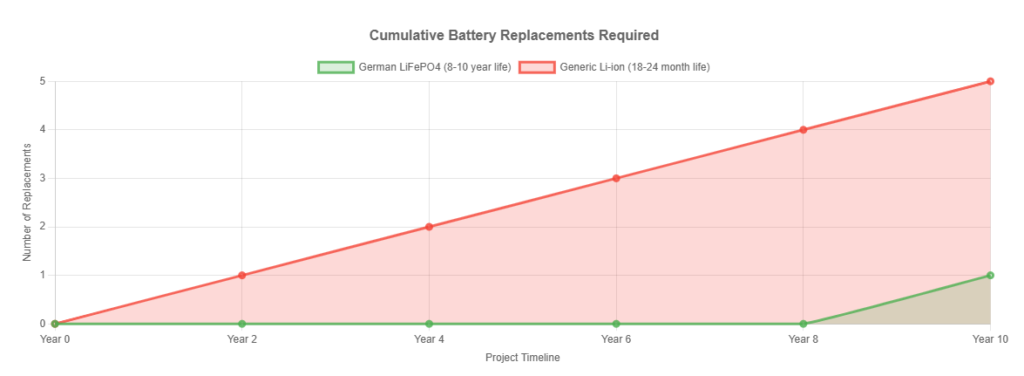
LED replacement frequency compounds maintenance differences. Generic LEDs rated for 20,000 hours or less require replacement after approximately 5 years of nightly operation. Quality LEDs with 50,000 to 100,000 hour L70 ratings operate 10 to 15 years without replacement. Each LED replacement involves both components cost 50 to 150 dollars for quality units and labor cost for accessing elevated fixtures. Eliminating these replacements through quality component selection produces measurable savings.
Controller and wiring failures create additional maintenance events. Generic systems with basic PWM controllers and inadequate weatherproofing experience higher failure rates requiring diagnostic trips and component replacement. Quality MPPT controllers with proper thermal management and IP67-rated connections demonstrate lower failure rates documented through warranty claim data. Each avoided service call saves 150 to 300 dollars in labor, transportation, and equipment costs.
Environmental disposal costs favor systems with longer component lifespans. Replacing batteries every 2 years creates 5 disposal events over 10 years versus 1 to 2 events for long-life batteries. Each disposal carries both direct costs 20 to 50 dollars per battery for proper handling and regulatory compliance expenses. Lifecycle analysis must include these end-of-life costs that accumulate disproportionately with shorter-lived components.
Insurance and warranty costs reflect system reliability expectations. Quality systems with comprehensive warranties and insurance-backed performance guarantees incur minimal unexpected repair costs. Generic systems without robust warranties expose project owners to full replacement costs for premature failures. This risk differential must be quantified in lifecycle analysis through either insurance premium differences or expected value calculations of failure probability times replacement cost.
Local Participation and Skills Transfer: Meeting New Requirements
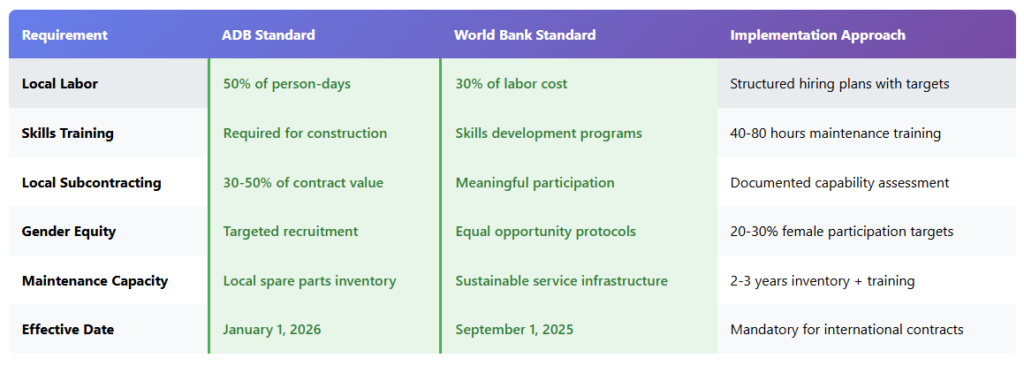
ADB and World Bank requirements for local economic participation create new compliance dimensions beyond technical specifications. Projects must demonstrate meaningful domestic workforce engagement and knowledge transfer that builds national capacity.
The ADB requirement for 50 percent of person-days on construction contracts to be completed by local labor becomes effective January 1, 2026. For solar street lighting projects, this encompasses installation activities including foundation preparation, pole erection, electrical connections, and commissioning. Proposals must detail hiring plans specifying target percentages for different labor categories, recruitment strategies for local workers, and training programs ensuring adequate skill development.
Skills transfer programs distinguish superficial local hiring from genuine capacity building. Effective programs include structured training covering solar technology fundamentals, electrical safety procedures, installation techniques, testing protocols, and maintenance procedures. Training documentation should specify program duration typically 40 to 80 hours for comprehensive solar street light maintenance training curriculum content, instructor qualifications, and assessment methods verifying skill acquisition. Certificate programs registered with local vocational authorities add credibility and scoring value.
Local subcontracting requirements extend participation beyond labor to domestic businesses. Proposals should identify local firms for civil works, electrical installation, and ongoing maintenance services. Documentation must demonstrate subcontractor capability assessment, quality control oversight mechanisms, and contract terms ensuring fair pricing. Subcontracting percentages typically target 30 to 50 percent of contract value flowing to domestic firms, with higher percentages scoring favorably in technical evaluation.
Maintenance capability development ensures project sustainability beyond installation. Proposals must address spare parts supply chains, diagnostic equipment provision, and technical support arrangements that enable local maintenance teams to service systems independently. Establishing in-country spare parts inventory with documented quantities covering typical failure modes for 2 to 3 years demonstrates commitment to long-term local capacity. Training local technicians to diagnose and replace components without manufacturer support creates sustainable maintenance infrastructure that evaluators reward.
Gender equity considerations increasingly influence evaluation scores. Projects demonstrating commitment to women’s participation through targeted recruitment, appropriate facilities, safety protocols, and advancement opportunities align with development bank priorities. Quantified targets such as 20 to 30 percent female participation in training programs with implementation strategies receive favorable scoring compared to generic equal opportunity statements.
Community engagement protocols address social license and stakeholder buy-in. Proposals should document consultation plans with local authorities, community leaders, and affected residents covering project benefits, construction impacts, and ongoing service expectations. Grievance mechanisms providing accessible channels for community concerns demonstrate commitment to responsive implementation. These social safeguards, while less technical than component specifications, increasingly influence overall project evaluation.
Creating Winning Technical Proposals: Document Organization and Presentation
Technical proposal organization significantly impacts evaluation efficiency and scoring outcomes. Evaluators processing multiple bids favor clearly structured submissions that facilitate rapid information location and comparative analysis.
Executive summary sections should concisely present key technical advantages, cost-effectiveness justification, and compliance with mandatory requirements. This opening section typically 2 to 3 pages must orient evaluators to proposal highlights before they encounter detailed technical specifications. Effective executive summaries reference specific performance advantages with quantified metrics: “Our LiFePO4 battery system delivers 5,200 cycle life versus typical 2,000 cycle alternatives, reducing replacement frequency by 62 percent over 10-year project life.”
Technical specification sections require logical organization following evaluation criteria structure. If MPC criteria address battery performance, controller efficiency, LED longevity, structural design, and local participation, the technical proposal should organize content identically. This parallel structure allows evaluators to locate responsive information efficiently rather than searching through generic product descriptions.
Test report integration presents evidence supporting claimed specifications. Rather than lengthy appendices requiring cross-reference, effective proposals incorporate excerpted test data directly into relevant specification sections. For example, battery capacity retention curves from accelerated aging tests appear adjacent to lifecycle analysis, while thermal performance data accompanies operating temperature range claims. This integration technique keeps evidence proximate to claims for immediate verification.
Comparison matrices demonstrating competitive advantages clarify technical differentiation. Tables comparing proposed system specifications against typical generic alternatives across key parameters battery cycle life, controller efficiency, LED luminous efficacy, IP rating, certification status provide evaluators rapid assessment of quality delta. These matrices must cite third-party verification for claimed specifications to maintain credibility.
Visual presentation quality affects professional perception and information retention. Technical drawings showing system architecture, wiring diagrams, mounting details, and installation sequences clarify implementation approach. Photographs of reference installations demonstrate real-world performance rather than renderings. Charts presenting lifecycle cost analysis, performance curves, and reliability data communicate complex information more effectively than dense text.
Case study documentation provides performance evidence from completed projects. Effective case studies specify project scope, installation date, environmental conditions, and measured performance outcomes. Quantified results such as “System has operated 1,823 days with 99.7 percent availability and zero battery replacements” carry more weight than testimonial letters lacking specific performance metrics. Case studies from projects financed by ADB, World Bank, or other multilateral development banks demonstrate familiarity with their requirements and expectations.
Reference project lists should emphasize relevant experience. Projects of similar scope, comparable environmental conditions, and matching technical requirements demonstrate capability more convincingly than larger but dissimilar installations. Listing 50 projects of varying types dilutes impact compared to presenting 8 to 10 highly relevant installations with detailed specifications and verifiable outcomes. Contact information for reference projects enables verification projects with contactable references score higher than those providing only generic descriptions.
Quality assurance documentation outlines manufacturing controls ensuring specification compliance. Factory inspection photographs, production testing equipment descriptions, quality control procedures, and defect tracking systems demonstrate systematic quality management. ISO 9001 certification alone provides less assurance than certification combined with detailed quality protocols specific to solar street lighting production.
Warranty and support commitments transform promises into enforceable obligations. Effective proposals specify warranty terms by component typically 10 years for solar panels, 8 years for batteries, 5 years for LEDs and controllers, 3 years for structural elements with clear description of coverage scope, response timeframes, and replacement procedures. Extended warranty options with associated pricing allow evaluation of different risk-transfer scenarios. Performance guarantees backed by bonds or insurance provide additional assurance that particularly benefits risk-averse evaluation committees.
Conclusion: Positioning for Success in the New Procurement Environment
The 2026 procurement reforms fundamentally reshape competitive dynamics in multilateral development bank financing. EPCs that excel under the new Merit Point Criteria evaluation bring demonstrable quality advantages, comprehensive lifecycle documentation, and genuine local capacity building commitments. Those continuing to compete primarily on price find themselves systematically disadvantaged before technical evaluation even begins.
Success requires strategic investment in three areas. First, develop comprehensive technical documentation systems that capture specifications, test results, certifications, and performance data in evaluator-friendly formats. Generic product catalogs no longer suffice proposals must present objective evidence supporting every claimed advantage. Second, establish relationships with accredited testing laboratories and certification bodies that provide third-party verification. Self-certified specifications carry minimal evaluation weight regardless of actual product quality. Third, create genuine local participation programs that transfer skills and build sustainable maintenance capacity rather than superficial compliance exercises.
The transition from price-based to value-based procurement ultimately benefits all stakeholders. Project owners receive infrastructure delivering long-term performance rather than cheap systems requiring frequent replacement. Local economies gain skills, jobs, and business opportunities that outlast individual projects. Quality manufacturers compete on demonstrable merit rather than engaging in destructive price wars with inferior products. The development finance itself achieves better outcomes per dollar invested, maximizing impact for borrowing nations.
For EPCs ready to compete effectively, the opportunity is substantial. Asia-Pacific infrastructure financing needs exceed several trillion dollars with solar street lighting representing billions annually across thousands of projects. Understanding Merit Point Criteria, documenting sustainability credentials, and demonstrating lifecycle value positions firms to capture market share from competitors still fixated on lowest-bid strategies. The procurement revolution rewards those who embrace quality, transparency, and genuine development impact.
Visit solar-led-street-light.com to discuss how German-engineered solar street lighting solutions can strengthen your ADB and World Bank project proposals. Our team provides comprehensive technical documentation, third-party verification support, and lifecycle analysis services tailored to MPC evaluation requirements.
FAQ
Q: What is Merit Point Criteria and how does it differ from traditional lowest-bid procurement?
Merit Point Criteria evaluates bids using weighted scoring across technical quality, experience, innovation, and price rather than selecting the lowest price automatically. Technical factors receive 50 to 70 percent weighting in high-risk procurements, meaning superior specifications can overcome significant price disadvantages. This ensures contracts are awarded to bidders delivering best lifecycle value rather than cheapest initial cost.
Q: When does the ADB Merit Point Criteria requirement become mandatory?
Beginning January 1, 2026, all internationally advertised contracts financed by the Asian Development Bank must be evaluated using Merit Point Criteria. This applies to all project types including solar street lighting installations across Asia and the Pacific region. Borrowers must structure all new international tenders using MPC evaluation methodology with minimum 50 percent technical weighting for high-risk projects.
Q: How does lifecycle cost analysis affect solar street light procurement decisions?
Lifecycle cost analysis examines total ownership expenses over 10 to 15 years including acquisition, installation, energy, maintenance, replacement, and disposal costs. Quality systems with higher initial cost often deliver lower total cost through extended battery life 8 to 10 years versus 18 to 24 months, reduced maintenance requirements, and eliminated energy charges. This analysis converts traditional capital expenditure decisions into comprehensive value assessments favoring quality over cheapest options.
Q: What third-party certifications provide the strongest competitive advantage in MPC evaluation?
TÜV certification for major components including solar panels, batteries, and complete systems provides maximum verification value. ISO 9001 quality management certification demonstrates systematic production control. IP67 ingress protection verified by accredited laboratories rather than self-claimed proves weatherproofing. Thermal testing across -20°C to 60°C by independent labs documents operational reliability. Each certification translates directly into technical scoring points that less-documented competitors cannot match.
Q: How do the World Bank’s local participation requirements affect project implementation?
Starting September 1, 2025, World Bank civil works contracts must ensure 30 percent of labor cost represents local workers. Projects must document hiring strategies, training programs, subcontracting plans, and skills transfer initiatives that maximize domestic economic benefit. Effective compliance requires structured training typically 40 to 80 hours for solar maintenance skills, local spare parts inventory, and technical support enabling independent local maintenance beyond manufacturer dependence.
Q: What battery specifications are necessary for competitive solar street light proposals?
Competitive proposals specify A-grade LiFePO4 battery cells with verified 5,000-plus cycle life at 80 percent depth of discharge from third-party testing. Operating temperature range must span -20°C to 60°C with documented performance data. Battery management systems require detailed specification including overcharge protection, cell balancing, thermal management, and deep discharge prevention. Self-claimed specifications without laboratory test reports receive minimal evaluation scoring regardless of stated performance levels.
Q: How should proposals address environmental sustainability requirements?
Environmental documentation must quantify carbon emission reductions versus grid alternatives typically 0.2 metric tons CO2 avoided annually per 60-watt solar fixture replacing 150-watt grid light. Material sustainability addresses battery recyclability, solar panel disposal, and aluminum housing reuse with documented end-of-life arrangements. Lifecycle analysis must include disposal costs and demonstrate that quality components with longer service life generate less waste than cheaper alternatives requiring frequent replacement.
Q: What differentiates German-engineered solar street lights in MPC evaluation?
German engineering standards emphasize rigorous component testing, comprehensive quality control, and conservative design margins ensuring long-term reliability. Systems typically specify A-grade LiFePO4 batteries with 8 to 10 year lifespan versus recycled cells lasting 18 to 24 months, MPPT controllers achieving 95 to 98 percent efficiency versus 70 to 75 percent PWM alternatives, and third-party verified IP67 ratings rather than self-certification. These measurable specification differences translate directly into higher technical scores under Merit Point Criteria evaluation.
References
Asian Development Bank. (2025). ADB to Require Merit Point Criteria from 2026, Evolving its Procurement Approach to Enhance Quality and Create Local Jobs. Retrieved from https://www.adb.org/news/adb-require-merit-point-criteria-2026-evolving-its-procurement-approach-enhance-quality
Asian Development Bank. (2025). Merit Point Criteria and ADB’s Evolving Procurement Approach. Retrieved from https://www.adb.org/news/features/merit-point-criteria-and-adbs-evolving-procurement-approach
World Bank Group. (2025). World Bank Group Strengthens Procurement Requirements to Support Job Creation, Skills Development. Retrieved from https://www.worldbank.org/en/news/press-release/2025/07/18/world-bank-group-strengthens-procurement-requirements-to-support-job-creation-skills-development
World Bank Group. (2025). World Bank Operations Procurement. Retrieved from https://thedocs.worldbank.org/en/doc/3b69905d2142467386a74a74eb2269fc-0290012025/original/WB-Operations-Procurement-presentation-Apr2025.pdf
World Bank Group. (2023). Sustainable Procurement Guidance. Retrieved from https://thedocs.worldbank.org/en/doc/01802d374f64ff681613cff8ccad3576-0290012023/original/Sustainable-Procurement-August-2023.pdf
Coherent Market Insights. (2025). Solar Street Lighting Market Size, YoY Growth Rate, 2025-2032. Retrieved from https://www.coherentmarketinsights.com/industry-reports/solar-street-lighting-market
MANLY Battery. (2025). How Long Do Solar Street Light Batteries Last In 2025. Retrieved from https://manlybattery.com/how-long-do-solar-street-light-batteries-last/
Large Battery. (2025). Why LiFePO₄ Batteries Are Becoming the Standard for Solar Street Lights. Retrieved from https://www.large-battery.com/blog/lifepo4-batteries-standard-for-solar-street-lights/
Bosun Lighting. (2025). Solar vs. Grid Street Lights: 20-Year Cost & ROI Analysis. Retrieved from https://www.bosunlighting.com/solar-street-lights-vs-traditional-grid-the-real-cost-breakdown.html
Access Fixtures. (2025). Solar Street Light with Lithium Battery: LiFePO4 LED Solar Light Batteries. Retrieved from https://www.accessfixtures.com/outdoor-solar-light-batteries-led-solar-light-lifepo4-batteries/
Disclaimer
This article is for informational purposes only and does not constitute professional engineering, installation, or procurement advice. Performance specifications and costs may vary based on project requirements, location, and local regulations. Always consult qualified solar energy professionals and legal advisors before making procurement decisions.
For expert consultation on solar LED street lighting solutions, visit solar-led-street-light.com or contact our team for a customized quote.