
Kenya’s county governments are collectively spending between KSh 80 million and KSh 170 million every single month on grid-connected street lighting electricity bills – a fiscal crisis that has triggered service disconnections at hospitals, stalled development budgets, and forced a nationwide rethink of how public lighting is funded and delivered. Kiambu County alone was spending over KSh 1 billion annually on electricity before launching its landmark “Angaza Kiambu” solar street lighting programme. That figure represents money that could have funded schools, health workers, and road maintenance – redirected instead to Kenya Power bills that were growing every year and being left partially unpaid.
For city planners, procurement officers, EPC contractors, and county facility managers, the Kenyan solar street lighting market in 2024–2026 offers both a compelling opportunity and a set of hard lessons. Projects are being delivered at scale, backed by World Bank funding, Public-Private Partnership (PPP) frameworks, and county government mandates. But procurement decisions made on price alone are generating outcomes that undermine long-term project value. This blog unpacks the real costs of solar street light projects in Kenya, examines the country’s most significant live deployments, and draws out the technical and procurement lessons that determine whether a project succeeds or fails over its full lifecycle.
Kenya’s Grid Crisis: Why Solar Street Lights Have Become Unavoidable
Kenya’s national electricity grid – despite generating roughly 90% of its power from renewable sources – has a serious reliability problem. In August 2024, a nationwide blackout struck Nairobi and six other regions simultaneously. System energy losses reached 23.36% in 2025, far above the regulator’s benchmark of 17.5%. Peak demand growth of approximately 6.5% annually between 2025 and 2027 is straining a grid whose firm capacity margin had shrunk to just 2.3% by December 2025.
For county governments responsible for street lighting bills, this creates a double burden. They pay a residential tariff of approximately KSh 28.43 per kWh (USD 0.22, as reported by EPRA in June 2025) on a supply that is neither reliable nor consistently delivered. Grid-connected street lights fail silently when outages occur, leaving residents without safety lighting. When invoices go unpaid – as inevitably happens when monthly bills run into the hundreds of millions of shillings – Kenya Power disconnects services, sometimes including hospitals and emergency facilities.
Solar street lights – self-contained units that generate power through photovoltaic panels, store it in on-board batteries, and deliver it through LED modules without any grid connection – cut through this cycle entirely. Kenya’s solar irradiance of 4.0–6.0 peak sun hours per day across most counties, and the equatorial climate’s consistent day length, make the country an excellent environment for solar street light performance. For procurement officers evaluating off-grid solar street lights in Kenya, the grid instability context is not background information: it is the primary technical and financial justification for the switch.
Major Kenyan Projects: Scale, Cost, and Structure
Kenya’s solar street light projects in 2024-2026 fall into three distinct categories: World Bank-funded county programmes, PPP-structured city-level initiatives, and Rural Electrification and Renewable Energy Corporation (REREC) rural deployments. Each has its own cost structure, procurement requirements, and performance outcomes.
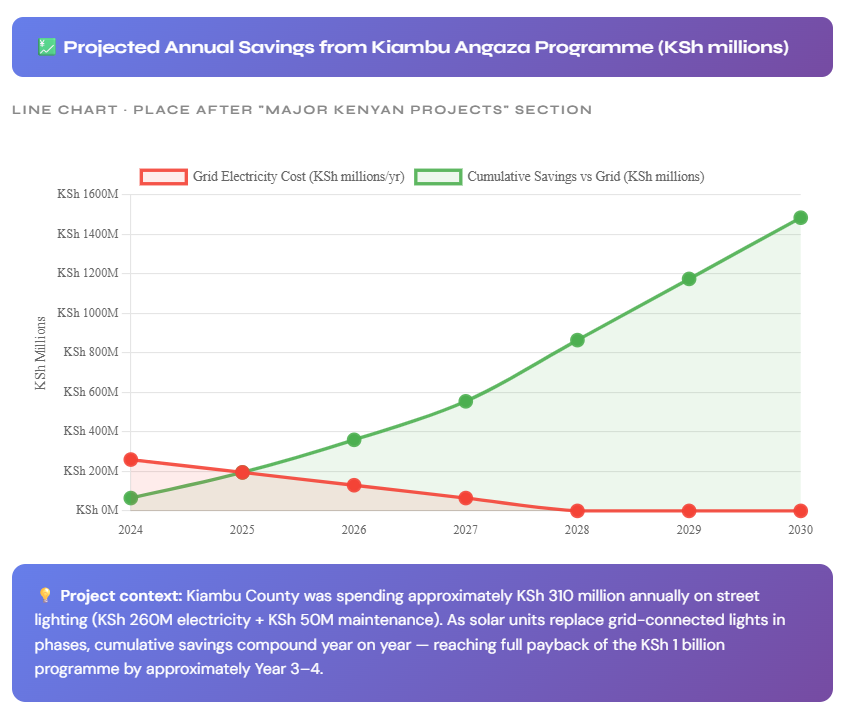
The most thoroughly documented county-level project is the “Angaza Kiambu” programme run by Kiambu County Government. Fully funded by the World Bank and the Agence Française de Développement (AFD), Phase One saw 6,000 solar street lights installed across all 60 wards, followed by Phase Two adding 12,000 units. Phase Two was formally launched in January 2026. Combined, the initiative represents a KSh 1 billion investment targeting complete replacement of Kiambu’s 19,621 grid-connected street lights – which had been costing KSh 260 million annually in electricity plus KSh 50 million in routine maintenance. Once fully commissioned, the savings are projected to eliminate KSh 310 million annual expenditure, paying back the programme cost within approximately three years on electricity savings alone.
At the city scale, Eldoret – Kenya’s fifth city, granted that status in August 2024 – launched a USD 23 million (approximately KSh 3 billion) PPP solar street lighting project through a collaboration between Uasin Gishu County and Rayuton Seko Energy Ltd, a Kenya–Czech Republic joint venture. The project covers over 20,000 adaptive LED streetlights integrated with CCTV surveillance cameras, smart remote monitoring controls, and a 3MWp solar power plant with 10MWh battery storage. A 200-kilometre underground distribution network with fibre optic cabling will support both the lighting and high-speed connectivity. The project structure spans 15 years: two years of construction followed by 13 years of operation and maintenance before county handover. This BOOT (Build, Operate, Own, Transfer) structure transfers long-term operational risk to the private partner and provides the county with a fully maintained, performance-guaranteed system. The county’s own pilot solar installations at its headquarters had already demonstrated the concept – cutting the building’s monthly electricity bill from KSh 800,000 to KSh 200,000.
REREC has also been active in rural counties. Turkana County issued formal tender documentation in 2024–2025 for solar street light supply, installation, and commissioning at the Letea Centre, while similar rural lighting tenders have been awarded across Siaya, Busia, Bomet, Embu, Makueni, Kitui, and Machakos Counties. These rural deployments typically involve 20W–60W all-in-one solar street lights, where the solar panel, battery, LED module, and charge controller are integrated in a single compact unit – reducing installation complexity and eliminating the risk of ground-level battery cabinet theft that affects split-type systems in rural areas.
Real Costs: What Procurement Officers Must Understand
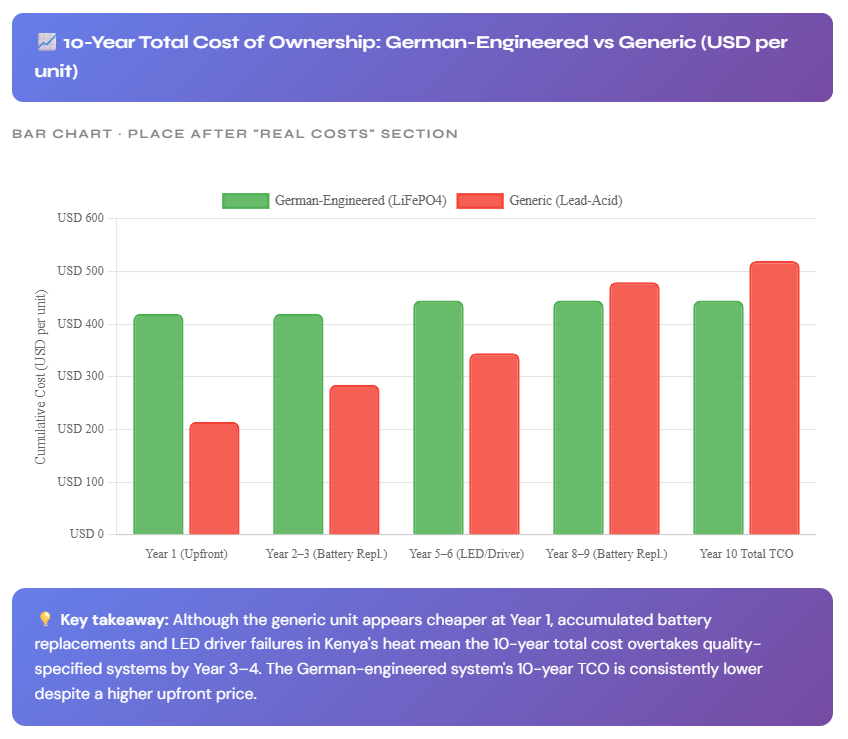
The unit cost of a solar street light in Kenya varies significantly based on specification, quantity, and procurement channel. For a baseline 40W all-in-one solar street light with lead-acid battery storage and PWM (Pulse Width Modulation) charge controller – the generic specification most commonly supplied through lowest-bid county tenders – the installed cost typically ranges from USD 150 to USD 280 per unit at current market rates. At this specification, lead-acid batteries require replacement every two to three years in Kenya’s equatorial climate, where ambient temperatures regularly exceed 30°C and battery degradation accelerates with heat cycling. Over a ten-year project lifecycle, two or three battery replacement cycles at USD 30–50 per replacement, combined with LED driver failures in plastic-housed units, push the actual ten-year cost per generic unit to USD 350–550 – significantly above the apparent upfront saving.
German-engineered solar street light systems with LiFePO4 (lithium iron phosphate) battery chemistry, MPPT (Maximum Power Point Tracking) charge controllers, and 21–23% efficient monocrystalline solar panels carry a higher upfront cost but eliminate replacement cycles within the project lifecycle. LiFePO4 batteries deliver 2,000–3,000 charge cycles with a calendar life of 8-12 years – compared to 300–500 cycles and 2-4 years for lead-acid equivalents. MPPT controllers capture 25–30% more energy from available sunlight than PWM alternatives, reducing the required panel size and ensuring reliable charging during Kenya’s cloud-cover periods. LED modules in die-cast aluminium housings maintain junction temperatures at or below 85°C even at 35°C ambient air temperature – critical for LED lifespan in equatorial climates. At 50,000-hour rated LED life versus 20,000–30,000 hours for generic alternatives, quality-specified systems avoid any LED replacement within a standard ten-year contract period.
For EPC contractors bidding on World Bank or AFD-funded projects such as Angaza Kiambu, understanding the certification requirements for bankable EPC contracts is essential. Development finance institutions specify minimum standards – including IEC 62133 and UN 38.3 battery safety certifications, IP67 ingress protection verified by an ISO 17025-accredited laboratory (not self-declared), and IK08 impact resistance – that generic suppliers frequently cannot meet with independent documentation. Failure to provide certified hardware at project completion creates contract compliance risk that can trigger financial penalties or contract termination.
Grid connection costs – often overlooked in naive cost comparisons – also favour solar strongly. Installing a new grid-connected street light in a rural or peri-urban Kenyan location requires trenching, cabling, and utility connection works that industry analysis consistently estimates at USD 200-1,000 per light depending on terrain and distance from distribution infrastructure. Solar street lights eliminate these civil works entirely.
Lessons Learned: What Kenya’s Projects Are Teaching the Industry
Kenya’s solar street lighting programme pipeline has generated a clear set of lessons that any EPC contractor, procurement officer, or county planning department should absorb before tendering or specifying a new project.
The first lesson is that lowest-bid procurement produces predictable failures. Multiple county projects funded through standard public procurement have subsequently faced battery failures within 18 to 24 months of installation, with units going dark by early evening rather than maintaining dusk-to-dawn operation. The root cause is invariably undersized lead-acid batteries paired with PWM controllers – a combination that cannot sustain full-night operation after two consecutive overcast days and degrades rapidly with thermal cycling. Kiambu County’s Auditor General flagged exactly this pattern for grid-connected lighting in the 2023–2024 audit period; the lesson applies equally to poorly specified solar procurement.
The second lesson concerns battery autonomy sizing. Kenya’s climate includes extended cloud cover during the long rains (March–May) and short rains (October–December). Solar street light systems must be sized for battery backup of at least three to five days at the project’s specific latitude – not annual average irradiance figures – to maintain reliable dusk-to-dawn performance through consecutive low-sun days. Systems sized only for average conditions fail during Kenya’s worst-case cloud periods, precisely when road safety and security are most needed.
The third lesson addresses the governance gap in street lighting ownership. As Kiambu County’s experience illustrated, national agencies including Kenya Power, KURA (Kenya Urban Roads Authority), and REREC frequently install street lights that counties are then expected to maintain and pay for – without receiving operating budgets to do so. County procurement teams are therefore inheriting maintenance obligations for systems they did not specify or procure. This makes warranty enforcement, minimum specification requirements, and life-cycle cost analysis critical tools at the procurement stage – not afterthoughts.
A fourth lesson applies to large-scale PPP projects like Eldoret’s USD 23 million initiative: community consultation and phased rollout planning are essential for accountability. Civil society groups monitoring the Kiambu project raised concerns about billing transparency for the KSh 1 billion programme, highlighting that projects at this scale require clear reporting structures. EPC contractors should align with FIDIC EPC contract frameworks for solar street light projects that provide structured performance obligations and reporting milestones to maintain stakeholder confidence.
For contractors managing installations across geographically dispersed rural sites – such as REREC’s deployments across Turkana, Samburu, and northern counties – remote monitoring becomes operationally essential. Solar street lights equipped with GSM/GPRS connectivity and remote management capability allow maintenance teams to detect faults, monitor battery state, and verify charging performance without physical site visits. The 9 benefits of solar light remote control technology are particularly compelling in Kenya’s context, where remote rural sites may be four to six hours from the nearest urban service centre.
Technical Specifications for Kenya’s Climate
Kenya’s equatorial climate – characterised by consistent solar irradiance of 4.0-6.0 peak sun hours per day, ambient temperatures ranging from 18°C at altitude to over 35°C in lowland areas, and two annual rainy seasons – defines the minimum technical specification that solar street lights must meet to perform reliably. Procurement officers should require:
- Solar panel efficiency: 21-23% monocrystalline cells, ensuring maximum energy harvest from Kenya’s peak sun hours across all seasons
- LED efficacy: 160-180 lumens per watt (lm/W), delivering 20-40 lux at road level for secondary road and market street applications using 30W-60W LED modules
- Battery chemistry: LiFePO4, with 2,000-3,000 cycle life and 8-12 year calendar life – eliminating replacement within a ten-year contract period
- Charge controller: MPPT rated above 98% conversion efficiency, capturing 25-30% more energy than PWM alternatives during Kenya’s partial cloud conditions
- IP rating: IP67 verified by an accredited third-party laboratory – not self-declared – providing genuine protection through both rainy seasons and dust conditions in arid counties
- IK rating: IK08, providing impact resistance for public installation sites in markets and high-traffic areas
- Backup autonomy: Minimum three to five days of dusk-to-dawn operation without solar charging, calculated for the lowest-irradiance month at project latitude
- Warranty: Minimum five-year comprehensive warranty covering all system components, with a performance guarantee – the standard offered by German-engineered systems versus the one to two year warranties typical of generic suppliers
For urban road applications and county headquarters facilities, photometric simulation using DIALux or equivalent software should verify that lux levels meet Kenya’s applicable road classification standards before hardware is specified. The approach to DIALux luminaire spacing optimisation for EPC projects ensures that pole spacing, mounting height, and LED output are correctly matched to road width and surface reflectance – avoiding both under-illuminated sections and over-specified hardware that inflates project cost.
When comparing German-engineered systems versus generic solar street lights for Kenyan projects, the performance gap is most visible in the third and fourth year of operation, when lead-acid batteries in generic units begin their first replacement cycle. Projects that can demonstrate ten-year total cost of ownership data to county procurement committees consistently secure approval for quality-specified hardware over lowest-bid alternatives.
Conclusion – Solar Street Light Projects in Kenya
Kenya’s solar street lighting market has moved decisively from pilot programmes to large-scale deployment, driven by grid unreliability, unsustainable electricity tariffs, and explicit government mandates at county and national level. The Angaza Kiambu programme, the Eldoret PPP project, and REREC’s rural lighting tenders together represent hundreds of millions of dollars of procurement activity that will shape how public lighting is delivered across East Africa for the next decade.
Three takeaways stand out for every decision-maker involved in these projects. First, the financial case for solar street lights in Kenya is now beyond dispute: replacing grid-connected street lights eliminates electricity bills that run to hundreds of millions of shillings annually, with payback periods of three years or less on electricity savings alone at current KPLC tariffs. Second, specification quality is the single factor that determines whether a project delivers its promised savings or generates a secondary wave of replacement costs within three years of handover – LiFePO4 batteries, MPPT charge controllers, independently certified IP67 protection, and five-year comprehensive warranties are the minimum threshold for any project that will be audited for value-for-money. Third, governance structures around ownership, maintenance responsibilities, and warranty enforcement must be established before procurement is awarded, not after a county government discovers it has inherited maintenance obligations for systems it never specified.
If your organisation is planning a solar street light project in Kenya – whether a county-level rollout, a development-finance-backed EPC contract, or a rural community lighting programme – the team at solar-led-street-light.com provides German-engineered solar street lighting with verified IEC certifications, comprehensive project design support, and the technical documentation required for World Bank and AFD procurement compliance. Contact us today for a project-specific consultation and quote.
Frequently Asked Questions
1. What wattage is typically specified for solar street lights in Kenyan county projects?
For secondary roads and market streets across most Kenyan counties, 30W–60W LED all-in-one solar street lights are the standard specification, delivering 4,800–9,000 lumens sufficient for 20–40 lux at road level on a 6–8 metre pole with 25–35 metre spacing. For primary urban arterials and roundabouts, 80W–120W split-type systems with separate battery enclosures are used. Rural pathways and village feeder roads are typically served by 20W–30W units that are easier to install without specialist equipment.
2. How do Kenya’s rainy seasons affect solar street light performance?
Kenya’s long rains (March–May) and short rains (October–December) reduce average daily irradiance and can produce consecutive overcast days. Quality-specified solar street lights sized with LiFePO4 batteries providing three to five days of backup autonomy maintain reliable dusk-to-dawn operation through these periods. Generic systems with undersized lead-acid batteries frequently fail to complete full-night illumination after two or more consecutive low-sun days, leaving communities without lighting precisely when wet-season road safety risks are highest.
3. What financing structures are available for solar street light projects in Kenya?
The principal financing structures active in Kenya in 2024–2026 are World Bank and AFD grants (as used in Angaza Kiambu), PPP BOOT arrangements (as used in Eldoret), and county government development budgets supported by the Kenya Urban Support Programme. EPC contractors bidding on World Bank-funded projects should familiarise themselves with the ADB and World Bank solar street light procurement frameworks to ensure specification and documentation compliance from the tender stage.
4. What certification requirements apply to solar street lights in Kenya’s public procurement?
Kenya’s Public Procurement and Asset Disposal Act (2015) and development finance institution requirements align on a common baseline: IEC 62133 and UN 38.3 for battery safety, IEC 62109 for the charge controller, IP67 verified by an ISO 17025-accredited laboratory, IK08 impact resistance, and ISO 9001 quality management certification for the manufacturer. For World Bank and AFD-funded projects, TÜV or equivalent third-party certification of the complete system significantly strengthens compliance documentation and reduces lender queries. Self-declared IP ratings from suppliers without accredited test certificates are not acceptable on bankable contracts.
5. What are the most common failure modes in solar street light projects in Kenya?
The three most common field failure modes in Kenyan projects are: battery failure due to undersized capacity and thermal degradation of lead-acid cells, typically presenting as lights going dark three to four hours before dawn by the second or third year; LED driver failure in plastic-housed units where junction temperatures exceed 100°C during hot days, shortening LED life from a rated 50,000 hours to 15,000–20,000 hours in practice; and charge controller underperformance in PWM systems that fail to recover battery charge adequately during partial cloud periods. All three are eliminated by correct specification of LiFePO4 batteries, MPPT controllers, and die-cast aluminium LED housings.
6. How should EPC contractors manage maintenance across remote Kenyan sites?
Solar street lights equipped with GSM/GPRS remote monitoring modules allow battery state, charging current, and fault status to be transmitted to a central dashboard without physical site visits – a significant cost saving for projects covering multiple remote villages in counties like Turkana, Samburu, or Marsabit. Contractors should establish spare parts depots at county or sub-county level, ensure installation teams are trained in common solar light fault diagnosis and repair, and include response time obligations in service-level agreements tied to the project warranty structure.
7. How does Kenya’s 40% local content requirement affect solar street light procurement?
Kenya’s public procurement regulations require foreign tenderers to source at least 40% of contract inputs from national suppliers, contractors, or labour. For solar street light projects, this typically means procuring civil works, pole manufacture, installation labour, and on-site logistics from Kenyan firms, while specialised hardware – panels, batteries, LED modules – may be sourced internationally. EPC contractors should verify local content requirements at the tender stage and structure their supply chain accordingly to avoid disqualification.
8. What ROI timeline should county governments expect from replacing grid-connected street lights with solar?
Based on Kiambu County’s documented costs – KSh 260 million annually in electricity plus KSh 50 million in maintenance for approximately 20,000 grid-connected units – the per-unit annual cost of grid operation is approximately KSh 15,500. A quality-specified solar street light at an installed cost of USD 350–500 (approximately KSh 45,000–65,000) eliminates this ongoing cost entirely after installation. At current KPLC tariffs of KSh 28.43/kWh, the payback period on electricity savings alone is approximately three to four years, after which the county retains the full annual saving for the remaining 6–10 years of the system’s operational life.