
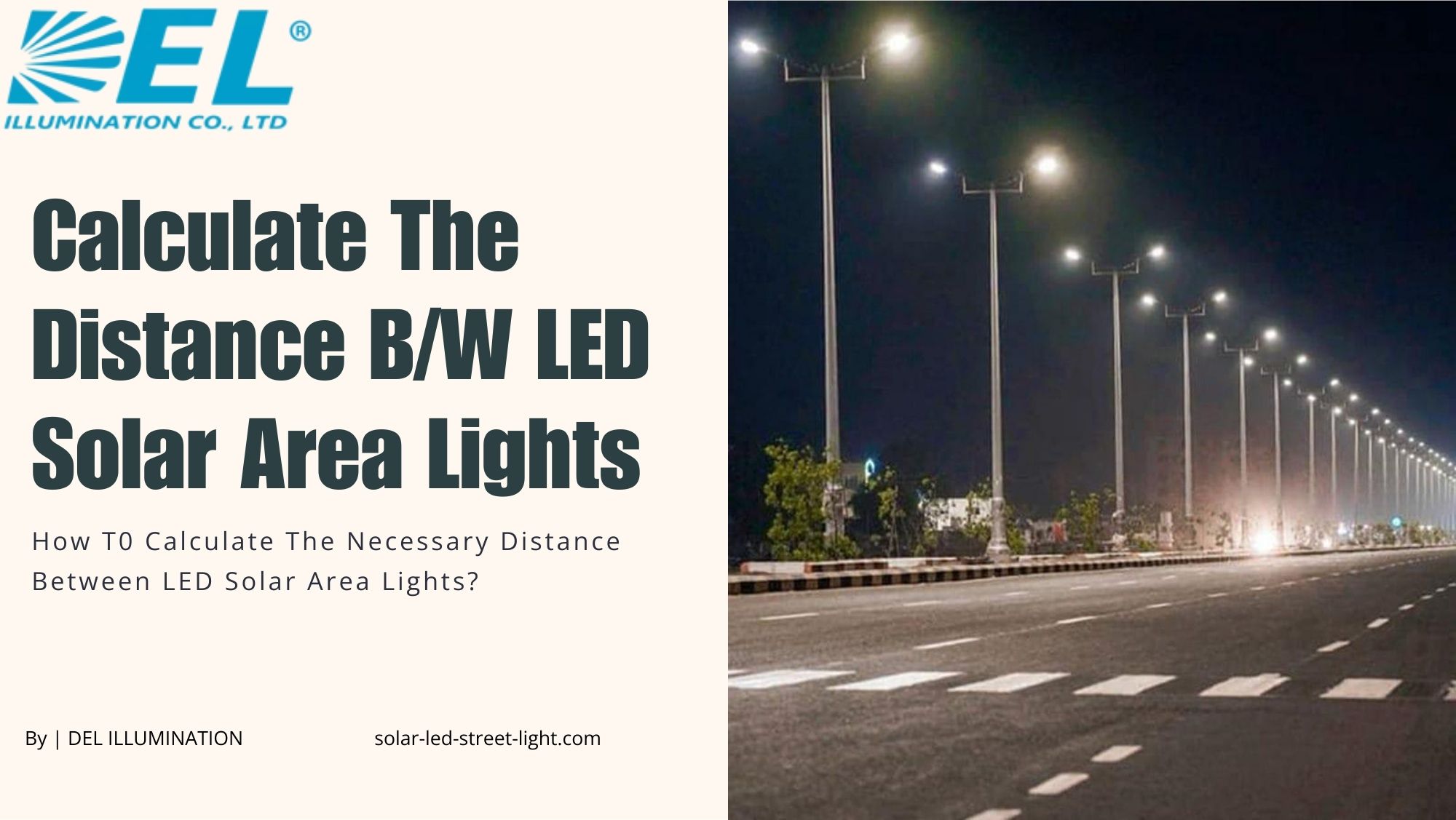
Installing LED solar area lights is one of the most cost-effective and sustainable solutions for outdoor illumination ,but the results depend heavily on proper spacing. Many project managers and contractors make the mistake of estimating pole distances by eye, which leads to dark spots, wasted investment, and poor energy utilisation. Whether you are planning a new installation or reviewing an existing layout, understanding the correct calculation method for LED solar area lights is essential to achieving consistent, high-quality illumination.
This guide walks you through every key variable involved in determining the right spacing between LED solar area lights, along with the step-by-step formula used by lighting engineers worldwide.
Why Accurate Spacing of LED Solar Area Lights Matters
When LED solar area lights are placed too far apart, the result is inadequate illumination and potential safety hazards. When placed too close together, resources are wasted and the total cost of ownership rises unnecessarily. You can learn more about managing project budgets in our article on Total Cost of Ownership for EPC Projects.
The goal is to find the optimal distance at which each pair of LED solar area lights delivers uniform coverage across the entire illuminated zone. This requires analysing several properties of both the lights themselves and the area in which they will be installed.
Key Factors That Determine Spacing Between LED Solar Area Lights
Before applying any formula, you need to gather specific data about your site and your chosen fixtures. The following variables directly influence the recommended distance between LED solar area lights:
1. Properties of the Area
The length and width of the area where LED solar area lights are to be installed play a fundamental role. If the width of the road or pathway exceeds the effective coverage radius of a single fixture, higher-wattage luminaires will be required ,or a staggered/opposite-side mounting arrangement must be adopted. For guidance on selecting the right configuration for parks and open spaces, see our Park Solar Lights Installation Guide.
2. Properties of the Terrain
Uneven or sloped terrain adds complexity to the planning process. Elevation changes affect the effective mounting height and the angle at which light hits the ground, both of which influence how far apart LED solar area lights should be placed. In hilly or irregular terrain, the calculated spacing may need to be reduced to maintain uniform illumination.
3. Overall Height of the Pole
Pole height is perhaps the single most important physical factor in the spacing equation for LED solar area lights. A taller pole allows light to be distributed across a wider area, which means poles can be spaced further apart. A shorter pole concentrates the light in a smaller area, requiring more frequent placement. This is a core reason why investing in quality solar light pole systems pays off over the long term.
4. Total Light Luminaries (Wattage)
The wattage (W) of LED solar area lights reflects the total energy input to the lighting system. Higher-wattage fixtures generally produce more lumens and can cover wider spacing, though efficiency varies significantly between brands and technologies. For a deeper comparison of quality tiers, read our analysis of German Engineering vs Generic Solar Street Lights.
5. Luminaire Output (LO) in Lumens
Every set of LED solar area lights carries a luminaire output (LO) specification measured in lumens. This is the actual quantity of light emitted by the fixture and is a critical input in the spacing formula. Do not confuse lumens with wattage ,two fixtures with the same wattage may have very different lumen outputs depending on their LED efficiency.
6. Lux Level Required (Lx)
Lux (lx) represents the intensity of light falling on a surface per square metre. Different road and area types require different minimum lux levels according to international standards. When spacing LED solar area lights, the lux requirement for your specific application must be met consistently across the entire area ,not just directly beneath each pole.
7. Productivity Factor (PF)
The productivity factor accounts for real-world losses in lighting efficiency ,including driver losses, thermal degradation, and optical imperfections. It is expressed as a percentage and is always less than 100%. When calculating the effective output of LED solar area lights, the PF reduces the theoretical lumen output to a realistic working value.
8. Deterioration of Lamp Output (DLO)
Over time, all light sources ,including LED solar area lights ,experience lumen depreciation. The deterioration of lamp output (DLO) factor accounts for this decline and ensures that spacing calculations remain valid not just at the point of installation but throughout the operational life of the fixture. Most reputable manufacturers provide both initial and maintained DLO values.
Pro Tip: Always use maintained (end-of-life) lumen values rather than initial values when calculating spacing for LED solar area lights. This ensures your installation continues to meet minimum lux requirements throughout the product’s rated lifespan. Learn more about what to look for in our guide to 5 Benefits of IP65 Solar Street Lights.
The Formula for Calculating Distance Between LED Solar Area Lights
With the above variables in hand, you can now apply the standard formula used by lighting engineers to determine the recommended spacing between LED solar area lights.
The core principle is that the pole-to-height ratio must not exceed 3. If the distance between poles divided by the mounting height of the LED solar area lights is greater than 3, the illumination between poles will fall below acceptable standards.
The effective luminaire output used in the calculation is derived as follows:
Effective LO = LO × PF × DLO
The spacing (S) between LED solar area lights is then calculated using:
S = Effective LO ÷ (Lx × Width of Area)
Finally, always verify the result against the pole-height ratio:
Pole Spacing ÷ Pole Height < 3
For example, if the calculated spacing comes out at 33.6 feet and the pole height is 12 feet, the ratio is 2.8 ,which is less than 3, confirming that this spacing is valid for your LED solar area lights installation.
|
Variable |
Symbol |
Unit |
Where to Find It
|
|---|---|---|---|
|
Luminaire Output |
LO |
Lumens (lm) |
Product datasheet |
|
Productivity Factor |
PF |
% (decimal) |
Manufacturer spec |
|
Deterioration of Lamp Output |
DLO |
% (decimal) |
Manufacturer spec / IES LM-80 |
|
Required Lux Level |
Lx |
Lux (lx) |
Road/area lighting standard |
|
Width of Area |
W |
Feet / Metres |
Site survey |
|
Pole Height |
H |
Feet / Metres |
Pole specification |
Common Mistakes When Spacing LED Solar Area Lights
Even experienced installers sometimes overlook variables that compromise the performance of LED solar area lights. Here are the most frequent errors:
- Using initial lumen values instead of maintained values ,this causes gradual non-compliance as the lamps age.
- Ignoring the productivity factor ,failing to apply PF inflates the effective output and results in under-illumination.
- Not accounting for terrain ,flat-surface calculations applied to sloped ground produce inaccurate spacing.
- Choosing generic fixtures without verified datasheets ,without certified lumen data, the entire calculation becomes unreliable. This is a key procurement risk covered in our article on Patent Design Solar Street Lights and EPC Project Risk.
- Exceeding the 3:1 pole-to-height ratio ,this is a hard threshold. LED solar area lights spaced beyond this ratio will fail to provide adequate mid-span illumination.
How Fixture Quality Affects Spacing Calculations
The accuracy of your spacing formula is only as good as the data you input. Low-quality or uncertified LED solar area lights frequently report inflated lumen figures that do not reflect real-world performance. This is why product certification matters enormously ,particularly for publicly funded infrastructure projects subject to procurement standards such as those from the ADB or World Bank.
If you are working on an EPC or government-funded project, it is worth reviewing the ADB and World Bank Solar Street Light Procurement Requirements for 2026 and understanding the ADB Merit Point Criteria (MPC) to ensure your chosen LED solar area lights comply with all applicable standards.
For FIDIC-based contracts, you may also want to review how lighting specifications interact with contract obligations in our article on FIDIC EPC Contracts for Solar Street Lights.
Engineered products with independently verified performance data ,such as those conforming to German engineering standards ,give you far more confidence that the lumen and DLO values used in your spacing calculations will hold true in the field. Read more in our comparison of German Engineered Solar Street Lights.
The Broader Impact of Correctly Spaced LED Solar Area Lights
Getting the spacing right for LED solar area lights has implications that go well beyond individual project performance. At scale, correctly planned solar street lighting installations contribute to safer communities, reduced energy poverty, and lower carbon emissions. For a broader look at how solar lighting intersects with development finance and global infrastructure trends, see our piece on Solar Road Lights and Global Economic Growth.
The power of the modern solar street lamp lies not only in its self-sufficiency but in the precision with which it can be deployed ,and that precision begins with an accurate spacing calculation.
For installations requiring remote monitoring and adaptive control, the addition of remote control technology can further optimize the performance of LED solar area lights by adjusting brightness levels based on time of night or motion detection, effectively extending battery life and coverage.
Conclusion
LED solar area lights are a powerful, sustainable solution for outdoor lighting ,but their effectiveness depends entirely on proper planning. By understanding the key variables (pole height, luminaire output, productivity factor, lumen deterioration, required lux levels, and area dimensions) and applying the pole-to-height ratio rule, you can calculate the ideal spacing for any LED solar area lights project with confidence.
Always source your input data from certified, independently verified product specifications. And for large or public-sector projects, ensure your chosen LED solar area lights meet the applicable procurement and certification standards. Explore our full range of resources on innovative LED solar street light solutions and certification requirements for bankable EPC contracts to support your next project from specification through to delivery.
Frequently Asked Questions (FAQs)
Q1. What is the maximum allowable pole-to-height ratio for LED solar area lights?
The pole-to-height ratio for LED solar area lights must not exceed 3:1. This means the distance between two poles should be no more than three times the mounting height of the fixture. If this ratio is exceeded, the mid-span illumination will be insufficient and the installation will fail to meet standard lux requirements.
Q2. What lumen output should I look for when selecting LED solar area lights for road use?
The required lumen output depends on the width of the road, the mounting height, and the minimum lux standard applicable to your road classification. As a general rule, LED solar area lights for secondary roads with a 6–8 metre width and 6-8 metre pole height typically require between 8,000 and 14,000 lumens. Always confirm the requirement against your local or project-specific lighting standard before specifying fixtures.
Q3. How does lumen depreciation affect the spacing of LED solar area lights over time?
All LED solar area lights experience gradual lumen depreciation throughout their operational life. If spacing is calculated using only initial lumen values, the installation may comply with lux standards when first commissioned but fall below the minimum requirement after a few years. To prevent this, always use the maintained (end-of-life) lumen value ,typically the L70 figure (the point at which lumen output falls to 70% of its initial value) ,in your spacing calculation.
Q4. Can LED solar area lights be installed on uneven terrain using the same formula?
The standard spacing formula provides a reliable starting point, but uneven terrain requires additional adjustments. Elevation changes affect the effective mounting height and the angle of light distribution, which can create dark zones between poles. For sloped or irregular terrain, it is advisable to reduce the calculated spacing by 10–20% and to carry out a photometric simulation using professional lighting design software to verify coverage before finalising the layout of your LED solar area lights.
Q5. Do procurement standards for LED solar area lights on government projects affect spacing specifications?
Yes. For government or multilateral-funded projects, procurement frameworks such as those set by the ADB or World Bank often specify minimum photometric performance criteria that directly determine the lumen output and spacing of LED solar area lights. Non-compliance with these criteria can result in contract disputes or disqualification from future tenders. Ensure that your chosen fixtures are supported by certified photometric data and that your spacing plan is documented and verifiable against the applicable standard.