
Over 178 remote Indigenous and Northern communities across Canada have no connection to the North American electricity grid – and extending that grid to reach them can cost between CAD $30,000 and $100,000 per kilometre. In Australia, where outdoor temperatures regularly exceed 45°C in remote outback regions, the challenge is equally stark: vast distances, extreme climate conditions, and the prohibitive cost of conventional grid infrastructure leave thousands of rural roads, mining access tracks, and Indigenous community streets unlit every night.
For city planners, facility managers, EPC contractors, and procurement officers operating in these environments, off-grid solar street lighting is no longer a compromise – it is the most technically sound and cost-effective solution available. This blog covers why Canada and Australia represent two of the world’s most compelling markets for off-grid solar street lighting, what engineering standards genuinely matter in these climates, and how to evaluate systems that will perform reliably across decades.
Why Remote Areas in Canada & Australia Demand Off-Grid Solar Solutions
Canada’s geography is extraordinary in scale. According to Natural Resources Canada’s Clean Energy for Rural and Remote Communities (CERRC) programme – which has committed over CAD $453 million to reduce diesel dependence in remote settlements – the majority of off-grid communities rely on diesel generators for all electricity needs, including street lighting. This diesel dependency is expensive, environmentally damaging, and logistically fragile: fuel deliveries to fly-in-only communities are vulnerable to weather disruptions and supply chain failures.
In a landmark 2024 example, a USD $15.8 million combined federal-provincial investment enabled the Ulkatcho First Nation in British Columbia to replace approximately 64% of its diesel generation with solar energy, cutting roughly 1.1 million litres of diesel consumption annually. This is the scale of impact off-grid solar solutions can deliver when engineered correctly for remote conditions.
Australia’s situation mirrors this in climate terms but differs in character. The country receives more solar radiation per square metre than almost any other nation, making it ideally suited to photovoltaic generation. Yet the Australian Renewable Energy Agency (ARENA) has consistently identified remote community lighting as one of the most underserved infrastructure gaps. The Australia solar street lighting market was valued at USD $176.12 million in 2024 and is projected to reach USD $757.08 million by 2033, growing at a CAGR of 15.70%, driven in significant part by rural infrastructure development and the expansion of solar lighting across remote communities, mining sites, and agricultural zones where grid connection is limited or unviable.
For procurement officers, the strategic argument is clear: off-grid solar street lighting eliminates trenching costs, avoids ongoing electricity tariffs, and delivers a near-zero operational cost profile after payback – making it the preferred infrastructure choice for any remote outdoor lighting project.
Understanding the Climate Challenges: Cold North vs. Scorching Outback
The engineering requirements for off-grid solar street lighting in Canada and Australia sit at near-opposite ends of the climate spectrum – and this is precisely where quality differentiation matters most.
Canada’s Northern Challenge centres on extreme cold, reduced winter daylight hours, and battery performance degradation. In northern regions above 60°N latitude, winter daylight can shrink to as few as 8 hours per day in December, while temperatures routinely drop below -30°C. Standard lithium-ion batteries suffer significant capacity loss at these temperatures, and lead-acid alternatives degrade rapidly under repeated deep-discharge cycles in cold conditions.
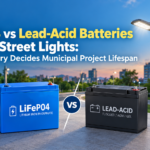
German-engineered systems address this through LiFePO4 (Lithium Iron Phosphate) battery chemistry, which maintains stable electrochemical performance across a temperature range of -20°C to +60°C. With a rated cycle life of 2,000–3,000 charge-discharge cycles, these batteries deliver 8–12 years of reliable calendar life even in environments that push conventional cells to failure within 2–4 years. Critically, German-engineered systems are sized with 5–7 days of backup autonomy for high-latitude locations, ensuring continuous illumination through extended overcast or snowfall periods – not the 1–2 days of backup that generic systems typically provide.
Australia’s Outback Challenge is the inverse: ambient temperatures regularly exceeding 45°C in the Kimberley, Northern Territory, and outback Queensland create thermal stress on LED junctions, battery cells, and charge controller electronics. Industry research confirms that outdoor temperatures frequently exceed 45°C in remote Australian locations, placing extreme demands on thermal management.
In a German-engineered system, the die-cast aluminium housing functions as a passive heat sink, keeping LED junction temperatures at or below 85°C even at 50°C ambient. Generic plastic or thin sheet-metal housings allow junction temperatures to exceed 100°C under the same conditions – dramatically accelerating LED lumen depreciation and shortening rated life from the standard 50,000 hours to as few as 20,000 hours in practice. In remote Australia, where a maintenance visit might involve a 500-kilometre round trip, premature LED failure is not merely inconvenient – it is a significant lifecycle cost event.
Core Technical Specifications That Determine Real-World Performance
When evaluating off-grid solar street lighting for remote Canadian or Australian applications, procurement officers and EPC contractors should focus on the following verified performance parameters:
Solar Panel Efficiency: German-engineered monocrystalline panels achieve 21-23% conversion efficiency, compared to 15-17% typical of generic polycrystalline alternatives. In Canada’s low winter sun angles and Australia’s intense UV irradiance, this efficiency gap directly translates to more energy harvested per panel area – meaning smaller physical arrays for equivalent output, or greater energy reserves in the battery bank.
MPPT Charge Controllers: Maximum Power Point Tracking (MPPT) controllers extract 25-30% more energy from solar panels compared to the PWM (Pulse Width Modulation) controllers commonly found in budget systems. In a remote location where every watt-hour of harvested energy extends backup autonomy, this efficiency advantage is operationally significant.
LED Efficacy: German-engineered luminaires deliver 160-180 lumens per watt, achieving the lux levels required under Australian standard AS/NZS 1158 and Canadian road lighting guidelines with less power draw. Generic luminaires rated at 100-120 lm/W require proportionally larger battery banks and solar panels to achieve the same illumination output – increasing both system cost and physical weight on the pole.
IP and IK Ratings: An IP67 rating (verified by an accredited third-party laboratory) confirms complete dust exclusion and protection against water immersion – essential for both Canadian freeze-thaw cycles that cause water ingress, and Australian dust storms common in arid regions. An IK08 mechanical impact rating provides verified resistance to physical impact, important on rural and mining-adjacent roads. Generic systems frequently self-declare IP65 ratings without independent verification and carry no IK rating at all.
Warranty: A 5-7 year comprehensive warranty with a performance guarantee reflects the manufacturer’s confidence in long-term reliability. Compare this to the 1-2 year warranties typical of generic alternatives – warranties that are frequently voided by exposure to the very weather conditions these lights are designed to operate in.
For a deeper comparison of how these parameters affect total lifecycle cost on EPC projects, see our detailed breakdown at Total Cost of Ownership for EPC Projects.
Funding Programmes and Policy Frameworks Supporting Deployment
Both Canada and Australia have established substantial funding mechanisms that actively support off-grid solar lighting deployment in remote communities – a factor that significantly alters the financial calculation for procurement officers.
In Canada, Natural Resources Canada’s Clean Energy for Rural and Remote Communities (CERRC) programme has an overall funding commitment of CAD $453 million until 2027, targeting diesel reduction through renewable energy deployment in Indigenous and remote settlements. The programme has supported over 190 renewable energy and capacity building projects across Canada as of early 2025. In parallel, the Arctic Energy Alliance offers renewable energy rebates of up to CAD $20,000 for NWT residents and up to CAD $50,000 for community governments and non-profit organisations, covering 50% of eligible project costs. The federal government’s Clean Technology Investment Tax Credit also provides a 30% refundable tax credit on qualifying solar and storage capital investments – a meaningful offset on the upfront cost of a quality street lighting system.
In Australia, the Australian Renewable Energy Agency (ARENA) operates the Regional Microgrids Program, which has committed AUD $75 million for solar infrastructure in remote communities, including funding for standalone power systems that underpin off-grid street lighting. Australia’s AUD $1 billion Solar Sunshot Program, announced in March 2024, supports solar technology manufacturing and deployment domestically. The small-scale Renewable Energy Scheme (SRES) provides financial incentives that reduce upfront costs for qualifying solar installations across remote locations.
These funding frameworks transform off-grid solar street lighting from a capital-intensive infrastructure decision into a substantially subsidised investment with accelerated payback periods. EPC contractors and facility managers tendering for remote community lighting contracts should incorporate these incentive streams into their financial modelling before evaluating competing solutions.
For procurement officers working within multilateral-funded frameworks, our analysis of ADB and World Bank solar street light procurement requirements outlines the certification and documentation standards required for bankable project submissions.
10-Year Total Cost of Ownership: German-Engineered vs. Generic Systems
The most important financial metric for remote off-grid solar street lighting is not the upfront unit price – it is the total cost of ownership (TCO) across the operating life of the installation. In remote Canada and Australia, this calculation is dominated by two factors: replacement frequency and maintenance logistics.
A German-engineered system with LiFePO4 batteries rated for 2,000-3,000 cycles and 8-12 years of calendar life, combined with LED luminaires rated for 50,000 hours, typically requires no major component replacement within a 10-year period. Operational cost after installation is essentially zero – no electricity tariffs, no fuel costs, and minimal scheduled maintenance.
A generic system with lead-acid batteries rated for 300-500 cycles and a 2-4 year calendar life will require battery replacement 2-3 times within the same 10-year window. In a remote Canadian First Nation community accessible only by winter road or floatplane, or an Australian outback station accessible only by unsealed track, a single battery replacement call-out can cost AUD $3,000-$8,000 in logistics alone before the replacement parts are even factored in.
When procurement officers model a 10-light installation over 10 years:
- German-engineered system: Higher upfront investment per unit, near-zero operational cost, single warranty claim window covered by the 5–7 year guarantee
- Generic system: Lower apparent upfront cost, 2–3 battery replacement cycles, LED degradation requiring luminaire replacement, and 2–3× higher total lifecycle expenditure
This TCO advantage is why German engineering standards form the basis of procurement specifications in multilateral-funded infrastructure programmes worldwide. For solar pole system analysis, see 5 Advantages of Solar Light Pole Systems.
For remote communities in Canada and Australia where maintenance access is difficult and service disruption has direct safety implications, the engineering quality of the initial installation is not a luxury – it is the most cost-effective long-term decision available.
Remote Area Applications: Where Off-Grid Solar Street Lighting Delivers Most Value
Off-grid solar street lighting in Canada and Australia is deployed across a broad and growing range of remote applications. Understanding which application drives your procurement decision helps specify the correct lux level, mounting height, autonomy period, and climate rating.
Indigenous and Remote Community Streets: Illuminating pedestrian pathways, community centres, and residential streets in First Nations communities (Canada) or Aboriginal and Torres Strait Islander communities (Australia) improves safety, extends usable hours for community activities, and reduces the crime and accident risks associated with unlit environments. These installations typically require 10–20 lux average maintained illuminance at ground level per relevant national standards.
Rural and Outback Road Junctions: Isolated intersections, cattle grid approaches, and remote highway rest areas benefit from solar street lights configured with motion-activated dimming – operating at 100% output when a vehicle approaches and reducing to 30% in the absence of traffic. This extends battery backup autonomy significantly in locations with low overnight traffic volumes.
Mining and Resources Industry Access Roads: Western Australia’s Pilbara and Kimberley regions, and Canada’s oil sands and mining corridors in Alberta, Saskatchewan, and the Northern Territories, present a large installed base opportunity. Mining operators require IK10-rated luminaires capable of withstanding industrial vibration and debris impact alongside IP67 environmental sealing. For more on all-in-one system advantages in industrial contexts, see 7 Benefits of All-In-One Street Light Technology.
Agricultural Properties and Farm Boundaries: Illuminating grain storage facilities, shearing sheds, and rural property entrances in remote Australia, or farm compounds across Canada’s Prairie provinces, allows for 24-hour operational access without grid dependency.
Remote Tourism Infrastructure: Campgrounds, national park facilities, and eco-tourism accommodation in both countries increasingly specify solar street lighting as both an operational requirement and a sustainability credential for accreditation purposes.
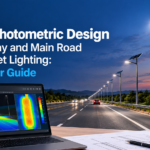
For all applications, the solar LED street light simulation tool and DIALux luminaire spacing optimisation guide can assist procurement teams in validating illuminance compliance before specifying quantities.
Conclusion
Off-grid solar street lighting for remote areas in Canada and Australia is not simply an alternative to grid-connected infrastructure – in most remote scenarios, it is the superior solution on every meaningful metric: total lifecycle cost, installation speed, energy independence, and environmental impact.
Three takeaways define the procurement decision for decision-makers in these markets:
- Climate-matched engineering is non-negotiable. Canada’s sub-zero winters and Australia’s extreme heat demand LiFePO4 battery chemistry, MPPT charge control, IP67-verified sealing, and die-cast aluminium thermal management – specifications that only quality manufacturers consistently deliver.
- The 10-year TCO calculation always favours German-engineered systems in remote deployments. The logistics cost of a single replacement visit in a remote location frequently exceeds the price premium of quality equipment purchased upfront.
- Substantial public funding is available in both countries. Canada’s CERRC programme and Australia’s ARENA Regional Microgrids Program significantly reduce net capital outlay for qualifying remote community projects.
If you are planning an off-grid solar street lighting deployment for a remote community, mining site, rural road network, or Indigenous infrastructure project in Canada or Australia, the team at solar-led-street-light.com can provide a fully engineered system specification, DIALux-validated lighting layout, and climate-specific component selection. Contact us today for a customised consultation and quote.
Frequently Asked Questions
1. How many days of battery backup should an off-grid solar street light have in northern Canada?
For locations above 55°N latitude in Canada, a minimum of 5–7 days of battery backup autonomy is recommended during system design, accounting for extended cloudy periods and reduced winter solar irradiance. German-engineered systems use LiFePO4 batteries sized specifically for regional peak sun hour data. Generic systems often provide only 1–2 days of backup, which is insufficient for Canadian northern winter conditions. Always request documented backup autonomy calculations as part of your supplier’s technical submission.
2. Can solar street lights operate reliably at temperatures above 45°C in the Australian outback?
Yes, provided the system uses appropriate thermal management. German-engineered luminaires with die-cast aluminium housings keep LED junction temperatures at or below 85°C even when ambient temperatures exceed 45°C – protecting rated LED life of 50,000 hours. Systems with plastic or thin metal housings allow junction temperatures to exceed 100°C under the same conditions, significantly shortening functional lifespan. Verify the housing material, thermal specification, and ambient operating temperature range before procurement.
3. What Australian standard governs solar street lighting compliance?
AS/NZS 1158 is the primary Australian and New Zealand standard for road lighting, covering illuminance levels, uniformity ratios, and glare limits for public roads and pedestrian areas. Solar street lighting systems must be designed to meet the relevant category within this standard. Ensure your supplier can provide DIALux or equivalent photometric simulation reports confirming compliance with the specified road category before installation.
4. What Canadian certification requirements apply to off-grid solar street lights?
Solar photovoltaic systems in Canada should be designed and installed in accordance with the Canadian Electrical Code (CEC) and relevant CSA standards, including SPE-900-13 for rooftop and ground-mounted PV installations. Components such as charge controllers, batteries, and luminaires should carry CSA or ULC certification. For community lighting projects seeking CERRC funding, ensure all equipment documentation is in order before submitting a funding application to Natural Resources Canada.
5. How does MPPT compare to PWM charge control in remote solar street light systems?
MPPT (Maximum Power Point Tracking) charge controllers continuously optimise the electrical operating point of the solar panel to extract maximum available energy, delivering 25–30% more harvested power compared to PWM (Pulse Width Modulation) controllers under the same conditions. In remote locations with variable cloud cover – common in both Canadian boreal regions and parts of the Australian tropics – this efficiency advantage directly extends backup battery autonomy and reduces the risk of premature battery discharge. All German-engineered systems specify MPPT as standard.
6. What lux level is required for remote road and pathway lighting in Australia and Canada?
Requirements vary by road category and applicable standard. For low-volume rural roads and pedestrian paths, AS/NZS 1158 Category P4 specifies approximately 3 lux average maintained horizontal illuminance in Australia. Canadian guidelines under the Illuminating Engineering Society (IES) standards similarly categorise remote road lighting by traffic volume and pedestrian risk. Your supplier should be able to provide photometric calculations and a lighting layout confirming the specified lux levels are achieved at the proposed pole spacing and mounting height. Use the calculate distance for LED solar area lights guide to assist with initial spacing estimates.
7. Are off-grid solar street lights suitable for remote mining sites with heavy vehicle vibration?
Yes, provided the system is specified with an appropriate IK mechanical impact rating. German-engineered luminaires rated IK08 or above are verified to withstand significant physical impact and vibration – important on mining haul roads where ground vibration from heavy vehicles is a constant factor. The IP67 ingress protection rating also prevents dust infiltration, which is critical in arid mining environments. For installation best practices in challenging remote locations, see 5 Ways to Fix Solar Lights Not Working.
8. How do I calculate the payback period for off-grid solar street lighting in a remote community?
The payback calculation for off-grid applications differs from grid-connected scenarios. Instead of comparing against electricity tariff savings, compare the total installed cost of solar street lighting against the alternative: grid extension cost (CAD $30,000-$100,000+ per km in Canada), ongoing diesel generator fuel and maintenance cost, or the cost of leaving the area permanently unlit. In most remote Canadian and Australian scenarios, off-grid solar street lighting achieves effective payback within 3-6 years when modelled against diesel or grid-extension alternatives, and then operates at near-zero cost for the remaining 10+ year system life.