
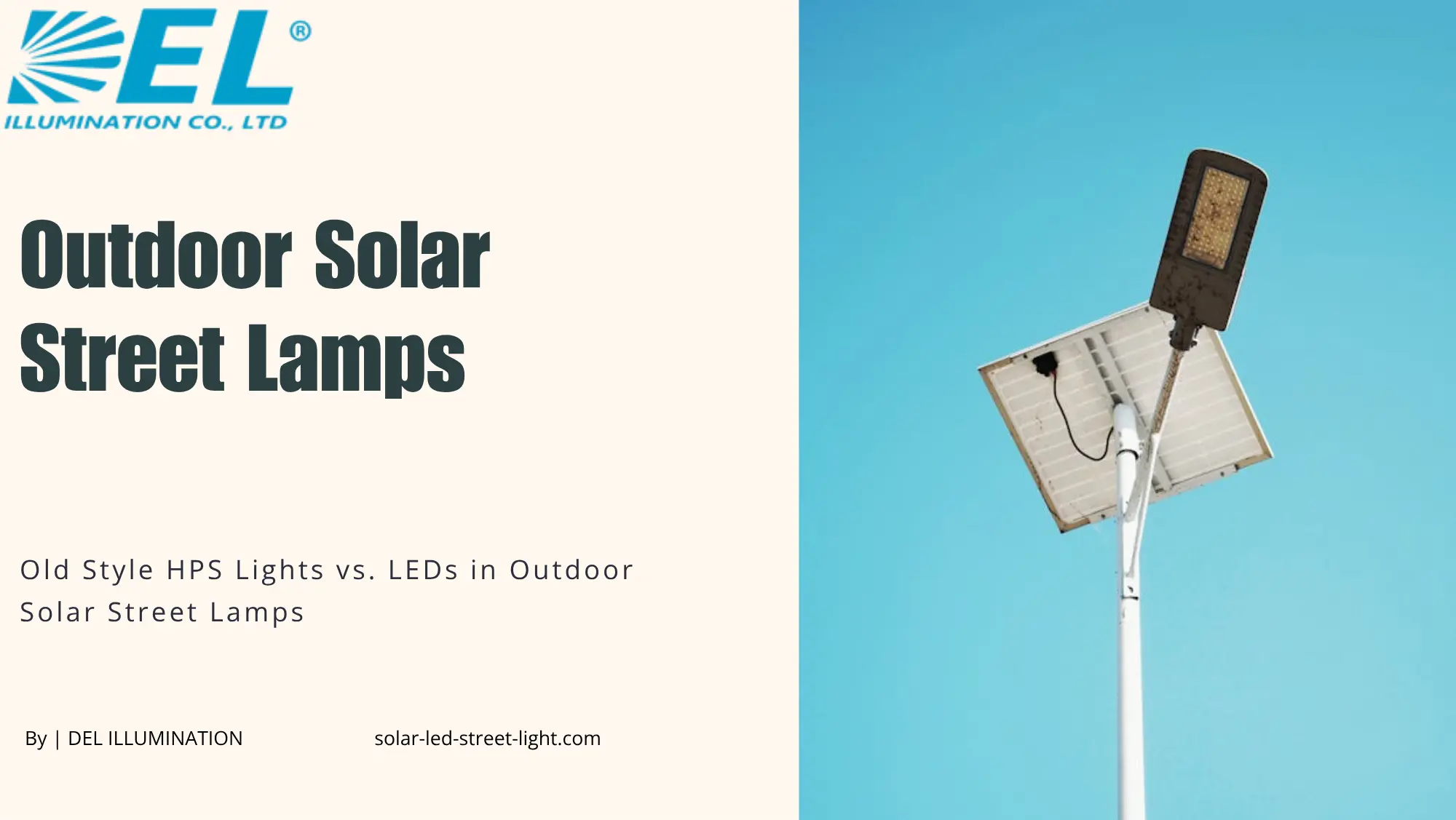
In the past decade, LED technology has undergone a remarkable transformation delivering substantial increases in light output, significant efficiency improvements, and dramatic reductions in cost. LED fixtures in outdoor solar street lamps come with outstanding benefits, and among the most compelling is the positive impact on the environment, on wildlife, and on road safety for pedestrians and drivers. For city planners, facility managers, and procurement officers still evaluating whether to specify LED or retain HPS technology in their next lighting project, the data is now unambiguous: LED street lights achieve energy savings of 41–62% compared to equivalent HPS installations, according to research published in the journal Energy (ScienceDirect, 2022 the baseline study cited across 2024–2025 procurement frameworks globally).
In this article, we take a detailed look at how LEDs have evolved compared to HPS (High Pressure Sodium) lamps, covering the technical differences in efficacy, light quality, colour rendering, lifespan, optical efficiency, environmental impact, and total cost of ownership all in the context of outdoor solar street lamps where energy efficiency per watt is the decisive system design variable.
A Breakdown of LEDs in Outdoor Solar Street Lamps
LEDs were initially criticised when first deployed in outdoor applications because their heavy blue spectrum output caused reduced visibility comfort, disrupted circadian rhythms in human populations near lit roads, and disturbed wildlife particularly nocturnal species and migratory birds whose navigation depends on natural darkness. The evolution of LED technology over the past decade has addressed all of these concerns through dramatic improvements in spectral engineering and optical design.
The most significant development has been the shift to warmer, more spectrally balanced LED outputs achieved by refining the phosphor coatings on LED chips to reduce the proportion of blue wavelengths in the emitted spectrum. Simultaneously, luminous efficacy (the measure of how much visible light is produced per watt of electricity consumed, expressed in lm/W) has increased dramatically. A wattage that previously produced only 50 lm/W can now produce 130–160 lm/W in quality commercial LED modules a three fold improvement. Premium German engineered outdoor solar street lamps achieve LED efficacy of 160–180 lm/W in 2024–2025 specifications, while even standard commercial LEDs now routinely achieve 120–140 lm/W.
These improved efficacy figures and reduced wattage requirements translate directly into lower power demand in outdoor solar street lamps meaning a smaller solar panel and a smaller battery can sustain equivalent or superior road surface illumination compared to the previous generation. For a city or municipality deploying hundreds or thousands of outdoor solar street lamps, this efficiency advantage compresses the system size and cost per installation while delivering better lighting outcomes.
As LEDs now feature lower blue light content, they also produce better perceived visibility for drivers and pedestrians. Improved visibility translates into improved security and safety reduced accident risk, better recognition of hazards and pedestrians, and a lighter, more natural appearance in lit environments. The introduction of 4000K–5000K CCT (Correlated Colour Temperature) LEDs in outdoor solar street lamps now provides clarity comparable to neutral daylight without the extreme blue end that characterised early LED street lights. For guidance on how this evolution in LED optical technology improves solar street light performance, see our article on 4 innovative solutions in LED solar street lights.
The low power requirement of modern LEDs in outdoor solar street lamps also creates room for improved dark sky compliance reducing the light pollution that affects wildlife habitats, astronomical observation, and human health. LED optics use precision secondary lenses (Type II, III, and IV distributions) to project light exactly where it is needed: onto the road surface. This task specific directional distribution prevents light from casting upward into the sky or outward into adjacent properties, minimising skyglow and light trespass. LEDs used in quality outdoor solar street lamps achieve a light output efficiency (the ratio of light reaching the target area to total fixture lumen output) of up to 80–90%, compared to 65–70% for HPS luminaires using arc reflectors.
Additionally, LEDs boast a very long lifespan compared to other light sources. Quality LED modules achieve an L70 lifespan (the point at which output falls to 70% of initial value) of 50,000–100,000 hours. At 10 operating hours per night, 100,000 hours represents 27 years of operation far exceeding the economic life of any other currently available street light technology. The primary practical caveat for outdoor solar street lamps is that junction temperature management is critical to achieving this lifespan: German engineered systems with die cast aluminium housings maintain LED junction temperature at ≤85°C at 50°C ambient, while generic plastic housed fixtures can exceed 100°C dramatically accelerating lumen depreciation. Notwithstanding, LEDs do tend to carry a higher upfront cost compared to HPS, though as the lifecycle analysis below confirms this premium is consistently recovered within 2–4 years through energy savings and reduced maintenance costs.
A Breakdown of Old Style HPS Outdoor Solar Street Lamps
HPS lights are a type of gas discharge lamp that, as the name indicates, operate at high internal pressure within the lamp arc tube. The arc tube is composed of aluminium oxide, and sodium metal is mixed with mercury and other elements that act as spectral counterbalances producing the characteristic yellow orange glow with some light blue to white emissions.
The fundamental operational characteristic of HPS that most directly affects its suitability for outdoor solar street lamps is its warm up time. An HPS lamp requires 5–10 minutes after activation to reach full light output, as the internal sodium and mercury vaporise and the arc achieves stable pressure equilibrium. This warm up period is incompatible with the demand responsive, dusk to dawn automatic switching that defines modern outdoor solar street lamps every activation event requires a full warm up cycle, and any brief power interruption (such as a battery voltage drop during extended overcast periods) restarts the cycle. This makes HPS fundamentally unsuitable for integration with smart solar street light control systems, sensor based dimming, and IoT energy management platforms.
To maintain optimal performance, HPS lamps need to be replaced approximately every 12–24 months under standard operational use. At 10 hours per night, a 24,000 hour HPS lamp lifespan translates to roughly 6–7 years but with practical lumen depreciation beginning much earlier. Depleted HPS bulbs emit light at significantly reduced levels, which is particularly problematic for outdoor solar street lamps where maintaining the design lux level at road surface is both a safety and a contractual performance requirement. The maintenance cost implications of annual or biannual HPS lamp replacement across a large deployment are substantial and frequently underestimated at the procurement stage.
HPS lighting has been produced commercially for decades and does have genuine advantages in certain large area applications it is still used in car parks, roadside applications, and highway lighting where its historically high wattage output and wide coverage made it competitive before LED technology reached its current performance level. HPS also outlasts fluorescent, incandescent, and other high intensity discharge lamps, and its relatively low unit purchase price makes replacement accessible. However, old style HPS fixtures used in outdoor solar street lamps cause significant light pollution because their omnidirectional emission pattern 360 degrees in all directions from the lamp arc requires arc reflectors that redirect wasted light toward the road. This redirection process loses 30–35% of total lamp output to absorption, blocking, or misdirection within the fixture housing itself. As a result, the effective light output efficiency of an HPS luminaire is only 65–70% of rated lamp lumens with the remaining 30–35% generating heat, sky glow, and light trespass rather than useful road illumination.
Additionally, HPS lights have a poor colour rendering index (CRI) typically as low as 20–25. CRI (a scale from 0–100) measures how accurately a light source renders the colours of illuminated objects compared to natural daylight at 100. An HPS fixture with CRI 20–25 makes its environment appear dark yellow and monochromatic, turning people and objects into shadowy versions of their daytime appearance. This dramatically reduces the ability of drivers and pedestrians to identify hazards, read faces, and navigate safely a documented public safety concern that has accelerated the replacement of HPS in urban road lighting programmes worldwide. For further context on how different lighting technologies affect road safety and ecological environments, see our article on solar cell street light ecological damage.
The Definitive Comparison: LED vs HPS in Outdoor Solar Street Lamps
The performance gap between LED and HPS in the context of outdoor solar street lamps can be summarised across six dimensions:
Luminous efficacy: LED street lights in 2024–2025 achieve 140–180 lm/W at the lamp level. Actual HPS efficacy in practice accounting for ballast losses (a 400W HPS requires a 34W ballast), circuit harmonic losses, and fixture optical losses is only 70–75 lm/W at the system level, compared to 85–100 lm/W system efficiency for LED. This means LED delivers equivalent road surface illumination at approximately 40–52% lower wattage.
Colour rendering: LED delivers CRI 70–80+ with a neutral white (4000K–5700K) output that renders colours accurately and improves visibility for drivers and pedestrians. HPS delivers CRI 20–25 with monochromatic yellow output making it impossible to distinguish colours in lit environments and reducing effective road safety.
Lifespan: LED modules achieve L70 lifespans of 50,000–100,000 hours. HPS lamps have an L70 lifespan of approximately 24,000 hours with significant lumen depreciation beginning after 12,000–15,000 hours of operation. An 88W LED street light in a real world comparison study achieved equivalent road illuminance to a 150W HPS fixture at 48% lower energy consumption and with a light output ratio of 99.99% versus 76.99% for HPS in the same pole configuration.
Light distribution: LED uses precision secondary optical lenses that achieve light output efficiency of 80–90%, directing virtually all generated light onto the intended road surface. HPS uses arc reflectors with 65–70% optical efficiency wasting 30–35% of generated light to internal absorption and sky glow.
Dark sky compliance: LED outdoor solar street lamps meet IDA (International Dark Sky Association) and EN 13201 dark sky compliance standards through directional optics and adjustable CCT. HPS fixtures are fundamentally incompatible with dark sky compliance due to their omnidirectional emission and high wattage output.
Solar system sizing impact: Because LED requires 40–52% less wattage for equivalent illumination, an outdoor solar street lamp using LED requires a proportionally smaller solar panel and battery to sustain the same operating hours. This directly reduces system cost and installation weight making LED not just the better light source but the better system level engineering choice for solar powered applications. For a comprehensive resource on how the anatomy of a solar LED luminaire is designed to maximise these efficiency advantages, see our guide on the anatomy of solar LED street light luminaires.
The adoption of LED in outdoor solar street lamps has accelerated globally throughout 2024 and 2025. According to Coherent Market Insights, LED now accounts for 72.8% of the global solar street lighting market in 2025 a figure that continues to grow as awareness of the performance gap becomes embedded in government procurement specifications and development bank tender requirements. For guidance on the emerging LED and smart technology features that are advancing outdoor solar street lamps beyond simple on off operation, see our article on 9 benefits of solar sensor street lights.
Conclusion
The lower wattage and higher lumen output of LEDs in outdoor solar street lamps provide a substantially better cost effective solution compared to old style HPS lights used in traditional street lighting. The lower wattage translates into higher effective road illumination with lower solar panel and battery requirements reducing the capital cost of the complete system. Although the initial unit cost of HPS is lower, the total cost of maintenance lamp replacement every 12–24 months, higher energy consumption, and ballast replacement cycles is significantly higher than the equivalent LED operational cost over a 10 year lifecycle.
The lifespan of HPS, while longer than most conventional fluorescent and incandescent bulbs, is no match for LED. Modern LED modules in quality outdoor solar street lamps achieve 50,000–100,000 hours L70 lifespan four to six times the practical life of an HPS lamp under the same operating conditions.
LED used in outdoor solar street lamps is directional producing light in a 180 degree pattern directly onto the road surface while HPS produces omnidirectionally at 360 degrees, requiring inefficient reflectors that waste 30–35% of generated light. As a result, LED outdoor solar street lamps meet dark sky compliance standards and provide the road safety illumination needed without disturbing migratory patterns of wildlife and bird populations a documented ecological benefit that is increasingly valued in government procurement specifications.
For expert guidance on specifying the right LED based outdoor solar street lamp system for your project whether for a residential road, commercial estate, highway, or rural community visit solar led street light.com to consult with our engineering team or request a customised project quote.
FAQs
1. Why are LED outdoor solar street lamps better than HPS for solar powered applications specifically? In a solar powered system, every watt of LED load directly determines the size of the solar panel and battery required to sustain all night operation making LED efficacy the single most important specification parameter. Because LED achieves 140–180 lm/W compared to an effective 70–75 lm/W for HPS (after ballast and optical losses), an equivalent LED fixture consumes 40–52% less power for the same road surface lux level. This means a solar only system using LED can use a proportionally smaller panel and battery directly reducing system cost and installation weight. HPS also has a 5–10 minute warm up time that makes it incompatible with the automatic dusk to dawn photosensor switching and demand responsive dimming that defines modern outdoor solar street lamps. For a deep dive into how solar street light systems are designed for maximum efficiency, see our guide on 9 factors to consider when setting up solar street light LED systems.
2. What is CRI and why does it matter in outdoor solar street lamps? CRI (Colour Rendering Index) is a measure from 0 to 100 of how accurately a light source renders the colours of illuminated objects compared to natural daylight (CRI 100). HPS lights have a CRI of only 20–25, producing a monochromatic yellow output that makes people, vehicles, and road markings appear as shadowy versions of their daytime appearance. LED outdoor solar street lamps deliver CRI 70–80+, rendering colours accurately and enabling drivers and pedestrians to identify hazards, read faces, and navigate safely. Research and real world experience confirm that improved CRI in road lighting is directly associated with reduced nighttime crime and road accident rates making CRI a genuine public safety metric, not merely an aesthetic one.
3. How long do LED outdoor solar street lamps last compared to HPS? Quality LED modules in outdoor solar street lamps achieve an L70 lifespan (the point at which output falls to 70% of initial brightness) of 50,000–100,000 hours. In German engineered systems with die cast aluminium housings that maintain junction temperature at ≤85°C at 50°C ambient, the full 100,000 hour rating is achievable in practice. At 10 operating hours per night, this represents 27 years of service. HPS lamps have an effective L70 lifespan of approximately 24,000 hours, with significant lumen depreciation beginning after 12,000–15,000 hours meaning lamp replacement every 1–2 years under standard outdoor use. This lifespan difference is the primary driver of the LED total cost of ownership advantage over 10 years.
4. Are HPS street lights still used anywhere in 2025? Yes HPS street lights remain in service in many cities and on highway networks globally, primarily due to the capital cost of replacement rather than because HPS technology remains competitive. In 2025, LED accounts for 72.8% of the global solar street lighting market, and most new municipal procurement programmes specify LED as the baseline technology. Retrofit programmes replacing HPS with LED in existing grid connected street light networks are ongoing across Europe, North America, Asia, and Africa. Portland (Oregon, USA), for example, converted 20,000 city street lights from HPS to LED in the largest efficiency programme the city had undertaken. For most applications including all outdoor solar street lamps HPS is no longer the rational specification choice when evaluated against LED on a total cost of ownership basis.5. What colour temperature should I choose for LED outdoor solar street lamps? The most widely specified colour temperature (CCT) for road and street lighting applications is 4000K–5000K a neutral to cool white that provides excellent visibility for drivers and pedestrians without the extreme blue spectrum of 6000K+ outputs that were associated with early LED street lights. A 4000K output provides natural looking white light with good colour rendering (CRI 70+), adequate contrast for hazard recognition, and compliance with most national road lighting standards. For residential roads and areas near nature reserves or wildlife habitats where light pollution and circadian rhythm disruption are concerns, 3000K warm white is an appropriate alternative it produces less sky glow, causes fewer wildlife disturbances, and has reduced biological impact on nocturnal species. For guidance on how CCT selection integrates into overall system specification, our article on 10 things that make the best solar street lights covers the key evaluation criteria.