
India installs more than 1.34 crore LED street lights through government programmes ,yet millions of rural roads and urban streets remain poorly lit, costing municipalities billions in wasted energy and accident-related losses. As Indian cities race to modernise infrastructure, solar street lights have moved from a niche technology to a central pillar of national energy policy. Whether you are a city planner allocating the next municipal budget, a procurement officer evaluating tenders, or a contractor bidding on a smart city project, this guide gives you the verified data, regulatory context, and engineering benchmarks you need to make the right decision in 2026.
India’s Solar Street Light Market: Scale, Growth & Government Push
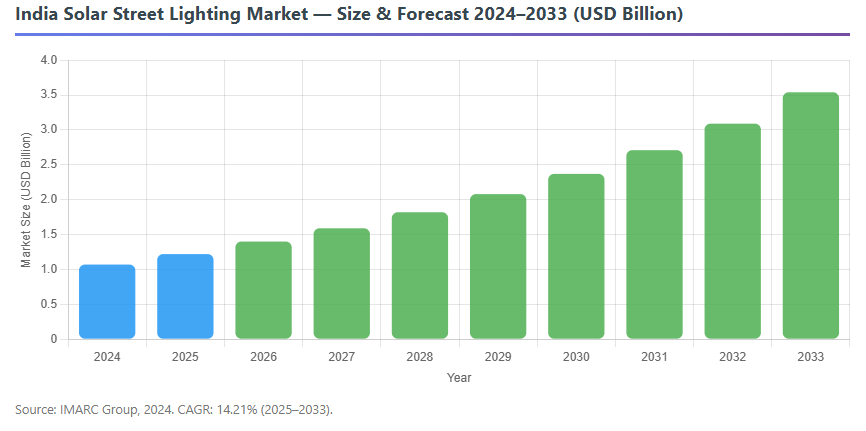
The India solar street lighting market reached USD 1.07 billion in 2024 and is projected to grow at a compound annual growth rate of 14.21% to reach USD 3.54 billion by 2033, according to industry research. This growth is not accidental ,it is the direct result of coordinated government action across multiple funding channels.
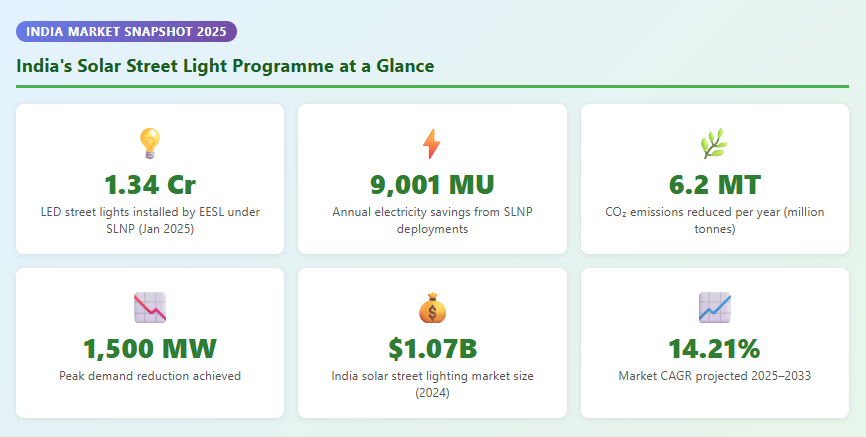
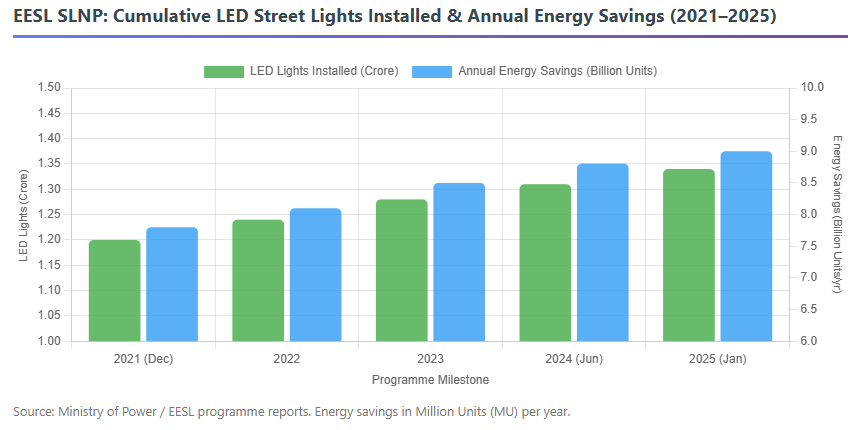
The flagship vehicle for this transformation is the Street Lighting National Programme (SLNP), implemented by Energy Efficiency Services Limited (EESL) under the Ministry of Power. As of January 2025, EESL had successfully deployed over 1.34 crore LED street lights across Urban Local Bodies (ULBs) and Gram Panchayats, generating estimated annual energy savings of over 9,001 million units (MUs) of electricity. This achievement has reduced peak demand by more than 1,500 MW and cut CO₂ emissions by 6.2 million tonnes per year.
Alongside SLNP, the Atal Jyoti Yojana (AJAY) has been instrumental in rural deployment, with approximately 2.72 lakh solar street lights installed across two phases in underserved constituencies. The Smart Cities Mission and AMRUT 2.0 have together replaced over 62.78 lakh conventional street lights with LED equivalents in urban areas, while the Deen Dayal Upadhyaya Gram Jyoti Yojana (DDUGJY) drives decentralised solar lighting into areas where grid extension is economically or geographically impractical.
India’s solar potential ,assessed at 10,830 GW in 2025 with approximately 300 sunny days per year across most of the country ,makes solar street lighting an economically superior option compared to grid-connected alternatives, particularly in Tier-2, Tier-3 cities and rural India.
Key Government Schemes and Funding Routes in 2026
Understanding which scheme your project qualifies under determines both the procurement process and the technical specifications you must meet. The principal funding routes active in 2026 are:
EESL-SLNP (Street Lighting National Programme): The most established programme, operating on a Build-Own-Operate-Transfer (BOOT) model. Municipalities pay nothing upfront; EESL recovers costs from energy savings over a contract period. Procurement follows EESL’s standardised technical specifications, with a seven-year warranty maintenance obligation.
PM-KUSUM (Pradhan Mantri Kisan Urja Suraksha evam Utthaan Mahabhiyan): Scaled up in January 2024 and active until December 2026, PM-KUSUM targets rural electrification. Component B installs standalone solar-powered systems with a 30% government subsidy, making it directly relevant to solar street light deployment in agricultural zones and rural gram panchayats.
Smart Cities Mission: Urban projects under this scheme must comply with smart lighting standards ,including IoT connectivity, adaptive dimming, and remote monitoring capabilities. Funding is available through city-level special purpose vehicles (SPVs).
AMRUT 2.0: The updated Atal Mission allocates infrastructure spending to water, sewerage, and urban lighting modernisation. Central and state shares are disbursed through Urban Local Bodies.
MPLAD Funds: Members of Parliament’s Local Area Development funds can be directed at solar street light installation. Procurement through EESL-empanelled vendors simplifies compliance.
For each scheme, procurement officers should note that BIS-certified products compliant with IS 10322 (Part 5) and IS 16612 are typically mandatory. Projects funded by the Asian Development Bank (ADB) or World Bank carry additional requirements around labour standards and technical traceability ,a topic covered in depth in our guide on ADB and World Bank solar street light procurement 2026.
Technical Standards and Certification Requirements
India’s regulatory framework for solar street lights has matured significantly. Procurement officers and contractors must verify compliance across three primary frameworks:
BIS Standards: The Bureau of Indian Standards mandates compliance with IS 10322 (Part 5): Section 3 for luminaires intended for road and street lighting. The updated IS 10322: 2026 standard for LED luminaires used in road and street lighting has brought Indian requirements into closer alignment with IEC equivalents. Additionally, the BIS Act 2016 (effective October 2017) requires mandatory registration for LED lighting products sold in India.
BEE (Bureau of Energy Efficiency) Certification: BEE’s Standards & Labelling programme, which became mandatory for grid-connected solar inverters from January 2026, signals a tightening regulatory direction for solar components. Solar street light systems procured under government schemes are expected to use BEE-compliant charge controllers and inverters.
MNRE Specifications: The Ministry of New and Renewable Energy (MNRE) publishes benchmark costs and technical specifications for solar street lighting systems. MNRE Model I operates dusk-to-dawn at full brightness, while Model II operates at full brightness for the first four hours before reducing output ,two configurations that reflect India’s varying usage patterns and backup requirements.
IP Ratings: For India’s climatic conditions ,which include monsoon humidity, dust storms, and temperature extremes ,IP65 minimum is the baseline for luminaire protection. Premium German-engineered systems typically carry IP67 certification, providing full immersion resistance that is particularly valuable in flood-prone regions.
IK Rating: Vandal resistance rated to IK08 or above is strongly recommended for urban deployments. Generic systems frequently omit this specification entirely, leading to premature failure in high-traffic areas.
Where projects fall under bankable EPC contracts or multilateral funding, additional certifications may apply. Our detailed reference on certification requirements for bankable EPC contracts covers these in full.
German Engineering vs. Generic: What India’s Climate Demands
India’s solar street light market is price-competitive, with units ranging from approximately ₹12,000 to ₹50,000 for 9W to 60W systems. The price differential between generic and German-engineered products is real ,but so is the performance gap, which becomes financially significant over a 10-year project horizon.
Solar Panel Efficiency: German-engineered systems use monocrystalline panels rated at 21–23% conversion efficiency, compared to 15–17% for standard polycrystalline panels in generic units. In India’s sun-rich climate, this efficiency advantage translates directly into higher energy yield per unit of panel area ,critical for systems deployed on constrained pole-top surfaces.
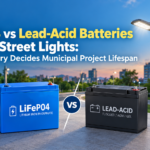
Battery Technology: The single most important quality differentiator in India’s demanding climate is the battery. German-engineered systems use LiFePO4 (Lithium Iron Phosphate) batteries rated for 2,000–3,000 charge-discharge cycles, with a calendar life of 8–12 years. Generic systems often use lead-acid batteries (300–500 cycles, 2–4 year lifespan) or unspecified lithium cells without verified cycle ratings. In a market where battery replacement is the dominant lifetime cost, this matters enormously ,a system requiring battery replacement every three years incurs 2–3x higher lifecycle cost compared to a LiFePO4 system over ten years.
LED Luminous Efficacy: Premium systems achieve 160–180 lumens per watt (lm/W), compared to 100–120 lm/W for generic alternatives. This means a 30W German-engineered luminaire produces the same road illuminance as a 45–50W generic unit ,requiring a smaller solar panel and battery to deliver equivalent performance.
MPPT Controllers: Maximum Power Point Tracking controllers in premium systems extract 25–30% more energy from the solar panel compared to basic PWM (Pulse Width Modulation) controllers used in budget units. In cloudy periods or during winter months in northern India, this difference can determine whether the system delivers reliable illumination or fails to charge adequately.
Thermal Management: India’s summers regularly exceed 45°C in many states. German-engineered systems use die-cast aluminium housings with integrated heat sinks designed to maintain LED junction temperature below 85°C even at ambient temperatures of 50°C. Generic plastic or thin-sheet-metal housings accelerate LED degradation, reducing rated life from 50,000 hours to 20,000–30,000 hours in practice.
For a detailed technical comparison with specifications, refer to our analysis of German engineering vs. generic solar street lights.
Buying Guide: What to Evaluate Before You Procure
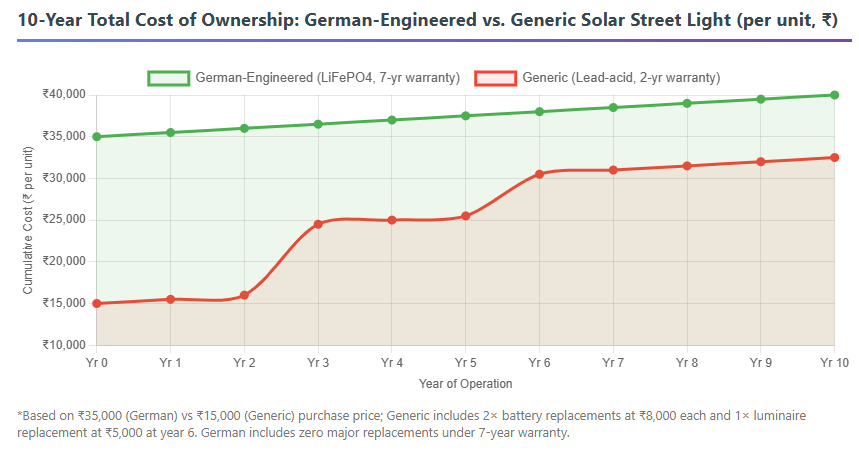
For decision-makers conducting procurement in 2026, the following evaluation framework applies whether you are sourcing for a municipal tender, a private real estate development, or a rural gram panchayat:
Step 1. Define the Application:
Identify the road classification (arterial, collector, residential, rural track) and required illuminance level. Indian road lighting standards prescribe lux levels from 5–15 lux for residential roads up to 20–30 lux for arterial roads. Ensure the supplier can provide a DIALux simulation confirming compliance before purchase ,a topic our DIALux luminaire spacing optimisation guide covers in detail.
Step 2. Verify Certifications:
Request copies of BIS registration, IP and IK test certificates, and battery cycle-test reports. For government-funded projects, confirm that the system meets MNRE benchmark specifications and is sourced from EESL-empanelled or MNRE-approved suppliers where applicable.
Step 3. Evaluate the Battery Specification:
Ask specifically for the battery chemistry, rated cycle count, and warranty terms. Any supplier unwilling to provide a third-party test report for battery performance should be regarded with caution. Insist on LiFePO4 chemistry for systems expected to operate for more than five years without major maintenance.
Step 4. Assess the Warranty Structure:
A credible warranty covers both the luminaire and the battery for a minimum of five years, with clear replacement terms. Some German-engineered systems offer 7-year comprehensive warranties that include a performance guarantee ,a contractually enforceable commitment to minimum light output levels.
Step 5. Calculate Total Cost of Ownership (TCO):
The procurement price is only one component of the true cost. Factor in battery replacement cycles, maintenance visits, and luminaire replacement probability over a 10-year period. Industry research confirms that grid-connected conventional street lights can cost ₹8,000–₹12,000 per unit per year in electricity and maintenance combined. A properly specified solar street light reduces this to near-zero operational cost after the initial capital investment ,delivering ROI within 3–5 years depending on local electricity tariffs. Our complete TCO framework for EPC projects is available at total cost of ownership for EPC projects.
Step 6. Check Local Content Requirements:
Under the Make in India initiative and government procurement guidelines, certain schemes require minimum domestic content in solar products. Verify whether your project triggers local content rules before finalising supplier selection, as non-compliance can disqualify a bid. Our guide on local content requirements for solar street lights provides a complete framework.
Three Takeaways for India’s Solar Street Light Decision-Makers in 2026
India’s solar street lighting sector is at an inflection point. Government funding is abundant, standards are maturing, and the technology has proven itself across millions of installations. Three priorities stand out for anyone procuring solar street lights in 2026:
First, choose battery technology wisely. LiFePO4 batteries are no longer a premium add-on ,they are the baseline for any system expected to deliver reliable performance for five years or more. The energy cost of a battery replacement at year three will often exceed the price difference between a generic and a premium system at the point of purchase.
Second, insist on verified certifications. BIS registration, IP67 rating, and third-party battery test reports are not bureaucratic formalities ,they are the only objective evidence that a system will perform as specified in India’s demanding operating conditions.
Third, calculate lifecycle cost, not purchase price. A ₹15,000 generic unit that requires battery replacement at year three and LED replacement at year five will cost more over a decade than a ₹35,000 German-engineered system backed by a seven-year warranty and 2,000+ cycle LiFePO4 batteries.
Ready to specify or procure solar street lights that meet India’s toughest standards? Visit solar-led-street-light.com for expert consultation, project-specific DIALux simulation, and a customised quote for any scale of deployment ,from a single gram panchayat to a multi-city smart infrastructure programme.
Frequently Asked Questions
Q1: Which government scheme is best for solar street light installation in my municipality?
The EESL-SLNP programme is the most established route for Urban Local Bodies, offering a zero-upfront-cost BOOT model. For rural areas, PM-KUSUM and AJAY provide direct subsidy pathways. The right choice depends on your project’s scale, location, and whether you prefer outright ownership or a service contract model.
Q2: What wattage solar street light do I need for a typical Indian residential road?
A typical 6-metre-wide residential road requires illuminance of approximately 5–7 lux at road level. A 20–30W all-in-one solar street light with 160 lm/W efficacy, mounted at 5–6 metres height with 20-metre pole spacing, will generally meet this requirement. Always confirm with a DIALux simulation before finalising specifications.
Q3: Is LiFePO4 battery mandatory for government-funded solar street lights?
MNRE and EESL specifications increasingly favour LiFePO4 (Lithium Iron Phosphate) batteries due to their superior cycle life and safety profile. While lead-acid batteries are not universally prohibited in older scheme guidelines, LiFePO4 is now the industry standard for quality procurement and is preferred by most multilateral-funded project evaluators.
Q4: How many backup days should a solar street light battery provide in Indian conditions?
MNRE recommends a minimum of three backup days (72 hours of stored energy without solar charging). In areas with extended monsoon cloud cover ,particularly northeast India and the Western Ghats coastal belt ,five to seven backup days are advisable. This requires careful sizing of both the panel and the battery capacity.
Q5: What does IP67 certification mean for a solar street light?
IP67 means the luminaire housing is fully dustproof (rated 6) and can withstand immersion in water up to one metre for 30 minutes (rated 7). This is significantly more robust than the IP65 baseline (dustproof and protected against water jets). IP67 is recommended for flood-prone regions and heavy monsoon areas.
Q6: How do I verify that a solar street light supplier is MNRE-approved?
MNRE publishes a list of empanelled manufacturers for solar products on its official website (mnre.gov.in). For EESL-procured projects, check the EESL vendor empanelment list. Always request the supplier’s BIS registration certificate and verify the registration number directly on the BIS portal (crsbis.in) before finalising procurement.
Q7: What is the typical payback period for solar street lights in India?
For municipal projects replacing grid-connected HPS or conventional LED lights, the payback period is typically 3–5 years, depending on the local electricity tariff (currently ₹6–₹10 per unit in most states for commercial/municipal use) and the system’s maintenance cost baseline. After payback, the system delivers near-zero operational cost for the remaining 10–15 years of service life.
Q8: Are solar street lights suitable for India’s cloudy northern winters?
Yes, when properly sized. Monocrystalline panels with 21%+ efficiency and MPPT charge controllers can generate adequate energy even on overcast days, as they respond to diffuse light. Systems intended for deployment in Punjab, Himachal Pradesh, or Jammu & Kashmir should be specified with larger panel wattage (typically 1.5–2× the luminaire wattage) and extended battery backup to account for reduced winter insolation.
References
- IMARC Group. (2024). India Solar Street Lighting Market Size, Share and Forecast 2033. https://www.imarcgroup.com/india-solar-street-lighting-market
- Ministry of Power, Government of India / EESL. (2025). Street Lighting National Programme (SLNP) ,Progress Update. https://www.saurenergy.com/solar-energy-news/eesl-aims-to-install-1-6-crore-smart-led-streetlights-in-india-by-2024
- Ministry of New and Renewable Energy (MNRE). (2026). Standard, Specification & Benchmark Cost for Solar Street Lights. https://mnre.gov.in/en/solar-standard-specification-benchmark-cost/
- Bureau of Indian Standards (BIS). (2026). BIS Registration for LED Luminaires for Road and Street Lighting ,IS 10322: 2026. https://absoluteveritas.com/led-luminaires-for-road-and-street-lighting/
- UniVDatos Market Insights. (2024). India LED Lighting Market Trends & Growth Analysis 2033. https://univdatos.com/reports/india-led-lighting-market
- Press Information Bureau, Government of India. (2021). AMRUT ,Six Years of Urban Transformation: LED Street Light Replacement Statistics. https://pib.gov.in/PressReleasePage.aspx?PRID=1730341
- Global Energy Alliance for People and Planet. (2024). Distributed Renewable Energy and Rural India. https://energyalliance.org/dre-expands-energy-acces-in-rural-india/
- Wikipedia / Solar Power in India. (2025). Solar Power in India ,Infrastructure and Policy Overview. https://en.wikipedia.org/wiki/Solar_power_in_India
- Bureau of Energy Efficiency (BEE). (2024). Mandatory Standards for Grid-Connected Solar Inverters ,IS 17980:2022 and IEC 62891:2020. https://pronouncesolar.in/blogs/news/india-introduces-mandatory-standards-for-grid-connected-solar-inverters-complete-2025-2026-guide
- Bonafide Research. (2026). India Street Light Market Overview 2030. https://www.bonafideresearch.com/product/6510394606/india-street-light-market
Disclaimer
This article is for informational purposes only and does not constitute professional engineering, installation, or procurement advice. Performance specifications and costs may vary based on project requirements, location, and local regulations. Always consult qualified solar energy professionals and legal advisors before making procurement decisions.
For expert consultation on solar LED street lighting solutions, visit solar-led-street-light.com or contact our team for a customised quote.