
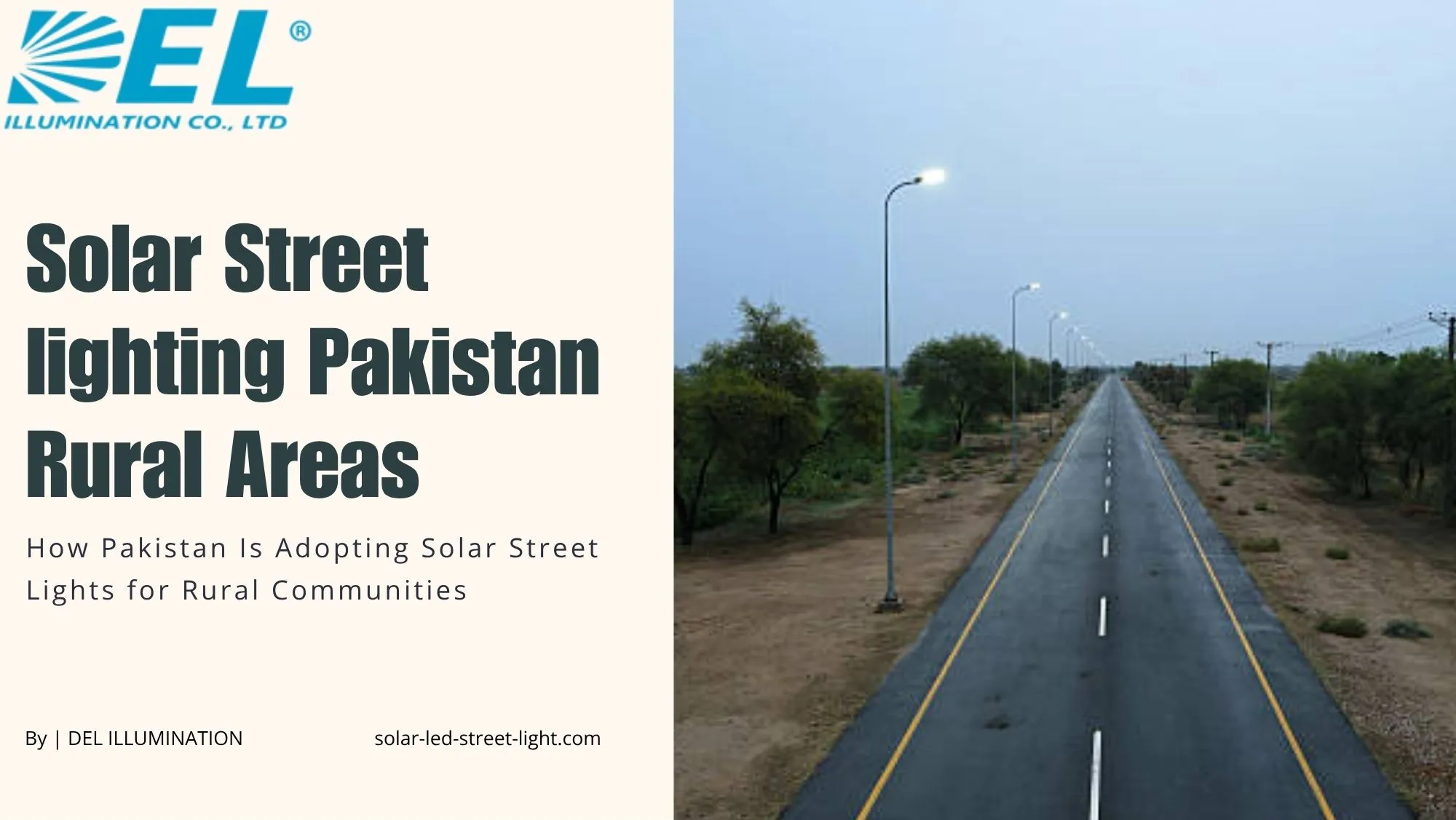
Across rural Pakistan, load shedding can stretch beyond 12 to 14 hours a day – leaving villages without light, security, or economic activity after sunset. In provinces like Balochistan and Sindh, grid access remains below 70%, meaning entire communities have never been reliably connected to the national electricity network. As electricity tariffs surged by over 155% between 2021 and 2024, and with Pakistan importing a record 17 GW of solar panels in 2024 alone – more than any other country in the world – a grassroots solar revolution is underway. At its most practical and immediate level, this revolution is lighting up rural streets, markets, and pathways through the rapid adoption of solar street lights for rural communities.
This blog explores why rural Pakistan is turning to solar street lighting, how government programmes and procurement frameworks are accelerating deployment, what technical specifications actually matter in Pakistan’s harsh climate, and how German-engineered systems are helping communities achieve long-term reliability that generic alternatives simply cannot deliver.
The Rural Lighting Crisis: Why Pakistan’s Villages Cannot Wait for the Grid
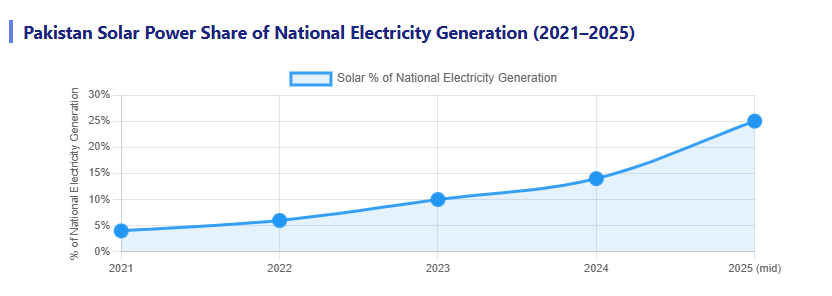
Pakistan’s rural electricity crisis is not a new problem, but it has become an acute one. By 2025, solar has become the country’s single largest electricity source, accounting for over 25% of total generation – yet this transition has largely benefitted urban and semi-urban households with the capital to invest in rooftop systems. For the rural poor, the gap remains stark.
In remote areas of Balochistan, KPK, and interior Sindh, rural communities endure up to 20 hours of daily outages during peak demand periods. The national electricity grid’s reach in Balochistan sits at just 54.7%, and in Sindh at 77.6%, according to Wikipedia’s analysis of NEPRA data. Even where grid infrastructure technically exists, transmission losses, aging distribution lines, and structural under-investment mean that reliable supply is rarely delivered.
Without functional street lighting, the consequences ripple outward. Women and children are exposed to safety risks after dark. Local markets close early, suppressing economic activity. Schools and community health centres are inaccessible at night. Road accidents on unlit rural roads increase during winter months. These are not abstract concerns – they are daily realities documented by provincial planners and development agencies across Pakistan’s interior districts.
Solar street lights – self-contained units that generate, store, and deliver light independently of the grid – address all of these constraints simultaneously. They require no trenching, no grid connection infrastructure, and no ongoing electricity bills. For communities where grid extension would cost tens of millions of rupees and take years to deliver, solar street lighting offers a deployable solution within weeks.
Government Frameworks and Provincial Schemes Driving Deployment
Pakistan’s policy environment has shifted considerably in favour of solar-powered public infrastructure since 2022. The Alternative Energy Development Board (AEDB) and the National Electric Power Regulatory Authority (NEPRA) continue to provide the primary regulatory scaffolding for renewable energy deployment, though the Private Power and Infrastructure Board (PPIB) now handles vendor certification oversight as of 2024.
At the provincial level, practical programmes are moving quickly. Punjab Chief Minister Maryam Nawaz Sharif inaugurated a subsidised solarisation initiative for agricultural communities in February 2025, while both the Punjab and Sindh provincial governments announced policies in 2024 to distribute subsidised solar systems to low-income residents. The Sindh Solar Energy Project (SSEP), backed by a USD 100 million World Bank commitment, is deploying solar home systems across areas with limited grid access and includes public infrastructure components. The Khyber Pakhtunkhwa government also announced in 2024 a scheme to distribute free 2-kilowatt solar setups to 100,000 households in its first phase.
For EPC contractors and procurement officers working on rural lighting projects, these provincial programmes represent genuine deployment pipelines. Understanding the certification requirements – including AEDB/PPIB vendor approval, NEPRA compliance, and the applicable ISO and IEC standards – is essential for securing project approvals and funding from development finance institutions. Contractors involved in World Bank or ADB-funded rural electrification projects should also familiarise themselves with the procurement frameworks governing bankable EPC contracts to avoid costly compliance failures.
The AEDB has also historically documented that Pakistan has over 500,000 street lights – most based on outdated 80W, 125W, and 250W sodium fixtures – that represent a major upgrade opportunity. Replacing these with solar LED units eliminates both the ongoing electricity cost and the substantial grid load these fixtures impose.
Technical Specifications That Determine Success in Pakistan’s Climate
Pakistan’s climate presents serious demands on solar street lighting hardware. Average ambient temperatures in Sindh and Punjab’s southern belt regularly exceed 45°C in summer, while mountainous areas in KPK and Gilgit-Baltistan see winter temperatures drop below -15°C. Dust storms are common across Balochistan and Cholistan. Solar irradiance across most of Pakistan’s major provinces ranges from 5.0 to 6.5 peak sun hours per day, according to AEDB resource data – an exceptional solar resource that rewards high-efficiency panel specifications.
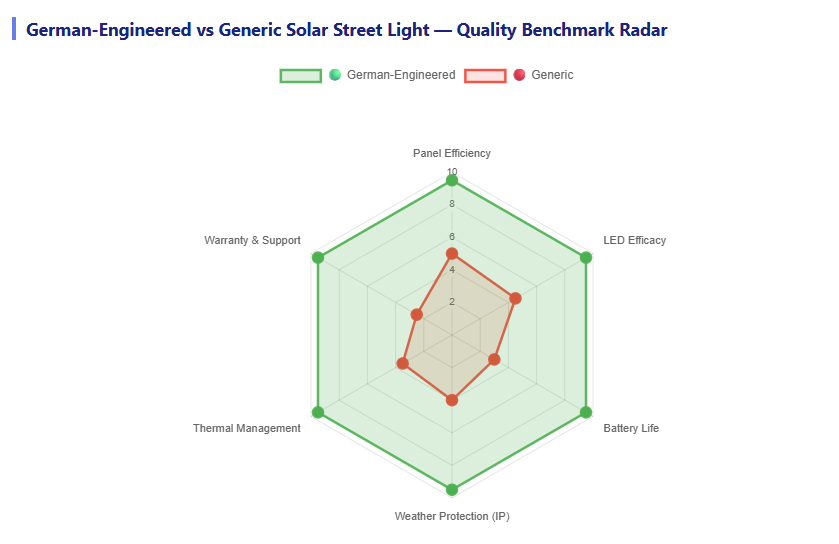
This climate context makes specification selection a make-or-break decision. German-engineered solar street lights deployed by solar-led-street-light.com are built to perform in precisely these conditions. Key specifications include:
- Solar panel efficiency: 21–23% monocrystalline cells, compared to 15–17% for generic polycrystalline alternatives – meaning significantly more energy captured per panel surface area
- LED efficacy: 160–180 lumens per watt (lm/W) at rated current, versus 100–120 lm/W in generic units – more light output from less stored energy
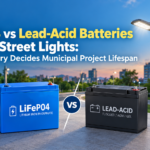
- Battery chemistry: LiFePO4 (lithium iron phosphate) with 2,000–3,000 charge cycles and an 8–12 year calendar life, compared to lead-acid batteries delivering just 300–500 cycles and a 2–4 year service life
- Charge controller: MPPT (Maximum Power Point Tracking), which captures 25–30% more energy from available sunlight versus the PWM controllers fitted to most generic systems
- IP rating: IP67, independently verified by an accredited laboratory, providing genuine dust and water ingress protection suitable for Pakistan’s dust storms and monsoon season
- LED junction temperature: ≤85°C even at 50°C ambient air temperature when housed in die-cast aluminium – critical in Pakistan’s summer heat, where generic plastic-housed units can exceed 100°C junction temperature, triggering rapid LED degradation
- Backup days: 3–7 days of autonomous operation without sun – essential for Pakistan’s occasional extended overcast periods and monsoon weeks
For procurement officers specifying rural projects, requiring IK08 impact resistance rating alongside IP67 ensures units survive vandalism and accidental contact – a practical necessity in high-traffic rural market areas.
The Total Cost of Ownership Case: Why Cheap Units Cost More
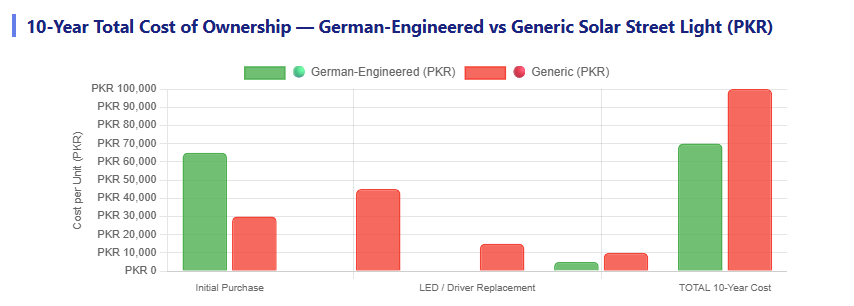
For rural district governments and municipal bodies operating under constrained budgets, the upfront price of solar street lights is the instinctive decision criterion. This is a costly mistake. The total cost of ownership (TCO) over a 10-year project life tells a radically different story.
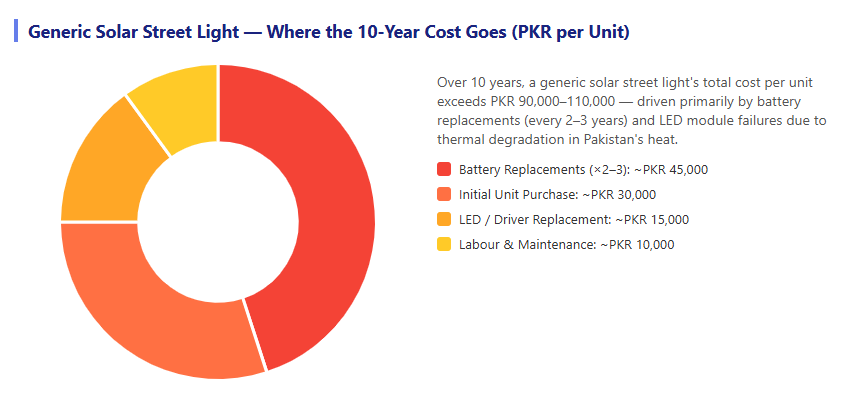
A generic solar street light priced at PKR 25,000-35,000 per unit typically relies on lead-acid batteries, PWM controllers, and polycrystalline panels. Lead-acid batteries in Pakistan’s heat degrade rapidly – often requiring replacement within 2-3 years. At current market rates, two battery replacement cycles over 10 years, combined with LED replacements due to thermal stress at 20,000-30,000 hour rated life, push the 10-year cost per unit to PKR 80,000-110,000. Add unreliable performance, voided warranties (often valid for just 1-2 years), and the political cost of failed rural lighting projects, and the true price of generic procurement becomes clear.
German-engineered systems from solar-led-street-light.com carry a higher upfront cost but offer a 5-7 year comprehensive warranty with a performance guarantee, LiFePO4 batteries rated to 8-12 years of service, and LED modules rated to 50,000 hours – eliminating replacement cycles within the project lifecycle. The 10-year TCO of a quality-specified system is consistently lower than the cumulative replacement and maintenance cost of generic alternatives. For EPC contractors bidding on projects with multi-year performance obligations, this distinction is not academic – it is the difference between a profitable contract and a costly liability.
Procurement officers can explore the total cost of ownership framework for EPC projects and the 5 advantages of solar light pole systems to build a defensible procurement case for quality-specified systems.
Real-World Applications: Where Solar Street Lights Are Making an Impact
Across Pakistan’s rural landscape, solar street lighting is already transforming communities in measurable ways. In Balochistan – where grid access is lowest and solar irradiance is among the highest in South Asia – solar street lights are being deployed along market streets, around schools, and at rural health centres. The government of Balochistan has previously launched dedicated programmes to electrify off-grid villages through solar technology, with AEDB having installed solar home systems in remote districts such as Khuzdar.
In rural Punjab and interior Sindh, village case studies documented in 2025 found that nearly 50% of households in some communities had already adopted solar solutions – a figure that reflects the broader bottom-up solar adoption reshaping Pakistan’s energy landscape. As solar street lights follow this household adoption trend, communities gain safer streets, longer market hours, and improved security infrastructure at near-zero operational cost after installation.
From the perspective of contractors and facility managers, solar street lights are also the only practical lighting solution for locations that are physically remote from distribution infrastructure – river-crossing communities, mountain valleys, desert settlements, and new housing schemes being developed outside existing grid coverage. For these projects, understanding how to calculate correct LED solar area light spacing and how to apply DIALux simulation for luminaire spacing optimisation ensures lux levels meet local road standards from day one.
A completed solar street light project on a main road in Quetta in September 2025 – deploying all-in-two solar street lights optimised for the city’s high-altitude solar conditions – demonstrates that Pakistan’s urban-fringe and rural markets are actively absorbing quality solar street lighting infrastructure.
Choosing the Right System: What Pakistan’s Procurement Officers Must Demand
Procurement in Pakistan’s solar sector has historically been vulnerable to specification dilution – where projects are awarded on lowest unit price and delivered with hardware that fails within the first monsoon season. As development finance institution funding (ADB, World Bank) increasingly specifies certification requirements, procurement officers now have both the mandate and the framework to demand higher standards.
When specifying solar street lights for rural Pakistan, the minimum technical requirements that protect project integrity include: monocrystalline solar panels with independently verified efficiency ratings; LiFePO4 battery chemistry with a minimum 2,000-cycle rating; MPPT charge controllers with certified efficiency above 98%; IP67 dust and waterproofing protection from an accredited third-party laboratory; IEC 62133 and UN 38.3 battery safety certifications; and a minimum 5-year comprehensive warranty covering all system components.
Procurement officers should also verify that suppliers are not relying on self-declared IP ratings or in-house test certificates – a common practice among generic manufacturers that leaves projects exposed during monsoon seasons. The certification requirements for bankable EPC contracts outline exactly which certifications are required for ADB and World Bank-aligned procurement. Comparing German-engineered systems versus generic alternatives provides a side-by-side technical benchmark that procurement committees can use to set defensible minimum specifications.
Remote-control technology and motion-sensing dimming functions – available in premium all-in-one systems – also allow maintenance teams to monitor fleet performance remotely, reducing operational visits to remote rural sites. The 9 benefits of solar light remote control technology explores how connected solar street lights are reducing maintenance costs in remote deployments globally.
Conclusion – Solar Street Lights for Rural Communities
Pakistan’s rural communities cannot wait years for grid extension to deliver the safety, security, and economic activity that functioning street lighting enables. With rural areas of Balochistan and Sindh experiencing grid access rates below 70%, load shedding exceeding 12 hours daily in remote areas, and a proven national capacity for rapid solar adoption – the conditions for large-scale solar street light deployment across rural Pakistan have never been more favourable.
Three takeaways stand out for decision-makers. First, solar street lights are the only technically and economically viable lighting solution for Pakistan’s off-grid and under-served rural communities in the near term. Second, specifying quality-engineered systems with LiFePO4 batteries, MPPT controllers, and independently certified IP67 protection is essential for long-term performance in Pakistan’s demanding climate – and lower total cost over a 10-year project life. Third, procurement frameworks aligned with AEDB/PPIB certification requirements and international financing standards are now mature enough to support compliant, bankable rural lighting projects at scale.
If your organisation is planning a rural lighting project in Pakistan – whether for a provincial government scheme, a development-finance-backed EPC contract, or a community infrastructure initiative – the team at solar-led-street-light.com can provide German-engineered solar street lighting solutions with verified certifications, project-specific design support, and the technical documentation required for ADB and World Bank procurement compliance. Contact us today for a customised consultation and quote.
Frequently Asked Questions
1. What wattage of solar street light is typically recommended for rural roads in Pakistan?
For rural secondary roads and village streets, solar street lights in the 30W–60W LED range are typically specified, delivering between 3,600 and 9,000 lumens – sufficient to achieve 10–20 lux at road level depending on pole spacing. In high-irradiance provinces like Balochistan and Sindh, a 40W LED unit with a 21–23% efficient monocrystalline panel and a 100–150Wh LiFePO4 battery provides reliable dusk-to-dawn illumination with 3–5 days of backup autonomy. Procurement officers should require a photometric simulation (DIALux or Relux) confirming lux levels meet applicable road classification standards before finalising specifications.
2. How do solar street lights perform during Pakistan’s monsoon season?
A properly specified solar street light with IP67 ingress protection, LiFePO4 battery storage providing 3–7 backup days, and MPPT charging can sustain reliable operation through extended cloudy and rainy periods. The key is correct system sizing before installation – battery capacity must be calculated for the lowest-irradiance month at the project’s specific latitude, not average annual figures. Generic systems with undersized batteries or lead-acid cells often fail within the first monsoon season because the battery cannot recover charge in consecutive low-sun days.
3. Are there specific government schemes in Pakistan that fund solar street lights for rural communities?
Several active programmes are relevant. The Sindh Solar Energy Project (SSEP), funded by the World Bank with USD 100 million, includes off-grid solar infrastructure for areas with limited grid access. Punjab and Sindh provincial governments announced subsidised solar schemes for low-income communities in 2024. KPK’s solar distribution scheme targets 100,000 households in its first phase. EPC contractors should also monitor AEDB and PPIB tender portals for rural electrification and street lighting contracts funded through development finance institutions.
4. What is the expected lifespan of a quality solar street light in Pakistan’s climate?
German-engineered solar street lights with LiFePO4 batteries (8–12 year calendar life), monocrystalline panels (25-year power output warranty is standard for quality manufacturers), and LED modules rated to 50,000 hours should deliver 10–15 years of functional service with minimal maintenance when correctly installed and sized. Generic systems relying on lead-acid batteries typically require battery replacement every 2–3 years, and LED drivers in plastic-housed units can fail within 3–5 years under Pakistan’s high-ambient-temperature conditions.
5. What certifications should procurement officers require for solar street lights in Pakistan?
For project integrity and financing compliance, the minimum certification baseline should include: IEC 62133 and UN 38.3 for battery safety, IEC 62109 for the charge controller, IP67 verified by an ISO 17025-accredited third-party laboratory (not self-declared), IK08 impact resistance for public installation sites, and ISO 9001 quality management for the manufacturer. For ADB and World Bank-funded projects, TÜV or equivalent certification significantly strengthens procurement documentation and reduces lender risk queries.
6. How do all-in-one solar street lights compare to split-type systems for rural Pakistan?
All-in-one solar street lights – where the solar panel, LED, battery, and controller are integrated into a single compact unit – offer faster installation, lower civil works cost, and reduced theft risk compared to split-type systems where the battery is housed separately at pole base level. For rural Pakistan, where installation teams may lack specialist experience and site security can be a concern, all-in-one designs simplify deployment and reduce vulnerability. The 7 benefits of all-in-one street light technology explores these advantages in detail.
7. How can EPC contractors manage solar street light projects in remote Pakistani locations?
Remote project management is significantly aided by solar street lights fitted with GSM/GPRS monitoring modules, which allow performance data – battery state, charging current, fault alerts – to be transmitted to a central dashboard without physical site visits. For projects spanning multiple remote villages, this connectivity reduces operational costs substantially. Contractors should also ensure their installation teams are trained on how to fix solar lights not working for common field issues, and that spare components are staged at provincial depot locations to minimise response times.
8. What is the return on investment timeline for solar street lights in rural Pakistan?
For municipal and government bodies replacing grid-connected sodium street lights with solar LED units, the payback period depends on the existing electricity tariff and connection costs. At NEPRA’s current commercial tariff of approximately PKR 43.83/kWh (June 2025), a 40W solar street light operating 12 hours per night saves roughly 175 kWh per year – representing approximately PKR 7,670 in annual electricity cost savings per fixture. When grid connection and trenching costs are factored in for new rural installations (PKR 200,000-400,000 per 100-metre section), solar street lights achieve a payback within 12–24 months and deliver near-zero operational cost for the remainder of their 10–15 year service life.