
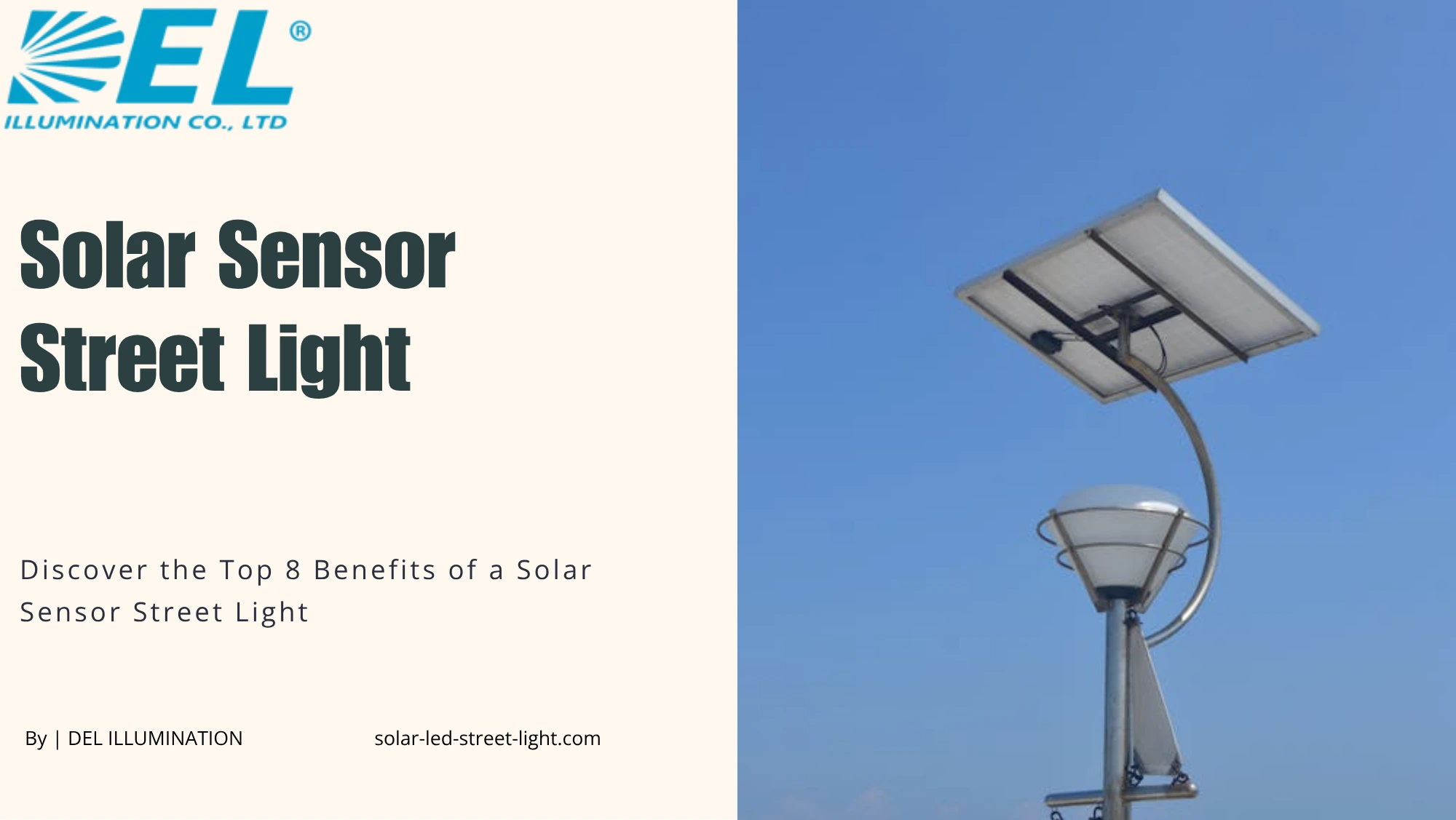
The world is rapidly transitioning towards sustainable solutions that reduce our carbon footprint while meeting growing infrastructure demands. A solar sensor street light stands at the forefront of this transition combining solar energy harvesting with intelligent sensing technology to create an outdoor lighting system that is smart, self managing, and genuinely cost effective over its operational lifetime.
These innovative lights provide measurable economic and social advantages, making them a compelling choice for cities, municipalities, facility managers, and businesses seeking to upgrade outdoor lighting without ongoing electricity costs. Cities that have implemented smart street lighting with sensor technology have reported energy savings of up to 48% compared to conventional systems with on demand motion sensing reducing battery capacity requirements by 40–50%, directly lowering both initial system cost and long term maintenance expenditure.
In this article, we explore what a solar sensor street light is, how it works, the eight most important benefits it delivers, the key features to look for when specifying one, and what factors influence pricing across the market.
What Is a Solar Sensor Street Light?
A solar sensor street light is an outdoor lighting device that detects the presence or absence of ambient light and in advanced models, the presence of movement and automatically activates or deactivates the light accordingly. This intelligent operation eliminates the need for manual switching or grid connected timer controls.
The system uses a photocell sensor to measure the intensity of ambient sunlight. When the sensor detects a decrease in light level, typically during dusk, it sends a signal to the fixture’s control circuitry to turn the LED light on. When the sensor detects an increase in sunlight during dawn or in the presence of sufficient ambient light it sends a signal to turn the light off. This automatic operation ensures the solar sensor street light only consumes battery energy when illumination is genuinely required.
Advanced solar sensor street light systems add a second layer of intelligence through motion detection. Using PIR (Passive Infrared), microwave, or ultrasonic sensors, the fixture maintains a reduced brightness level typically 20–30% of rated output during inactive periods, and instantly restores full brightness when pedestrian or vehicle movement is detected within the sensor’s range. PIR sensors typically cover 8–15 metres at detection angles of 120–180 degrees, while microwave sensors offer wider detection angles and greater resistance to temperature interference making them better suited for larger open areas such as parking lots, highways, and industrial perimeters.
This combined photosensor plus motion architecture is what makes a modern solar sensor street light so energy efficient in practice. To understand how sensor integration fits into the broader solar street light system design, see our guide on the design and construction of automatic solar street lights.
The 8 Benefits of a Solar Sensor Street Light
1. Environmentally Friendly
A solar sensor street light benefits the environment in two complementary ways. First, it derives its power entirely from the sun a renewable, zero emission energy source eliminating the carbon emissions associated with grid connected street lighting powered by fossil fuels. Second, the sensor ensures the light operates only when genuinely needed: when the photocell detects sufficient daylight, the light automatically switches off, preventing unnecessary energy consumption during daytime hours or periods of natural ambient light.
The result is a significant reduction in carbon footprint relative to conventional street lighting. For large scale deployments highways, industrial parks, residential colonies, or municipal road networks covering hundreds or thousands of fixtures this environmental benefit compounds into a measurable contribution toward national carbon reduction targets. For further reading on how solar street lights minimise ecological damage compared to conventional alternatives, see our article on solar cell street light ecological considerations.
2. Energy Efficiency
A solar sensor street light achieves exceptional energy efficiency by continuously monitoring ambient light levels and adjusting power output to match actual conditions. In abundant ambient light, the sensor reduces power to the LED source or switches it off entirely. When ambient light levels fall below the threshold, it increases LED power to deliver the required illuminance for safety and visibility.
When motion sensing is layered on top of this photosensor control, the energy efficiency advantage becomes quantifiable. Industry data from 2025 shows that the intelligent control system in a motion sensing solar sensor street light can reduce annual energy consumption by up to 80% compared to conventional all night full brightness operation. A 60W traditional street light operating all night consumes approximately 525 kWh per year; the same fixture equipped with motion sensing operates at an average effective consumption of just 105 kWh annually a direct consequence of dimming to 20–30% output during low activity periods and activating to full brightness only when movement is detected.
3. Cost Savings
A solar sensor street light delivers cost savings across two distinct time horizons. In the long term, the elimination of electricity bills since the light’s entire power requirement is met by solar energy produces ongoing savings year after year with no recurring utility cost. In the near term, the sensor driven intelligent operation reduces battery cycling depth and frequency, which extends battery lifespan and reduces the capital cost of battery replacement across the system’s operational life.
Although the initial purchase cost of a solar sensor street light is higher than a conventional grid connected fixture, the total cost of ownership analysis consistently favours the solar sensor option. The return on investment period is typically 2–5 years depending on local electricity tariffs and deployment environment after which the system generates pure savings. No ongoing labour cost is required for manual switching, and the sensor’s self managing operation reduces the maintenance call out frequency compared to systems requiring scheduled human intervention. For a deeper understanding of how to evaluate the full cost structure of solar street light procurement, our guide on 8 ways that affect solar street light price covers all the key variables.
4. Customisable Settings
One of the most practically useful features of a solar sensor street light is its adaptability to specific deployment requirements through adjustable sensor parameters. Rather than applying fixed default settings across all installations, procurement officers and facility managers can work with their supplier to customise the sensor behaviour for each location’s unique operating conditions.
Customisable parameters typically include:
- Sensitivity threshold: The ambient light level at which the photosensor triggers the light on or off adjustable to account for local light pollution or proximity to other light sources
- Motion detection range and angle: Adjustable detection zone to match the specific coverage area of the installation
- Dimming profile: The percentage brightness maintained during inactive periods (typically 10–30%) and the trigger brightness upon motion detection (typically 100%)
- Hold time: How long the fixture remains at full brightness after motion is no longer detected (commonly 15–120 seconds, adjustable to balance safety and energy efficiency)
- Time based scheduling: Programmed dimming at specific hours for example, reducing output after midnight when traffic volumes are lowest independent of motion detection
This depth of configurability makes a solar sensor street light suitable for a wide range of applications, from high traffic urban roads where the hold time should be extended, to low activity rural paths where aggressive dimming between motion events delivers maximum battery conservation.
5. Reliable Performance
A solar sensor street light offers reliable, consistent performance because its operation is governed by objective sensor readings rather than manual timers or human scheduling. The photocell continuously monitors ambient light intensity and responds promptly to changes activating the LED fixture even in borderline low light conditions such as heavy overcast, dense fog, or storm cloud cover before dusk.
The sensor’s responsiveness ensures the street light activates promptly when lighting is needed, regardless of weather or seasonal variation in daylight duration. The solar panel charges the LiFePO4 battery during available daylight hours and in quality German engineered systems, MPPT (Maximum Power Point Tracking) charge controllers ensure maximum energy harvest even during cloudy periods, harvesting 25–30% more energy than PWM controllers under the same conditions. This means the battery enters each night at maximum available state of charge, supporting reliable all night operation. For guidance on maintaining this reliable performance across a deployment’s full operational life, see our article on 9 tips to maintain solar compound lighting.
6. Easy Installation
A solar sensor street light requires minimal wiring and electrical infrastructure during installation. Because the entire system solar panel, battery, LED fixture, sensor, and charge controller is self contained and grid independent, there is no requirement to dig cable trenches, run underground conduit, install electrical meters, or connect to local utility infrastructure.
The sensor module is either factory integrated into the luminaire or field mounted onto the light pole or fixture housing. Once physically mounted and the system powered on, the sensor activates automatically and the solar sensor street light begins operating as programmed without further manual intervention. This dramatically reduces installation time, specialist labour requirements, and associated costs particularly for large scale deployments across remote roads, rural communities, or locations where underground cabling would be prohibitively expensive. Our comprehensive park solar lights installation guide provides practical guidance on the installation process for pole mounted solar lighting systems.
7. Versatility
A solar sensor street light can be deployed in virtually any outdoor location that receives adequate direct sunlight from urban streets and highway junctions to rural village roads, off grid industrial sites, agricultural facilities, and temporary event venues. The grid independent operating principle means the solar sensor street light functions equally in areas connected to the electrical grid and in remote locations with no utility infrastructure whatsoever.
The adaptive brightness capability makes the solar sensor street light particularly well suited to deployments where lighting requirements vary throughout the night. Sports facilities can be configured for full brightness during evening activity and reduced output after midnight. Parking lots can maintain safety level ambient illumination between vehicle movements, activating full brightness when a vehicle or pedestrian is detected. School zones can be programmed for full brightness during drop off and collection times and minimal output at other hours. For specific guidance on solar street light deployment in these varied contexts, our guides on solar street lights for school zones, solar street lights for industrial parks, and off grid solar street lighting provide detailed application guidance.
8. Sustainability
The sustainability advantage of a solar sensor street light operates at two levels simultaneously. At the system level, sensor driven demand responsive operation reduces daily depth of battery discharge, which directly extends cycle life. A LiFePO4 battery in a non sensor system cycling to 80% depth of discharge every night may achieve 2,000 full cycles before meaningful capacity loss; the same battery in a sensor equipped system where partial dimming reduces discharge depth on most nights can extend its effective cycle life significantly beyond that baseline. Fewer battery replacement cycles means lower lifetime material consumption and reduced end of life waste.
At the component level, reduced operating hours at full LED output lower the thermal stress on the LED chip and driver electronics, extending the rated 50,000 hour LED lifespan toward its full potential rather than truncating it through excessive thermal cycling. Taken together, these sustainability benefits make the solar sensor street light a more responsible procurement choice not just in terms of energy source, but in terms of the total material and maintenance resource it consumes across its operational lifetime.
What Is a Solar Pole Light and How Does Pricing Work?
A solar pole light is an outdoor lighting system that uses solar energy to illuminate streets, car parks, pathways, and public areas. The photovoltaic panel, typically mounted at the top of the pole or on the fixture housing, absorbs sunlight during the day and stores the energy in a battery. At night, the stored energy powers the LED source with the sensor controlling automatic activation at dusk and deactivation at dawn.
Understanding the factors that influence solar sensor street light pricing helps procurement officers and facility managers make informed, value based purchasing decisions rather than defaulting to the lowest upfront price.
Quality of components: Systems manufactured to higher specifications using monocrystalline panels (21–23% efficiency), LiFePO4 batteries, MPPT charge controllers, and die cast aluminium housings rated IP67 carry higher upfront costs but deliver lower total cost of ownership across a 10 year operational lifecycle. Generic systems using polycrystalline panels (15–17% efficiency), lead acid batteries, and PWM controllers are cheaper to purchase but significantly more expensive to own. Our detailed comparison of German engineering versus generic solar street lights quantifies these lifecycle cost differences.
Brand and certification: Reputable manufacturers who subject their products to independent TÜV certification, ISO 9001 quality management audits, and IEC standards testing can demonstrate verified performance claims justifying a higher price point with documented evidence rather than marketing assertions.
Design and features: LED wattage, battery capacity, sensor type (photocell only vs photocell plus motion), smart IoT connectivity, remote monitoring capability, and IK impact resistance rating all influence the final price. Features like five stage dimming profiles, adjustable hold times, and programmable time based scheduling add cost but deliver proportional operational value.
Shipping and installation: Transportation cost from manufacturing facility to installation site, packaging, import duties, and any specialist installation labour should all be factored into total procurement cost. A solar sensor street light with higher upfront cost but easier self installation may deliver lower total deployment cost than a cheaper unit requiring specialist electrical contractors.
Market demand: In high demand regions or during supply chain constraints, prices may be elevated. Procuring as part of a larger project order rather than single unit purchases typically secures more favourable unit pricing and technical support terms.
For a full guide to what features separate a best in class solar street light from a mediocre alternative, see our article on 10 things to look for in the best solar street lights.
Key Features to Look for in a Solar Sensor Street Light
When specifying a solar sensor street light, the following features define the difference between a system that performs to specification across a decade and one that fails within two years:
- High efficiency solar panel: Monocrystalline cells rated at 21–23% conversion efficiency, sized to deliver full battery charge within the available peak sun hours at the deployment location
- Energy saving LED fixture: LED chips rated at 160–180 lm/W (German engineered standard) for maximum light output per watt of battery energy consumed
- Photosensor with motion capability: A dual function sensor combining photocell automatic dusk/dawn switching with PIR or microwave motion detection for demand responsive brightness control
- Long life LiFePO4 battery: Rated for 2,000–3,000 charge discharge cycles with a calendar life of 8–12 years; stable performance from 20°C to +60°C
- MPPT charge controller: For maximum energy harvest efficiency especially important in cloudy climates or high latitude locations with variable irradiance
- IP67 rated, IK08 rated enclosure: Independent laboratory verified protection against dust ingress, water immersion, and mechanical impact not self declared IP65
- Easy installation and pole compatibility: Confirmed compatibility with standard pole diameters and straightforward field installation without specialist electrical tools
Conclusion
A solar sensor street light is no longer simply an energy saving alternative to conventional street lighting it is a smart, self managing infrastructure asset that reduces installation complexity, eliminates electricity costs, extends battery life through intelligent demand management, and contributes to measurable carbon reduction targets. With cities implementing smart sensor street lighting reporting energy savings of up to 80% compared to conventional all night full brightness operation, and motion sensing systems reducing battery capacity requirements by 40–50%, the operational and financial case for specifying a solar sensor street light is stronger in 2025 than at any previous point.
The three most important specification decisions are: insist on MPPT charge controllers and LiFePO4 batteries as the baseline chemistry requirement; verify IP ratings through independent laboratory certification rather than manufacturer self declaration; and configure the sensor dimming profile during commissioning rather than accepting factory defaults the right profile for your specific deployment will materially extend battery life and reduce the total cost of ownership.
For expert guidance on specifying, procuring, and deploying the right solar sensor street light system for your project, visit solar led street light.com to consult with our engineering team or request a customised project quote today.
FAQs
1. What is the difference between a photosensor and a motion sensor in a solar sensor street light? A photosensor (photocell) detects ambient light levels and controls the automatic dusk on/dawn off switching of the solar sensor street light ensuring the LED only operates when natural light is insufficient. A motion sensor (PIR, microwave, or ultrasonic) operates at night within the already activated fixture, adjusting brightness up or down based on detected movement. Premium solar sensor street light systems integrate both functions: the photosensor manages the day/night cycle, while the motion sensor manages the dimming profile throughout the night to maximise energy conservation. For further insight into how remote control technology enhances these sensor capabilities, see our article on 9 benefits of solar light remote control technology.
2. How long does a solar sensor street light last without sunlight? A correctly sized solar sensor street light with a LiFePO4 battery and MPPT charge controller is typically designed to deliver 3–5 days of autonomous operation without solar recharge, depending on the battery capacity, LED wattage, and programmed operating profile. The sensor’s dimming capability directly extends this autonomy: operating at 30% output during inactive periods rather than maintaining full brightness all night can extend the backup duration from 3 days to 5–6 days on the same battery capacity. Our guide on reliable solar energy street light systems explains how to calculate the correct backup day provision for specific deployment environments.
3. Can a solar sensor street light work in a location with partial shading or frequent cloud cover? Yes a well specified solar sensor street light with a monocrystalline solar panel and MPPT charge controller maintains meaningful energy harvest in diffuse light and partial cloud cover conditions. Monocrystalline panels perform significantly better in low irradiance conditions than polycrystalline alternatives, and MPPT controllers extract the maximum available power from the panel at any given light level harvesting 25–30% more energy than PWM controllers under the same conditions. For locations with extended overcast seasons, system designers should increase battery backup capacity (to 5–7 days) and specify slightly oversized panels to account for reduced average daily harvest. Our guide on 9 factors to consider when setting up solar street light LEDs covers site assessment and system sizing for challenging irradiance environments.
4. What maintenance does a solar sensor street light require? A high quality solar sensor street light with LiFePO4 batteries and a robust IP67 rated enclosure requires very little ongoing maintenance. The primary maintenance tasks are: periodic solar panel cleaning every 2–4 weeks in dusty or arid environments, quarterly in temperate climates to remove accumulated dust and maintain rated energy harvest; annual battery capacity verification using a discharge test to confirm the battery is delivering above 80% of its rated capacity; and visual inspection of the sensor window, LED lens, and housing seals during each cleaning visit. For a practical maintenance checklist, see our guide on 10 tips to maintain a solar street light battery.
5. Is a solar sensor street light suitable for high security areas such as military sites or industrial perimeters? Yes a solar sensor street light with microwave motion sensing is particularly well suited to high security perimeter applications. Microwave sensors offer detection ranges of 15–25 metres, are less affected by environmental temperature variation than PIR sensors, and can detect movement through light barriers such as rain or fog. The instant transition from dim ambient lighting to full brightness upon motion detection serves as a deterrent to intrusion and provides high lux illumination for CCTV camera coverage. Grid independent operation ensures the lighting remains functional even if site power is disrupted. Our dedicated resources on solar street lights for military applications and solar street lights for industrial parks provide detailed guidance on specifying sensor street lights for security critical environments.