
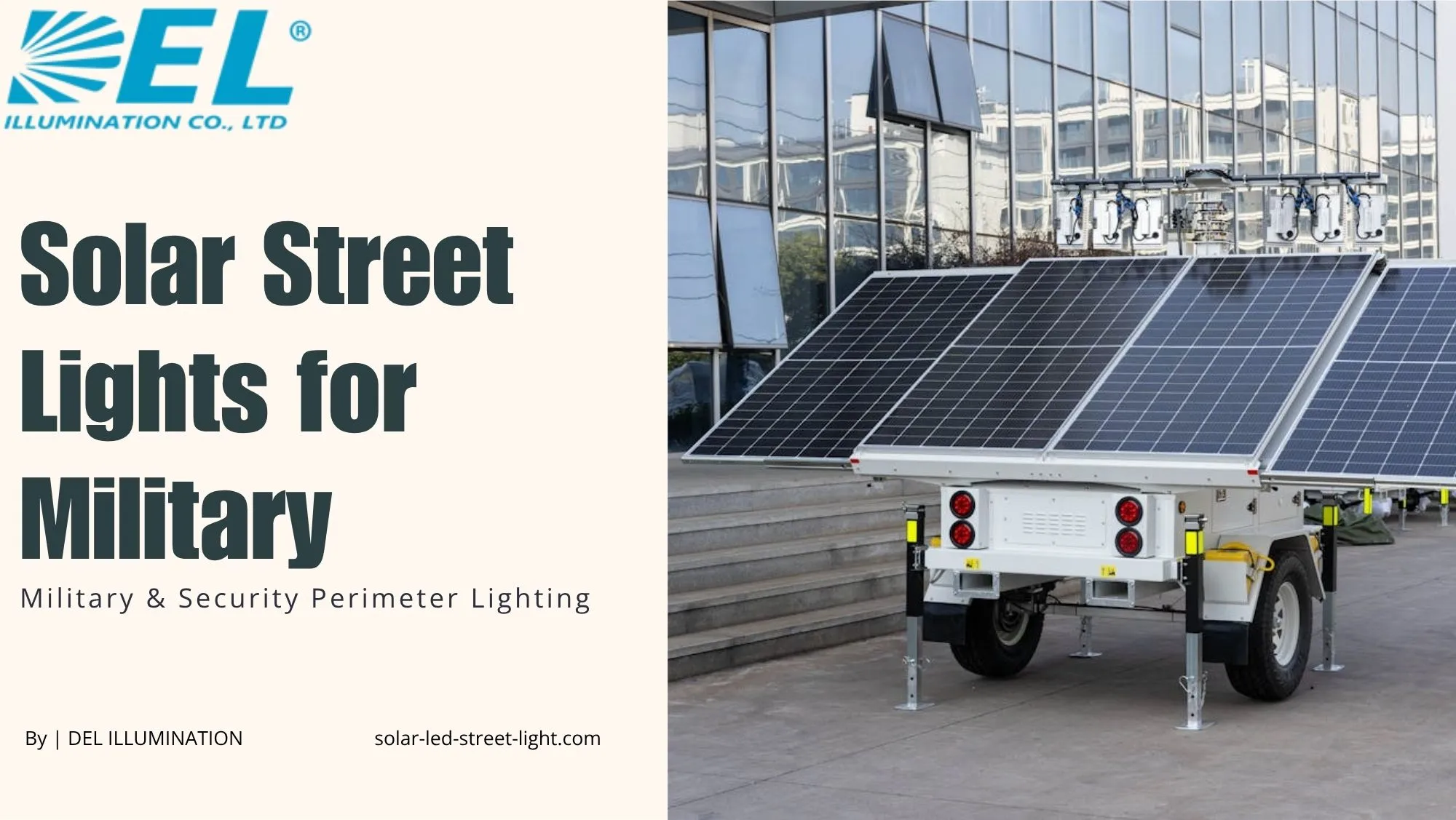
Grid-dependent perimeter lighting is one of the most overlooked vulnerabilities in military and high-security facility design. When a power outage strikes – whether caused by a cyberattack, natural disaster, or infrastructure failure – grid-tied lights go dark at exactly the moment security matters most. Industry data shows that the U.S. Department of Defense has installed over 1.3 gigawatts of renewable energy capacity since 2010, with solar-powered lighting playing an increasingly central role in base resilience strategies. For security planners worldwide, the shift to solar street lights for military and perimeter applications is no longer an environmental preference – it is a strategic imperative.
This blog explains why solar LED street lights are uniquely suited to military installations, high-security perimeters, and critical infrastructure sites. It covers the technical specifications that matter for security performance, how German-engineered systems outperform generic alternatives in demanding environments, and the long-term cost case that procurement officers and facility managers need to justify the investment.
Why Grid-Dependent Perimeter Lighting Is a Security Risk
Every military base, government compound, correctional facility, and critical infrastructure site shares a common operational requirement: uninterrupted perimeter illumination throughout the night, every night, regardless of external conditions. Traditional grid-connected street lighting fails this test in multiple ways.
The core problem is the single point of failure. A grid-tied perimeter lighting system depends on a continuous, unbroken chain of utility supply, transformer reliability, underground cabling integrity, and distribution panel function. Any break in that chain – accidental or deliberate – can extinguish kilometres of perimeter lighting simultaneously. For security facilities, that window of darkness is an operational crisis.
The trenching and cabling costs associated with grid extension compound this problem. Industry estimates place grid extension costs at USD 50 to USD 150 per linear foot for perimeter cabling on secured sites, factoring in environmental review requirements, conduit installation, and coordination with utility providers. On large military installations spanning hundreds of acres, this infrastructure investment runs into millions – and still leaves the system grid-dependent once it is complete.
Off-grid solar street lights eliminate this dependency entirely. Each unit generates, stores, and delivers its own power independently. A fault in one luminaire has zero effect on adjacent units. Even during severe weather events that knock out regional grid infrastructure, a properly designed solar perimeter lighting system continues to operate without interruption. This architecture – distributed, autonomous, and resilient – aligns directly with the energy security principles now embedded in modern defence planning frameworks.
Lighting Standards That Apply to Security Perimeters
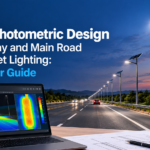
Before specifying any solar street light for a security perimeter, procurement officers and facility planners need to understand the illuminance targets that govern effective security lighting. Under-lit perimeters create detection failures; poorly designed light distribution creates shadows that adversaries can exploit.
The UK National Protective Security Authority (NPSA) security lighting guidance – one of the most widely referenced documents in the field – defines lux as the primary unit of specification for security lighting. For facial identification and CCTV image capture, the minimum vertical illuminance recommended by the IESNA Security Lighting Committee is 5.0 lux. A common uniformity ratio for perimeter security applications is 4:1, meaning that the maximum horizontal illuminance should not exceed four times the minimum across the lit zone.
For military and high-security applications, standard perimeter lighting columns are typically installed at 8 metres height, with spacing of 25 to 30 metres between units. Entry control facilities and access road intersections require higher maintained illuminance, typically 10–30 lux average horizontal, with uniformity ratios tighter than those applied to general perimeter zones.
German-engineered solar LED street lights are capable of delivering 160–180 lumens per watt (lm/W) LED efficacy, enabling luminaires in the 40–80W range to achieve the maintained illuminance levels specified for perimeter security applications – without oversizing the solar panel or battery to compensate for inefficient light sources. For comparison, generic alternatives typically achieve only 100–120 lm/W, requiring larger wattages to hit the same lux targets – consuming more stored energy and reducing backup days on cloudy periods.
For camera-integrated perimeter systems, a colour rendering index (CRI) of 70 or above and a colour temperature of 4,000K is recommended to support accurate facial identification and video evidence quality. These values should be specified explicitly in procurement documents, not left to supplier discretion. Proper spacing calculations for perimeter layouts are covered in our guide to calculating distance for LED solar area lights.
Key Technical Specifications for Military-Grade Solar Street Lights
Not every solar street light is suitable for mission-critical security applications. The specifications that matter most for military and high-security deployments are those that determine reliability under stress – extreme temperatures, vandalism attempts, long cloudy periods, and the need for minimum maintenance intervention.
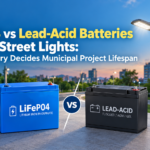
Battery chemistry and cycle life are the first critical differentiator. German-engineered systems use lithium iron phosphate (LiFePO4) battery chemistry, rated to 2,000–3,000 charge/discharge cycles and a calendar life of 8–12 years. LiFePO4 batteries carry IEC 62133 safety certification and are thermally stable across ambient temperatures from -20°C to +60°C – a critical property for perimeter lights operating in desert, tropical, or sub-arctic environments. Generic systems frequently use lead-acid batteries rated to only 300–500 cycles and lasting 2–4 years, requiring replacement every few years at significant maintenance cost and operational disruption.
Ingress protection and impact resistance determine whether a fixture survives both weather and deliberate interference. For security perimeters, IP67 ingress protection (verified by an accredited third-party laboratory, not self-declared) ensures full dust exclusion and protection against temporary water submersion. An IK08 or above impact resistance rating (IEC 62262) provides protection against 5-joule impacts – resistant to thrown objects and casual vandalism attempts. Generic products frequently carry only self-declared IP65 ratings and are often unrated for IK.
Solar panel efficiency governs how much energy a system harvests during limited daylight. Monocrystalline panels used in German-engineered systems achieve 21–23% conversion efficiency, compared to 15–17% for polycrystalline panels common in generic products. In high-security installations where backup days of 3–7 are specified to cover periods of poor irradiance, this efficiency gap directly determines whether the system meets its operational requirement.
MPPT charge controllers (Maximum Power Point Tracking) extract 25–30% more energy from the solar panel compared to basic PWM (Pulse Width Modulation) controllers used in generic systems. For perimeter lighting operating at full brightness throughout the night, this energy recovery margin is the difference between a system sized correctly for the duty cycle and one that dims or shuts off prematurely in the early morning hours.
Finally, LED junction temperature management determines luminaire longevity on sites where ambient temperatures exceed 40°C. German-engineered die-cast aluminium housings maintain LED junction temperatures at or below 85°C even in 50°C ambient conditions, supporting a rated LED life of 50,000 hours. Plastic or thin-metal housings common in generic products allow junction temperatures to exceed 100°C, dramatically accelerating LED degradation and shortening practical life to 20,000–30,000 hours. See our full comparison of German-engineered versus generic solar street lights for a deeper technical breakdown.
Integration with Security Technology: Sensors, CCTV, and Smart Controls
Modern security perimeter lighting is rarely a standalone system. It operates as part of a layered defence that includes CCTV surveillance, intrusion detection sensors (IDS), access control systems, and patrol support infrastructure. For solar street lights to serve effectively in this integrated environment, they need specific design features that generic products typically cannot deliver.
Motion-activated output adjustment is one of the most valuable features for security perimeters. During low-activity periods, luminaires can operate at 30–50% output to extend battery backup, automatically stepping up to 100% output when a sensor detects movement. This capability requires a compatible MPPT controller with programmable dimming schedules and sensor input compatibility – standard in German-engineered systems, but often absent or poorly documented in generic alternatives.
CCTV camera power supply integration is increasingly common on security perimeters, with solar luminaire poles providing mounting points and auxiliary power outputs for surveillance cameras. This eliminates the need for separate cable runs to power cameras, significantly reducing installation complexity and cost on secured sites where cable trenching requires environmental permits and security clearances. Some installations in the Middle East and South Asia have adopted this configuration to rapidly deploy perimeter surveillance without disturbing existing hardened infrastructure. Our solar lighting projects for industrial parks explore similar integrated configurations.
Remote monitoring and fault reporting capability is another requirement that security-focused procurement documents increasingly specify. Military and government facilities need real-time awareness of luminaire status – a failed unit on a perimeter is a security gap, not just a maintenance task. German-engineered solar systems with IoT-enabled controllers can report battery status, fault conditions, and output levels to a central management platform, enabling security and energy personnel to identify and respond to failures immediately.
For high-security installations that require backlight shields – to prevent light spill into restricted or observation zones – specialised optical lens configurations should be specified in procurement documents. These directional optics ensure illumination is projected precisely onto the sterile zone outside the perimeter fence, without creating glare that could compromise guard night vision or be exploited by intruders observing from elevated positions.
Total Cost of Ownership: The Case for Solar Over Grid in Security Applications
Procurement officers evaluating solar street lights for military and security perimeter applications frequently encounter higher upfront unit costs compared to basic grid-connected alternatives. This comparison is misleading without a complete 10-year total cost of ownership (TCO) analysis that accounts for all cost components.
Grid-connected perimeter lighting carries ongoing electricity costs of USD 150–250 per fixture per year in utility bills, based on industry benchmarks for outdoor lighting. Over 100 fixtures across a perimeter, that represents USD 15,000–25,000 annually in energy costs alone – before factoring in maintenance, lamp replacement, and potential emergency repair call-out charges.
The trenching and cabling infrastructure required for grid extension on a secured perimeter adds a one-time capital cost that solar completely eliminates. In one documented case from the civil infrastructure sector, trenching costs for a collector road lighting project ran to USD 600,000 – entirely avoided by switching to solar. On military sites, where cable installation requires coordination with base engineers, environmental review, and security clearances, the avoided infrastructure cost is even greater.
German-engineered LiFePO4 battery systems operating for 8–12 years before replacement, combined with LED fixtures rated at 50,000 hours, mean that the primary maintenance events on a solar perimeter are panel cleaning and occasional controller inspection – tasks that do not require specialist contractors or equipment. Generic systems with lead-acid batteries require full battery replacement every 2–4 years, adding recurring procurement and installation costs that compound significantly over a 10-year horizon.
When these factors are combined, off-grid solar perimeter lighting delivers a 30–40% reduction in total cost of ownership over 10 years compared to grid-connected alternatives, according to assessments from federal and military lighting providers active in 2024–2025. For procurement officers working within constrained capital budgets, the TCO argument is often more persuasive than the upfront unit cost comparison. Our full total cost of ownership guide for EPC projects provides the analytical framework for building this business case.
Deployment Considerations: From Desert Bases to Remote Perimeters
Solar street lights for military and security applications are deployed in some of the world’s most challenging environments – desert bases in the Middle East and North Africa where ambient temperatures regularly exceed 45°C, remote perimeters in sub-Saharan Africa with no grid infrastructure within 50 kilometres, high-altitude facilities in Central Asia with extreme cold and variable solar irradiance, and coastal sites exposed to salt-laden air and corrosive humidity.
Each of these environments demands specific design responses. For desert deployments, the combination of high solar irradiance (which supports generous energy harvest) and extreme heat (which degrades battery performance) means that LiFePO4 chemistry and die-cast aluminium thermal management are not optional – they are the minimum viable specification. In Middle East climates, German-engineered solar systems have demonstrated consistent performance at ambient temperatures up to 50°C, operating within specified parameters where generic alternatives experience accelerated degradation. Our dedicated guide to solar street lights for Middle East climates covers these environmental factors in detail.
For remote perimeters in Africa and South Asia – including military forward operating bases and government compound boundaries – the absence of grid infrastructure makes solar the only practical solution. The ability to deploy without trenching, utility coordination, or permanent electrical infrastructure means installation timelines are measured in days rather than the 12–24 months typical of grid extension projects. Solar street light projects in Africa and Kenya demonstrate how this deployment model works at scale in challenging environments.
Vandal-resistant design is another deployment consideration specific to security perimeter applications. IK08-rated housings, tamper-resistant fasteners, and pole designs that resist climbing are features that should be explicitly specified in procurement documents for correctional facilities, border security installations, and high-risk urban perimeters. German-engineered systems that meet IK08 or above – a standard often absent from generic product specifications – provide the physical security assurance that security planners require. Our analysis of IP65-rated solar street lights explains the ingress protection rating system in detail.
Conclusion
Solar street lights are no longer a compromise for military and security perimeter applications – they are the technically superior choice across most deployment scenarios. Three takeaways stand out from the analysis in this blog.
First, grid independence is a security asset. Off-grid solar architecture eliminates the single point of failure inherent in grid-connected perimeter lighting, ensuring that security illumination remains operational during the incidents – cyberattacks, natural disasters, and infrastructure failures – when it is most needed.
Second, German engineering standards matter for mission-critical applications. The combination of LiFePO4 batteries (2,000–3,000 cycles, 8–12 year life), 21–23% monocrystalline solar panels, MPPT charge controllers, IP67 verified ingress protection, IK08 impact resistance, and 50,000-hour LED life delivers a system that generic alternatives simply cannot match in reliability, longevity, or total cost of ownership over a 10-year horizon.
Third, the cost argument is increasingly decisive. With grid extension costs running to USD 50–150 per foot on secured sites, and solar perimeter systems delivering 30–40% lower TCO over 10 years, the procurement case for solar is now stronger than the case against it – even before factoring in energy cost savings and reduced maintenance burden.
If you are planning a military base, correctional facility, border security installation, government compound, or any high-security perimeter lighting project, the team at solar-led-street-light.com can provide system specifications, lux calculations, and a customised TCO analysis for your specific site conditions. Contact us today for a consultation or project quote.
FAQ
1. Can solar street lights maintain full brightness throughout the night on a security perimeter?
Yes, provided the system is correctly sized for the site’s peak sun hours and specified with an adequate number of backup days. German-engineered systems sized with 3-7 backup days of battery capacity and MPPT charge controllers will maintain specified lux levels throughout the night under normal operating conditions. The key is professional photometric design and energy budget calculation before procurement – not relying on standard catalogue configurations.
2. What happens to perimeter lighting during extended overcast periods?
A properly specified solar perimeter system operates on stored battery energy during periods without solar harvest. German-engineered LiFePO4 batteries rated at 3–5 backup days maintain full output during typical overcast periods. For sites in high-latitude locations or regions with extended monsoon seasons, programmable dimming schedules – reducing output to 50% during low-activity hours and stepping up on sensor trigger – extend effective backup duration without compromising security coverage.
3. Are solar street lights suitable for CCTV-integrated security perimeters?
Yes. Solar luminaire poles can be configured to provide auxiliary power outputs for PTZ cameras and fixed surveillance cameras, eliminating separate cable runs to each camera position. This capability requires explicit specification at the procurement stage, including the auxiliary output wattage, connector type, and weatherproofing requirements. Always confirm camera power draw with the surveillance system integrator before specifying the solar power budget.
4. How do solar perimeter lights perform in extreme temperature environments – both hot and cold?
LiFePO4 chemistry is thermally stable across a range of approximately -20°C to +60°C, making it suitable for both desert and cold-climate deployments. However, battery capacity decreases at low temperatures, which must be factored into system sizing calculations for sites experiencing prolonged sub-zero winters. German-engineered systems are typically validated with derating factors for cold climates built into their sizing methodology – generic systems frequently lack this documentation entirely.
5. What certifications should procurement officers require for security perimeter solar street lights?
At a minimum: IP67 ingress protection verified by an accredited third-party laboratory (not self-declared), IK08 impact resistance per IEC 62262, IEC 62133 battery safety certification for the LiFePO4 cell and pack, ISO 9001 quality management certification for the manufacturer, and TÜV or equivalent independent product testing documentation. For projects funded by multilateral development banks or subject to international procurement rules, additional certification requirements may apply.
6. How quickly can solar perimeter lighting be deployed compared to grid-connected alternatives?
Solar perimeter lighting systems can typically be installed within days to a few weeks, depending on the number of fixtures and site access conditions. This compares favourably to grid extension timelines of 12–24 months on secured sites requiring environmental review, permitting, and utility coordination. For forward operating bases, temporary deployments, or emergency security upgrades, the deployment speed advantage of solar is a strategic capability, not just a convenience.
7. What maintenance is required for solar perimeter lighting over a 10-year operational period?
German-engineered solar perimeter systems require minimal scheduled maintenance: periodic panel cleaning (frequency depends on dust levels at the site), annual controller inspection and firmware review, and battery replacement at approximately 8-12 years. LED fixtures rated at 50,000 hours do not require lamp replacement within the 10-year period. This maintenance profile contrasts with generic systems using lead-acid batteries, which typically require full battery replacement every 2-4 years.
8. Can existing perimeter lighting poles be retrofitted with solar LED systems?
In many cases, yes. Solar LED retrofit options are available where the existing pole structure is structurally sound and at appropriate spacing. However, perimeter security applications often require specific pole heights, setback distances from the fence line, and backlight shielding configurations that may not be compatible with existing pole placement. A site survey by a qualified solar lighting engineer is recommended before specifying a retrofit rather than a new installation.
References
- National Protective Security Authority (NPSA). (2023). Security Lighting: Guidance for Security Managers. https://www.npsa.gov.uk/system/files/documents/9f/fc/Security-lighting-guidance.pdf
- U.S. Army. (2025). Bulletin: Exterior Lighting for Safety and Security. https://api.army.mil/e2/c/downloads/2025/08/25/2cf43ea9/bulletin-exterior-lighting-for-safety-and-security.pdf
- Stimson Center. (2024). Military Bases and the Green Transition. https://www.stimson.org/2024/military-bases-and-the-green-transition/
- 8MSolar. (2026). How Solar Power Is Redefining Military Operations. https://8msolar.com/how-solar-power-is-redefining-military-operations/
- IRENA. (2025). Off-grid Renewable Energy Statistics 2025. https://www.irena.org/Publications/2025/Dec/Off-grid-Renewable-Energy-Statistics-2025
- Clear Blue Technologies. (2025). Solar Lighting for Federal & Military Facilities. https://www.clearbluetechnologies.com/lighting/segments/federal-military
- CAST Perimeter Lighting. (2024). Perimeter Security Lighting and Video Surveillance. https://castperimeter.com/blog/post/perimeter-security-lighting-video-surveillance-challenges-pt-2
- Fiber SenSys / Accu-Tech. (2024). Application Note AN-SM-080: Lighting for Perimeter Security Applications. https://www.accu-tech.com/hs-fs/hub/54495/file-223248737-pdf/docs/an-sm-080_lighting_for_perimeter_security_applications_rev._a__7-13.pdf
- Large Battery. (2026). Safety First: Navigating IEC 62133 and UN38.3 Certification for Global Distribution. https://www.large-battery.com/blog/safety-first-iec-62133-un38-3-global-ipc-distribution
- SEPCO Solar Lighting. (2025). Solar LED Lighting for Government and Military Projects. https://www.sepco-solarlighting.com/solar-led-lighting-government-and-military
Disclaimer
This article is for informational purposes only and does not constitute professional engineering, installation, or procurement advice. Performance specifications and costs may vary based on project requirements, location, and local regulations. Always consult qualified solar energy professionals and legal advisors before making procurement decisions.
For expert consultation on solar LED street lighting solutions, visit solar-led-street-light.com or contact our team for a customised quote.