
Industrial facilities are among the most energy-intensive environments on earth – and their outdoor lighting bills reflect it. Traditional grid-connected street lighting in a mid-sized industrial park can consume upwards of 150,000 kWh annually, generating electricity costs that compound year after year. Against this backdrop, the global solar street lighting market reached USD 10.95 billion in 2024 and is projected to grow at nearly 12% annually through 2032, with industrial parks emerging as one of the fastest-growing application segments. For facility managers, procurement officers, and EPC contractors overseeing industrial zones, this is not merely a sustainability trend – it is a procurement decision with measurable financial consequences. This blog outlines the critical heavy-duty specifications to evaluate when sourcing solar street lights for industrial parks environments, contrasting German-engineered solutions against generic alternatives at every step.
Why Industrial Parks Demand More Than Standard Solar Street Lights
Most commercial solar street lights are designed for residential streets, parks, or municipal pathways. Industrial parks are categorically different environments. They operate around the clock, handle heavy vehicle and forklift traffic, and expose lighting hardware to vibration, chemical fumes, dust, and extreme temperatures simultaneously.
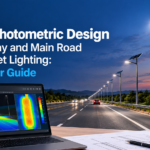
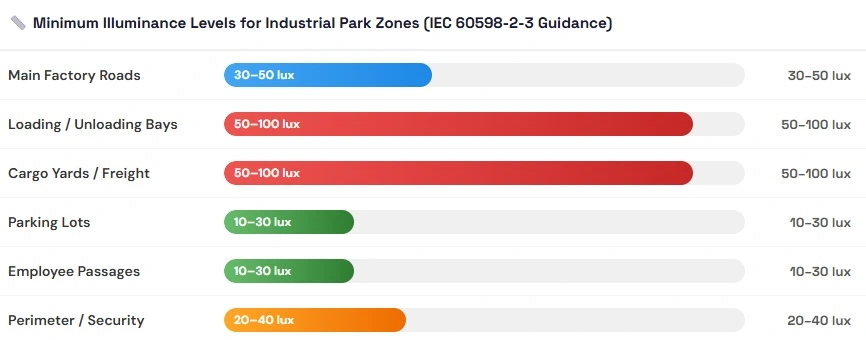
The loading and unloading areas in a typical logistics park, for example, require illuminance levels of 50–100 lux – significantly higher than the 20–30 lux adequate for residential roads. Main access roads within factory zones typically call for 30–50 lux, while parking areas and employee passages need 10–30 lux. These are not arbitrary figures; they align with the IEC 60598-2-3 standard for road and street luminaires and directly affect worker safety, CCTV image clarity, and logistics efficiency after dark.
Generic solar street lights are often engineered to the minimum viable specification. Their LED modules may produce only 100–120 lm/W (lumens per watt), their battery chemistry is frequently unspecified or lead-acid, and their ingress protection ratings are sometimes self-declared rather than independently verified. In industrial environments, under-specified lighting fails sooner, costs more to maintain, and carries safety liabilities that far outweigh the upfront savings.
The procurement benchmark for any serious solar street lights for industrial parks project must therefore begin with understanding what the specifications actually mean – and holding suppliers accountable to independently tested data.
Solar Panel Efficiency: Why Monocrystalline Matters in Tight Industrial Footprints
In an industrial park, pole positions are dictated by road layouts, safety clearances, and structural constraints. There is rarely flexibility to add a larger solar panel simply because the chosen module underperforms. This is why panel efficiency – the percentage of incoming sunlight converted into usable electricity – is a foundational specification.
German-engineered systems specified to DIN and IEC standards use monocrystalline silicon panels rated at 21–23% efficiency. Generic alternatives commonly use polycrystalline panels at 15–17% efficiency. The practical difference is significant: to deliver equivalent energy output, a 15%-efficient panel needs roughly 40% more surface area than a 21%-efficient one. In dense industrial settings where mounting geometry is constrained, that difference determines whether a system can reliably power the LED load through consecutive overcast days.
Pair this with charge controller technology. German-engineered systems use MPPT (Maximum Power Point Tracking) controllers, which continuously optimise the electrical operating point of the panel, extracting 25–30% more usable energy compared to older PWM (Pulse Width Modulation) controllers. MPPT is especially critical in climates with frequent cloud cover, where panel output fluctuates throughout the day. For solar street lights for industrial parks in Southeast Asia, Africa, or the Middle East – regions with variable irradiance patterns alongside high ambient temperatures – MPPT charging is not optional, it is the engineering baseline.
Procurement officers should require panel efficiency certification from an accredited testing laboratory, not a manufacturer’s self-declared specification sheet.
Battery Chemistry and Backup Autonomy: The Make-or-Break Specification
No single specification has a greater long-term financial impact on an industrial park solar lighting project than battery chemistry. This is where the difference between a 3-year replacement cycle and a 10-year maintenance-free installation is determined.
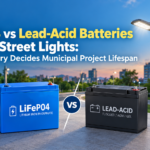
Lead-acid batteries, still found in many low-cost generic solar street lights, deliver only 300–500 charge-discharge cycles at 50% depth of discharge (DoD). Under daily solar street lights for industrial parks use, this translates to a battery lifespan of roughly 2–4 years – at which point the entire battery module requires replacement, generating significant labour and material costs across a large site.
LiFePO4 (Lithium Iron Phosphate) batteries, the standard in German-engineered systems, deliver 2,000–3,000 cycles at 80% DoD. Industry data for 2024–2025 confirms calendar lives of 8–12 years under proper thermal management. LiFePO4 chemistry offers inherent thermal stability, with no risk of thermal runaway, and maintains over 80% of its rated capacity at -20°C – critical for industrial parks operating in northern Europe, Central Asia, or high-altitude regions.
The total cost of ownership (TCO) difference is decisive. A lead-acid system requiring two battery replacements over a 10-year period typically costs 2–3 times more in operational expenditure than a LiFePO4 system that reaches the decade mark without a battery change. For EPC contractors bidding on FIDIC-structured contracts with operational performance guarantees, specifying LiFePO4 from the outset is a risk management decision as much as a technical one.
Backup autonomy is an equally important parameter. A properly engineered industrial park system should provide 3–7 consecutive days of full-output operation without solar recharging. Generic systems frequently omit this calculation entirely, leaving industrial sites in darkness during extended overcast periods or monsoon seasons.
IP and IK Ratings: The Physical Protection Specifications That Industrial Parks Cannot Compromise
In a residential street application, a solar street light faces rain and wind. In an solar street lights for industrial parks, it faces rain and wind – plus vibration from heavy goods vehicles, impact from reversing forklifts, dust from bulk material handling, and, in chemical or pharmaceutical zones, corrosive airborne particles.
IP (Ingress Protection) rating, defined by the IEC 60529 standard, classifies a fixture’s resistance to dust and moisture. IP67 – the minimum benchmark for German-engineered solar street lights for industrial parks – means the enclosure is fully dust-tight and can withstand immersion in water up to 1 metre for 30 minutes. Generic fixtures frequently claim IP65 ratings, but this rating is often self-declared by manufacturers without independent laboratory verification. In procurement terms, an unverified IP65 claim is not a specification – it is marketing.
The second critical physical protection parameter is IK rating, defined under IEC 62262, which classifies resistance to mechanical impact. IK08 means the fixture withstands a 5-joule impact – equivalent to a 1.7 kg mass dropped from 29.5 cm. IK10, the maximum classification, withstands 20 joules – equivalent to a 5 kg mass dropped from 40 cm. For solar street lights for industrial parks zones with mobile cranes, active logistics operations, and vehicle traffic, IK08 is the minimum acceptable standard, with IK09 or IK10 recommended for loading bays and cargo yards.
Generic solar street lights for industrial parks are frequently rated for IK protection. A cracked polycarbonate lens does not merely look damaged – it breaks the IP seal, allows moisture ingress, and accelerates LED junction failure. Facilities procuring German-engineered systems with TÜV-verified IP67 and IK08 ratings pay a modest upfront premium that is recovered many times over through reduced emergency maintenance and avoided downtime costs.
LED Module Performance: Efficacy, Junction Temperature, and Rated Life
Industrial parks operate their outdoor lighting for approximately 10–12 hours per night, often at higher intensities than residential applications. Over a 10-year system life, this represents 36,000–43,000 operating hours – bringing the fixture within range of or past the rated lifespan of lower-quality LED modules.
German-engineered systems specify LED modules with an efficacy of 160–180 lm/W (lumens per watt). This means that a 60-watt solar street light delivers 9,600–10,800 lumens of actual illuminance output – comparable to a traditional 250-watt HPS (High Pressure Sodium) fitting. Generic systems rated at 100–120 lm/W require proportionally larger wattage to achieve the same lux levels, which increases the solar panel size, battery capacity, and total system cost.
LED junction temperature – the temperature at the semiconductor die inside the LED chip – is the primary determinant of LED longevity. At a 50°C ambient temperature (common in Middle Eastern and South Asian solar street lights for industrial parks), German-engineered systems maintain junction temperatures at or below 85°C through die-cast aluminium thermal management housings. Generic fixtures using plastic or thin-gauge metal housings frequently allow junction temperatures to exceed 100°C under the same ambient conditions, accelerating lumen depreciation and shortening operational life from a rated 50,000 hours to 20,000–30,000 hours in practice.
For industrial parks deploying hundreds or thousands of light points, the cumulative impact on replacement cycles and labour costs over a 10-year period is substantial. Procurement specifications should require L70 lumen maintenance data – meaning the hours at which the LED module retains at least 70% of its initial lumen output – verified by an independent photometric laboratory.
Smart Controls and Adaptive Dimming: Reducing Consumption Without Sacrificing Safety
A sophisticated specification, solar street lights for industrial parks goes beyond structural and photovoltaic hardware. Smart control systems – integrated as standard in German-engineered products – enable adaptive lighting strategies that significantly reduce energy consumption during low-traffic periods without compromising site safety.
Motion detection-based dimming is the most widely deployed smart function. Fixtures operate at 30–50% of rated output during low-activity periods – for example, between midnight and 04:00 in an industrial park – and ramp to full 100% output within milliseconds when motion is detected. Industry data for 2024–2025 indicates that adaptive dimming can reduce nightly energy consumption by 30–50% compared to constant full-output operation, extending battery autonomy and reducing the required solar panel capacity.
Time-scheduled dimming profiles provide additional control, allowing procurement teams and facility managers to align illuminance levels with shift patterns. A park with three shifts, for example, can maintain full illuminance during shift changes and reduce output during mid-shift low-traffic windows. IoT-enabled remote monitoring – available in premium German-engineered ranges – allows centralised visibility of each fixture’s status, battery state of charge, and fault codes, significantly reducing the labour cost of routine maintenance checks across large industrial sites.
These capabilities align directly with corporate ESG (Environmental, Social, and Governance) reporting requirements. Solar street lights for industrial parks transitioning to solar LED street lighting with smart controls can demonstrate quantifiable carbon reductions, supporting sustainability certifications and green building accreditation frameworks that increasingly influence investor and tenant decisions.
For further guidance on calculating pole spacing and lux levels to meet these performance targets, our DIALux solar street light simulation guide and luminaire spacing optimisation resource for EPC projects provide detailed methodologies.
Conclusion – Solar Street lights for Industrial Parks
Solar street lights for industrial parks represent one of the most technically demanding deployment environments for solar LED street lighting. The specifications that matter most are not arbitrary – they are the difference between a system that delivers reliable, safe illumination for a decade and one that generates maintenance callouts, replacement cycles, and safety liabilities within three to five years.
The three most important takeaways for procurement officers and EPC contractors are these. First, insist on independently verified ratings: TÜV-certified IP67, IK08 or above, and photometric test reports for LED efficacy – not manufacturer self-declarations. Second, specify LiFePO4 battery chemistry with a minimum 2,000-cycle rating and 3–7 days of backup autonomy; the 10-year TCO advantage over lead-acid or unspecified lithium is substantial. Third, require MPPT charge controllers paired with monocrystalline panels at 21–23% efficiency to ensure consistent energy harvesting regardless of local weather conditions.
German-engineered solar street lights for industrial parks meeting these benchmarks are available through solar-led-street-light.com. Our technical team works with industrial park developers, facility managers, and EPC contractors across Asia, Africa, the Middle East, and Europe to specify, simulate, and deliver lighting systems built to perform in the most demanding outdoor environments on earth. Visit solar-led-street-light.com to request a customised specification review or project quote.
Frequently Asked Questions
Q1: What wattage of solar street light is typically required for the main roads inside an industrial park?
For main factory access roads requiring 30–50 lux illuminance at 8–10 metre pole heights with 25–30 metre spacing, German-engineered systems in the 80–120 watt range with 160–180 lm/W efficacy are typically specified. The exact wattage depends on pole spacing, road width, reflectance of surrounding surfaces, and the number of cloudy days the battery must bridge. A DIALux photometric simulation should always precede final specification. For detailed guidance, see our solar street light simulation resource.
Q2: Can solar street lights handle the vibration and dust generated in heavy manufacturing or mining-adjacent industrial zones?
Yes, provided the fixture meets IP67 (full dust ingress protection and temporary immersion resistance) and IK08 or higher (5–20 joule mechanical impact resistance) under IEC 60529 and IEC 62262 respectively. Die-cast aluminium housings with sealed cable entries are the standard in German-engineered systems. Plastic housings, even with self-declared IP65 ratings, are unsuitable for heavy industrial environments. Our article on 5 benefits of IP65-rated solar street lights provides further context, though solar street lights for industrial parks typically require the higher IP67 benchmark.
Q3: How does the total cost of ownership compare between a German-engineered solar street light and a generic imported alternative over 10 years?
German-engineered systems with LiFePO4 batteries and 5–7 year warranties carry a higher upfront cost but typically achieve near-zero operational expenditure after installation payback. Generic systems with lead-acid or unspecified lithium batteries require 2–3 battery replacements over the same period, plus more frequent lamp and controller servicing. When these replacement and labour costs are aggregated, generic systems typically incur 2–3 times the 10-year TCO of their German-engineered counterparts. Our detailed total cost of ownership analysis for EPC projects provides a full quantitative framework.
Q4: What certifications should procurement officers require when sourcing solar street lights for an industrial park?
At minimum: CE marking (European conformity), IEC 60598-2-3 (luminaires for road and street lighting), ISO 9001 (quality management), IP67 verified by an accredited independent laboratory (not self-declared), and IK08 under IEC 62262. For projects funded by ADB or World Bank, additional documentation requirements apply. German-engineered products may also carry TÜV Rheinland or TÜV SÜD certification, providing a globally recognised third-party quality assurance benchmark. Our certification requirements guide for bankable EPC contracts details the full documentation checklist.
Q5: How do smart dimming systems work in practice for an industrial park with 24-hour shift operations?
Modern German-engineered solar street lights use PIR (Passive Infrared) motion sensors combined with programmable time schedules. During high-traffic shift periods, fixtures operate at 100% output. During inter-shift low-activity windows, they dim to 30–50%, conserving battery charge. When a vehicle or worker is detected, full brightness is restored in under one second. This adaptive approach can reduce nightly energy draw by 30–50% versus constant full-output operation, extending battery backup autonomy by a corresponding margin. Remote IoT monitoring allows facility managers to adjust profiles from a central dashboard without site visits.
Q6: Are solar street lights suitable for industrial parks in hot climates such as the Middle East or sub-Saharan Africa?
German-engineered systems are designed for ambient temperatures up to 50°C and above. The critical specifications are die-cast aluminium thermal management housings (keeping LED junction temperatures at or below 85°C), LiFePO4 batteries with a high-temperature operating tolerance, and solar panels with low temperature coefficient ratings. Generic systems using plastic housings and standard lithium batteries can experience accelerated degradation in sustained high-ambient-temperature conditions, with LED junction temperatures exceeding 100°C – reducing rated life from 50,000 hours to 20,000–30,000 hours in practice. Our region-specific resources on solar street lights for Middle East climates and solar street lights for Southeast Asia provide additional deployment guidance.
Q7: What pole height and spacing guidelines apply to loading and unloading areas in an industrial park?
Loading bays, freight yards, and cargo handling areas require the highest illuminance levels in an industrial park – typically 50–100 lux – to ensure safe operations and support CCTV imaging. Industry guidance specifies 10–12 metre pole heights with 20–25 metre spacing for these zones. To avoid dark spots, a staggered bilateral arrangement is often preferred over single-side mounting. For tools and methods to calculate these parameters precisely, refer to our guide on calculating distance for LED solar area lights.
Q8: What warranty terms should a procurement officer insist on for an industrial park solar street lighting project?
German-engineered systems typically carry 5–7 year comprehensive warranties covering the LED module, battery, charge controller, and housing – with explicit performance guarantees (e.g., minimum lumen maintenance levels at year 5). Generic suppliers often offer 1–2 year limited warranties that exclude damage from weather, temperature, or improper installation – conditions that describe virtually every real-world industrial deployment. For large-scale EPC projects, contractual warranty requirements should align with FIDIC performance guarantee provisions. Our FIDIC EPC contract resource and patent and design risk guide provide further procurement protection guidance.
References
- GMI Insights. (2024). Solar Street Lighting Market Size, Growth Analysis 2025–2034. https://www.gminsights.com/industry-analysis/solar-street-lighting-market
- Fortune Business Insights. (2024). Solar Street Lighting Market Size, Share & Industry Analysis. https://www.fortunebusinessinsights.com/industry-reports/solar-street-lighting-market-100585
- IRENA. (2025). Renewable Power Generation Costs in 2024. https://www.irena.org/Publications/2025/Jun/Renewable-Power-Generation-Costs-in-2024
- UL Solutions. (2025). Infrastructure Lighting – Standards and Certification. https://www.ul.com/industries/products-and-components/lighting/infrastructure-lighting
- NOKIN Street Light. (2025). Industrial Solar Street Lights: A Complete Guide. https://www.nokinstreetlight.com/blog/company/a-comprehensive-guide-to-industrial-solar-street-lights.html
- MANLY Battery. (2025). How Long Do Solar Street Light Batteries Last? https://manlybattery.com/how-long-do-solar-street-light-batteries-last/
- Battery PK Cell. (2025). Solar Street Light Battery: Why LiFePO4 is the Industry Standard. https://www.batterypkcell.com/news/solar-street-light-battery-ultimate-guide-why-lifepo4-battery-is-the-industry-standard/
- Linklights. (2025). IK Rating: The Essential Guide to LED Light Impact Protection. https://linkolights.com/ik-rating-the-essential-guide-to-led-light-impact-protection/
- Emergen Research. (2025). Solar LED Street Lighting Market Report 2024–2034. https://www.emergenresearch.com/industry-report/solar-led-street-lighting-market
- IEC Standard 62262. Degrees of protection provided by enclosures for electrical equipment against external mechanical impacts (IK code). https://www.iec.ch/homepage
Disclaimer
This article is for informational purposes only and does not constitute professional engineering, installation, or procurement advice. Performance specifications and costs may vary based on project requirements, location, and local regulations. Always consult qualified solar energy professionals and legal advisors before making procurement decisions.
For expert consultation on solar LED street lighting solutions, visit solar-led-street-light.com or contact our team for a customised quote.