
When municipalities invest millions in solar street lighting infrastructure, performance guarantees become the difference between predictable returns and costly liabilities. In EPC (Engineering, Procurement, and Construction) turnkey projects, one critical question dominates procurement: How do German engineering standards backed by rigorous research and development compare to generic solar street light solutions for bankable performance guarantees? why German Engineering vs Generic Solar Street Lights matters?
With global smart city investments projected to exceed $2.5 trillion by 2025, understanding the engineering foundations separating reliable systems from problematic installations has never been more critical for large-scale lighting deployments.
EPC Performance Guarantees: The Risk Reality
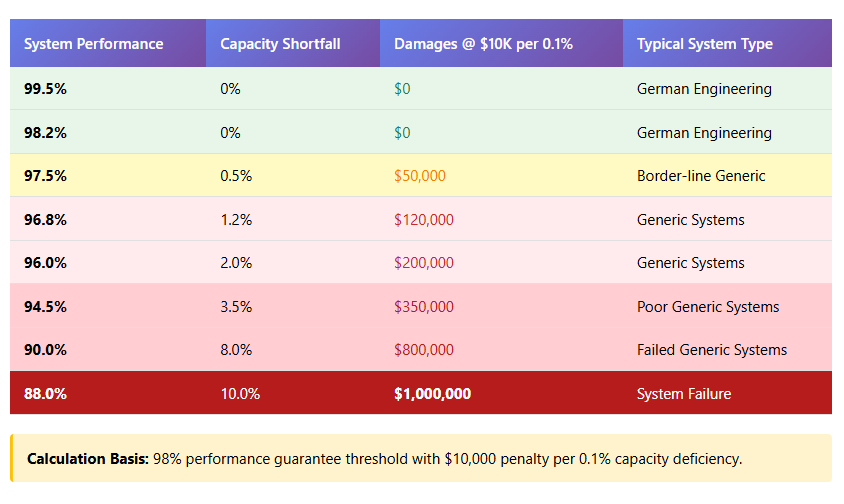
EPC solar street light performance guarantees establish baseline capacity and efficiency expectations tied directly to project financing and operational requirements. Modern contracts require contractors to achieve minimum performance thresholds typically 98% of nameplate capacity with liquidated damages provisions activating when systems underperform.
The financial stakes are substantial. Performance liquidated damages commonly run $10,000 per 0.1% capacity deficiency. A 500-light system achieving only 96.8% capacity subjects the contractor to $120,000 in penalties. For a 2% system-wide underperformance, damages can reach $1 million.This creates powerful incentives for EPC contractors to select components backed by rigorous engineering rather than generic alternatives with uncertain performance profiles. Turnkey solar street light projects consolidate all responsibility under a single contractor who guarantees long-term performance outcomes making component reliability non-negotiable.
German Engineering Standards: Technical Excellence
Germany’s technical universities and research institutions rank among the world’s elite, with their contributions to solar technology providing foundations that distinguish German-engineered solutions in critical ways.
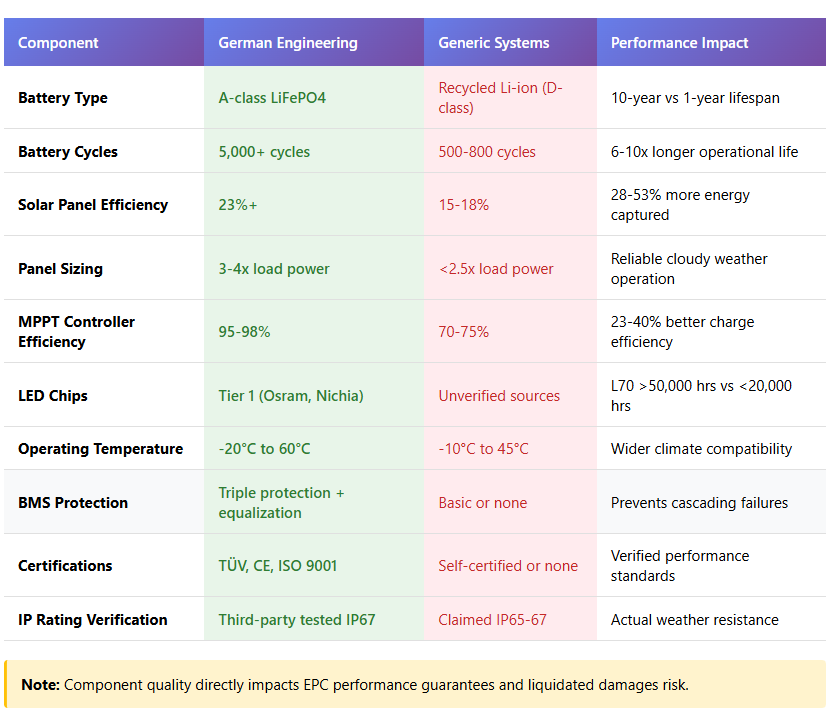
German researchers have achieved breakthrough performance in photovoltaic efficiency and stability parameters directly impacting solar street light reliability. Advanced work on next-generation solar cells has reached record efficiency levels while improving device stability. This research translates into practical advantages: monocrystalline panels incorporating the latest cell technology achieve 23%+ conversion efficiency compared to 15-18% for standard polycrystalline panels.
German engineering excellence manifests through comprehensive system integration. German Engineering vs Generic Solar Street Lights feature:
- Advanced thermal management keeping batteries operational from -20°C to 60°C
- Triple-protection Battery Management Systems preventing overcharge, over-discharge, and overcurrent conditions
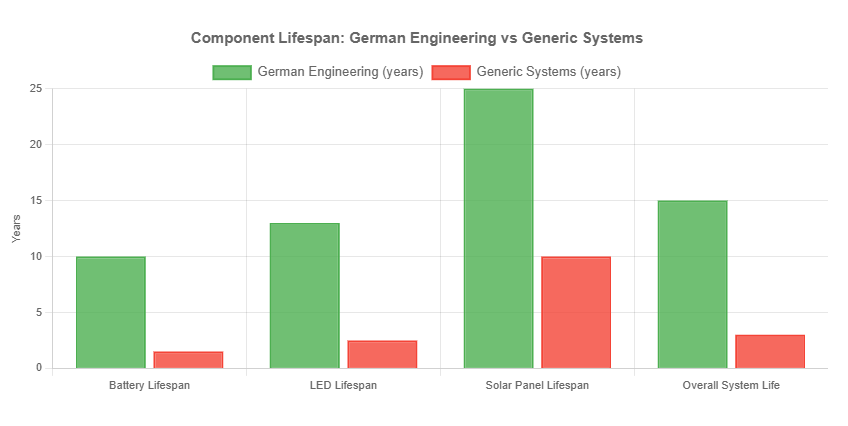
- LiFePO4 batteries delivering 10-year operational life with over 5,000 charge cycles
- TÜV certification ensuring compliance with EN 55015, EN 61000, EN 61547, and EN 62776 standards
- MPPT controllers achieving 95-98% charging efficiency versus 70-75% for basic PWM controllers
Quality control extends to manufacturing with ISO 9001 certification and accelerated lifecycle testing including salt spray corrosion resistance, high-temperature endurance, and mechanical stress evaluations simulating decades of operation.
German Engineering vs Generic Solar Street Lights: Hidden Performance Risks
Market expansion has attracted numerous manufacturers offering competitively priced products, but industry analysis reveals concerns about quality variations directly impacting EPC performance guarantees.
Component Quality Disparities
Over 90% of generic manufacturers use recycled lithium batteries from electric vehicles, classified as D-class components with lifespans under one year. German-engineered systems specify A-class LiFePO4 batteries offering 3-5 year extended lifespans despite higher initial costs.
Generic suppliers frequently undersize solar panels at less than 2.5 times load power insufficient for maintaining brightness during cloudy periods. German Engineering vs Generic Solar Street Lights standards mandate panels at 3-4 times load power with 23%+ efficiency, ensuring reliable charging in suboptimal conditions.
Field Performance Failures
Several countries including Iraq and Nepal temporarily banned solar street light installations after widespread failures of generic systems with operational lifespans under two years instead of expected 5-10 years. Generic systems often claim IP65-IP67 ratings without independent verification, leading to premature failures in harsh weather.
The absence of comprehensive BMS technology creates cascading reliability issues. Without intelligent battery equalization, individual cells age unevenly, reducing overall capacity and causing unexpected failures that trigger performance liquidated damages.
German R&D Reduces EPC Project Risk
German engineering research directly addresses EPC project risks through technology transfer and rigorous engineering methodologies.
Predictive Performance Modeling
German engineering emphasizes simulation before implementation. Engineers use software like Polysun and DIALux to predict performance under various scenarios, identifying issues during design rather than after installation. This enables EPC contractors to provide bankable performance projections to financing institutions.
Quality Assurance Protocols
German manufacturers implement multi-stage verification including incoming component inspection, in-process testing, and final system validation. Environmental simulation at leading research facilities subjects products to accelerated aging under extreme conditions. Products must demonstrate performance retention exceeding warranty periods before market release.
Turnkey Solutions: Single-Source Responsibility Benefits
Turnkey EPC delivery consolidates engineering, procurement, construction, and commissioning under one contractor assuming comprehensive performance risk. This single-source responsibility model only works when contractors select proven components precisely where German engineering provides critical advantages.
Integrated System Design
German-engineered turnkey solutions emphasize holistic design analyzing site-specific factors:
- Local solar irradiance patterns and seasonal variations
- Historical weather data for battery autonomy calculations
- Required illumination levels per international standards
- Electrical load profiles including dimming schedules
Long-Term Value
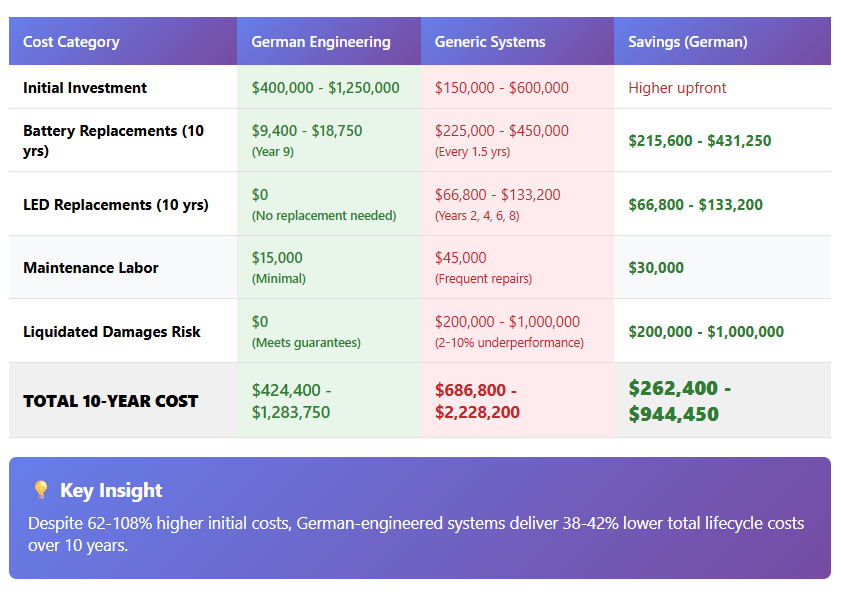
While German-engineered systems command 15-30% higher initial investment, lifecycle analysis consistently favors the engineered approach. Energy Performance Contracts demonstrate LED replacement occurs after 13 years for quality systems versus 2-3 years for generic installations, while battery replacement extends to 9 years versus 1-2 years.
The Financial Equation: ROI Analysis
Financial analysis must extend beyond initial costs to lifecycle value.
Upfront Investment
German-engineered all in one solar street lights range from $800-2,500 per unit versus $300-1,200 for generic alternatives. For 500 lights, this represents $250,000-650,000 additional investment but if generic components trigger $1 million in liquidated damages from 2% underperformance, the “savings” evaporate immediately.
Operational Costs
Generic systems requiring battery replacement every 18-24 months at $150-300 per unit generate $37,500-75,000 annual costs for 500 lights. German systems with 8-10 year battery life reduce this to $9,400-18,750 annually savings of $28,100-56,250 per year.
LED replacement frequency compounds savings. Generic fixtures requiring replacement every 2-3 years cost $16,700-33,300 annually for 500 units. German-engineered LEDs lasting 10-15 years reduce this to $3,300-6,700 annually.
Financing Advantages
Projects using German Engineering vs Generic Solar Street Lights components often qualify for more favorable financing terms due to reduced performance risk. On a $10 million project, a 0.5% interest rate reduction over 15 years saves $375,000, substantially offsetting the initial cost premium.
Selection Criteria for EPC Contractors
When evaluating solar street light systems for EPC projects, contractors should verify:
Component Verification Essentials
- A-class LiFePO4 batteries with 3,000+ cycle life at 80% depth of discharge
- TÜV-certified solar panels with verified efficiency and degradation rates
- Tier 1 LED chips (Osram, Nichia, Lumileds) with L70 ratings exceeding 50,000 hours
- MPPT controllers with 95%+ efficiency and comprehensive BMS features
Performance Track Record
Request references for installations operating 3+ years in similar climates. German-engineered systems should demonstrate sustained performance with minimal maintenance.
Warranty Requirements
Look for 10+ year solar panel warranties, 5+ year battery warranties, and performance guarantees ensuring 80% of rated capacity after 5 years with clear remediation procedures.
| Verification Item | Minimum Requirement |
| Battery | A-Class LiFePO4, 3,000+ cycles |
| Solar Panel | TÜV-certified, low degradation |
| LED Chips | Tier-1 (Osram / Nichia / Lumileds) |
| Controller | MPPT with full BMS |
| Warranty | Panels ≥10 yrs, Battery ≥5 yrs |
| References | 3+ year live installations |
Frequently Asked Questions
Q: What is the typical lifespan difference between German Engineering vs Generic Solar Street Lights?
German Engineering vs Generic Solar Street Lights achieve 10-15 year lifespans with proper maintenance, while generic systems often require major component replacement within 2-3 years. The difference lies in LiFePO4 versus recycled lithium batteries, Tier 1 versus unverified LED chips, and comprehensive battery management systems extending component life.
Q: How do performance liquidated damages work in EPC contracts?
Damages compensate owners when systems fail to meet guaranteed capacity levels. They’re typically structured as fixed dollar amounts per percentage point below threshold. With a 98% guarantee and $10,000 per 0.1% shortfall, a system achieving 96% capacity triggers $200,000 in damages.
Q: Are solar street lights effective in regions with limited sunlight?
Yes, when properly engineered. German Engineering vs Generic Solar Street Lights standards specify solar panels at 3-4 times daily load power and battery capacity providing 3-5 days autonomous operation during cloudy periods. MPPT controllers optimize charging even under diffuse light. Generic systems often undersize these components, causing failures during extended cloudy weather.
Q: What certifications should I verify for EPC projects?
Essential certifications include TÜV solar panel testing, CE marking, RoHS standards, IP65-IP67 ingress protection, IK08-IK10 impact resistance, and ISO 9001 quality management. Verify LED chip certifications from recognized manufacturers and battery certifications confirming chemistry and cycle life claims.
Q: How does turnkey EPC differ from traditional procurement?
Turnkey EPC consolidates engineering, procurement, construction, and commissioning under one contractor assuming comprehensive performance risk. Traditional procurement requires owners to coordinate multiple vendors. Turnkey provides one accountability point and clearer warranty coverage but only delivers value with quality components.
Q: What maintenance is required for high-quality solar street lights?
German Engineering vs Generic Solar Street Lights require minimal maintenance: solar panel cleaning every 6 months, visual hardware inspection annually, and battery capacity verification every 2-3 years. LED modules need no maintenance until end-of-life replacement after 50,000-100,000 hours. Generic systems often require battery replacement every 18-24 months.
Q: How can I verify performance versus manufacturer claims?
Request third-party test reports from accredited laboratories (TÜV, Intertek, SGS) verifying lumen output, panel efficiency, and battery capacity. Obtain reference projects in similar climates operating 3+ years. German manufacturers provide comprehensive technical documentation and support independent verification.
Q: What role does German research play in commercial products?
German research institutions advance photovoltaic efficiency, battery stability, and energy system optimization. German manufacturers incorporate findings through technology licensing and hiring university-trained engineers. The rigorous analytical approach produces designers who specify appropriate safety margins and conduct thorough performance modeling—directly benefiting EPC reliability.
———————————————————————————————————————References
- Climate Solutions Legal Digest. (2025). Performance Guarantees and Liquidated Damages in Solar EPC Contracts. https://www.climatesolutionslaw.com/
- Stoel Rives LLP. (2024). Solar Energy System Design and Installation Agreements. https://www.stoel.com/
- King & Spalding. (2024). Performance and Testing of Solar Power Projects. https://www.kslaw.com/
- VOLTAGE. (2025). Understanding Benefits and Risks of EPC Contracts. https://voltageg.com/
- European Commission. (2017). Energy Performance Contracting for Street Lighting. https://www.streetlight-epc.eu/
- MANLY Battery. (2025). Solar Street Light Battery Capacity Specification. https://manlybattery.com/
- Fraunhofer Institute for Solar Energy Systems. (2025). Photovoltaic Technology and Research. https://www.ise.fraunhofer.de/
- Wiley. (2025). Organic and Perovskite Solar Cells Research. https://advanced.onlinelibrary.wiley.com/
- Stellaris Power. (2025). Turnkey EPC Solar Power Solutions. https://stellarispower.com/
- International Energy Agency. (2024). Solar Technology Market Report. https://www.iea.org/
Disclaimer
This article is for informational purposes only and does not constitute professional engineering, installation, or procurement advice. Performance specifications and costs may vary based on project requirements, location, and local regulations. Always consult qualified solar energy professionals and legal advisors before making EPC procurement decisions.
For expert consultation on solar LED street lighting solutions, visit solar-led-street-light.com or contact our team for a customized quote.