
Pole height is one of the most technically consequential decisions in any solar street lighting project yet it is also one of the most frequently determined by cost alone rather than by engineering calculation. Across more than 200 global solar street lighting projects surveyed through 2025, procurement teams that selected pole height without reference to road width, required lux levels, and luminaire spacing routinely produced installations with uniformity ratios below the EN 13201 minimum of 0.4 and illuminance values 30–40% below target. The result is road surfaces that appear unlit between poles, glare near poles, and public safety complaints that lead to costly remediation.
The connection between solar street light pole height and system performance runs deeper than visual appearance. Height determines spacing, which determines pole count, which determines the total number of solar units required and the project’s total capital cost. Height also affects wind load on the pole and panel, foundation depth requirements, maintenance access logistics, and critically for solar systems the angular relationship between the panel face and available sunlight. This blog compares 6 metre, 8 metre, and 10 metre solar street light poles across five dimensions: illumination coverage and lux performance, pole spacing and project economics, structural and foundation requirements, solar panel performance at height, and the application guide specifying which height band serves which road type.
Illumination Coverage: How Height Changes What the Light Reaches
The relationship between solar street light pole height and illumination coverage follows a key photometric principle: as mounting height increases, the beam spread on the road surface increases, but the peak illuminance at any given point decreases due to the inverse square law light intensity diminishes with the square of the distance from the source. Taller poles illuminate wider areas but at lower average illuminance unless LED wattage is increased proportionally.
A 6 metre pole with a 40W German engineered LED at 160–180 lm/W delivers 6,400–7,200 lumens. With Type II asymmetric optics and a pole spacing of 20–22 metres, this produces a maintained average illuminance of approximately 10–15 lux across a road width of 6–8 metres appropriate for residential streets and footpaths under EN 13201 S class standards. The coverage zone per pole at 6 metres is limited to approximately 8–10 metres of effective road width without bilateral lighting.
An 8 metre pole with a 60–80W German engineered LED delivers 9,600–14,400 lumens. At a pole spacing of 25–30 metres with a cross bilateral layout, this achieves 12–20 lux across a 10–15 metre road width, fully covering a three lane collector road or a two lane arterial with parking lanes. This is the most versatile solar street light pole height for municipal projects and is specified as the standard for collector roads in numerous national road lighting guidelines.
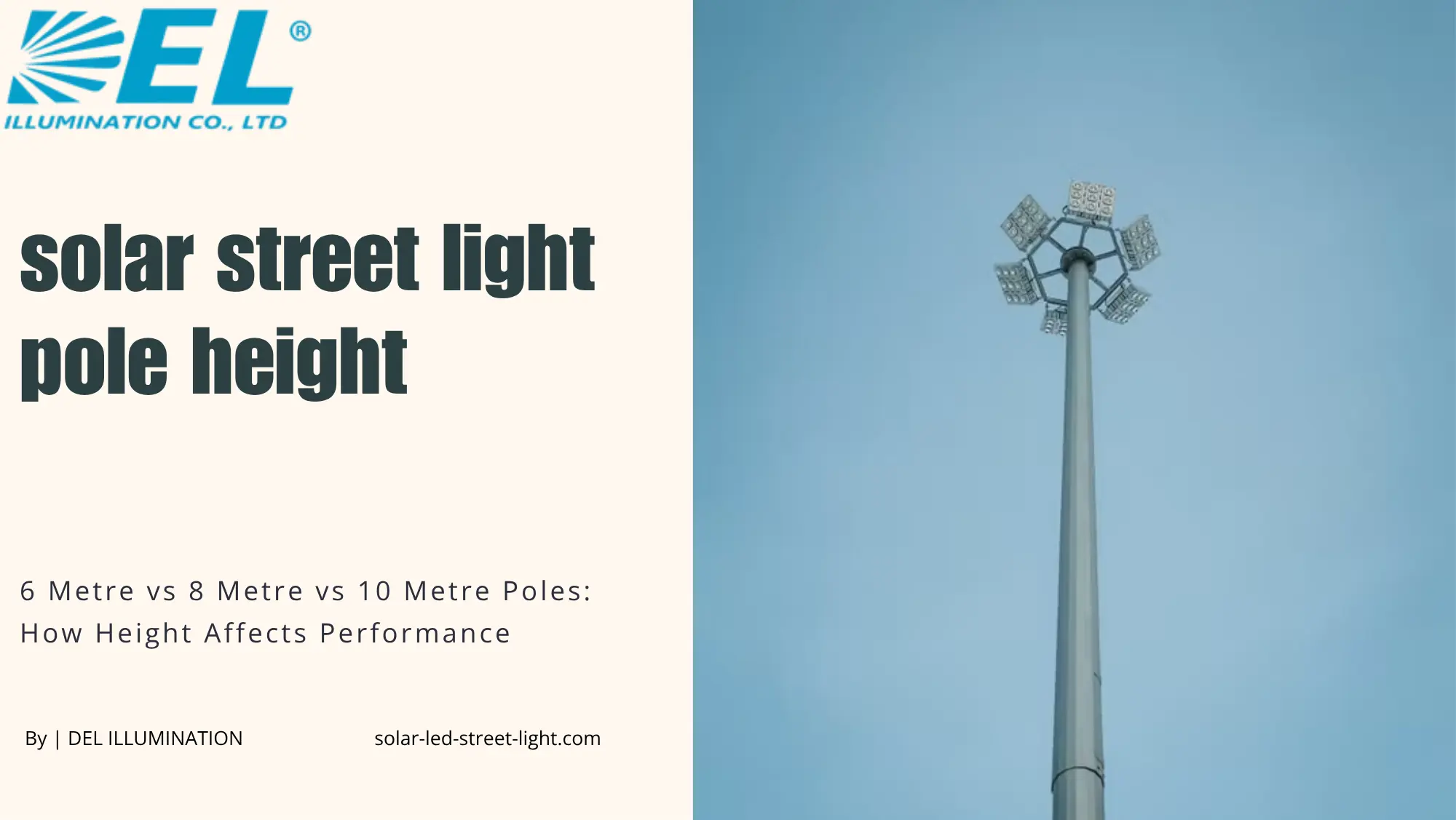
A 10 metre pole with a 100–120W LED delivers 16,000–21,600 lumens. With pole spacing of 30–35 metres, it covers road widths of 15–20 metres at 20–25 lux suitable for primary arterial roads and major intersections. Industry guidance from 2024–2026 confirms that the planning formula for spacing at 10m poles is approximately 3× the mounting height, giving a 30 metre starting point for simulations. For detailed photometric verification before specification, our DIALux luminaire spacing optimisation for EPC projects guide explains accurate photometric simulation from first principles.
Pole Spacing, Pole Count, and Project Economics
Pole height directly determines optimal pole spacing, and pole spacing determines how many poles a project needs. This is where the height decision has the most direct impact on total project cost and where the choice between 6 metre, 8 metre, and 10 metre poles should be evaluated not on unit cost alone but on system level economics across the full kilometre.
Verified design data from 2024–2025 industry sources confirm these practical spacing benchmarks: a 6 metre all in one solar street light with a 64W LED has a recommended pole to pole distance of 22 metres; an 8 metre pole with a 100W all in one is recommended at 30 metre spacing; and a 10 metre pole with adequate wattage achieves 30–35 metres. For a 1 kilometre road section, this translates to approximately 46 poles at 22 metre spacing (6m poles), 34 poles at 30 metre spacing (8m poles), or 30 poles at 33 metre spacing (10m poles).
The reduction in pole count from 6 metre to 8 metre height approximately 12 fewer poles per kilometre reduces the number of solar units, foundations, civil works, and long term maintenance points by 26%. At a total installed cost of USD 1,500–3,000 per pole, this represents a saving of USD 18,000–36,000 per kilometre that often justifies the higher cost of 8 metre poles and the slightly higher LED wattage required to cover the wider spacing.
Analysis from 200+ global projects surveyed through 2025 confirms that mid range heights of 6–8 metres offer optimal lifecycle ROI the 10 metre configuration saves pole count but adds foundation cost, taller equipment for installation, and higher maintenance access cost. Using 10 metre poles at 25–30 metre spacing on projects covering more than one acre saves approximately 35% compared to 6 metre poles at 15 metre spacing, provided the road width justifies the 10 metre height. For calculating the correct spacing for LED solar area lights, always calculate from the required lux level first and work backward to LED output and wattage.
Structural Requirements: Foundation, Wind Load, and Safety Standards
As solar street light pole height increases, structural engineering demands increase non linearly. Wind load on the pole shaft, mounting arm, and solar panel creates a bending moment at the base that must be resisted by the foundation and the pole’s structural section. Field reports from coastal and typhoon prone regions consistently identify insufficient foundation depth and underspecified pole wall thickness as the root causes of pole failures a risk that is far more significant at 10 metres than at 6 metres.
The established engineering formula for minimum foundation depth is: depth = pole height ÷ 10 + 0.2 metres. For a 6 metre pole, this gives 0.8 metres minimum depth. An 8 metre pole requires 1.0 metres, and a 10 metre pole requires 1.2 metres as a starting point. Early stage guidance for foundation depth in exposed locations often falls in the 1.8–2.2 metre range for taller poles, increasing further with high wind exposure, long outreach arms, or weak soil. Final foundation specification must follow local structural codes, confirmed soil classification, and site specific wind data.
Wall thickness also increases with height. A Q235 steel octagonal pole at 6 metres typically carries a wall thickness of 2.5–3 mm. At 8 metres, 3–3.5 mm is standard. At 10 metres, 3.5–4 mm wall thickness is necessary to resist bending under combined wind and panel weight loading. For coastal or typhoon exposed projects including solar street lights for ports and solar street lights for highways in wind corridors a qualified structural engineer must specify foundation depth from local wind speed data.
German engineered poles are hot dip galvanized to EN ISO 1461 with zinc coating thickness of 65–90 µm and powder coated to 60–80 µm, providing corrosion protection over the pole’s intended 20–30 year service life regardless of height. Generic poles with cold dip zinc paint (10–20 µm) lose structural protection rapidly at the base, where water pooling is most aggressive a risk that scales with foundation depth and height. For anti corrosion specification guidance, see our guide on solar street light pole rusting.
Solar Panel Performance at Height: Angle, Shading, and Access
For solar street lights unlike conventional grid connected poles height introduces considerations unique to solar systems: the interaction between mounting height, panel tilt angle, shading risk, and maintenance access. These factors affect annual energy yield and therefore the battery’s ability to maintain adequate charge for full night operation.
At heights above 8 metres, solar panels may require a 15°–30° tilt angle adjustment depending on installation latitude to maximise irradiance capture a consideration that affects the panel mounting bracket design and the structural load on the pole arm. At 6 metre pole height, horizontal or near horizontal panel mounting is typically adequate for tropical and subtropical latitudes (within 25° of the equator), where sun angles remain high enough year round that tilt optimisation delivers marginal gains.
Cleaning access is a dimension that procurement teams consistently underestimate. Panels at 10 metres require elevated access equipment boom lifts, tower cranes, or scissor lifts for cleaning and inspection. Panels at 6 metres can often be reached safely by a worker using an extension cleaning tool from ground level, and at 8 metres with a moderate ladder or extendable cleaning brush. In high dust environments, where solar panel dust accumulation has been documented to reduce output by up to 34% in desert deployments, the frequency and therefore the total cost of cleaning events scales with the access equipment required at greater height.
For solar street lights in Africa and solar street lights for rural communities where elevated access equipment is limited or expensive, 6–8 metre poles are operationally preferable even if the pole count per kilometre is higher. The per cleaning maintenance cost differential must be included in any TCO analysis comparing pole height options. For solar street lights for Middle East climates where panel cleaning is required monthly or fortnightly, this calculation is particularly significant.
Application Guide: Which Pole Height for Which Project?
The correct solar street light pole height for any project is determined by the combination of road width, required lux level, available spacing, maintenance access capability, and structural site conditions. The following application reference consolidates the engineering data above.
6 metre poles are the correct specification for:
- Residential colony streets and cul de sacs (5–8 metre road width, EN 13201 P/S class)
- Footpaths, park walkways, and cycle lanes
- School zone pedestrian approaches and drop off zones
- Rural village roads with modest traffic volumes
- Solar street lights for residential colonies and solar lights for bus stops
Target LED: 30–50W. Pole spacing: 18–22m. Foundation depth: 0.8m (standard soil).
8 metre poles are the correct specification for:
- Collector and secondary urban roads (8–12 metre road width, EN 13201 S/M class)
- Commercial street frontages and market access roads
- Solar street lights for school zones on approach arterials
- Solar street lights for petrol stations and forecourt perimeters
- Solar street lights for sports grounds perimeter and car park areas
Target LED: 60–80W. Pole spacing: 25–30m. Foundation depth: 1.0m (standard soil).
10 metre poles are the correct specification for:
- Primary arterial roads and multi lane thoroughfares (12–15 metre road width, EN 13201 M class)
- Solar street lights for highways on rural highway sections
- Solar street lights for toll plazas and major intersection approach zones
- Solar street lights for industrial parks main access roads
- Solar street lights for military perimeter roads requiring high illuminance security coverage
Target LED: 80–120W. Pole spacing: 30–35m. Foundation depth: 1.2m+ (geotechnical confirmation required in high wind zones).
Conclusion
Pole height is not a cosmetic decision it is a core engineering variable that determines road surface illuminance, uniformity, pole count, project economics, structural risk, and solar panel maintenance access. The fundamental principle is that height must be matched to road width and required lux level first, and to cost secondarily.
The three most important takeaways for procurement officers and EPC contractors are: first, 8 metre poles offer the broadest return on investment across standard municipal solar street light projects fewer poles per kilometre at adequate lux levels for collector roads and collector arterial junctions; second, foundation depth and pole wall thickness must be engineered for the specific height, wind zone, and soil class generic table values are starting points only; third, taller poles in high dust environments require both verified panel wind ratings and a maintenance access plan that accounts for the real cost of elevated access equipment at each cleaning event.
To receive a solar street light pole height recommendation, LED wattage specification, photometric layout, and foundation depth guidance calibrated to your specific road classification, site conditions, and project scale, visit solar led street light.com to speak with our engineers and request a customised quote.
Frequently Asked Questions
1. What is the standard pole height for residential solar street lights? The standard height for residential streets is 5–6 metres, corresponding to road widths of 5–8 metres and LED outputs of 30–50W. At 6 metres with single sided installation, poles are typically spaced 18–22 metres apart, producing 10–15 lux maintained adequate for pedestrian safety. For narrower footpaths and lanes, 4–5 metre poles are sometimes used. For wider residential boulevards above 8 metres road width, 7–8 metre poles should be considered.
2. Can I use the same LED wattage on a 10 metre pole as a 6 metre pole? Not if the objective is to achieve the same road illuminance. On a 10 metre pole, the luminaire is farther from the road surface, so the inverse square law reduces illuminance at any given point. To maintain 15 lux on a 10 metre road at 10 metre mounting height, more lumens are needed than the same lux target at 6 metres. However, because 10 metre poles are spaced farther apart, fewer total units are required meaning the higher LED wattage per unit is partially offset by the reduced pole count across the project.
3. How does pole height affect wind load on the solar panel? Wind speed at height is higher than at ground level, and the bending moment at the pole base increases with the square of the panel height above the foundation. A solar panel mounted at 10 metres in a wind zone rated for 120 km/h (typhoon or cyclone region) creates a bending moment approximately 2.8 times higher than the same panel at 6 metres. This requires a larger flange plate, heavier anchor bolts, and deeper foundation embedment. Always request wind resistance certification that covers the installation height and local wind zone category from the pole supplier.
4. Is a 10 metre pole more expensive to install than a 6 metre pole? Yes, in three ways: the pole itself costs more in materials; the foundation requires greater concrete volume and deeper excavation; and installation typically requires heavier lifting equipment. However, the 10 metre pole’s greater spacing reduces the total number of poles, excavations, and units per kilometre which frequently makes the total installed cost per kilometre comparable to, or in some configurations lower than, a 6 metre alternative. The analysis must be done at project level, not per unit.
5. How do I choose between 8 metre and 10 metre poles for an arterial road? The decision depends primarily on road width and required lux level. For a road of 10–12 metres width targeting 15–20 lux (EN 13201 M class lower), 8 metre poles on a cross bilateral layout at 25–30 metre spacing with a 60–80W LED is typically sufficient. For a road wider than 12 metres or requiring above 20 lux, 10 metre poles with 100W+ LED are necessary. Running a photometric simulation in DIALux before finalising the specification prevents both under illumination and over specification. Our DIALux solar street light simulation guide walks through this process step by step.
6. Do taller poles require more panel maintenance in dusty climates? Yes, significantly. Panels at 10 metres require elevated access equipment for cleaning and inspection, while panels at 6 metres can often be reached with an extension cleaning tool. In high dust environments where accumulation can reduce panel output by 20–34%, the frequency of cleaning directly impacts system energy yield. For projects where maintenance access to elevated equipment is costly or limited, factoring the per cleaning cost into the TCO comparison between 6 metre and 10 metre poles is essential.
7. What is the correct foundation depth for an 8 metre solar street light pole? The standard formula gives 1.0 metre minimum depth for an 8 metre pole in standard soil at moderate wind exposure (depth = pole height ÷ 10 + 0.2m). In high wind exposure zones, soft clay, or loose sand, this increases to 1.2–1.5 metres and should be confirmed by geotechnical assessment. Foundation concrete grade should be C25 minimum, with steel rebar reinforcement as specified by the structural engineer. Anchor bolt specification must be sized for the combined pole weight and wind overturning moment.
8. What are the 5 advantages of solar light pole systems over concrete poles for solar applications? Steel tapered poles have a higher strength to weight ratio than concrete, allowing taller heights with smaller foundations. Steel poles can be factory fabricated with integrated cable entry points, hand hole cut outs, and mounting brackets that concrete poles cannot match. Hot dip galvanized steel poles offer 20–30 years of corrosion protection with one treatment, versus ongoing maintenance costs for deteriorating concrete. Steel poles are also lighter to transport and faster to install, reducing project labour costs. For a full breakdown of the advantages, see our article on 5 advantages of solar light pole systems.
References
- Luxman Light. (2024). Solar Street Light Pole Height and Distance Calculation and Standard. https://luxmanlight.com/how to calculate the height and distance of solar street light pole/
- Langy Energy. (2025). What Is the Best Height for Solar Street Lights? https://www.langy energy.com/blogs/solar lights/what is the best height for solar street lights
- Clodesun. (2024). How to Design Solar Street Light Pole Height and Distance. https://www.clodesun.com/how to design solar street light pole height and distance/
- Luxman Light. (2025). LED Solar Street Light Design Guide (2025 Edition). https://luxmanlight.com/led solar street light design guide 2025 edition/
- Xinhai Light. (2025). What Is the Best Height for Solar Street Lights? https://www.xinhai light.com/news/what is the best height for solar street lights.html
- Sunlurio. (2026). Street Light Pole Foundation Depth (6m–12m): Rules. https://sunlurio.com/street light pole foundation depth/
- Inlux Solar. (2026). What Is the Standard Distance Between Street Lights? Spacing Chart for 6m, 8m, 10m & 12m Poles. https://www.inluxsolar.com/standard distance between street lights/
- Luxman Light. (2026). Industrial Area Road Solar Lighting Design Guidelines. https://luxmanlight.com/industrial area road solar lighting design guidelines/
- Teco Solar. (2026). Street Light Pole Height Guide: Standard Sizes for Residential, Highway & Parking Lighting. https://tecosolar.cn/street light pole height guide/
- LED Best Lights. (2023). How to Specify the Height of Solar Street Light Poles. https://ledbestlights.com/blog/how to specify the height of solar street light poles/
Disclaimer
This article is for informational purposes only and does not constitute professional engineering, installation, or procurement advice. Performance specifications and costs may vary based on project requirements, location, and local regulations. Always consult qualified solar energy professionals and legal advisors before making procurement decisions.
For expert consultation on solar LED street lighting solutions, visit solar led street light.com or contact our team for a customised quote.