
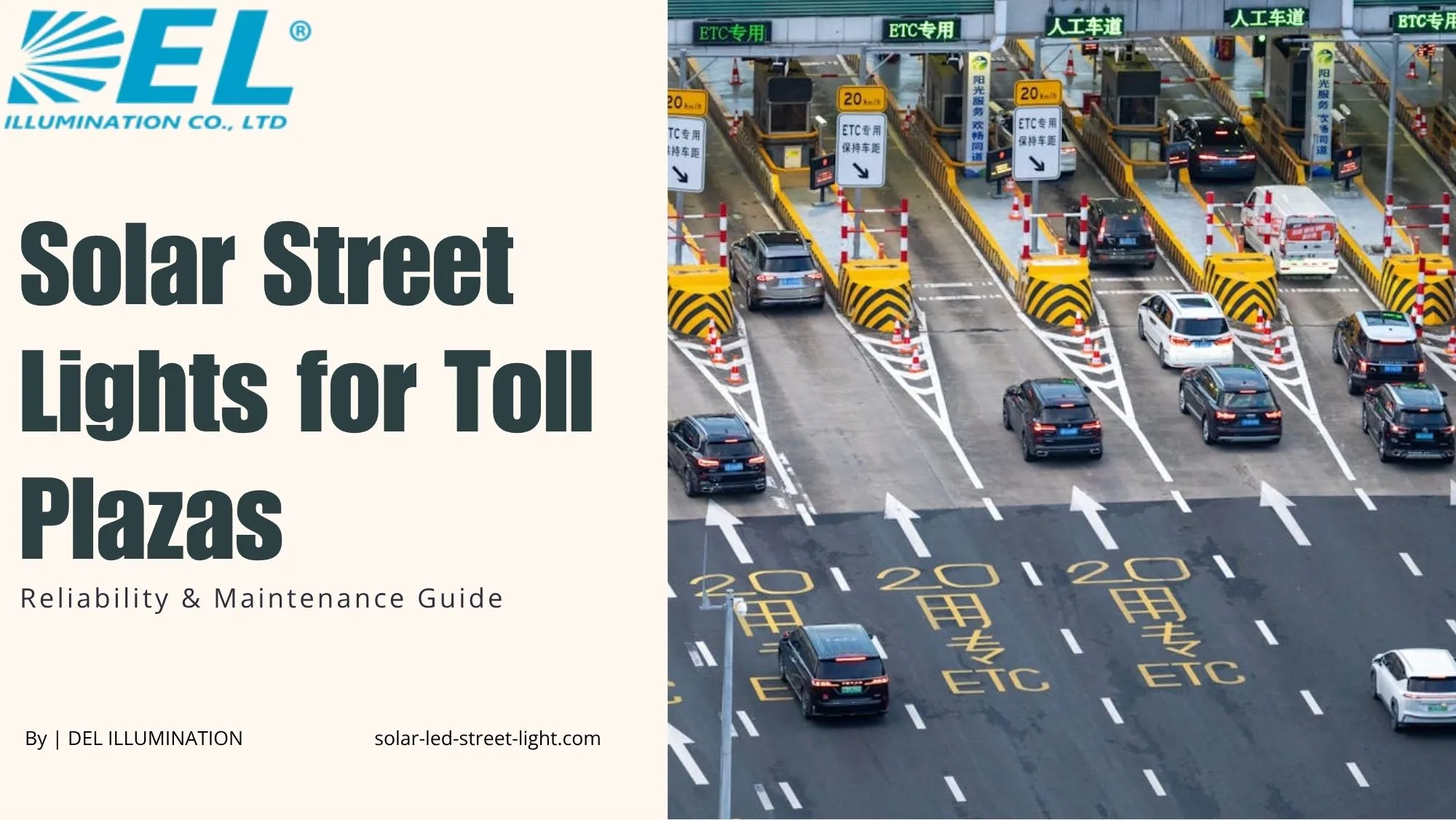
India operates more than 855 toll plazas across its national highway network, and collectively these facilities consumed billions of rupees in grid electricity and maintenance expenditure every year before solar alternatives entered the picture. For facility managers and EPC contractors responsible for these sites, a single lighting failure at a busy toll lane – especially during peak night hours – does not simply mean a darkened booth: it creates safety risks for toll operators, slows transaction throughput, and exposes concession operators to potential liability. This guide examines why Solar Street Lights for Toll Plazas are rapidly becoming the preferred lighting solution for toll plazas, what technical specifications genuinely matter in this demanding environment, and how a well-structured maintenance programme protects both performance and investment over a decade of operation.
Why Toll Plazas Demand Exceptional Lighting Performance
Toll plazas are not ordinary roadside locations. They combine the high-speed approach of highway traffic with the controlled deceleration zone of a transaction point, creating a unique lighting challenge that far exceeds the requirements of a standard residential or commercial street.
International lighting standards – including IES RP-8 for roadway illumination and EN 13201 for European road lighting – recognise that toll collection areas require significantly elevated illuminance levels. Industry practice and road authority guidelines consistently specify a minimum of 50–80 lux at the toll canopy level, with vertical illuminance of at least 20–30 lux across lane approaches to ensure clear vehicle identification and facial recognition for CCTV systems. These are demanding targets for any lighting system, and they become doubly challenging for a solar-powered solution operating continuously through 12 or more hours of darkness.
What makes toll plazas additionally complex is the physical environment. Canopy structures partially shade rooftop solar panels during certain sun angles. Vehicle exhaust deposits on panel surfaces at a faster rate than on open roadways. High-volume traffic generates vibration stress on pole-mounted fixtures. And because toll operations rarely cease – many plazas process traffic 24 hours a day, 365 days a year – there is simply no window for unplanned maintenance downtime.
For procurement officers specifying solar street lights for toll plazas, these realities translate into a non-negotiable performance threshold: the system must deliver consistent, certified illuminance levels night after night, with enough autonomous battery reserve to bridge overcast weather cycles without dimming below safety thresholds.
Choosing the Right Solar LED System: Core Technical Specifications
Not every solar street light on the market is engineered to meet the demands of a toll plaza environment. Generic systems – typically built with polycrystalline panels running at 15–17% conversion efficiency and lead-acid batteries rated for only 300–500 charge cycles – are fundamentally unsuited to critical infrastructure duty.
German-engineered solar street lights, by contrast, use monocrystalline silicon panels delivering 21–23% conversion efficiency, which means meaningfully more energy harvested per square metre of panel area – a critical advantage where canopy shading already constrains available panel space. The LED luminaires in these systems achieve 160–180 lumens per watt (lm/W) efficacy, verified under IEC 62722-2-1:2023 performance standards for LED luminaires, compared to 100–120 lm/W in generic alternatives.
Battery chemistry is arguably the single most consequential component choice for a toll plaza installation. Lithium Iron Phosphate (LiFePO4) batteries – the chemistry specifiedin German-engineered systems – deliver 2,000–3,000 charge-discharge cycles over an 8–12 year calendar life. Lead-acid alternatives reach exhaustion at 300–500 cycles, typically within 2–4 years, meaning a concession operator could face full battery replacement costs two or three times before a LiFePO4 pack would need its first change.
The charge controller is the intelligence layer that connects panel, battery, and luminaire. MPPT (Maximum Power Point Tracking) controllers harvest 25–30% more energy from the same panel area compared to the older PWM (Pulse Width Modulation) technology still common in budget systems. In a toll plaza context – where partial canopy shading creates variable irradiance conditions – MPPT’s ability to dynamically track the panel’s optimum operating point throughout the day is not a luxury feature but an operational necessity.
For highway-speed environments, luminaire impact protection matters too. An IK08-rated (or above) housing, verified by an accredited testing laboratory, withstands the ballistic debris common near multi-lane toll points. IP67 ingress protection – dust-tight and immersion-proof – ensures the luminaire performs through monsoon downpours and the pressure washing that toll canopies routinely undergo.
Sizing Solar Street Lights Correctly for 24/7 Toll Operations
One of the most common procurement errors for toll plaza lighting projects is under-sizing the solar and battery subsystem. A system calibrated purely to average daily sun hours will fail to maintain full lux output through consecutive cloudy days – precisely the low-visibility weather conditions when lighting is most safety-critical.
Correct sizing for a toll plaza application starts with the luminaire’s wattage. High-performance toll-lane luminaires in the 80–120W LED range deliver the 6,000–12,000 lumens needed to achieve 50–80 lux targets across a typical four-to-six lane plaza configuration, using correctly calculated pole heights of 8–10 metres and spacings derived from photometric simulation tools such as DIALux. For guidance on spacing calculations, the methodology outlined in solar street light spacing and area light calculations applies directly to toll plaza layouts.
Battery capacity must then be sized to power the luminaire for a minimum of 3–5 autonomous nights without solar recharge – the design backstop for extended overcast periods in monsoon-affected regions of South and Southeast Asia, or during winter cloud cover in temperate zones. German-engineered systems are explicitly sized to this backup day requirement rather than relying on optimistic average sun hour assumptions.
Panel wattage is calculated to fully recharge this battery within available peak sun hours, including a derating factor of 15–20% for dust accumulation and 10% for temperature-driven efficiency loss at elevated ambient temperatures. A properly engineered 100W LED toll plaza luminaire typically requires a 200–300Wp monocrystalline panel and a 200–300Ah LiFePO4 battery pack at 12.8V system voltage to meet these criteria reliably.
Adaptive dimming control further extends autonomous operation. During very low traffic periods – typically between 01:00 and 04:00 – luminaires can dim to 50–60% output, reducing energy demand and extending battery reserve without compromising safety during the brief bursts of full traffic. Intelligent motion-sensing controllers restore full brightness as vehicles enter the deceleration zone. To understand how remote control technology for solar lights enables this kind of dynamic management, the principles translate directly to toll plaza applications.
Maintenance Protocols That Protect Long-Term Reliability
The appeal of solar street lights for toll plazas is partly the elimination of grid cabling, monthly electricity bills, and the complex utility coordination that grid-connected systems require. However, “low maintenance” should never be misread as “zero maintenance.” A structured maintenance programme is what separates a system that performs consistently for 10–12 years from one that degrades unpredictably after three.
Solar Panel Cleaning is the highest-frequency and highest-impact maintenance task in a toll plaza environment. Vehicle exhaust particulates, rubber tyre dust, and diesel soot accumulate on panel glass faster at toll locations than on open highway poles. Industry data consistently shows that dust accumulation alone can reduce panel output by 20–30% if left unaddressed. At toll plazas, panels should be cleaned every 4–6 weeks using a soft cloth and mild detergent solution – more frequently during high-dust seasons or in arid regions. A pressure-wash cycle during the plaza’s routine canopy cleaning cycle is a practical integration point.
Battery Health Monitoring is the second pillar of effective maintenance. LiFePO4 batteries in German-engineered systems include built-in battery management systems (BMS) that track cell voltage balance, state of charge, and charge-discharge cycle count. Many systems now support remote telemetry, allowing facility managers to monitor battery health across all poles via a centralised dashboard without requiring physical inspection. A six-monthly data review and an annual on-site inspection of connections and cell voltage are appropriate for LiFePO4 installations.
LED Fixture and Controller Inspection should be conducted annually. LED junction temperatures in quality die-cast aluminium housings remain at or below 85°C even at 50°C ambient temperature – well within the rated operating range for a 50,000-hour LED life expectancy. Plastic-housed generic luminaires routinely exceed 100°C at junction level under the same ambient conditions, dramatically accelerating lumen depreciation. Annual inspection should confirm no condensation ingress, secure pole connections, and no physical damage to the luminaire or panel glass.
Comprehensive maintenance logs – recording cleaning dates, battery telemetry readings, and any component interventions – are increasingly required under FIDIC EPC contracts and multilateral development bank procurement frameworks. Operators seeking to align with ADB and World Bank solar street light procurement standards will find that documented maintenance protocols directly support bankability assessments. For further guidance on how maintenance obligations interface with FIDIC EPC contract structures for solar street lights, the contractual alignment is worth reviewing before project closeout.
Total Cost of Ownership: Solar vs Grid-Connected Toll Lighting
The case for solar street lights at toll plazas becomes most compelling when evaluated over a 10-year total cost of ownership (TCO) rather than on upfront capital expenditure alone. This is the framework that responsible procurement officers and EPC contractors apply, and it consistently favours well-specified solar systems.
A grid-connected toll plaza lighting installation carries three layers of recurring cost that solar eliminates or dramatically reduces. First, utility electricity costs: grid-powered lighting typically imposes USD 150–250 per fixture per year in utility charges. Across a 20-pole toll plaza, that is USD 3,000–5,000 annually – or USD 30,000-50,000 over a decade, before accounting for tariff escalation. Second, cabling and infrastructure maintenance: underground cable faults, meter servicing, and transformer maintenance add a further significant recurring cost that is entirely absent in off-grid solar installations. Third, lamp and ballast replacement: HPS or older LED systems require periodic lamp changes, whereas a 50,000-hour rated solar LED luminaire operating 12 hours per night will not reach end of lamp life for over 11 years.
Against these savings, the solar system’s 10-year maintenance costs are structured and predictable: panel cleaning labour, a single LiFePO4 battery replacement at approximately year 8–10 (for the 2,000-cycle entry point of premium batteries), and occasional controller firmware updates. Industry analysis consistently shows that high-quality solar LED systems save 40–60% in total lifecycle costs over a decade compared to grid-connected alternatives, after accounting for capital, energy, and maintenance expenditure. For a full methodology on how to structure this comparison for EPC project procurement, the total cost of ownership framework for EPC projects provides the appropriate analytical model.
German-engineered systems – carrying comprehensive 5–7 year warranties with performance guarantees – offer an additional layer of financial protection. Generic alternatives with 1–2 year warranties (often voided by weather events) transfer the financial risk of early component failure directly to the operator. For a toll concession running on a 15–25 year BOT agreement, this warranty structure has direct implications for the project’s financial model.
The broader comparison of German engineering versus generic solar street lights reinforces why component quality is not a superficial differentiator but a determinant of financial outcome over infrastructure project timescales.
Conclusion
Solar LED street lights represent a technically mature and financially compelling solution for toll plaza lighting – but only when specified and maintained to the standards that this demanding environment requires. Three takeaways stand above all others.
First, component quality determines reliability. Monocrystalline panels at 21-23% efficiency, LiFePO4 batteries rated for 2,000-3,000 cycles, MPPT charge controllers, and IEC-certified LED luminaires at 160-180 lm/W are not premium options – they are the baseline for critical infrastructure duty at a 24/7 toll operation.
Second, correct system sizing for 3-5 autonomous nights is non-negotiable. Under-sized systems fail silently during extended overcast periods – the very conditions when highway lighting is most essential to safety. Every toll plaza solar specification should include photometric simulation and battery autonomy verification before procurement approval.
Third, a structured maintenance programme is what converts a capital investment into a decade of reliable performance. Panel cleaning every 4–6 weeks, six-monthly battery telemetry review, and annual fixture inspection are the three pillars that protect the system’s lux output and battery life across its full operating cycle.
For toll plaza operators, EPC contractors, and infrastructure procurement teams ready to specify a solar lighting solution built to German engineering standards – with verified IEC certifications, comprehensive warranty coverage, and the technical support to back it – visit solar-led-street-light.com for a customised consultation and project quote.
Frequently Asked Questions
Q1: Can solar street lights deliver the high lux levels required at busy toll plazas?
Yes. High-performance solar LED luminaires in the 80–120W range, paired with appropriate pole heights of 8–10 metres and correctly calculated spacing, consistently achieve the 50–80 lux targets specified for toll collection areas. The key is photometric simulation – using tools like DIALux to verify lux uniformity across all lanes before procurement – rather than relying on nominal wattage figures alone. Verified IEC-certified luminaires at 160–180 lm/W efficacy make this achievable without oversizing the solar or battery subsystem.
Q2: What happens to toll plaza lighting during extended cloudy or monsoon periods?
This is precisely why battery autonomy sizing matters. A correctly specified German-engineered system is sized for 3–5 autonomous nights without solar recharge. During prolonged overcast periods, adaptive dimming controllers can reduce luminaire output to 50–60% during the lowest-traffic hours of the night, extending battery reserve while maintaining safe minimum illuminance levels. Systems that are under-sized for backup days will dim or extinguish during extended overcast weather – making autonomous day specification a safety requirement, not a comfort feature.
Q3: How often do solar panels need cleaning at toll plazas specifically?
At toll plazas, more frequently than on open highway poles. Vehicle exhaust, tyre rubber particulates, and diesel soot accumulate rapidly on panel glass in a multi-lane tolling environment. A cleaning interval of every 4–6 weeks is appropriate for most toll plaza installations, increasing to every 2–3 weeks during high-dust seasons or in arid climates. Each 10% reduction in panel soiling translates directly into recovered charging capacity, making panel cleaning the highest return-on-effort maintenance task in the entire programme.
Q4: Is the IK impact rating relevant for toll plaza solar lights?
Absolutely. Toll plazas are high-velocity traffic environments where gravel, debris, and – in some markets – deliberate vandalism are genuine risks. IK08 is the minimum impact resistance rating suitable for a toll plaza luminaire, signifying the ability to withstand 5 joules of impact energy. This rating should be verified by an accredited third-party laboratory report rather than accepted as a self-declared specification. Generic luminaires frequently carry no IK rating at all, leaving the fixture vulnerable to mechanical damage that voids any warranty claim.
Q5: How do solar street lights at toll plazas integrate with CCTV and FASTag systems?
Modern German-engineered solar street light poles can be specified with integrated cable management channels and additional load outputs to power low-wattage auxiliary equipment – such as CCTV cameras, FASTag RFID readers, and small communication modules – directly from the solar battery bank. This requires that the auxiliary load be factored into the total energy budget during system sizing. The pole’s IK08-rated housing also provides a structurally sound mounting point for camera brackets. This integration capability is one of the differentiating advantages of a purpose-designed solar infrastructure pole over a basic residential-grade solar light.
Q6: What certifications should procurement officers demand for toll plaza solar street lights?
At minimum, the specification should require: IEC 62722-2-1:2023 for LED luminaire performance (verified by accredited lab); IEC 62093 for solar charge controller performance; IP67 ingress protection for the luminaire (lab-verified, not self-declared); IK08 mechanical impact rating; and ISO 9001:2015 quality management certification for the manufacturer. For projects funded by multilateral development banks, TÜV certification and compliance with certification requirements for bankable EPC contracts may also be required. Insisting on traceable test reports – not just marketing datasheets – is standard practice for infrastructure procurement.
Q7: What is the realistic payback period for solar street lights at a toll plaza?
For a well-specified installation replacing grid-powered lighting, the payback period typically ranges from 4–7 years depending on local electricity tariffs, project scale, available government incentives, and the comparative cost of grid connection infrastructure (trenching, metering, transformer). After payback, the solar system continues to deliver near-zero operational cost for the remaining 5–8 years of its design life. A full 10-year TCO analysis – incorporating energy savings, avoided maintenance, and battery replacement at year 8–10 – consistently demonstrates 40–60% lifecycle cost savings versus grid alternatives.
Q8: Are solar street lights suitable for toll plazas in extreme heat regions?
Yes, provided the luminaire is designed for high-ambient performance. German-engineered die-cast aluminium housings maintain LED junction temperatures at or below 85°C even at 50°C ambient – protecting the 50,000-hour LED rated life. The LiFePO4 battery chemistry in quality systems operates reliably across a temperature range of -20°C to +60°C, with far better thermal stability than lead-acid alternatives. Installations in the Middle East, South Asia, and sub-Saharan Africa have demonstrated that correctly specified solar systems perform reliably in extreme heat environments when thermal management is addressed in the design stage.
References
- International Electrotechnical Commission. (2023). IEC 62722-2-1:2023 – Luminaire performance – Part 2-1: Particular requirements for LED luminaires. https://store.accuristech.com/standards/iec-62722-2-1-ed-2-0-b-2023
- California Department of Transportation. (2025). Traffic Operations Manual – Chapter 205: Roadway Lighting (January 2025 Edition). https://dot.ca.gov/-/media/dot-media/programs/traffic-operations/documents/trafficops/202501-ch-205-part-1-roadway-lighting-a11y.pdf
- Ministry of Road Transport and Highways, Government of India. (2025). National Highway Toll Policy and Infrastructure Overview. https://morth.gov.in
- Queneng Lighting. (2026). Solar Street Light Cost Guide 2024: Price, Manufacturers & Value. https://www.quenenglighting.com/guides/solar-street-light-cost-guide.html
- Queneng Lighting. (2025). Operational Savings with Municipal Solar Street Light Solutions. https://www.quenenglighting.com/municipal-solar-street-light-savings.html
- Beyond Solar. (2025). Solar Street Lighting vs Traditional Street Lights: Cost Performance Comparison. https://beyondsolar.net/blogs/news/solar-vs-traditional-street-lights-cost-performance-comparison
- Motorbeam. (2025). India to Overhaul 30-Year-Old Toll Policy for Fairer Highway Pricing. https://www.motorbeam.com/india-toll-policy-revamp-2025/
- Hykoont Solar. (2026). Why MPPT Solar Controller Lights Are Changing the Game for Street Lighting. https://hykoont.com/blogs/news/why-mppt-solar-controller-lights-are-changing-the-game-for-street-lighting
- DEFA. (2024). Requirements of Street and Road Lighting. https://www.defa.com/requirements-of-street-and-road-lighting/
- Asselum. (2025). Tests According to IES LM-80, IES TM-21 and IEC 62717 and IEC 62722 Standards. https://asselum.com/en/calibration/tests-according-to-ies-lm-80-ies-tm-21-and-une-en-iec-62717-and-une-en-iec-62722-standards/
Disclaimer
This article is for informational purposes only and does not constitute professional engineering, installation, or procurement advice. Performance specifications and costs may vary based on project requirements, location, and local regulations. Always consult qualified solar energy professionals and legal advisors before making procurement decisions.
For expert consultation on solar LED street lighting solutions, visit solar-led-street-light.com or contact our team for a customised quote.