
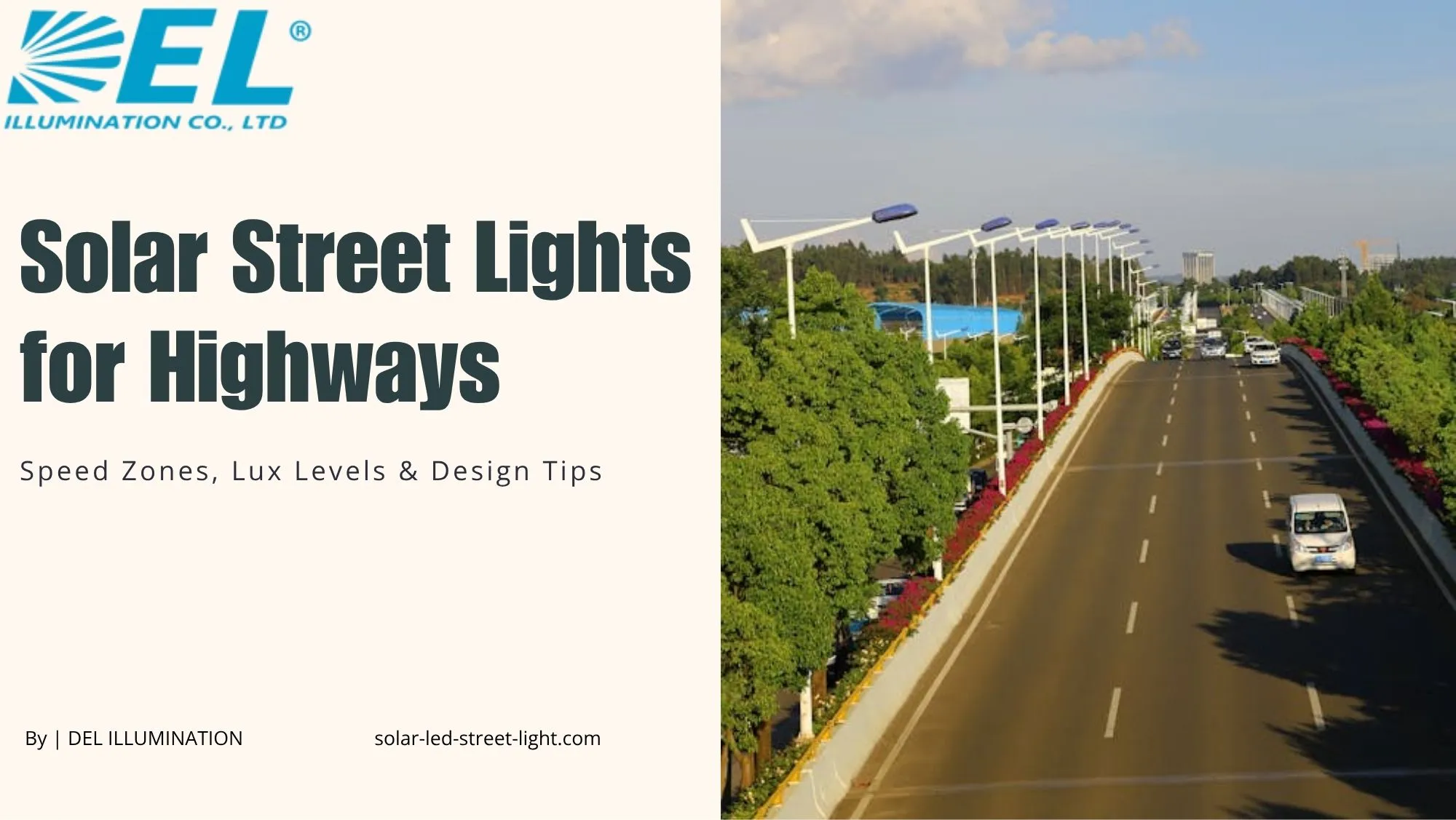
Nearly 50% of all fatal road crashes occur at night, despite night-time traffic accounting for only around 25% of total vehicle volume. On high-speed highway corridors – where reaction times are compressed and distances between hazards can be mere seconds – the quality of road lighting is not a comfort amenity. It is a life-safety infrastructure decision. Yet across developing and developed nations alike, thousands of kilometres of highway remain inadequately lit or entirely unlit, leaving drivers to navigate at 80-120 km/h in dangerous low-visibility conditions.
For city planners, EPC contractors, and procurement officers, solar street lights for highways offer a compelling answer: zero dependency on grid power, near-zero operational cost over a 10-year lifecycle, and the technical capability – when properly engineered – to meet or exceed international luminance standards. This blog covers what it actually takes to specify, design, and deploy solar lighting on high-speed road corridors: the lux levels required by speed zone, the hardware specifications that matter, smart control strategies, and the long-term financial case.
Why Highway Lighting Demands a Different Standard
Highway lighting is fundamentally different from residential or urban street lighting. The combination of high vehicle speeds, extended sight distances, lane-change manoeuvres, and the absence of ambient urban light creates a set of visual demands that cannot be met with generic specifications.
Under the European standard EN 13201 – which governs road lighting design across EU member states and many countries that have adopted European norms – highways and high-speed arterials fall into the M-class lighting category (motorised traffic). This class uses luminance-based design criteria rather than simple lux values, because driver visibility on fast roads depends on the contrast between objects and the road surface, not just raw light intensity. For our street lighting standards comparison blog we went deeper into EN 13201 versus IESNA frameworks.
In practical illuminance terms, first and second-class highways require a minimum average maintained illuminance of 20–30 lux on asphalt surfaces, with a luminance uniformity ratio of at least 0.4. Third-class highways require 15–20 lux with the same uniformity threshold. Concrete surfaces may use values reduced by up to 30% due to their higher reflectance. These are not starting figures – they are the maintained minimums that must be sustained throughout the entire service life of the installation, accounting for LED lumen depreciation over time.
The stakes are measurable. Industry research and government road safety agencies consistently report that well-designed highway lighting can reduce nighttime intersection crashes by 33–38%, and reduce pedestrian-injury crashes at lit zones by up to 42%. For procurement teams evaluating total project value, these safety dividends must be counted alongside energy savings.
Lux Levels, Uniformity, and Speed Zone Mapping
The single most common error in highway solar lighting projects is specifying by wattage rather than by lux output at road level. A 150W LED fixture mounted at 10 metres does not automatically deliver compliant illumination on a four-lane expressway. The lux level experienced at ground depends on mounting height, pole spacing, optical distribution type, and the reflectance characteristics of the road surface.
Correct specification begins with the speed zone and road classification:
- Expressways / Primary Highways (≥80 km/h): Target 25–30 lux average on asphalt, uniformity ≥ 0.4, EN 13201 Class M2 or M1
- First & Second-Class Highways (60–80 km/h): Target 20–25 lux average, uniformity ≥ 0.4, EN 13201 Class M3
- Third-Class / Rural Arterials (40–60 km/h): Target 15–20 lux, uniformity ≥ 0.4, EN 13201 Class M4
- Secondary Rural Highways (≤40 km/h): Target 10–15 lux, uniformity ≥ 0.3, EN 13201 Class M5–M6
For a four-lane expressway with 10–12 metre poles, achieving 25 lux uniformly across the carriageway typically requires fixtures producing 16,000–24,000 lumens per unit. At LED efficacy of 160–180 lm/W – the standard achievable in German-engineered systems – this translates to 100–150W LED fixtures. Generic alternatives operating at 100–120 lm/W require 30–50% more wattage to produce the same lux output, directly inflating the solar panel and battery sizing requirements and increasing system cost.
Optical distribution is equally important. Type III optics (medium lateral spread) are standard for straight highway sections with single-side or staggered pole arrangements. Type IV optics (wide lateral spread) suit wide shoulders and multi-lane roads. Using the wrong optic wastes lumens as sky glow, fails uniformity ratios, and can produce blinding glare for oncoming drivers – a dangerous outcome on high-speed roads. Always request verified IES photometric files from the manufacturer and run a DIALux or Relux simulation before finalising any highway specification. For a detailed walkthrough of that process, see our guide on DIALux luminaire spacing optimisation for EPC projects.
Hardware Specifications That Matter on High-Speed Corridors
Solar street lights for highways operate in a more demanding environment than their urban equivalents. Higher pole heights increase wind load forces. Larger solar panels present greater sail area. The continuous operation requirements – full brightness every night, no failure tolerance – place greater demands on battery capacity and charge controller precision.
Key hardware benchmarks for highway-grade solar street lights:
- Pole height: 10–12 metres for standard highways; 12–15 metres for expressways and multi-lane arterials. Foundation depth must follow the formula: depth = (pole height ÷ 10) + 0.2m.
- LED wattage: 100–150W for standard highway poles; up to 200W for high-mast configurations. Always specify output in lumens, not watts.
- Solar panel efficiency: German-engineered monocrystalline panels at 21–23% efficiency generate significantly more energy per square metre than polycrystalline alternatives at 15–17%. On tall poles with limited bracket space, this efficiency premium is critical.
- Battery chemistry: LiFePO4 (Lithium Iron Phosphate) is the only appropriate chemistry for highway applications. With 2,000–3,000 charge cycles and a calendar life of 8–12 years, LiFePO4 provides the deep-discharge tolerance and thermal stability required for year-round outdoor operation. Lead-acid batteries, which cycle only 300–500 times and degrade rapidly above 35°C, represent a false economy on highway projects.
- Charge controller: MPPT (Maximum Power Point Tracking) controllers extract 25–30% more usable energy from the solar panel compared to PWM (Pulse Width Modulation) alternatives. On a highway installation where panels may face partial shading or sub-optimal tilt due to pole orientation, MPPT charging is not optional – it is the difference between reliable operation and chronic under-charging.
- IP and IK ratings: Highway fixtures must carry at minimum IP67 (dust-tight and submersible), independently tested by an accredited laboratory – not self-declared. For zones prone to debris impact or road maintenance equipment proximity, IK08 mechanical impact resistance should be specified. Generic suppliers frequently self-declare IP65 without independent verification.
- Backup days: Highway solar lights should be sized for 3–5 consecutive days of autonomy in the project’s worst-case weather month. Failure to calculate backup days accurately is one of the most common causes of highway solar lighting outages.
For more on certifications and what bankable EPC contracts require, refer to our detailed guide on certification requirements for bankable EPC contracts.
Smart Controls and Adaptive Dimming for Highway Safety
A frequent concern among highway authorities and road safety engineers is whether solar street lights can maintain full illumination throughout the entire night on long highway stretches. The answer, with correctly sized systems and smart control strategies, is yes – and the energy management approach used actually extends battery life rather than compromising it.
Modern German-engineered highway solar lights incorporate multi-mode adaptive dimming that maps brightness to traffic intensity rather than simply running at fixed output:
- Hours 1–4 (peak traffic): 100% output, typically 25–30 lux at road level
- Hours 5–8 (mid-night, reduced traffic): 70–80% output, maintaining compliant minimum lux
- Hours 9–12 (pre-dawn, low traffic): 50% output with motion activation to 100%
This profile reduces average nightly energy consumption by approximately 30–40%, allowing the solar panel and battery to be sized more efficiently without compromising safety during high-traffic periods. Motion detection on highway installations must be calibrated carefully: detection range should extend far enough ahead of approaching vehicles to pre-illuminate the road section, typically 60–80 metres of advance activation on roads with ≥80 km/h design speed.
For procurement officers specifying smart features, look for systems with 0–10V dimming protocol, remote monitoring via GSM or IoT gateway, and programmable dimming profiles that can be adjusted without a site visit. These capabilities are standard in German-engineered systems. The 9 benefits of solar light remote control technology blog covers the operational advantages of remote management in depth.
Highway lighting should also incorporate colour temperature specifications. A 4,000K (neutral white) colour temperature is strongly recommended for high-speed roads: it improves contrast on wet asphalt, reduces glare scattering in rain and fog compared to warm white, and supports the mesopic vision range that drivers rely on in low ambient light conditions. Avoid colour temperatures above 5,000K on highways, as they increase disability glare and eye fatigue over long driving distances.
Pole Layout, Spacing, and Arrangement Design
Highway solar lighting layout follows engineering principles that differ from urban installations. The inverse-square law governs light decay with height: doubling the pole height reduces ground illuminance to approximately 25% of its previous value, requiring proportionally more powerful fixtures. This relationship makes getting pole height correct the single most important geometric decision in highway lighting design.
Standard layout guidelines for highway solar installations:
- National and expressway highways: Pole height ≥ 12m, spacing 35–45m, single-side or staggered bilateral arrangement depending on carriageway width
- Four-lane primary highways: Pole height 10–12m, spacing 30–40m, staggered or central median arrangement
- Three-lane rural highways: Pole height 9–10m, spacing 25–35m
- Curves and intersections: Additional poles required; reduce spacing by 30–40% on curves with radius < 300m; apply EN 13201 C-class (conflict zone) illuminance criteria at intersections, typically requiring 20–30 lux average with uniformity ≥ 0.4
For staggered bilateral arrangements on wide expressways, span arms (cantilever brackets) of 1.5–2.5 metres are typically used to project the fixture over the near lane. The arm must be engineered for the wind load at the installation site – highway poles on open terrain face significantly higher wind forces than urban poles. Foundation design must account for this: the standard formula (depth = pole height ÷ 10 + 0.2m) provides a minimum baseline; coastal, high-altitude, and typhoon-zone projects require site-specific structural calculations.
Pole arrangement also affects the solar panel orientation. On staggered highway installations where poles face alternating directions, solar panels must be mounted on an independently adjustable frame so all panels face true south (or true north in the southern hemisphere) regardless of pole orientation. This seemingly minor detail – frequently missed in generic specifications – can reduce annual energy yield by 15–25% if panels are forced into east-west orientations. For a full breakdown of how German-engineered solar street lights solve these design challenges, visit our detailed product overview.
Total Cost of Ownership: The Financial Case for Highway Solar
The upfront cost of a highway-grade German-engineered solar street light – typically $3,000–$6,000 per installed unit including pole, fixture, solar panel, LiFePO4 battery, MPPT controller, and civil works – is higher than a comparable grid-connected LED fixture. For procurement officers under budget pressure, this initial figure can be the primary objection. The total cost of ownership (TCO) over a 10-year lifecycle tells a very different story.
A grid-connected highway LED installation carries ongoing costs that solar eliminates entirely: electricity tariffs, grid connection fees, cabling and trenching (typically $500–$1,500 per pole in highway terrain), transformer installations, and reactive maintenance due to cable faults and vandalism. When these are factored into a 10-year TCO model, grid-connected systems routinely cost 2–3 times more than the equivalent solar installation.
For highway projects specifically:
- Electricity savings: A 150W grid LED running 12 hours per night consumes approximately 657 kWh per year. At a commercial tariff of $0.12–0.18/kWh, this represents $79–$118 per fixture annually – multiplied across hundreds of poles on a typical highway project.
- Maintenance savings: LiFePO4 batteries with 8–12 year calendar life and 50,000-hour LED rated life reduce scheduled maintenance intervals dramatically. Municipalities and highway authorities using German-engineered solar systems have reported 35–40% reductions in maintenance workload within three years of deployment compared to legacy grid systems.
- Payback period: Highway solar lighting projects typically achieve full payback within 5–8 years, after which operational costs are near zero for the remaining service life. Projects in high-electricity-cost regions (parts of Africa, Southeast Asia, island nations) often reach payback in 3–5 years.
For a structured deep-dive into how to calculate these numbers for a specific project, our total cost of ownership for EPC projects guide provides a step-by-step TCO framework.
Conclusion
Deploying solar street lights on highways is no longer an experimental approach – it is a proven, technically mature solution adopted on highway corridors across Africa, Southeast Asia, the Middle East, and Europe. But successful highway solar lighting demands precision in three areas: lux-level specification aligned to speed zones and EN 13201 / IESNA standards, hardware quality that meets IP67, IK08, LiFePO4, and MPPT benchmarks, and a pole layout designed from photometric simulation rather than rule-of-thumb wattage.
The critical takeaways for procurement teams and EPC contractors are these: specify in lumens and lux – not watts; insist on certified, independently tested components; and always evaluate total cost of ownership over 10 years rather than unit purchase price. A German-engineered solar street light system with a 5–7 year comprehensive warranty, 2,000–3,000 LiFePO4 cycles, and 160–180 lm/W LED efficacy will outperform and outlast a generic alternative by a margin that transforms the financial case entirely.
For a customised highway solar lighting specification – including photometric simulation, system sizing, and TCO modelling for your specific corridor – contact the engineering team at solar-led-street-light.com for a detailed technical consultation and project quote.
Frequently Asked Questions
1. Can solar street lights genuinely meet EN 13201 M-class standards on a busy highway?
Yes, provided the system is correctly sized and specified. German-engineered fixtures with 160-180 lm/W LED efficacy, properly selected Type III or Type IV optics, and verified photometric data can achieve M2 and M3 class compliance on standard highways. Independent photometric simulation using the manufacturer’s IES file is essential before procurement to confirm compliance under real-world pole spacing and road geometry.
2. What wattage is needed for a 12-metre highway pole to achieve 25 lux at road level?
At 160 lm/W LED efficacy, a 100–150W fixture produces 16,000-24,000 lumens – sufficient for 25 lux on a standard three-to-four lane highway with 35-40m pole spacing and Type III optics. The precise wattage depends on the road width, surface reflectance, and spacing. Always verify through photometric simulation rather than relying on wattage alone.
3. How many backup days should a highway solar light be designed for?
Highway solar lights should be sized for a minimum of 3–5 consecutive cloudy days of autonomous operation, calculated for the project location’s worst-case solar irradiance month. In tropical regions with reliable irradiance, 3 days is often sufficient. In higher-latitude or monsoon-affected zones, 5–7 days of battery autonomy may be required. Failure to calculate backup days accurately is among the most common causes of highway solar lighting failures.
4. Is LiFePO4 battery chemistry mandatory for highway installations, or will standard lithium batteries suffice?
For highway applications, LiFePO4 is strongly recommended and increasingly specified as a contractual requirement by development banks and government agencies. Standard lithium-ion (NMC or NCA chemistry) batteries offer higher energy density but degrade faster under the deep daily discharge cycles typical of highway solar installations. LiFePO4’s 2,000–3,000 cycle life and thermal stability at operating temperatures up to 60°C ambient make it the only chemistry reliably suited to 8–12 year highway service life.
5. What colour temperature is appropriate for highway solar lighting?
4,000K (neutral white) is the widely accepted optimum for high-speed roads. It provides sufficient blue-spectrum content to support driver alertness and mesopic vision without causing the excessive glare or visual fatigue associated with 5,000K+ cool white sources. For coastal highways prone to fog and sea spray, 4,000K also performs better than warmer temperatures in scattering conditions.
6. How does pole spacing change at highway curves, ramps, and intersections?
At horizontal curves with a radius below 300 metres, pole spacing should be reduced by 30-40% compared to straight sections to maintain uniformity and prevent dark zones on the outer edge of the curve. At on-ramps, off-ramps, and interchange zones, EN 13201 C-class (conflict zone) criteria apply, requiring 20–30 lux average illuminance with uniformity ≥ 0.4 – typically necessitating closer spacing and potentially higher pole heights. These transition zones should be individually simulated in DIALux rather than assumed to comply with standard highway spacing.
7. Are there wind-load considerations unique to tall highway solar poles?
Yes, and they are often underestimated. Highway poles at 10-12 metres with large-area solar panels attached face substantially higher wind forces than typical urban poles. In open-terrain highway corridors, wind speeds can exceed 50 m/s in storm events. Poles should be designed to IEC 60721 or equivalent structural standards for the local wind zone. The solar panel mounting frame, the pole-to-foundation flange, and the anchor bolt pattern all require engineering sign-off for wind-critical installations. German-engineered systems are designed to these standards; generic systems frequently are not.
8. What certifications should procurement officers require for highway solar lights under ADB or World Bank funding?
Projects funded by development finance institutions such as the ADB or World Bank typically require IEC-certified solar panels, CE-marked LED drivers, ISO 9001 quality management system certification for the manufacturer, and independently verified IP ratings (not self-declared). TÜV certification is widely recognised as the benchmark for German-engineered systems. Our dedicated guide on ADB and World Bank solar street light procurement for 2026 covers all compliance requirements in detail.
References
- Illuminating Engineering Society of North America (IESNA). (2024). Roadway Lighting Guidelines – Major Roads and Highways. https://www.iesna.org
- European Committee for Standardization. (2015, reaffirmed 2024). EN 13201-2: Road Lighting – Performance Requirements. https://www.en-standard.eu/csn-en-13201-1-4-road-lighting/
- Federal Highway Administration (FHWA). (2025). EDC-7: Nighttime Visibility for Safety. https://www.fhwa.dot.gov/innovation/everydaycounts/edc_7/nighttime_visibility.cfm
- National Safety Council (NSC). (2024). Driving at Night – Safety Topics. https://www.nsc.org/road/safety-topics/driving-at-night
- Luxman Light. (2024). Solar Street Light Lux Levels and Highway Illuminance Standards. https://luxmanlight.com/are-solar-street-lights-bright-enough/
- Luxman Light. (2026). Urban Roads Solar Street Lighting Design Guidelines. https://luxmanlight.com/urban-roads-solar-street-lighting-design-guidelines/
- Luxman Light. (2024). Solar Street Light Pole Height and Distance Calculation and Standard. https://luxmanlight.com/how-to-calculate-the-height-and-distance-of-solar-street-light-pole/
- BEGA Lighting. (2024). Maintained Illuminance According to DIN EN 13201. https://www.bega.com/en/knowledge/lighting-theory/reference-values-for-illumination/maintained-illuminance-according-to-dinen13201/
- Quenen Lighting. (2026). Solar Street Light Cost Guide 2024 – All-in-One and Split Systems. https://www.quenenglighting.com/guides/solar-street-light-cost-guide-2024.html
- Solar LED Street Light. (2025). Street Lighting Standards Comparison: EN 13201 vs CIE. https://solar-led-street-light.com/street-lighting-standards-comparison/
Disclaimer
This article is for informational purposes only and does not constitute professional engineering, installation, or procurement advice. Performance specifications and costs may vary based on project requirements, location, and local regulations. Always consult qualified solar energy professionals and legal advisors before making procurement decisions.
For expert consultation on solar LED street lighting solutions, visit solar-led-street-light.com or contact our team for a customised quote.