
Corrosion costs the global economy more than USD 2.5 trillion every year equivalent to approximately 3.4% of global GDP, according to the AMPP IMPACT study. For solar street light operators, facility managers, and EPC contractors, this headline figure is not an abstract statistic. It translates directly into failed poles, safety liability, premature replacement budgets, and public infrastructure that looks neglected within a few years of installation. A solar street light pole that begins rusting at the base weld within three to five years of commissioning a common failure mode in coastal, tropical, and industrial environments represents not just an aesthetic problem but a structural safety issue and a significant financial loss on an asset that should be performing for 20–30 years.
Solar street light pole rusting is preventable when the right material specification, surface treatment, installation practices, and maintenance programme are in place from day one. It is also recoverable in the early stages when caught through routine inspection before structural integrity is compromised. This guide covers why solar street light poles rust, which environments accelerate the process most aggressively, what the proven prevention methods are for both new specifications and existing deployments, and how to build a maintenance schedule that protects the full service life of your investment.
Why Solar Street Light Poles Rust: The Electrochemical Reality
Understanding why solar street light pole rusting happens is the starting point for preventing it. Steel the most commonly used material for solar street light poles is an alloy of iron and carbon. Iron is thermodynamically unstable when exposed to oxygen and moisture simultaneously. The electrochemical reaction that produces rust (iron oxide) proceeds spontaneously wherever these three elements co exist: steel surface, oxygen, and water.
In practical terms, this means every unprotected steel solar street light pole is continuously at risk of corrosion under normal outdoor operating conditions. The rate at which rust progresses depends on the concentration of the corrosive agents present. In standard urban environments with moderate humidity and low pollution, an uncoated steel pole may begin showing surface rust within two to three years. In coastal environments where salt laden air deposits chloride ions on metal surfaces galvanized steel exposed directly to marine winds can begin showing rust in as little as five to seven years without additional protective treatment. In heavy industrial areas with airborne sulphur dioxide and chemical particulates, corrosion rates are significantly higher than in suburban or rural settings.
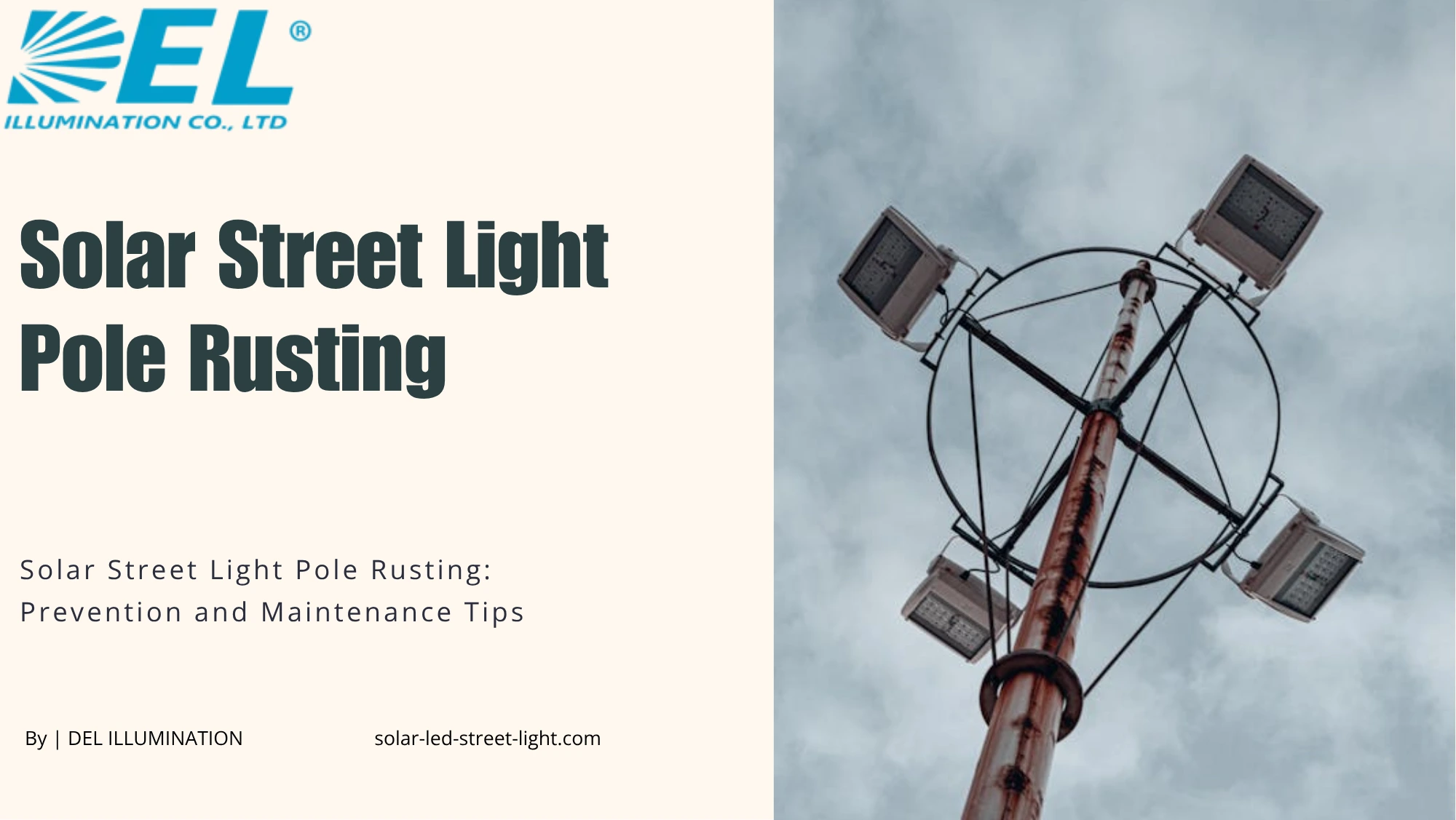
The most structurally critical zone on any solar street light pole is the base weld the junction where the pole shaft meets the base flange or the ground anchor. Industry research published in 2024 confirms that corrosion below and at ground level is the primary failure mode for partially buried steel poles, as this zone combines permanent moisture exposure, oxygen availability, and (in many soils) aggressive chloride or sulphate content. Structural load capacity is progressively reduced as corrosion penetrates the pole wall thickness, with catastrophic failure possible before surface inspection reveals the extent of internal degradation. This is precisely why visual inspection alone is insufficient in high risk environments: ultrasonic thickness testing of base sections is the only reliable method for assessing internal corrosion progression. For a broader view of how pole specification decisions affect long term performance and total cost of ownership, our guide on the 5 advantages of solar light pole systems covers the key evaluation criteria.
High Risk Environments: Where Solar Street Light Pole Rusting Accelerates
Not all deployment environments carry equal corrosion risk, and procurement specifications that are adequate for a temperate inland city may be critically insufficient for a coastal port, an industrial park, or a high humidity tropical location. Matching the corrosion protection specification to the actual deployment environment is the single most important upstream decision in preventing solar street light pole rusting.
Coastal environments represent the most aggressive corrosion challenge for steel poles. Structures located within one mile of the shoreline and especially within 250 feet are exposed to continuous chloride deposition from salt laden winds and marine spray. Research from the galvanising industry confirms that galvanised steel in direct coastal wind exposure can begin showing rust within five to seven years, while sheltered sections of the same structure may perform adequately for 15–25 years longer. For solar street light projects near ports, harbours, seafronts, and coastal highways, a duplex protection system hot dip galvanising with an additional powder coat applied over the zinc layer is the correct engineering specification, not an optional upgrade.
Tropical and high humidity environments, covering much of Southeast Asia, West Africa, South Asia, and Central America, sustain year round moisture conditions that accelerate the corrosion reaction continuously rather than seasonally. Annual average relative humidity above 70% materially increases the rate of steel corrosion compared to drier climates. In regions combining high humidity with elevated temperatures the Gulf states and South Asian coast, for example the rate of electrochemical corrosion on unprotected steel increases further. Our regional guides on solar street lights for Middle East climates and solar street lights for Southeast Asia discuss the full environmental specifications required for these deployment contexts.
Industrial environments introduce additional corrosive agents beyond moisture and oxygen. Sulphur dioxide, nitrogen oxides, acid rain, and chemical particulates from manufacturing processes create conditions where steel corrosion rates are several times higher than in clean rural air. Solar street light poles installed in or near chemical plants, refineries, heavy manufacturing zones, or agricultural processing facilities should always be specified with enhanced corrosion protection as a minimum. For guidance on solar street light specification for industrial deployments, see our dedicated resource on solar street lights for industrial parks.
Proven Prevention Methods for Solar Street Light Pole Rusting
The solar street light industry has three proven, well validated methods for preventing solar street light pole rusting in new installations. Understanding the differences between them and when to specify each is essential knowledge for any procurement officer or EPC contractor.
Hot dip galvanising is the first and most effective primary protection method. In this process, the fabricated steel pole is immersed in a bath of molten zinc at approximately 500°C. The zinc metallurgically bonds to the steel surface, forming a zinc iron alloy layer beneath an outer pure zinc layer. The total zinc coating thickness achieved is typically 65–90 micrometres (µm), with German engineered specifications requiring a minimum of 70µm. Unlike paint or cold applied coatings that form only a mechanical bond, hot dip galvanising forms a chemical bond with the steel meaning the protective layer cannot be peeled, flaked, or worn away by abrasion in the way that surface coatings can. When the zinc surface is scratched, it self heals through cathodic protection: the zinc sacrificially corrodes to protect the exposed steel beneath. The anti corrosion lifespan of hot dip galvanising varies significantly by environment: approximately 13 years in heavy industrial areas, around 30 years in typical urban conditions, and over 50 years in marine environments where the zinc is periodically rinsed by rainfall rather than subjected to continuous salt deposit accumulation.
Powder coating (electrostatic spray coating) is the standard secondary treatment applied over a hot dip galvanised surface to create a duplex protection system. Powder coating involves charging powder particles negatively and applying them to the grounded steel pole surface using electrostatic force and compressed air, producing a uniform, flat, strongly adherent coating. When cured, powder coating provides additional mechanical protection against scratching, UV degradation, and chemical attack extending the effective corrosion protection of the underlying zinc layer considerably beyond what either treatment delivers alone. A correctly applied duplex system of hot dip galvanising plus outdoor grade powder coating on a German engineered solar street light pole delivers a corrosion free surface life of more than 10 years in the most challenging environments, and significantly longer in standard urban conditions. The powder coat also enables custom RAL colour matching, which is important for municipal aesthetic requirements.
Stainless steel poles and thermoplastic nylon spray coating are increasingly used for ultra high corrosion environments. Stainless steel poles contain chromium, which forms a self renewing oxide layer that resists rust without any external protective treatment making them the appropriate specification for installations within 250 feet of a coastline or in continuous chemical exposure environments. Thermoplastic nylon flame spray is a newer technology that deposits a thick polymer coating on the prepared steel surface under controlled heat, providing excellent waterproofing and chemical resistance for aggressive environments.
Identifying Early Stage Solar Street Light Pole Rusting: An Inspection Protocol
Prevention is the optimal strategy, but early detection of solar street light pole rusting before structural integrity is compromised is the next best outcome and it depends entirely on a disciplined inspection programme. Rust that is identified in the early surface oxidation stage can be treated and arrested; rust that has penetrated to significant wall thickness reduction may require full pole replacement on safety grounds.
A practical inspection protocol for solar street light poles should include the following steps at minimum twice per year, with additional checks after extreme weather events:
- Visual inspection of the full pole surface from ground level, noting any discolouration, paint bubbling, blistering, or visible orange brown rust spots. Pay particular attention to the base to flange weld joint, any cable entry points, the mid pole bracket connection, and the luminaire mounting arm all areas where water pools or coating integrity is disrupted during installation.
- Tap test at the pole base: Gently striking the base section with a rubber mallet and listening for a hollow or dull sound rather than a solid ring indicates internal corrosion cavitation that is not visible externally.
- Ultrasonic wall thickness measurement at the base section and any areas of visible surface corrosion. This non destructive testing method provides a precise residual wall thickness reading that can be compared against the original specification to quantify corrosion progression. Any wall thickness reduction exceeding 20% of the original specification warrants immediate engineering assessment before the pole is returned to service.
- Inspection of protective coating integrity across the full pole surface. Any chip, crack, or peeling in the powder coat or paint layer exposes the underlying zinc or steel to direct atmospheric attack. Touch up coating of damaged areas within the same maintenance visit prevents the small localised damage from propagating into a wider corrosion front.
Documenting inspection findings with photographs and recording them in a maintenance log is essential for tracking progression across visits, planning targeted interventions, and demonstrating duty of care to regulators or insurers in the event of a pole failure.
Active Maintenance and Remediation for Rusted Solar Street Light Poles
When solar street light pole rusting is identified in its early stages surface oxidation with no structural penetration remediation is straightforward and cost effective compared to full pole replacement. The correct remediation sequence is as follows:
First, mechanically remove all loose rust, flaking paint, and corroded material from the affected area using a wire brush, angle grinder with a flap disc, or needle scaler for deeper pits. The goal is to reach clean, solid metal or intact galvanising before applying any treatment. Do not apply coating over loose rust it will continue to progress beneath the surface coating and reappear within months.
Second, apply a zinc rich primer to the cleaned surface area. Zinc rich primers contain high concentrations of zinc dust that provide sacrificial cathodic protection to the treated steel area, mimicking the function of the original hot dip galvanising in localised repair situations. Allow full cure time as specified by the primer manufacturer before applying topcoat.
Third, apply a compatible, outdoor rated topcoat in a matching colour to the repaired area. For poles in coastal or industrial environments, use a specifically formulated marine grade or chemical resistant topcoat rather than standard architectural exterior paint.
For poles where corrosion has penetrated to structural significance any section where wall thickness has been reduced by 20% or more from specification the pole must be decommissioned and replaced. Operating a structurally compromised light pole is a public safety risk that no maintenance intervention can adequately address. German engineered solar street light systems are designed with standardised base sections and pole diameters precisely to enable like for like replacement of a single pole without requiring changes to the luminaire, mounting arm, or anchor bolt assembly minimising the cost of individual pole replacement when it becomes necessary. For related guidance on maintaining the full solar street light system, our comprehensive resource on 9 tips for maintaining solar compound lighting covers all major maintenance workstreams in a single framework.
Conclusion
Solar street light pole rusting is a predictable, quantifiable risk that is well within the capability of informed procurement and maintenance practice to prevent and manage. The three most important takeaways for city planners, facility managers, and EPC contractors are: first, match the corrosion protection specification to the actual deployment environment at the design stage a standard galvanised pole is insufficient for coastal, tropical, or industrial conditions, where a duplex galvanising plus powder coat system is the minimum correct specification; second, conduct biannual visual inspections with ultrasonic base section testing in high risk environments, because structural corrosion progresses internally and invisibly before it becomes visible at the surface; and third, treat any coating damage or early surface rust at the first maintenance visit, since the cost of a zinc rich primer touch up is a fraction of the cost of a full pole replacement.
German engineered solar street light systems from solar led street light.com are manufactured using Q235 high strength steel, hot dip galvanised to a minimum zinc coating thickness of 70µm, powder coated with outdoor grade electrostatic spray, and supplied with 5–7 year comprehensive warranties giving procurement officers and EPC contractors the documented quality baseline needed for bankable, long duration infrastructure projects.
Ready to specify solar street light poles that resist corrosion across their full 20–30 year intended service life? Visit solar led street light.com today to consult with our engineering team or request a customised project quote.
FAQ
1. How long does a solar street light pole last before rusting becomes a structural concern? A steel solar street light pole treated with hot dip galvanising only will typically remain structurally sound for 15–25 years in standard urban environments, with the base weld section being the first area to show structural degradation due to combined moisture and soil chemical exposure. A duplex treated pole hot dip galvanising plus powder coat extends this to 25–30 years in urban conditions. In coastal environments with direct marine wind exposure, galvanised steel can begin showing surface rust in 5–7 years; duplex treated poles or stainless steel poles are required for these conditions. Regular biannual inspection and prompt remediation of any coating damage are the most effective interventions for maximising service life within these ranges.
2. What is the difference between hot dip galvanising and cold dip (cold galvanising) for solar street light poles? Hot dip galvanising immerses the steel pole in molten zinc at approximately 500°C, creating a metallurgical bond between the zinc and the steel that cannot be mechanically separated. The zinc coating penetrates the steel surface at a molecular level, producing a coating thickness of 65–90µm that provides sacrificial cathodic protection across the entire coated surface including edges, welds, and internal surfaces if the pole is hollow. Cold galvanising (also called zinc rich paint or cold zinc spray) applies a zinc loaded paint to the surface, forming only a mechanical rather than a chemical bond. Cold applied coatings are substantially thinner, can be abraded or chipped away, and do not provide cathodic protection in the same way. For outdoor solar street light poles, hot dip galvanising is the correct specification; cold galvanising is only acceptable as a repair treatment for small damaged areas.
3. Can a solar street light pole that has already started rusting be saved? Yes, if the rusting is in the early surface oxidation stage with no significant wall thickness reduction. The remediation process involves mechanically removing all loose rust to clean metal, applying a zinc rich primer for cathodic protection of the treated area, and applying a compatible outdoor grade topcoat. This sequence arrests the corrosion and restores coating integrity in the affected area. However, if ultrasonic testing reveals that wall thickness has been reduced by 20% or more from the original specification particularly at the base section the pole must be replaced on structural safety grounds. Early detection through biannual inspection is the key to keeping remediation cost effective rather than escalating to replacement.
4. Does solar street light pole rusting affect the electrical components inside the pole? Yes, in two ways. First, if external corrosion has created perforations or significant cracks in the pole wall, rainwater can enter the pole and reach the cable connections, battery compartment (in split type systems), and charge controller causing short circuits, insulation failure, or component corrosion that leads to fixture malfunction or fire risk. Second, the cable entry points at the base of the pole are common sites for both corrosion initiation (where the coating is penetrated during installation) and water ingress. Ensuring that cable entry grommets are correctly sealed with weatherproof compound at installation and re inspected and re sealed during maintenance visits is an important preventive measure that protects electrical components as well as structural integrity. If your solar street light is flickering or failing to turn on after a period of exposure to heavy rain, see our guides on solar street light flickering and solar street light not turning on for fault diagnosis.
5. What pole material should be specified for a solar street light near the coast? For installations within approximately one mile of a coastline, a duplex protection system is the minimum correct specification: hot dip galvanising to a minimum 70µm zinc coating thickness, with an outdoor grade powder coat applied over the zinc layer. This duplex system significantly extends the service life of the pole compared to galvanising alone by providing a second barrier that prevents salt laden moisture from reaching the zinc layer. For installations within 250 feet of the shoreline or in areas with continuous direct marine spray stainless steel poles (with chromium enhanced self renewing oxide layer) are the appropriate specification. Our project resources on solar street lights for ports cover the full corrosion protection requirements for these extreme marine environments.
6. How does pole rusting affect the warranty and total cost of ownership of a solar street light installation? Most quality solar street light warranties including the 5–7 year comprehensive warranties offered by German engineered systems cover manufacturing defects in the pole surface treatment but do not cover accelerated corrosion resulting from deployment in environments more aggressive than the specified design category without appropriate corrosion protection upgrades. A generic solar street light pole supplied with only thin paint rather than verified hot dip galvanising may show structural rust within 3–5 years, typically voiding its 1–2 year warranty through the weather exclusion clause and requiring replacement at full capital cost. By contrast, correctly specified German engineered poles with documented hot dip galvanising certification and a 5–7 year warranty represent a significantly lower 10 year total cost of ownership. For a full lifecycle cost comparison methodology, see our guide on total cost of ownership for EPC projects.
7. What is the correct inspection interval for solar street light pole rusting in high risk environments? In standard urban and suburban environments with low humidity and no industrial pollution, biannual inspection before and after the main wet season is the recommended minimum. In coastal environments within one mile of the shoreline, quarterly inspection is appropriate during the first five years of service to establish how the specific installation is performing relative to its design specification. In industrial environments with continuous chemical or particulate exposure, quarterly inspection throughout the operational life is the correct approach. All inspections should include both visual surface assessment and a tap test of the base section; ultrasonic wall thickness measurement should be added annually in any environment where corrosion risk is rated as high. Findings should be photographed and logged for trend analysis across inspection cycles.
8. Should solar street light poles be painted over the hot dip galvanised surface? For standard deployments, the hot dip galvanised surface alone is sufficient and painting over it is not necessary. However, in high risk environments (coastal, industrial, tropical), a powder coat or high performance paint system applied over the galvanised surface creates a duplex system that substantially extends service life making it strongly recommended rather than optional. When painting over galvanising, it is important to allow the zinc surface to weather naturally for at least 6–12 months before applying paint, or to use a wash primer specifically formulated for application over zinc standard paints will not adhere adequately to fresh zinc and will peel within months. Using outdoor grade powder coat applied during manufacture (before installation) avoids this adhesion issue entirely and is the approach used in German engineered systems.
References
- Association for Materials Protection and Performance (AMPP). (2016). IMPACT Study: International Measures of Prevention, Application, and Economics of Corrosion Technology. http://impact.nace.org/economic impact.aspx
- Outokumpu. (2025). The Evolution of Materials: Stainless Steel Insights 2025 Cost of Corrosion. https://www.outokumpu.com/en/expertise/industrial evolution insights/2025/cost of corrosion
- ScienceDirect / Elsevier. (2024). Failure Assessment of Deteriorated Steel Light Poles. https://www.sciencedirect.com/science/article/pii/S2590123024008764
- Plasgain. (2025). What Is the Life Expectancy of a Street Light Pole? https://plasgain.com.au/what is the life expectancy of a street light pole/
- Hot Dip Galvanizing Association. (2025). Hot Dip Galvanizing Performance in Coastal Environments. https://www.hotdipgalvanizing.com/technical resources/hot dip galvanizing in coastal environments
- LightMart. (2024). The Importance of Corrosion Resistance in Light Poles. https://www.lightmart.com/blog/the importance of corrosion resistance in light poles/
- Phoebus Lighting. (2024). Tips to Avoid Rust on Steel Light Poles. https://www.phoebuslight.com/news/tips to avoid rust on steel light poles 82404485.html
- CHZ Lighting. (2024). Why the Solar Street Light Pole Is Hot Dip Galvanized and Sprayed. https://www.chz lighting.com/why the solar street light pole is hot dip galvanized and sprayed.html
- Infralumin. (2025). What Is the Life Expectancy of a Street Light Pole? https://infralumin.com/blogs/what is the life expectancy of a street light pole
- BASF. (2025). Why More Research on Corrosion Protection Leads to Lower Greenhouse Gas Emissions. https://www.basf.com/global/en/media/news releases/2025/08/p 25 152
Disclaimer
This article is for informational purposes only and does not constitute professional engineering, installation, or procurement advice. Performance specifications and costs may vary based on project requirements, location, and local regulations. Always consult qualified solar energy professionals and legal advisors before making procurement decisions.
For expert consultation on solar LED street lighting solutions, visit solar led street light.com or contact our team for a customised quote.