

One Wrong Number, 1,000 Wrong Poles
Industry research indicates that up to 40% of solar street lighting installations in emerging markets fail to meet design-intent illuminance levels ,often because photometric simulation was either skipped entirely or executed incorrectly during procurement. On a project involving just 200 units, a flawed luminaire spacing assumption might mean a handful of under-lit roads. Scale that to 1,000 units or more, and the consequences compound into contractual penalties, costly retrofits, and reputational damage that can end a contractor’s relationship with a funding agency overnight.
For city planners, EPC contractors, facility managers, and procurement officers managing large-scale solar street light rollouts, DIALux luminaire spacing optimization is not a back-office formality. It is the technical foundation on which every pole position, every watt of LED power, and every kilometer of compliant road lighting is built. This guide covers the full process: how to run a professional simulation, which EN 13201 parameters govern acceptability, and the most damaging mistakes that experienced teams still make on large projects.
Why DIALux Luminaire Spacing Optimization Matters at Scale
DIALux evo is the industry-standard photometric simulation platform used by lighting engineers, EPC contractors, and procurement evaluators worldwide. For solar street light projects, its road lighting module allows engineers to model pole spacing, mounting height, luminaire tilt, road geometry, and surface reflectance ,then calculate the actual illuminance and uniformity that will appear on the ground.
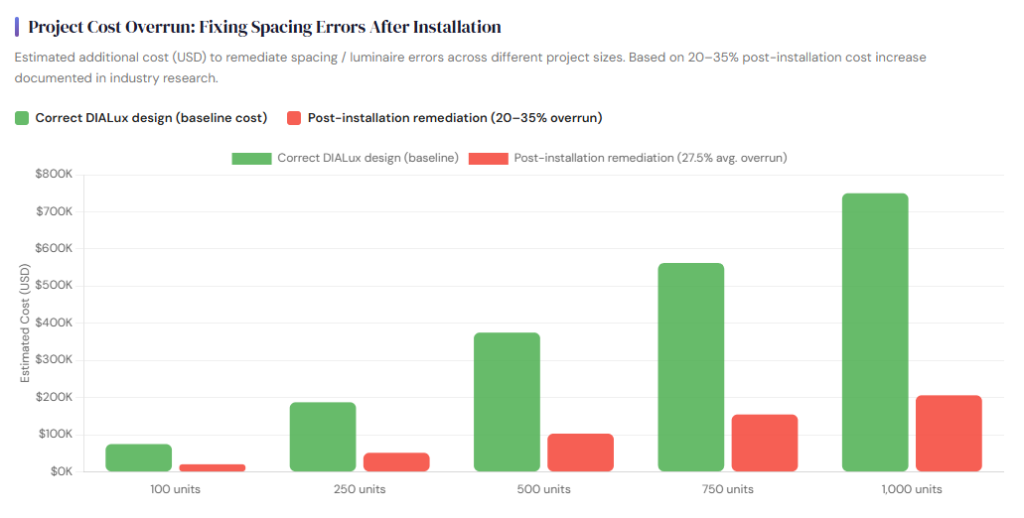
At the 1,000-unit scale, the economics are stark. A spacing decision of 30 meters versus 28 meters across a 1,000-pole project translates to a difference of roughly 67 fewer poles ,a significant procurement saving. But if that 30-meter spacing produces uniformity ratios below the EN 13201 threshold, every pole in the scheme is technically non-compliant. Upgrading under-specified luminaires or reducing pole spacing after installation can increase project costs by 20-35%, according to industry research on solar street light EPC projects.
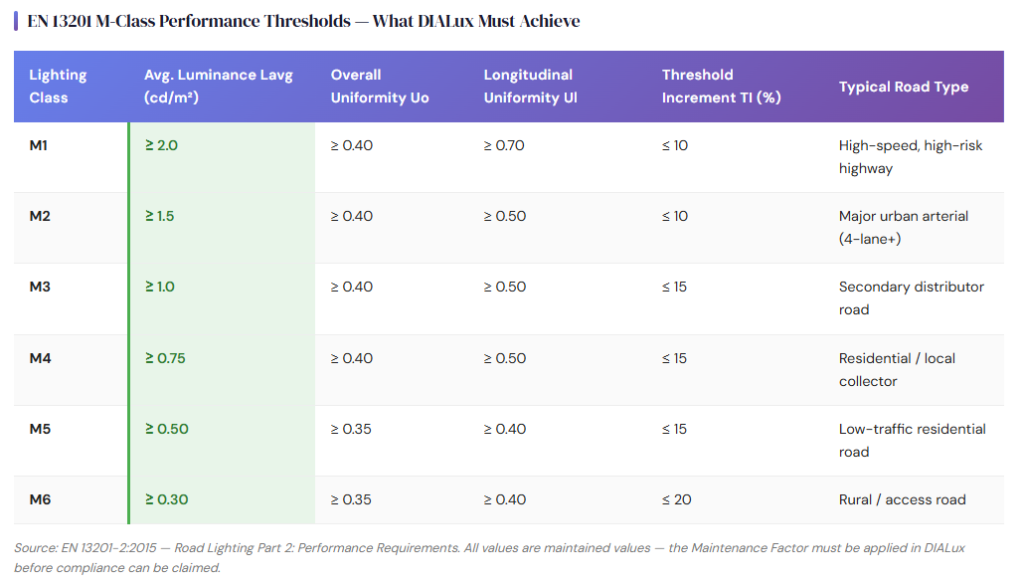
The EN 13201 standard ,the European benchmark for road lighting performance ,defines performance through a series of lighting classes. M-classes govern motorized vehicle roads using luminance-based criteria, while C-classes cover conflict areas such as intersections, and P-classes apply to pedestrian and cyclist routes. Each class specifies minimum average luminance or illuminance levels, overall uniformity ratios (Uo), longitudinal uniformity, and threshold increment (TI) values controlling glare. DIALux luminaire spacing optimization must simultaneously satisfy all of these parameters ,not just average lux ,for a simulation to constitute credible compliance evidence.
The DIALux Workflow for Large EPC Projects
A professional DIALux luminaire spacing optimization workflow for a 1,000+ unit EPC project follows a structured process that begins long before the simulation software is even opened.
Step 1: Accurate Road Geometry Input. In DIALux evo’s road lighting module, enter exact carriageway width, number of lanes, median width, footpath dimensions, and kerb offsets based on verified site survey data. Even a 0.5-meter error in road width can shift uniformity results enough to affect compliance across an entire road class.
Step 2: Select the Correct Lighting Class. Using CEN/TR 13201-1 ,the guidance companion to EN 13201-2 ,determine the appropriate lighting class based on traffic volume, road type, speed limit, and surrounding environment. A four-lane arterial road typically falls into M2 or M3 class, requiring average luminance values of 1.0-1.5 cd/m² with overall uniformity of 0.4 or better.
Step 3: Import Model-Specific IES or LDT Files. This is the step where most large-project errors originate. An IES file (Illuminating Engineering Society format) is a standardized photometric data file capturing a luminaire’s full three-dimensional light distribution, measured using a goniophotometer under laboratory conditions. The European equivalent is the LDT format. DIALux evo accepts both. For EPC solar street light tenders, the IES file is the document that transforms a supplier’s claimed lumen figure into a verified, spatial representation of how that fixture will actually illuminate a road surface. Without it, all pole spacing and wattage calculations are engineering guesswork.
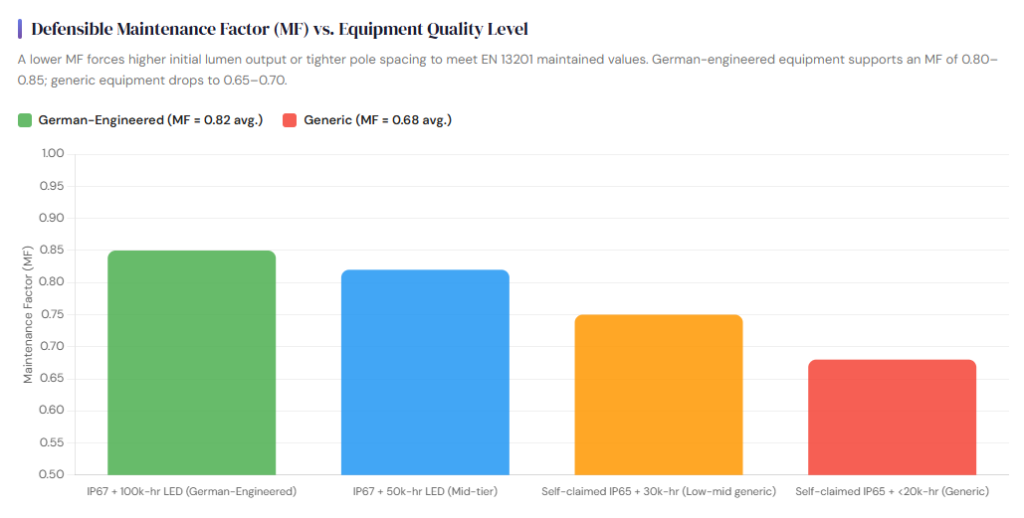
Step 4: Set the Maintenance Factor. EN 13201 specifies maintained values ,not initial values. Every simulation must incorporate a Maintenance Factor (MF) that accounts for LED lumen depreciation over time, luminaire soiling, and lamp survival rates. For German-engineered solar street lights with 50,000-100,000-hour L70 LED lifespans and third-party verified IP67 protection, a maintenance factor of 0.80-0.85 is defensible. For generic alternatives with self-claimed IP65-67 ratings and LED lifespans below 20,000 hours, the appropriate MF drops significantly ,increasing the required initial lumen output and forcing tighter pole spacing.
Step 5: Iterate Spacing and Height Parameters. With road geometry, lighting class, IES data, and maintenance factor set, the simulation engine can be run iteratively. The spacing-to-height ratio (S/H) is the primary lever: a ratio of 3.0-3.5 is typical for single-sided arrangements on narrow roads, while double-sided staggered layouts on wider carriageways may achieve ratios up to 4.0 with the right optic. For a 12-meter pole with a 30-meter spacing, the S/H ratio is 2.5 ,conservative and likely to over-illuminate. For a 10-meter pole at 35-meter spacing, S/H rises to 3.5, requiring a luminaire with strong forward throw and controlled cutoff to maintain uniformity.
Step 6: Generate and Review the Compliance Report. DIALux evo produces a report package including isolux diagrams, false-colour luminance maps, calculation grids, fixture lists, and a summary results table. For ADB and World Bank-funded EPC tenders, this report must clearly identify the applicable standard and lighting class, the specific luminaire model with wattage, lumens, and CCT (colour temperature), the IES file source and test laboratory, the road geometry inputs used, the maintenance factor applied with its derivation, and a results summary showing all calculated values against required thresholds.
Critical Inputs That Determine Simulation Accuracy
The quality of a DIALux luminaire spacing optimization is entirely determined by the quality of the inputs. Three input categories drive the most consequential errors on large EPC projects.
Photometric Data Quality. A generic IES file ,one generated for a different wattage, a different optic, or a different drive current ,cannot validly represent the product actually being supplied. German-engineered solar street lights carry LED efficacies of 160-200 lm/W, with luminaire output verified by accredited third-party laboratories using goniophotometer measurements traceable to international standards. Generic alternatives with self-reported efficacies of 100–130 lm/W and unverified IES data frequently produce field results that fall 25-40% below simulated values. That gap becomes a contractual liability the moment a post-installation audit is conducted.
Road Surface Reflectance. EN 13201 M-class calculations are luminance-based, meaning road surface reflectance (the R-table) directly affects the compliance result. An asphalt surface (R2 classification, qo ≈ 0.07) produces different luminance outcomes than a concrete surface (R1 classification, qo ≈ 0.10). Using the wrong R-table can create a 15-20% variance in simulated average luminance ,enough to move a simulation from compliant to non-compliant, or vice versa.
Worst-Month Solar Resource. For solar street lights specifically, DIALux spacing optimization must be coupled with energy sizing verification. A luminaire that delivers the required 5,000-9,000 lumens during initial commissioning but dims by 20-30% after four consecutive overcast nights because the battery is undersized will fail EN 13201 at the most critical time. German-engineered systems use panel sizing of 3-4× load power to ensure the MPPT controller ,operating at 95-98% efficiency ,can fully recharge LiFePO4 batteries even in worst-month irradiance conditions. Generic systems with panel sizing below 2.5× load power and PWM controllers at 70-75% efficiency frequently fall short of this baseline.
The Five Most Costly DIALux Mistakes on 1,000+ Unit Projects
Large EPC teams under procurement pressure repeatedly make the same simulation errors. Each one carries compounding consequences at scale.
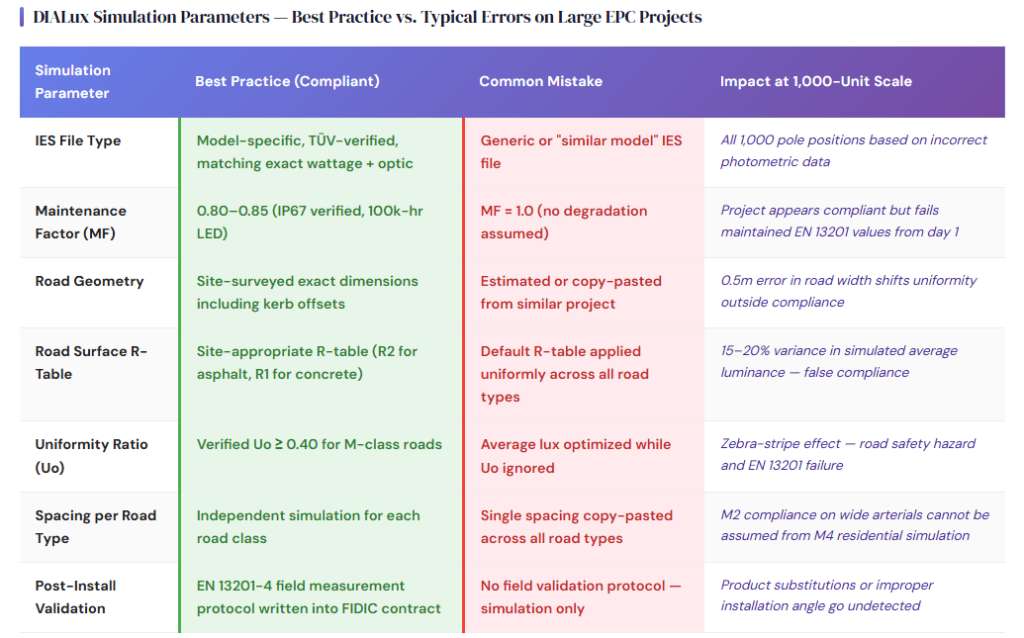
Mistake 1: Accepting Generic IES Files. A file generated for a 60W luminaire cannot validly represent a 40W fixture with a different optic ,even if both come from the same supplier catalogue. On a 1,000-unit project, a single IES mismatch applied uniformly across all simulation runs means every pole position in the project is based on incorrect photometric data.
Mistake 2: Omitting the Maintenance Factor. Simulations run with a Maintenance Factor of 1.0 (no degradation) show initial performance only. EN 13201 compliance is measured on maintained values. A project that passes at MF = 1.0 but fails at the correct MF of 0.75 will be non-compliant from day one of real-world operation.
Mistake 3: Copy-Pasting Spacings Between Road Types. A spacing that achieves M3 compliance on a 7-meter two-lane road will not automatically satisfy M2 requirements on a 10.5-meter four-lane arterial. Pole height, carriageway width, lane count, and road surface all interact. Each road type in a large project requires an independent simulation run.
Mistake 4: Ignoring Uniformity in Favour of Average Lux. A simulation that achieves an impressive average illuminance of 30 lx but delivers a uniformity ratio (Uo) of only 0.20 creates a zebra-stripe effect of bright and dark patches. EN 13201 M-class standards typically require Uo ≥ 0.40. Poor uniformity is not just an aesthetic problem ,it is a road safety hazard and a contractual failure.
Mistake 5: No Field Validation Protocol. DIALux is a pre-installation design tool. EN 13201-4 defines the post-installation measurement methodology. On projects without a structured field measurement protocol built into the FIDIC EPC contract, compliance claims rest entirely on the pre-installation simulation. If the installed product diverges from the IES file ,through substitution, damage, or improper installation angle ,there is no mechanism to detect or remedy the shortfall.
German Engineering Standards and Their Role in EPC Compliance
The reason German engineering standards are referenced as a benchmark in international EPC projects is not marketing ,it is traceability. TÜV-certified solar street lights go through independent third-party testing of lumen output, LED efficacy, IP rating, battery capacity, and MPPT controller performance. ISO 9001-certified manufacturing processes ensure that the unit installed on pole 947 in a 1,000-unit project performs the same as unit 1.
This matters for DIALux luminaire spacing optimization because the simulation is only as reliable as the product it models. When a German-engineered system specifies a luminaire output of 12,000 lumens at 80W, that figure comes from LM-79 photometric testing under controlled laboratory conditions. When the same IES file is loaded into DIALux, the simulation reflects a physical reality. The result: pole spacing decisions based on that simulation hold up in the field, in audits, and in the certification requirements required for bankable EPC contracts under multilateral development bank frameworks.
For procurement officers managing total cost of ownership for EPC projects, the quality of the photometric data underpinning the spacing simulation is a direct determinant of long-term cost. A project that installs 1,000 poles based on verified IES data from German-engineered luminaires with 50,000-100,000-hour LED lifespans avoids the remediation costs that befall projects built on marketing-grade photometric claims.
Conclusion: Spacing Is a System Decision, Not a Number
The most important takeaway from this guide is that DIALux luminaire spacing optimization is not a single-variable problem. Spacing, pole height, luminaire output, maintenance factor, road surface, and energy sizing interact as a system ,and every one of those variables must be verified before a result can be trusted at 1,000-unit scale.
The three decisions that determine project outcomes are: insisting on model-specific, third-party-verified IES files from suppliers; applying a defensible Maintenance Factor based on real LED depreciation and IP performance data; and coupling the photometric simulation with worst-month energy sizing to ensure that the luminaire actually delivers its rated output across the full operating life.
For EPC contractors, city planners, and procurement officers ready to build a 1,000+ unit solar street light project on a foundation of verified simulation data and German engineering quality, the team at solar-led-street-light.com is ready to provide project-specific DIALux simulation reports, model-specific IES files, and full EN 13201 compliance documentation. Visit solar-led-street-light.com to request a consultation or tailored project quote.
Frequently Asked Questions
Q1: What is DIALux luminaire spacing optimization and why is it critical for EPC projects?
DIALux luminaire spacing optimization is the process of using photometric simulation software to determine the ideal pole-to-pole distance for a street lighting system that meets specific illuminance, uniformity, and glare standards. For EPC projects, it is critical because spacing decisions made at the tender stage determine every pole position across the entire project ,errors multiply with scale and are expensive to correct after installation.
Q2: What is an IES file and why should procurement teams insist on model-specific files? An IES file is a standardized photometric data file that describes how a luminaire distributes light in three dimensions, measured under laboratory conditions. Model-specific IES files are generated for the exact product model, wattage, optic, and drive current being supplied. Using a generic or mismatched IES file in DIALux produces simulated results that do not reflect the product installed on site ,a discrepancy that surfaces during post-installation audits and creates contractual liability.
Q3: What EN 13201 parameters must a DIALux simulation demonstrate for M-class road compliance?
For EN 13201 M-class compliance, a simulation must demonstrate minimum average road luminance (Lavg), overall uniformity (Uo ≥ 0.40 for most M-classes), longitudinal uniformity (Ul ≥ 0.50 for M1–M4), and threshold increment (TI ≤ 15% for maintained installations) to control disability glare. All values must be calculated using maintained values, incorporating an appropriate Maintenance Factor.
Q4: How does the Maintenance Factor affect pole spacing on a large project?
The Maintenance Factor accounts for LED lumen depreciation, luminaire soiling, and component degradation over time. A lower MF requires a higher initial lumen output to meet maintained compliance thresholds ,which in turn may require either a more powerful luminaire or shorter pole spacing. For German-engineered solar street lights with verified IP67 ratings and 100,000-hour LED lifespans, an MF of 0.80–0.85 is defensible. For generic products with shorter lifespans, the MF drops to 0.65–0.70, forcing a more conservative ,and more costly ,spacing design.
Q5: What is the spacing-to-height ratio (S/H) and what are typical values for road lighting? The spacing-to-height ratio (S/H) is the pole-to-pole distance divided by the mounting height. It is a useful pre-simulation indicator of likely uniformity performance. For single-sided arrangements on narrow roads, a ratio of 3.0–3.5 is common. For double-sided staggered layouts on wider carriageways, ratios up to 4.0 are achievable with the right optic. However, S/H is a guideline only ,compliance must be confirmed through a full DIALux simulation using verified photometric data.
Q6: How do generic solar street lights create simulation-to-reality gaps in large projects? Generic solar street lights with self-reported LED efficacies of 100–130 lm/W, unverified IES data, and self-claimed IP ratings frequently deliver field performance 25–40% below simulated values. This gap occurs because the IES file used in simulation reflects a best-case laboratory scenario that the installed product cannot consistently replicate. On a 1,000-unit project, a 30% field shortfall across all poles means the entire scheme fails its performance baseline.
Q7: Can solar street lights achieve EN 13201 M-class compliance without dimming below compliance thresholds overnight?
Yes, but only with correctly sized energy systems. German-engineered solar street lights use A-class LiFePO4 batteries with 5,000+ charge cycles, panel sizing of 3–4× load power, and MPPT controllers at 95–98% efficiency. This combination ensures that the luminaire delivers its rated output ,and maintains EN 13201 compliance ,throughout the full operating night, even during multi-day overcast periods. Generic systems with undersized panels, PWM controllers, and recycled lithium-ion batteries frequently dim progressively through the night, producing early-night compliance and late-night failure.
Q8: What documents should a DIALux compliance report include for World Bank or ADB-funded tenders?
A complete DIALux compliance report for multilateral-funded EPC tenders should include: the applicable standard and lighting class; the specific luminaire model, wattage, lumens, and CCT; the IES file source and test laboratory name; the road geometry inputs; the Maintenance Factor with its derivation; and a results summary table showing all calculated values against required thresholds. Bids submitted without this documentation are increasingly disqualified as technically incomplete under current ADB and World Bank procurement frameworks.
References
- European Committee for Standardization (CEN). (2015). EN 13201-2: Road Lighting ,Part 2: Performance Requirements. https://www.en-standard.eu/csn-en-13201-1-4-road-lighting/
- European Committee for Standardization (CEN). (2015). EN 13201-3: Road Lighting ,Part 3: Calculation of Performance. https://www.en-standard.eu/csn-en-13201-1-4-road-lighting/
- DIAL GmbH. (2025). DIALux evo ,Professional Lighting Design Software. https://www.dialux.com/en-GB/dialux
- solar-led-street-light.com. (2025). DIALux Solar Street Light Simulation: EN 13201 Guide. https://solar-led-street-light.com/dailux-solar-street-light-simulation/
- Illuminating Engineering Society (IES). (2018). ANSI/IES RP-8-18: Roadway Lighting. https://www.ies.org/
- International Commission on Illumination (CIE). (2019). CIE 140:2019 ,Road Lighting Calculations. https://cie.co.at/
- LuxLuminaire. (2025). LED Street Lighting Design Guide: How to Achieve EN 13201 Compliance. https://solarstreetlighting.net/led-street-lighting-design-guide-how-to-achieve-en-13201-compliance
- Inlux Solar. (2026). IES & DIALux for Road Lighting: Inputs, Checklist & RFQ Clauses. https://www.inluxsolar.com/solar-street-light/resources/ies-dialux/
- solar-sourcing.com. (2024). How to Use DIALux for Solar Street Light Lighting Calculation. https://solar-sourcing.com/how-to-use-dialux-for-solar-street-light-lighting-calculation/
- European Commission. (2025). Draft Regulation on Drafting Lighting Studies for Outdoor Road Lighting. https://technical-regulation-information-system.ec.europa.eu/en/notification/25341/text/D/EN
Disclaimer
This article is for informational purposes only and does not constitute professional engineering, installation, or procurement advice. Performance specifications and costs may vary based on project requirements, location, and local regulations. Always consult qualified solar energy professionals and legal advisors before making procurement decisions.
For expert consultation on solar LED street lighting solutions, visit solar-led-street-light.com or contact our team for a customized quote.