
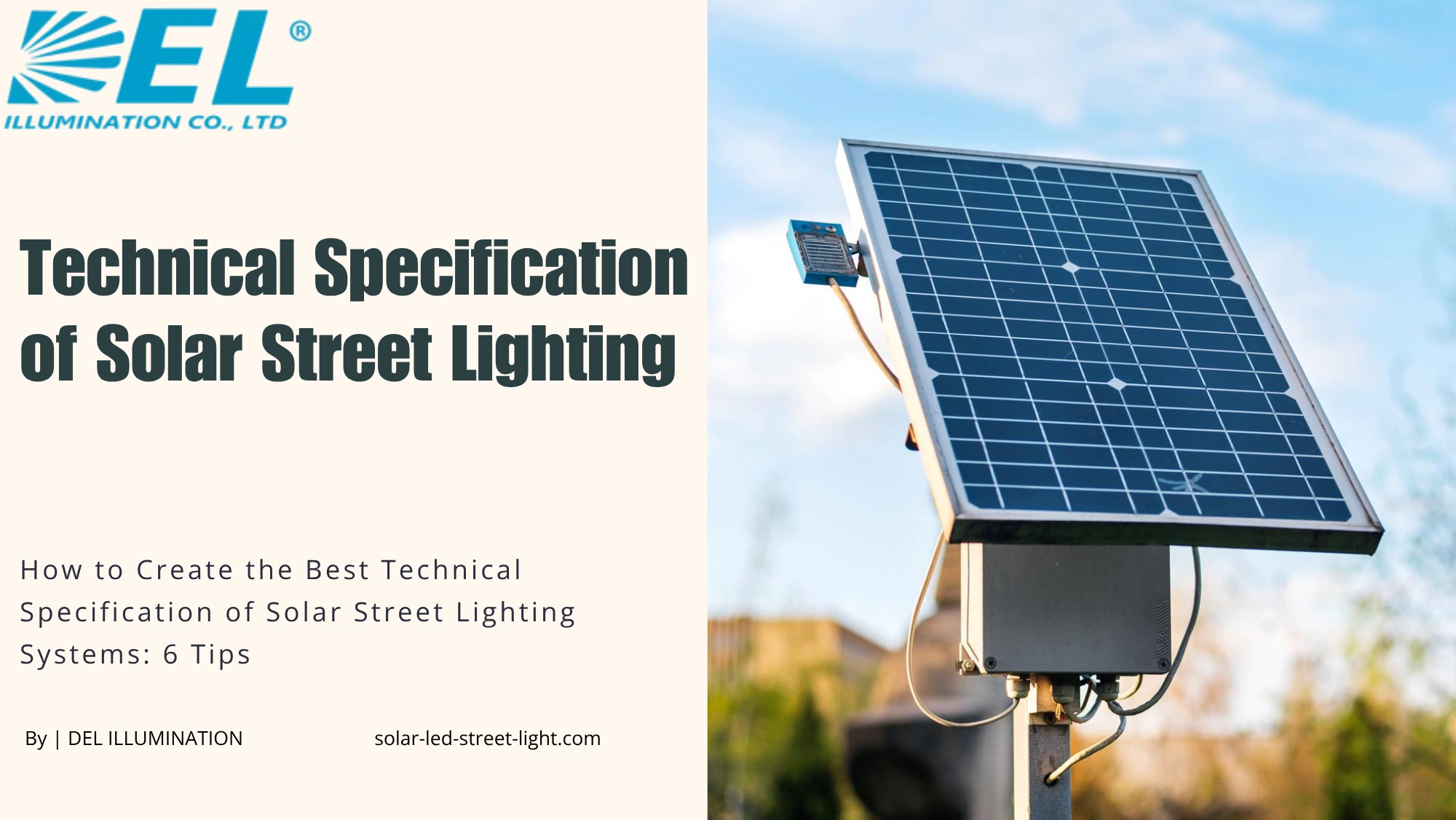
There are many different types of standards that a product, service, design, or material needs to follow. In the same way, there are a couple of methods manufacturers and consumers can use when describing a product, and the technical specification of solar street lighting is one of them.
A technical specification document lists several requirements that must be met for a product to be considered complete and functional as required. This type of product description is a requirement in the assembly and use of a product that is being advertised. Often, a technical specification is used by a developer, customer, or client for reference. It can also help you understand the configuration of the product, the hardware, and the software. A closely related document is the solar street light data sheet, which summarizes many of these same specs for buyers.
Technical Specification of Solar Street Lighting
Only the best technical specification of solar street lighting systems communicates clearly to the consumer and makes them want to buy solar street light. A solar street lighting system technical specification should include technical and physical details, followed by the functional and performance specifications. As you create this document, it is essential to also indicate the purpose and capacities. For the fundamentals of how the system works, our guide on the solar street light working principle is a helpful companion read.
Here is how to create one in 2026:
Physical Details or Definition
For technical specifications, you need to describe what you see when the solar street light is completely assembled. You will need to mention the various components that are visible and the role they play in the system. You will have to visualize the design of the solar street light and how different elements are mounted. You may also include where the product will be used, such as the suitable industry or area of application. Our post on the anatomy of solar LED street light luminaires breaks down these visible components.
This is a general description of the street light, including how the various components are housed. These components should be followed by a brief explanation of the functions they provide in the system.
At this point, you will have to describe how the street light is powered. This means you will have to describe the way electricity flows from the PV module until it reaches the luminaires. Most manufacturers prefer to use diagrams and visual aids, similar to those in our guideline for solar street light drawing.
Technical Details
In this section, you will have to provide more information about the various components you mentioned in the physical details section. A complete technical specification of solar street lighting typically breaks this down into five component groups:
1. PV Module
Here, you will need to mention the type of PV module, the power output, the open circuit voltage, its efficiency, number of cells, tilt angle (if required), output peak watt capacity, coatings, and the standards the component needs to meet. To understand these modules better, see our post on what photovoltaic street lights are, and on why the solar panel glass is crucial.
2. Battery
Here you will need to mention the battery make and type, the capacity, charge current, the permitted rate of discharge, power supply specs, mounting position, back up, housing specifications, and the standard requirements met by the component. You may also give a description of how protection is achieved. It may also be necessary to indicate the manufacture date. Our 10 tips to maintain your solar street light battery explain what makes a durable battery.
3. Light Source
In terms of the light source, you should mention the type of bulb used, the system wattage, the efficiency at system and bulb levels, correlated color temperature (CCT), dimming capability, and other standards met by the product. You may also include the luminaire housing, mounting height, and how protection is achieved. Our comparison of HPS lights vs LEDs in outdoor solar street lamps explains why light source choice matters.
4. Electronics
This part of the document accommodates all electrical aspects of solar street lighting. There is a need to mention the electronic efficiency, the load current to be used (DC or AC), the type of installation, the wiring required, the control mechanism or technology used, and other standards met by the various electronic products. Our guide to the solar street light controller covers control technology in detail.
You may also give an account of equipment such as the Maximum Power Point Tracking (MPPT) battery controllers, circuit breakers, chargers and inverters; information required may include the type, power supply specs, frequency, output wave, cooling method, efficiency, protection, and operating conditions. For the circuit side of things, see our guide on how to make a smart solar street light circuit.
This section may also include a brief description of the earth protection with great detail of the components used and the conditions required.
5. Mechanical Components
Mechanical components may include, but are not limited to, poles, cables, mounting and housing structures, fasteners, and accessories. The material used in the making of these components should be mentioned, and the corrosive resistance and the weatherproof nature should be indicated.
For the pole, you may provide details such as the type of material used, the height, the coating, and its wind speed resistance. Our 9 factors for choosing solar power light poles cover pole specifications in depth. As for the cables, you should try to describe the material used, the type of insulation, and dimensions.
Functional and Performance Specifications
The functional and performance specification deals with what the solar street lighting system does and what it can deliver. The functional specification specifies the functions that the solar street lighting system must perform, while the performance specifications specify the operational requirements or desired outcomes from the product.
Here you may include the environmental conditions that you must take into account for the design and operation of the product. These include conditions such as the ambient temperature, rainfall, relative humidity, seismic conditions, and climatic area classification. Do not forget to include the system’s duty cycles and protection ratings, such as an IP65 rating for dust and water resistance.
The Quality and Warranty
In this section, you will have to mention the quality standards that have been met or should be achieved by the component. Here, you are required to provide the quality control measures that you will use to ensure that the product is according to the client’s specifications. It is also essential to define the QA/QC, inspection, and testing activities. Choosing a reputable solar street light factory makes meeting these quality standards far easier.
The next thing that should follow is the warranty of the PV module, battery, luminaire, inverter, and any component that requires one.
International Codes and Standards
In this part of the document, you will have to provide the full list of standards and codes used in the design of the product. For guidance on efficient LED design standards, the U.S. Department of Energy is a helpful authoritative reference.
Packing and Storage
This marks the final process of the product development, ready for storage or shipping. You will have to cover transport and storage specifications. Other information includes protection against corrosion and the storage period. You may also include the requirements for the preservation of the product (equipment and materials) for long term storage after delivery. For import projects, our post on the 7 reasons an accurate solar street light HS code matters is also useful.
Technical Specification of Solar Street Lighting: Conclusion
It is expected that you write the technical specification of solar street lighting in the language of the target audience. The technical specification of solar street lighting can be presented in table form or in detailed paragraphs. Therefore, you will have to break down the solar street lighting system into its various components and gather enough information on each product before drafting the final document. For a broader buying reference, see our list of the 10 things about the best solar street lights.
Harness the Sun. Get Solar Power Today!
FAQs: Technical Specification of Solar Street Lighting
1. What is a technical specification document used for in solar street lighting?
A technical specification document lists the requirements a solar street lighting product must meet to be considered complete and functional. It’s used by developers, customers, and clients as a reference to understand the product’s configuration, from the hardware down to the control electronics, and to confirm the product meets the required performance and safety standards before it’s manufactured, purchased, or installed.
2. What are the main sections of a solar street lighting technical specification?
A thorough technical specification of solar street lighting typically covers physical details and definitions, technical details for each component (PV module, battery, light source, electronics, and mechanical components), functional and performance specifications, quality and warranty terms, international codes and standards, and packing and storage requirements.
3. Why should electronics like MPPT controllers be documented separately from the battery?
The battery section covers the storage device itself: capacity, discharge rate, housing. The electronics section covers how power actually flows and is regulated, including MPPT controllers, circuit breakers, chargers, and inverters. Separating these lets a reader assess the charging and protection system independently from the battery’s raw storage specs, which matters when comparing components from different suppliers.
4. Should a technical specification be written differently depending on who reads it?
Yes. It is expected that you write the technical specification in the language and level of detail appropriate to the target audience. A specification aimed at a procurement team may lean more on standards, certifications, and warranty terms, while one aimed at an installation crew may need more diagrams and physical mounting detail.
5. What environmental conditions should be included in the performance specification?
At minimum, ambient temperature range, rainfall exposure, relative humidity, seismic conditions where relevant, and the climatic area classification of the install site. These conditions directly affect component selection, for example, batteries rated for high heat, poles rated for wind load, or IP rated housings for high humidity or coastal environments, so they belong in the performance specification rather than being left implicit.