
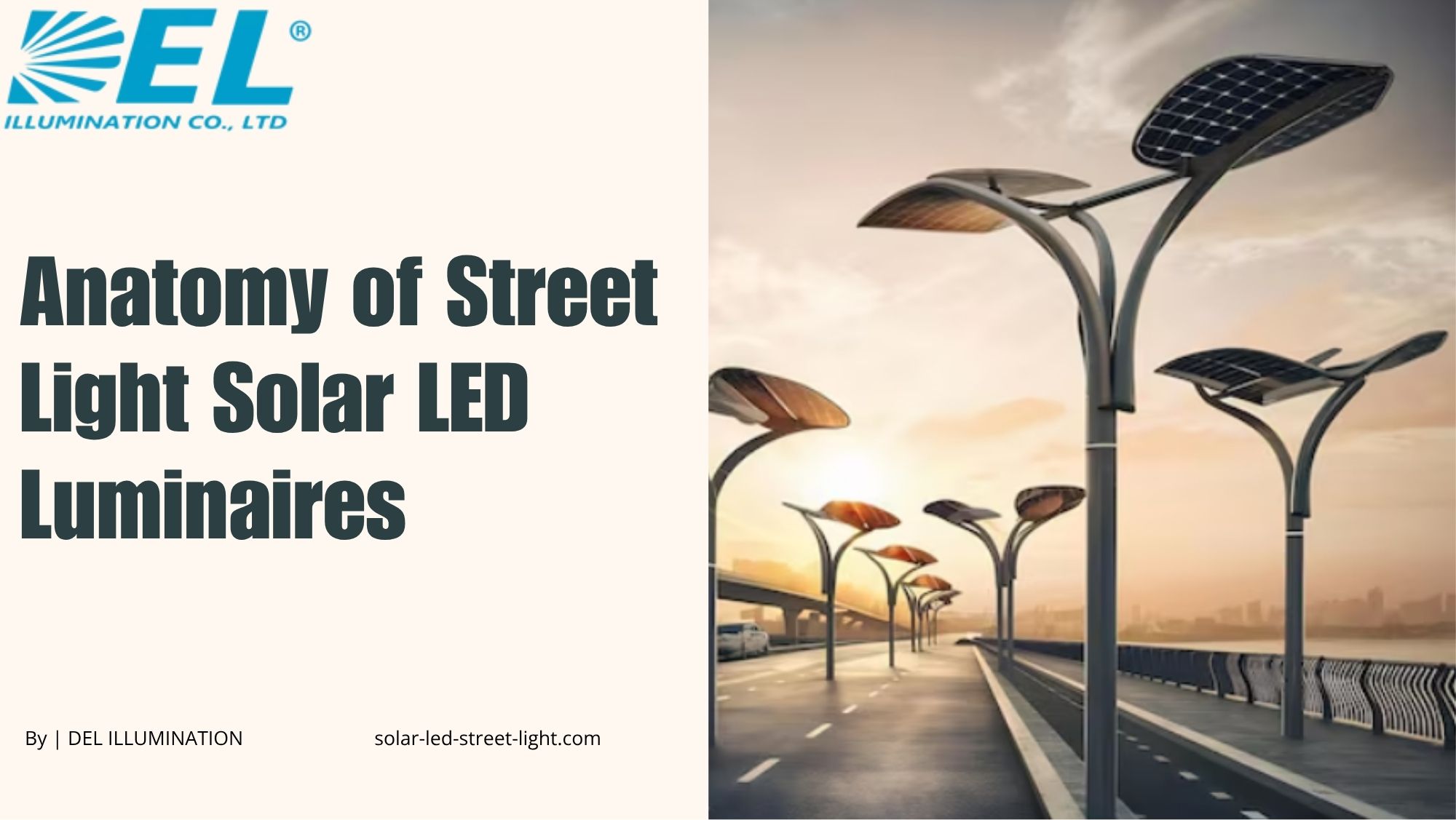
There is a dramatic increase in investment in energy-efficient street light upgrades and retrofits across companies and communities worldwide. What stands out most are the designs and diverse nature of street light solar LED fixtures available in today’s market. The marketplace offers a wide range of lighting fixtures to meet every system or project requirement -from residential pathways to large-scale municipal infrastructure.
The sudden shift from old-style High-Pressure Sodium (HPS) lamps to LED (Light Emitting Diode) technology in solar-powered streetlights has fundamentally influenced the design, efficiency, and style of modern luminaires. If you’re exploring the power of solar street lamps for your next project, understanding luminaire anatomy is the logical first step.
Before you invest in a street light solar LED system, it is best to understand the anatomy of each component in the whole unit. In this article, we will examine the anatomy of street light solar LED luminaires in detail -from basic manual fixtures to advanced all-in-one smart units.
Street Light Solar LED Structure
Now let’s explore the structures and organization of the light sources you are likely to encounter when selecting or designing your street light solar LED system. Each type serves a specific purpose, and knowing the differences helps you make smarter procurement and design decisions.
1. The Standard Manual LED Luminaire
A standard LED luminaire does not have much to show apart from the essential components that are interconnected to produce light. This type is common in split street light solar LED designs -typically overhead solar light fixtures and sometimes decorative types depending on the application. Unlike traditional HPS fixtures, these products support directional lighting applications with greater efficiency.
The product consists of:
- Replaceable LED units with LED chips
- Individual optical lens for each LED
- Tempered cover glass
- Aluminum alloy or polymeric material housing or casing
- Mounting bracket or connector
- Connecting cable
- Screws and gaskets
The finishing can vary -options include black, white, bronze, gray, and silver. Wattage varies depending on your needs: 20W, 30W, 40W, 60W, or 80W. As wattage changes, lumens also differ based on luminous efficacy. For a deeper look at how wattage and spacing interact, see our guide on how to calculate distance for LED solar area lights.
2. The Standard Automatic LED Luminaire
This category adds the element of automation to switch the street light solar LED system on and off at the required time of day -usually at dusk. Most manufacturers use transistor and sensor technology to achieve the automatic switching function.
What differentiates this category is the inclusion of a Light Dependent Resistor (LDR), photodiode, or phototransistor. These sensors detect ambient light levels and trigger the luminaire accordingly, eliminating the need for manual intervention. This is particularly useful in remote or unmanned installations. Learn more about designing and constructing automatic solar street lights in our dedicated guide.
3. LED Luminaires with Dimming
The key difference between this type of street light solar LED luminaire and the standard one is that it is dimmable. Systems in this category use automation to control the brightness of the lights based on time schedules or ambient conditions -an excellent way to save energy during low-traffic hours.
The product consists of:
- Replaceable LED units with LED chips
- Ambient Light Sensor (ALS)
- Individual optical lens for each LED
- Tempered cover glass
- Electronic dimming drivers
- Aluminum alloy or polymeric material housing or casing
- Mounting bracket or connector
- Screws and gaskets
The most common light distribution types for these luminaires are Type I, II, III, and V. Luminaires may share similar compositions, but styles differ -common forms include square, circular, oval, architectural, UFO, Flying Fish, Cobra Head, Airplane-shaped, Eagle-like, and Orchid-like. To understand the full range of innovations in this space, explore our article on 4 LED solar street light innovative solutions.
4. LED Luminaires with Motion Detection
Street light solar LED units with motion detection are ideal in situations where activity below the fixture should control the lighting behavior. These systems intelligently dim down during inactivity and brighten when movement is detected -maximizing battery efficiency without compromising safety.
Components include:
- Replaceable LED units with LED chips
- Individual optical lens for each LED
- Passive Infrared Sensor (PIR motion sensor)
- Tempered cover glass
- Electronic dimming drivers
- Aluminum alloy or polymeric material housing or casing
- Mounting bracket or connector
- Screws and gaskets
This type of street light solar LED is increasingly popular in parks, parking lots, and low-traffic residential streets. If you’re installing lights in a recreational area, our park solar lights installation guide provides step-by-step instructions. You may also want to explore the 9 benefits of solar light remote control technology for enhanced automation options.
5. All-in-One Luminaire
The all-in-one street light solar LED luminaire combines all components -except the pole -into a single, compact unit. These products offer minimal installation time, maximum ease of assembly, and reduced maintenance complexity. They are among the most popular choices for modern solar deployments.
Components in an all-in-one luminaire include:
- Replaceable LED units with LED chips
- Rechargeable and replaceable battery
- Individual optical lens for each LED
- Controller and inverter
- Tempered cover glass
- Electronic dimming drivers
- Aluminum alloy or polymeric material housing or casing
- Mounting bracket or connector
- Screws and gaskets
In this design, no external cables are required. You simply mount the fixture on the pole and it is ready to produce light. The presence of inverters in these luminaires means they can operate under both AC and DC solar power supply -a major advantage for flexible installations.
For a complete breakdown of why this format is gaining global traction, read our article on the 7 benefits of all-in-one street light technology.
Key Design Considerations for Street Light Solar LED Luminaires
In terms of visual comfort, some luminaires use diffusers or optimized lenses. These optical elements are engineered so they do not affect the performance of the street light solar LED source itself.
The material used in lighting fixtures must offer corrosion and wind resistance. Luminaires with high IP ratings provide comprehensive protection against moisture and dust -a non-negotiable feature for outdoor deployment. Read about the 5 benefits of IP65 solar street lights to understand why this rating matters.
The size of the light head depends heavily on the components the manufacturer integrates into the fixture. The type of control you want -Light sensing, Time-based, or Human (PIR) sensing -will determine which sensor is installed.
Modern street light solar LED design ensures compatibility with the most advanced LED technology on the market. When designing your luminaire selection, go beyond wattage and lumens. Consider:
- Luminous efficacy (lumens per watt)
- Quality certifications (CE, RoHS, UL)
- Waterproof and dustproof rating (IP Rating)
- Working temperature range
- Vandal resistance
- Lifespan (50,000 – 100,000 hours)
- Color temperature (3000K, 4000K, 6000K)
- Color Rendering Index (CRI)
For a comprehensive overview of what to look for, check out our guide on the 10 things that define the best solar street lights and the 9 factors for setting up a solar street light LED system.
The Role of Solar Street Lights in Global Energy Transition
The growing adoption of street light solar LED technology is not just a local trend, it is part of a global economic shift toward renewable energy infrastructure. Municipalities, developers, and urban planners are recognizing that solar LED street lighting reduces grid dependency, cuts electricity bills, and lowers carbon emissions simultaneously.
If you want to understand the larger context behind this shift, read our article on solar road lights and global economic growth. Additionally, choosing the right pole and post system is equally important to explore our insights on 5 advantages of solar light pole systems and 4 tips to invest in a solar street light post.
Street Light Solar LED: Conclusion
Understanding the anatomy of street light solar LED luminaires is crucial during the design phase of any lighting project. It defines the technology used and the features you can expect during operation.
Knowing the various components inside a street light solar LED fixture also simplifies maintenance. With component specifications in mind, replacements and optimizations become straightforward. Whether you’re managing a large municipal network or a small residential installation, this knowledge provides a strong foundation for saving energy and reducing total system cost.
If your system ever runs into issues, our guide on 5 ways to fix a solar light not working is a practical troubleshooting resource. For those evaluating pole placement and configuration, our article on 9 factors for choosing solar power light poles is equally valuable.
You may also want to check our article on Factors of Consideration in Solar Panels for Street Light Costs.
Frequently Asked Questions (FAQs)
Q1. What is a street light solar LED luminaire?
A street light solar LED luminaire is a lighting fixture that uses solar energy stored in a battery to power LED light sources. It typically consists of LED chips, optical lenses, a housing unit, and a mounting system and may also include sensors, controllers, and inverters depending on the type.
Q2. What are the main types of street light solar LED luminaires?
The main types include: Standard Manual LED luminaires, Standard Automatic LED luminaires, Dimmable LED luminaires, Motion Detection LED luminaires, and All-in-One LED luminaires. Each type serves a different application and offers varying levels of automation and energy efficiency.
Q3. What IP rating should a street light solar LED have?
For outdoor use, a minimum IP65 rating is recommended. This ensures the luminaire is fully protected against dust ingress and low-pressure water jets, making it suitable for year-round outdoor installation in various weather conditions.
Q4. How long do street light solar LED luminaires last?
High-quality street light solar LED luminaires are designed to last between 50,000 and 100,000 hours of operation. This translates to 10–20+ years of service life under normal operating conditions, significantly reducing maintenance and replacement costs.
Q5. What is the difference between a split solar street light and an all-in-one solar street light?
A split solar street light system has separate components: the solar panel, battery, and luminaire are installed independently, often connected by cables. An all-in-one solar street light integrates all these components into a single unit mounted directly on the pole, making installation faster, simpler, and more cost-effective.