
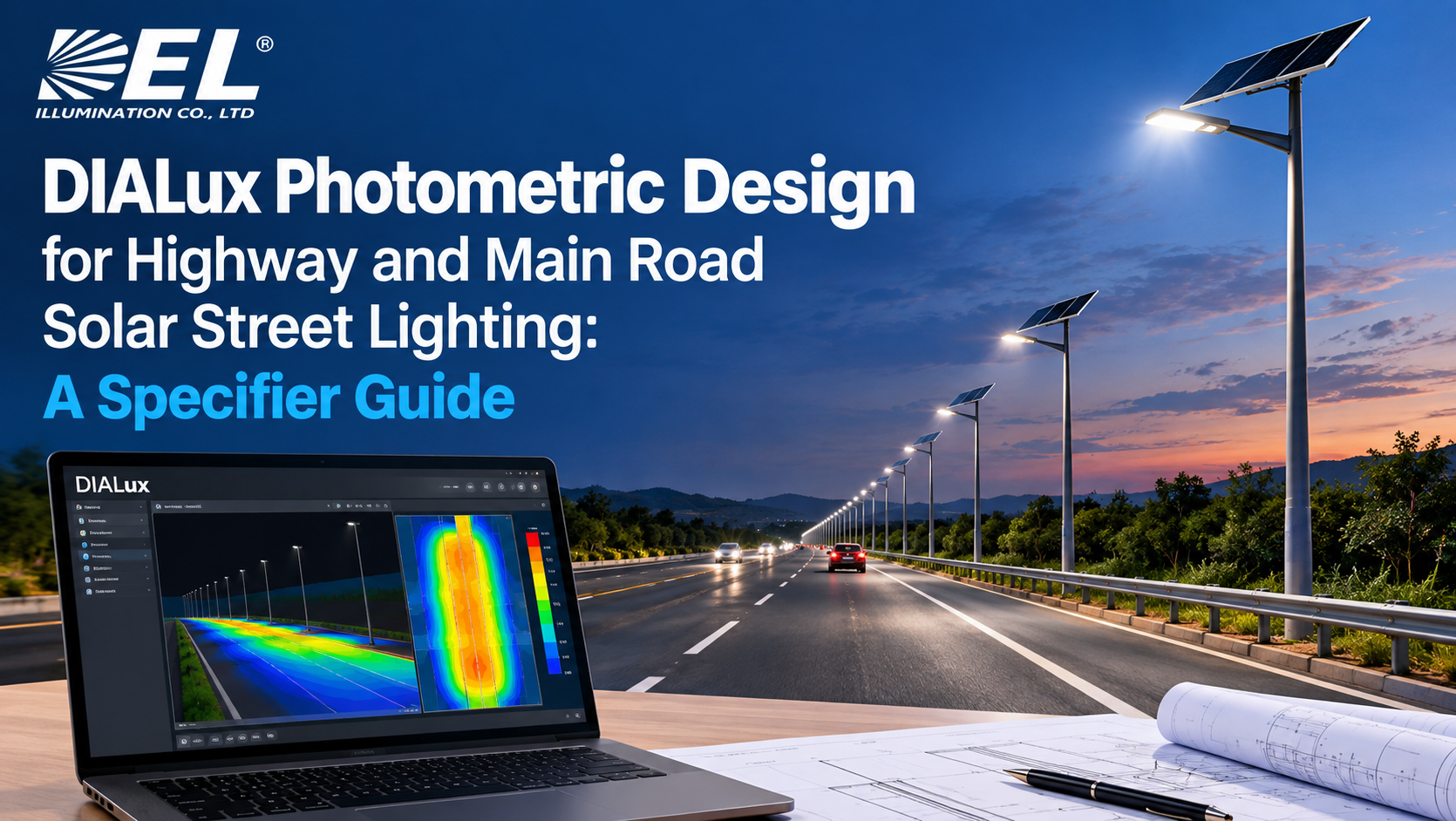
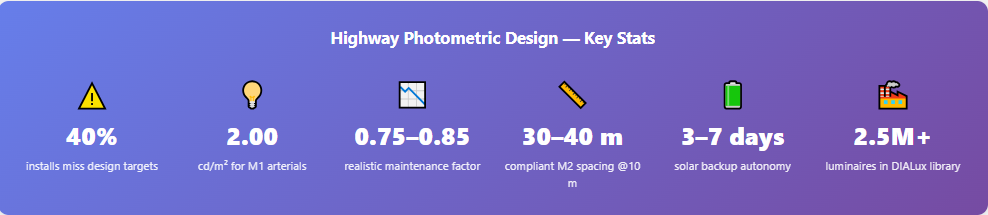
Field audits across emerging markets reveal a sobering statistic: up to 40% of solar street lighting installations fail to meet their design illuminance targets once switched on. On highways and main roads, where a driver travelling at 100 km/h covers nearly 28 metres per second, an underlit carriageway is not a cosmetic flaw. It is a safety liability that produces rejected handovers, costly re-lamping, and avoidable accidents. The root causes are almost always the same: oversized pole spacing, incorrect optical selection, unverified photometric files, and maintenance factors that were quietly ignored.
This guide explains how DIALux lighting design closes that gap, how EN 13201 lighting classes translate into measurable targets, and why the quality of your photometric data determines whether a solar highway lighting scheme performs for 12 years or fails within 18 months.
Why Highways Demand Photometric Proof, Not Wattage Charts
A wattage figure tells you nothing about how light lands on a road. Two 120 W luminaires can produce completely different results on the same carriageway depending on their optical distribution, mounting height, and pole spacing. This is the fundamental reason procurement officers and EPC contractors have moved away from lumen-per-watt marketing toward verified DIALux lighting design.
DIALux is the industry-standard software for this verification, with a free platform hosting over 2.5 million luminaires from more than 400 manufacturers. Proper DIALux lighting design calculates exactly how a proposed scheme will deliver illuminance, luminance uniformity, and glare control on the real road surface before a single pole is erected. For a professional solar street light manufacturer supplying infrastructure and municipal projects, this simulation is the evidence that turns a claimed specification into a bankable deliverable.
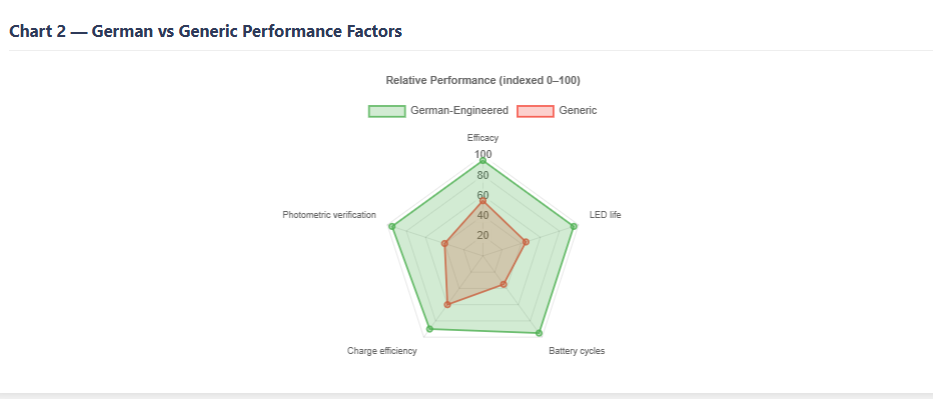
For highway and main-road projects, the stakes are highest. These roads typically fall into the most demanding EN 13201 categories, requiring the tightest tolerances on uniformity and glare. A DIALux lighting design report for tenders is increasingly a mandatory bid document, not an optional extra. German-engineered luminaires strengthen these simulations because their photometric files are measured in accredited, TÜV-witnessed laboratories, meaning the fixture modelled in software is genuinely the fixture that arrives on site. Generic suppliers frequently offer self-declared or generic files, which is why experienced specifiers treat any bid without model-specific photometry as high risk.
Understanding EN 13201 Lighting Classes for Main Roads
EN 13201 is Europe’s harmonised road lighting standard, developed by CEN/TC169, and it functions as the default procurement baseline across Europe, the Middle East, North Africa, and many development-bank-financed contracts. For highways and main roads, the M-class family applies, and it is built around road surface luminance (the brightness a driver actually perceives) rather than illuminance in lux.
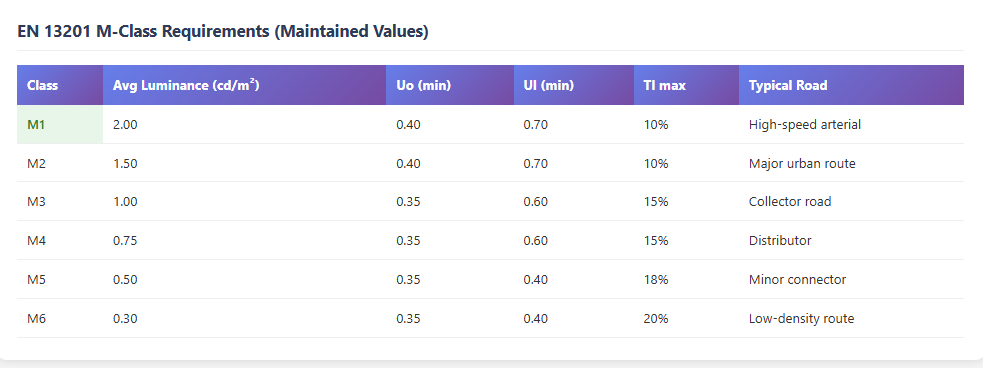
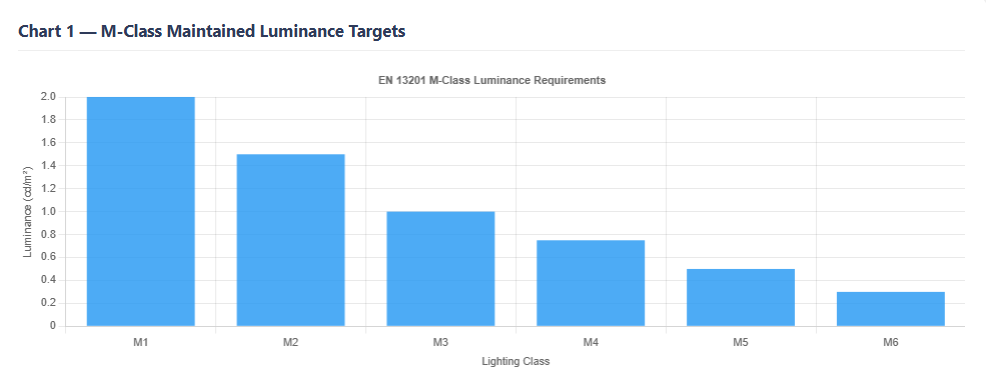
The six M-classes set a clear hierarchy of maintained average luminance:
- M1 requires 2.00 cd/m² for arterial roads with heavy, fast traffic
- M2 requires 1.50 cd/m² for major urban routes
- M3 requires 1.00 cd/m² for collector roads
- M4 requires 0.75 cd/m² for lower-speed distributors
- M5 requires 0.50 cd/m² for minor connecting roads
- M6 requires 0.30 cd/m² for the lowest-density routes
Luminance alone is not enough. For M1 roads, EN 13201 also mandates overall uniformity (Uo) of at least 0.40, longitudinal uniformity (Ul) of at least 0.70, and a threshold increment (TI) capped at 10%. Threshold increment measures disability glare, the momentary loss of vision when a bright source enters the driver’s field. Getting these three secondary metrics right is where most amateur designs collapse, because pushing average luminance up often worsens uniformity or glare unless the optical distribution is genuinely suited to the road geometry.
The DIALux Workflow: From Road Geometry to Compliant Scheme
Defensible DIALux lighting design follows a disciplined sequence, and skipping any step undermines the entire result.
- Model the exact geometry. Enter carriageway width, number of lanes, median, verge, and pole arrangement (single-sided, opposite, or staggered). Highway cross-sections with dual carriageways demand accurate median modelling.
- Select the correct lighting class. Use the CEN/TR 13201-1 guidance companion to match the road’s speed, traffic volume, and conflict density to an M-class.
- Load model-specific photometric files. Import the IES or LDT file measured for the exact luminaire proposed. Both formats encode the complete three-dimensional light distribution captured by a goniophotometer.
- Set the road surface reflectance table. Newly laid asphalt typically follows the R3 surface class; cement-treated surfaces may need R2. This choice directly affects the luminance result.
- Apply a realistic maintenance factor. Never accept a simulation run at MF = 1.00.
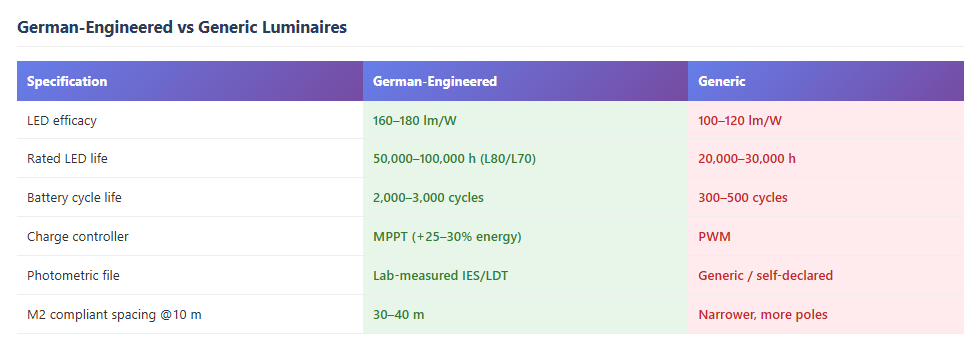
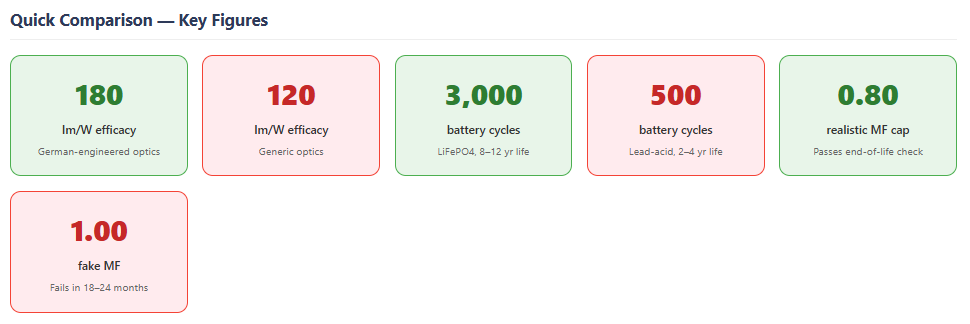
Once these inputs are set, DIALux calculates results across evaluation fields, producing isolux diagrams, value charts, and grid-point tables. This is where DIALux lighting design earns its value through pole spacing optimization: the designer tests successive spacings, tracking uniformity and TI at every iteration until the widest compliant spacing is found. On a typical M2 highway with 10-metre mounting height, German-engineered luminaires delivering 160 to 180 lm/W efficacy frequently achieve compliant spacings of 30 to 40 metres, whereas generic optics at 100 to 120 lm/W force poles closer together, driving up pole counts and total project cost.
The Maintenance Factor: The Number That Separates Real from Fake Compliance
The single most common cause of highway lighting failure is a simulation that looks perfect at handover but fails verification 18 to 24 months later. The culprit is almost always the maintenance factor.
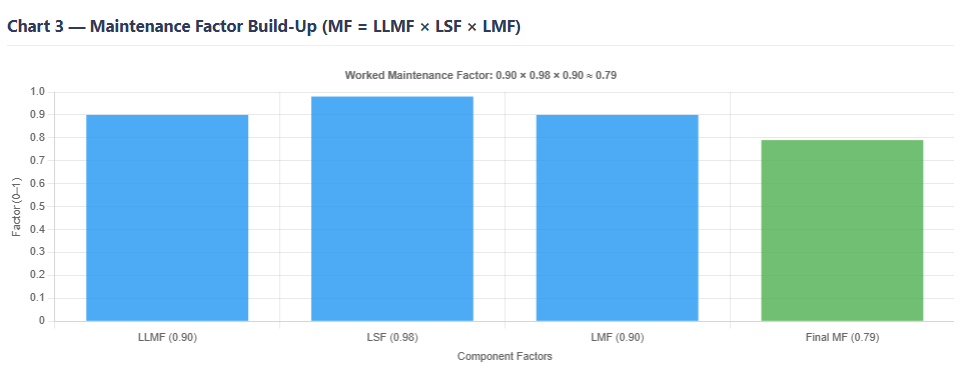
EN 13201 specifies maintained values, not initial values. A luminaire loses output over its life through LED lumen depreciation, dirt accumulation on the optics, and occasional component failure. The maintenance factor folds these into a single multiplier, calculated as MF = LLMF × LSF × LMF (Lamp Lumen Maintenance Factor × Lamp Survival Factor × Luminaire Maintenance Factor).
For a well-maintained LED system, a realistic MF falls between 0.75 and 0.85. A worked example makes this concrete: 0.90 × 0.98 × 0.90 gives roughly 0.79. Many rigorous tenders now cap the permitted maintenance factor at 0.80, meaning the design must deliver 25% more light at commissioning than the class minimum, so it still complies at end of life.
This is where German engineering standards deliver measurable advantage. Premium luminaires rated at 50,000 to 100,000 hours at L80 or L70 (the point at which output falls to 80% or 70% of initial value) sustain a higher LLMF, allowing wider compliant spacing under the same maintenance factor. Generic fixtures rated for 20,000 to 30,000 practical hours degrade faster, forcing conservative spacing or premature failure. Over a 10-year lifecycle, this difference determines whether operational cost approaches zero after payback or whether replacement cycles drive total cost two to three times higher.
Real-World Application: Specifying a Compliant Highway Tender
Consider a dual-carriageway arterial requiring M2 compliance. The specifier’s job is to write RFQ clauses that make competing bids genuinely comparable and to reject unverifiable claims. A well-drafted clause reads: the bidder shall submit a DIALux lighting design report for each road type using verified IES files, demonstrating compliance with the specified EN 13201 class using a maintenance factor no greater than 0.80.
That single sentence eliminates the most common tricks. It forces model-specific photometry, so no supplier can substitute a favourable generic file. It fixes the maintenance factor, so no bidder can inflate spacing by pretending the fixture never ages. And it ties the deliverable to a named class, so uniformity and glare are non-negotiable.
A complete highway lighting package should also include the pole layout drawing, the assumption list (mounting height, tilt, R-table, target class), and an energy-yield simulation for solar schemes. This last point is critical and frequently forgotten: a solar highway scheme that is optically perfect but cannot recharge after three overcast days will still fail in service.
German-engineered solar systems address this with LiFePO4 batteries rated for 2,000 to 3,000 cycles and 8 to 12 years of calendar life, combined with MPPT charge controllers that harvest 25 to 30% more energy than basic PWM units, and backup autonomy sized for 3 to 7 days depending on local climate. Sourcing from a commercial solar street light manufacturer that supplies both the photometry and the energy model keeps these two workstreams aligned, because the DIALux lighting design and the energy design must be validated together, never in isolation.
Conclusion
Three takeaways matter most for anyone specifying highway or main-road solar lighting. First, wattage means nothing without photometric proof: DIALux lighting design built on model-specific IES or LDT files is the only reliable evidence a scheme will perform. Second, EN 13201 compliance is defined at end of life, not at handover, which means a realistic maintenance factor of 0.75 to 0.85 is the difference between genuine and fake compliance. Third, German-engineered luminaires with verified photometry, high efficacy, and long L80 life allow wider compliant spacing, fewer poles, and dramatically lower 10-year cost of ownership.
For expert DIALux lighting design, verified IES files, and photometric reports built to EN 13201 for your highway and main-road projects, visit solar-led-street-light.com to request a consultation or a customised quote.
Frequently Asked Questions
What information does a supplier need before running a DIALux lighting design for a highway?
The supplier needs the carriageway width and number of lanes, the pole arrangement and mounting height, the target EN 13201 class, and the road surface reflectance table. Without a defined class and geometry, any resulting spacing claim is unverifiable and should be treated as high risk.
Can I trust a spacing figure quoted without an IES file?
No. Pole spacing, uniformity, and glare all depend on the luminaire’s real photometric distribution, which only a model-specific IES or LDT file describes. A spacing claim based on a wattage chart or a generic file should be classified as unverified and high risk.
What is the difference between an IES file and an LDT file?
Both store the measured light distribution of a luminaire, but IES (LM-63 format) is the North American standard while LDT (Eulumdat) is common in German and European projects. DIALux evo accepts both, so either is acceptable provided it was measured for the exact fixture being offered.
Why does the maintenance factor matter so much on highways?
Highways demand the tightest uniformity and glare tolerances, leaving little margin for light loss over time. If a design assumes no depreciation (MF = 1.00), it will typically fall below its target luminance within 18 to 24 months and fail verification, so a realistic factor around 0.80 is essential.
Does a warmer colour temperature affect EN 13201 compliance?
EN 13201 sets no colour temperature requirement, so a warmer 3000 K source can be fully compliant. Warmer light is often preferred near residential areas and habitats to reduce skyglow and glare discomfort, though optical control matters far more than colour for meeting the standard.
How much wider can spacing be with high-efficacy German-engineered optics?
Because efficacy of 160 to 180 lm/W delivers more usable light on the road than 100 to 120 lm/W generic optics, compliant spacing on an M2 route can often reach 30 to 40 metres at 10-metre mounting height. Wider spacing means fewer poles, which reduces both capital cost and civil works.
Do solar highway schemes need a separate energy simulation?
Yes. A photometric simulation proves the light lands correctly, but a separate energy-yield calculation proves the system can recharge and sustain output through cloudy periods. Both must be validated together, with battery autonomy typically sized for 3 to 7 days depending on climate.
Which standard applies if my project is outside Europe?
EN 13201 is widely used across Europe, the Middle East, North Africa, parts of Southeast Asia, and many development-bank-financed contracts. Projects following North American norms typically use the AASHTO Roadway Lighting Design Guide or IES RP-8 instead, so confirm the governing standard before selecting a class.
References
- European Committee for Standardization (CEN). (2015). EN 13201-2:2015 Road lighting Part 2: Performance requirements. https://www.en-standard.eu/csn-en-13201-1-4-road-lighting/
- DIALux (DIAL GmbH). (2025). Street Lighting with DIALux evo. https://www.dialux.com/en-GB/street-lighting
- POLAB. (2026). EN 13201 The Road Lighting Standard’s Classes and Requirements. https://www.polab.se/en/knowledge/en-13201-road-lighting-standard.html
- COST-LoNNe. (2026). EN 13201 Explained: Road Lighting Standard and Its Gaps. https://cost-lonne.eu/solutions/en-13201-explained/
- Swedish Transport Administration (Trafikverket). (2024). VGU 2024 (TRVINFRA-00396) Road Design Framework, Chapter 13: Lighting. https://www.trafikverket.se/
- LuxLuminaire (Mir Group). (2025). LED Street Lighting Design Guide: How to Achieve EN 13201 Compliance. https://solarstreetlighting.net/led-street-lighting-design-guide-how-to-achieve-en-13201-compliance
- Illuminating Engineering Society. (2024). ANSI/IES LM-63: Standard File Format for the Electronic Transfer of Photometric Data. https://www.ies.org/
- AGC Lighting. (2023). A Guide to Understanding Lighting Maintenance Factor. https://www.agcled.com/blog/guide-understanding-lighting-maintenance-factor.html
Disclaimer: This article is for informational purposes only and does not constitute professional engineering, installation, or procurement advice. Performance specifications and costs may vary based on project requirements, location, and local regulations. Always consult qualified solar energy professionals and legal advisors before making procurement decisions.
For expert consultation on solar LED street lighting solutions, visit solar-led-street-light.com or contact our team for a customised quote.