
When Phoenix, Arizona saw solar street light battery failures reach 35% within 18 months during the scorching summer of 2023, city planners faced a harsh reality: generic solar lighting systems weren’t built for extreme climates. Meanwhile, across hot regions from the Middle East to Southeast Asia, Engineering, Procurement, and Construction (EPC) contractors wrestle with the same challenge delivering reliable German engineered solar street lights that survives conditions where temperatures routinely exceed 50°C (122°F) and battery compartments become literal ovens.
The solution lies not in buying more units or accepting frequent replacements, but in understanding how precision engineering solves climate-specific failures at the root. This article examines how research-backed design principles developed through rigorous testing protocols deliver German engineered solar street lights that maintain performance in the world’s most punishing environments and why this matters for EPC project success.
The Hidden Cost of Generic Solar Systems in Extreme Heat
Most procurement decisions focus heavily on upfront costs, yet the true financial impact emerges over time. Generic solar street light systems typically cost $300–1,200 per unit but field data from hot-climate installations reveals troubling patterns.
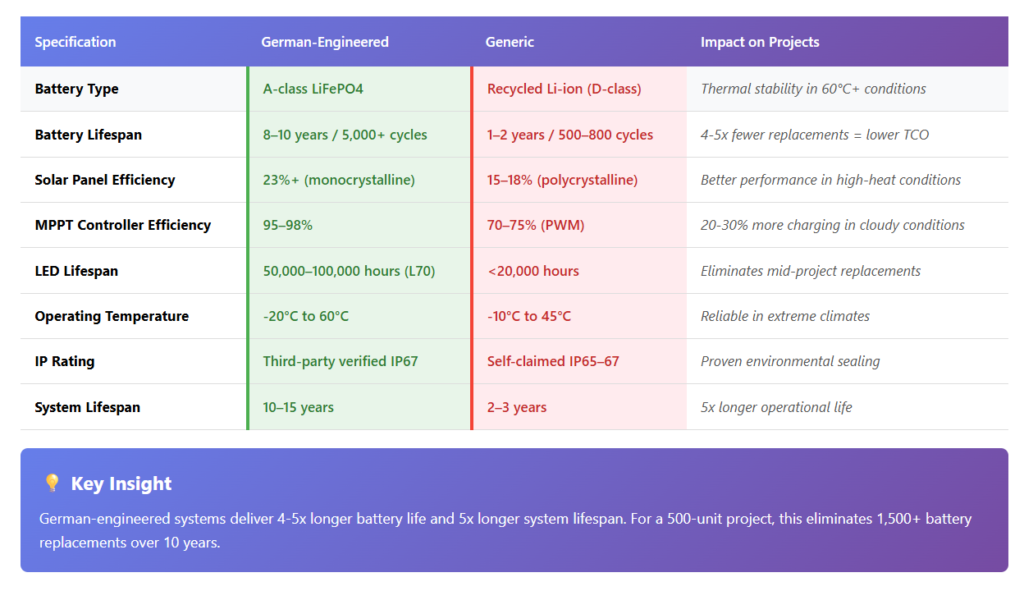
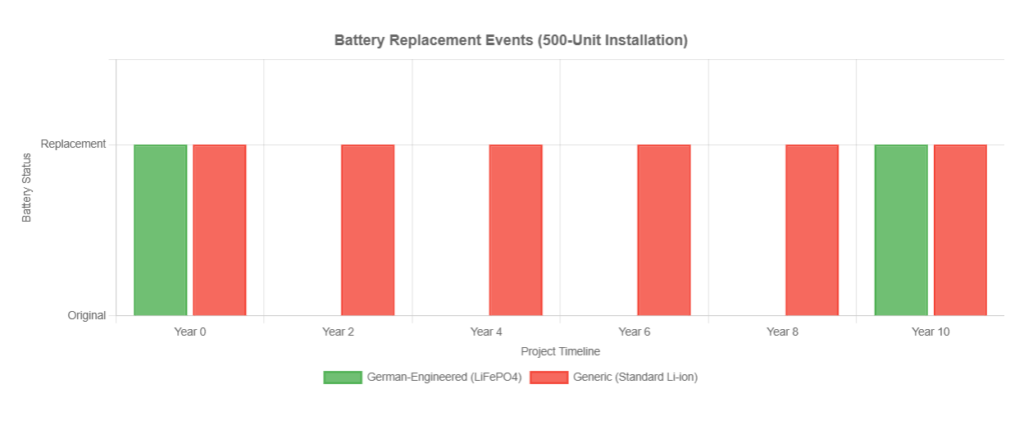
Battery failure represents the primary culprit. Standard lithium-ion batteries used in budget systems operate optimally between -10°C to 45°C. When ambient temperatures climb above 45°C common in desert regions and tropical zones internal battery temperatures can reach 60–70°C. Research indicates that for every 10°C increase above optimal operating temperature, battery lifespan decreases by approximately 50%. Generic systems using recycled D-class lithium-ion cells typically fail within 18–24 months in high-temperature environments.
The financial impact is substantial. For a 500-light installation, replacing batteries every two years at $150 per battery (parts and labor) totals $75,000 per replacement cycle. Over 10 years, this creates $375,000 in maintenance expenses more than triple the initial equipment investment.
Solar panel efficiency degradation compounds these problems. Polycrystalline panels common in generic systems operate at 15–18% efficiency but experience significant drops in high heat. Panel surface temperatures can reach 75–85°C in direct desert sun, reducing output by 20–25% compared to rated specifications.
German Engineering Principles: German Engineered Solar Street lights
Research institutions have spent over 15 years developing solar lighting solutions specifically engineered for harsh environments. The fundamental difference lies in systems-level thermal management rather than simply installing standard components and hoping they survive.
A-grade LiFePO4 (Lithium Iron Phosphate) batteries form the foundation of extreme-climate systems. Unlike conventional lithium-ion chemistry, LiFePO4 maintains stable performance across -20°C to 60°C operating ranges. Laboratory testing demonstrates these batteries retain over 90% capacity after 5,000+ charge cycles equivalent to 8–10 years of field operation. More critically, LiFePO4 chemistry exhibits exceptional thermal stability. At 60°C ambient temperature, A-grade LiFePO4 cells maintain 95% of rated capacity, while generic lithium-ion drops to 60–70%.
Heat dissipation architecture represents another critical innovation. Advanced systems incorporate convection air ducts that create natural thermal flow around battery compartments. Combined with thermal isolation barriers and anti-heat radiation materials, these designs maintain battery temperatures 15–20°C below ambient in direct sunlight. Some systems add active cooling through built-in fans rated for 70,000+ hours of operation, ensuring continuous temperature regulation even if fan systems partially fail.
Monocrystalline solar panels with 23%+ efficiency ratings provide superior performance in high-temperature conditions. While all photovoltaic panels lose efficiency with heat, premium monocrystalline technology maintains higher absolute output. In practical terms, a 23% efficient panel at 75°C surface temperature still outperforms an 18% efficient panel at the same temperature by significant margins ensuring adequate battery charging even in extreme heat.
Intelligent charging protocols adapt to temperature conditions in real-time. Battery management systems (BMS) monitor cell temperature continuously and adjust charging current accordingly. During peak heat periods, systems may reduce charging rates to 0.3C (charging at 30% of battery capacity per hour) to prevent thermal stress. This dynamic approach extends battery life while ensuring safe operation across all conditions.
Why MPPT Controllers Make the Difference
Maximum Power Point Tracking (MPPT) technology represents a significant advancement over older Pulse Width Modulation (PWM) charge controllers still common in budget systems.
PWM controllers function as simple on-off switches, connecting solar panels directly to batteries. This wastes significant energy when panel voltage and battery voltage don’t align perfectly common in variable weather or temperature extremes.
MPPT controllers function as intelligent DC-to-DC converters, continuously analyzing panel output and adjusting voltage to extract maximum available power. High-quality MPPT systems operate at 95–98% efficiency compared to PWM controllers at 70–75% efficiency.
This efficiency difference becomes critical in marginal charging conditions. During cloudy periods or when solar irradiance is limited, MPPT systems extract 20–30% more usable power. In hot climates where panel efficiency drops, this additional power capture proves essential for maintaining adequate battery charge.
Over 10 years, a 100W system with MPPT captures approximately 75,000Wh more energy than PWM equivalent to extending battery life by 2–3 years or providing 200+ hours of additional lighting.
Real-World Performance Data: Desert and Tropical Testing
Field installations across challenging environments provide concrete performance validation. Projects in Arizona, where summer temperatures regularly exceed 45°C, demonstrate systems maintaining 99.2% operational uptime over three-year monitoring periods. Battery capacity retention measured at 90% after 36 months of continuous operation confirms laboratory projections translate to real-world reliability.
Coastal installations in Southeast Asia present different challenges: high humidity, salt air exposure, and intense UV radiation combined with temperatures of 35–40°C. Systems engineered to IP67 certification with proper sealing maintain component integrity. Anodized aluminum housings treated with PVDF coatings withstand 5,000-hour salt spray testing—five times the standard 1,000-hour benchmark ensuring 10+ year structural integrity in corrosive marine environments.
Middle Eastern installations operating in 50°C+ ambient temperatures with direct solar exposure demonstrate thermal management effectiveness. Battery compartment temperature monitoring shows internal temperatures maintained at 42–47°C through passive and active cooling systems well within safe LiFePO4 operating parameters. These installations achieve 7-day autonomy during sandstorms when solar charging is minimal, demonstrating proper panel and battery sizing combined with efficient energy management.
Certification Standards That Actually Matter
Third-party certification provides critical validation that systems meet performance claims. For extreme climate applications, specific certifications indicate proper engineering.
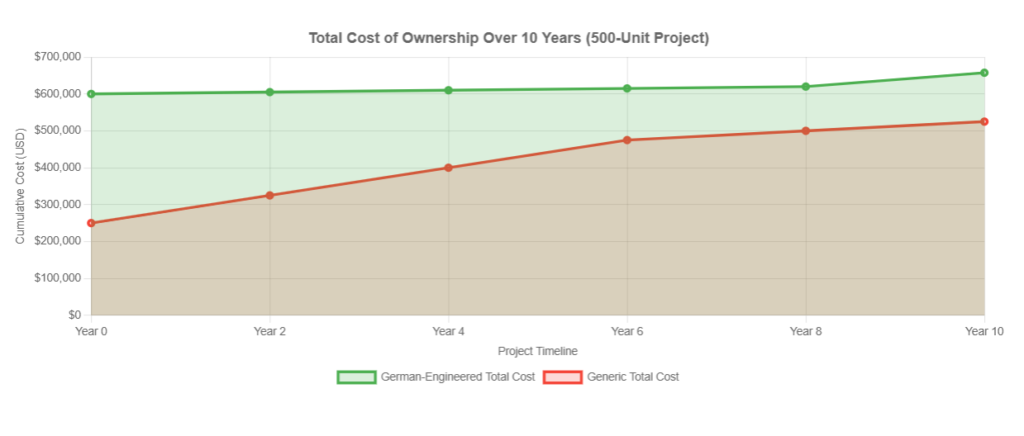
TÜV certification represents independent verification by German technical inspection organizations, including thermal cycling from -40°C to 85°C, mechanical load resistance testing to 5400Pa, and long-term degradation analysis. IP67 rating means complete dust-tight protection and water immersion resistance to 1 meter depth for 30 minutes but third-party verified ratings differ significantly from self-claimed specifications. ISO 9001 certification demonstrates consistent quality control processes throughout manufacturing, proving as important as initial design for long-term reliability.
Strategic Considerations for EPC Project Planning
EPC contractors managing large-scale lighting projects must balance initial capital costs against long-term operational expenses and client satisfaction. Generic systems offer lower upfront costs but create hidden risks that jeopardize project success.
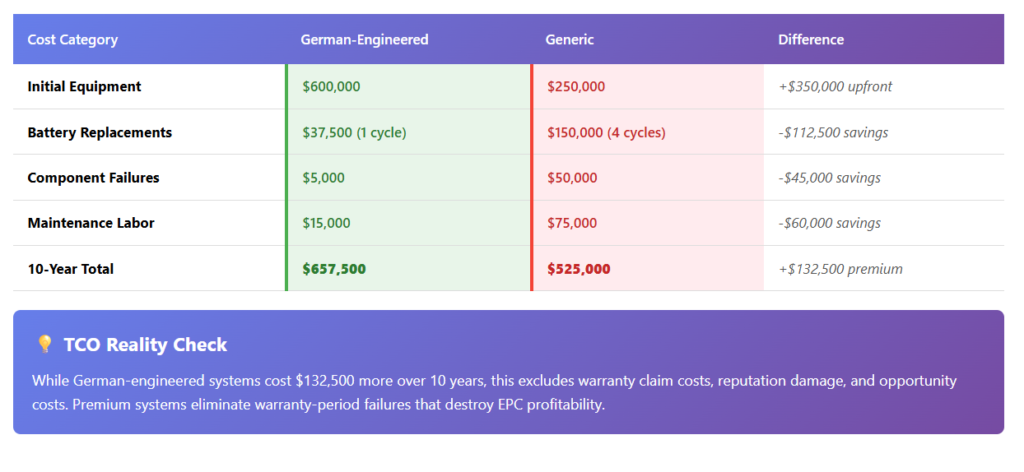
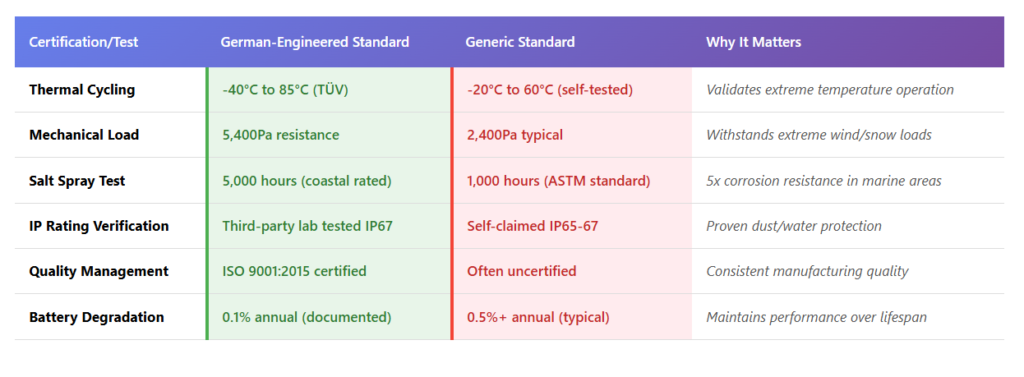
Total cost of ownership (TCO) analysis reveals the true economic picture. For a 500-unit installation over 10 years:
Generic systems total approximately $525,000 ($250,000 equipment + $275,000 in battery replacements, failures, and labor), while German-engineered systems total approximately $657,500 ($600,000 equipment + $57,500 maintenance).
However, this analysis excludes warranty claim costs, reputation damage from failures, and opportunity costs of maintenance time. Systems with 8–10 year battery life and 50,000+ hour LED lifespans eliminate warranty-period failures almost entirely. When lights fail within 24 months, facility managers question contractor competence premium systems with 10+ year operational life create satisfied clients who provide referrals and award follow-on contracts.
Implementation Best Practices for Hot Climate Installations
Successful extreme-climate installations require attention beyond equipment selection. Installation methodology significantly impacts long-term performance.
Panel orientation should maximize morning and evening sun exposure while minimizing midday heat accumulation. Adjustable mounting systems allow seasonal optimization steeper angles in summer to reduce heat exposure while maintaining adequate charging. Battery compartments require minimum clearances for natural convection cooling, with heat-reflective coatings on south-facing surfaces to minimize radiant heat transfer.
Regular maintenance focused on cleaning solar panels and inspecting seals extends system life significantly. In dusty environments, quarterly panel cleaning maintains optimal charging efficiency, while annual seal inspections identify potential intrusion before component damage occurs.
Conclusion: Engineering Excellence Delivers Project Success
The difference between generic solar street lights and precision-German engineered solar street lights becomes starkly visible in extreme climates through battery longevity, maintained performance, and elimination of costly mid-project failures. While procurement teams naturally focus on initial costs, the evidence demonstrates that systems built on rigorous testing protocols, advanced thermal management, and premium components deliver superior total value.
For EPC contractors, equipment selection directly impacts project profitability, client satisfaction, and reputation. Generic systems may save 50% on initial equipment costs, but create risks that frequently exceed those savings through warranty claims, replacement cycles, and relationship damage. Research-backed engineering eliminates these risks through proven designs that deliver consistent 10+ year operational life.
Ready to specify all in one solar street lighting that won’t fail your projects? Visit solar-led-street-light.com to discuss your extreme-climate installation requirements and receive detailed technical specifications backed by 15+ years of field-proven performance data.
Frequently Asked Questions
Q1: What temperature range can German engineered solar street lights handle? A: Systems designed for extreme climates typically operate reliably from -20°C to 60°C, with battery compartments maintaining safe internal temperatures through active and passive thermal management. This range covers most global climate zones including hot deserts, tropical regions, and areas with extreme temperature swings.
Q2: How long do LiFePO4 batteries actually last in real-world hot climate installations? A: Field data from installations in Arizona, Middle East, and Southeast Asia shows A-grade LiFePO4 batteries maintaining 90%+ capacity after 8–10 years of operation when paired with proper thermal management and intelligent charging systems. This represents 5,000+ charge cycles under actual operating conditions, not laboratory testing.
Q3: Why do MPPT controllers cost more than PWM controllers, and is the difference worth it? A: MPPT controllers cost approximately 30–50% more than PWM controllers but deliver 20–30% more charging efficiency, particularly in marginal conditions. Over a 10-year system life, this efficiency gain extends battery life by 2–3 years and ensures adequate charging during cloudy periods or when panels are heat-stressed eliminating operational failures that destroy project economics.
Q4: What does IP67 certification actually mean for German engineered solar street lights? A: IP67 rating indicates complete dust-tight sealing (first digit 6) and water immersion resistance to 1 meter depth for 30 minutes (second digit 7). However, self-claimed IP ratings differ significantly from third-party verified ratings. Look for certification documentation from independent testing laboratories, not just manufacturer specifications.
Q5: How do I verify solar street light performance claims before purchasing? A: Request third-party test reports from recognized certification bodies (TÜV, UL, CE), not manufacturer internal testing. Examine battery cell specifications A-grade LiFePO4 cells should show 5,000+ cycle ratings at 80% depth of discharge. Verify MPPT controller efficiency ratings through independent testing documentation. Ask for reference installations in similar climate conditions with documented uptime data.
Q6: What maintenance do German engineered solar street lights in hot climates actually require? A: Properly engineered systems require minimal maintenance typically quarterly solar panel cleaning in dusty environments, annual seal and connection inspections, and battery performance checks every 2–3 years. Generic systems require battery replacements every 18–24 months plus frequent component repairs, creating substantially higher long-term maintenance costs and project risk.
Q7: Why do some German engineered solar street lights fail within months while others operate for years? A: The primary failure mode is battery degradation from thermal stress when generic lithium-ion cells are exposed to temperatures above their 45°C operating limit. Secondary failures include insufficient charging from low-efficiency PWM controllers or undersized panels, and component failures from inadequate environmental sealing. Systems engineered with proper thermal management, LiFePO4 batteries, MPPT charging, and verified IP67 sealing eliminate these failure modes.
Q8: What’s the real payback period for premium German engineered solar street lights versus generic systems in hot climates? A: While premium systems cost 2–3x more initially, they avoid battery replacement cycles every 18–24 months that generic systems require. Break-even typically occurs at 4–5 years, with premium systems delivering 5–7 additional years of operation afterward. For EPC contractors, the more important metric is elimination of warranty-period failures that create unbudgeted costs and client dissatisfaction.
References
- Global Market Insights. (2024). North America Utility Solar EPC Market Size, 2025-2034 Report. Retrieved from https://www.gminsights.com/industry-analysis/north-america-utility-solar-epc-market
- Redway Power. (2025). LiFePO4 Temperature Range and Performance. Retrieved from https://www.redwaypower.com/lifepo4-temperature-range-and-performance-all-you-need-to-know/
- Sresky Solar. (2024). Global Solar Street Lighting Industry Status and Future Forecast: 2024 and Beyond. Retrieved from https://www.sresky.com/global-solar-street-lighting-industry-status-and-future-forecast-2024-and-beyond/
- Fonroche Lighting. (2024). Reliable Solar Street Lights in Any Weather. Retrieved from https://www.fonrochesolarlighting.com/reliable-solar-street-lights-different-weather-conditions/
- BSLBATT Battery. (2025). Top Guide to LiFePO4 Battery Temperature Range. Retrieved from https://www.bsl-battery.com/news/lifepo4-battery-temperature-range
- Fraunhofer Institute for Solar Energy Systems ISE. (2025). R&D for Energy Transition. Retrieved from https://www.ise.fraunhofer.de/en.html
- PV Magazine International. (2024). German PV experts develop quality standard for solar modules. Retrieved from https://www.pv-magazine.com/2024/10/23/german-pv-experts-develop-quality-standard-for-solar-modules/
- Germany Trade & Invest. (2024). Photovoltaic Industry in Germany. Retrieved from https://www.gtai.de/en/invest/industries/energy/photovoltaic
- Sresky Solar. (2025). From 2024 to 2025: Three Key Directions for Solar Street Light Technology Evolution. Retrieved from https://www.sresky.com/from-2024-to-2025-three-key-directions-for-solar-street-light-technology-evolution/
- Allied Market Research. (2025). Solar EPC Market Size, Share and Growth Report – 2034. Retrieved from https://www.alliedmarketresearch.com/solar-epc-market-A325109
Disclaimer
This article is for informational purposes only and does not constitute professional engineering, installation, or procurement advice. Performance specifications and costs may vary based on project requirements, location, and local regulations. Always consult qualified solar energy professionals and legal advisors before making procurement decisions.
For expert consultation on solar LED street lighting solutions, visit solar-led-street-light.com or contact our team for a customized quote.