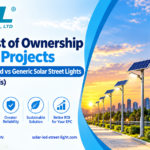

A solar street light that costs 30 percent less on the purchase order can cost two to three times more across ten years of service. That gap rarely shows up in a procurement spreadsheet, because the spreadsheet only records the day one price. For EPC contractors, municipal authorities, and infrastructure buyers, the number that actually decides project profitability is the total cost of ownership, the sum of hardware, installation, maintenance, replacements, and downtime over the full service life. This analysis breaks down where German engineered solar street lights and generic alternatives diverge over a decade, and why the cheapest bid is so often the most expensive fixture on the road.
Why Upfront Price Hides the Real Cost

Total cost of ownership, usually shortened to TCO, is the complete lifetime cost of an asset rather than its sticker price. In solar street lighting the purchase price is only the visible tip. Beneath it sit replacement batteries, failed drivers, warranty labour, truck rolls to remote poles, and the reputational cost of dark streets in a public project.
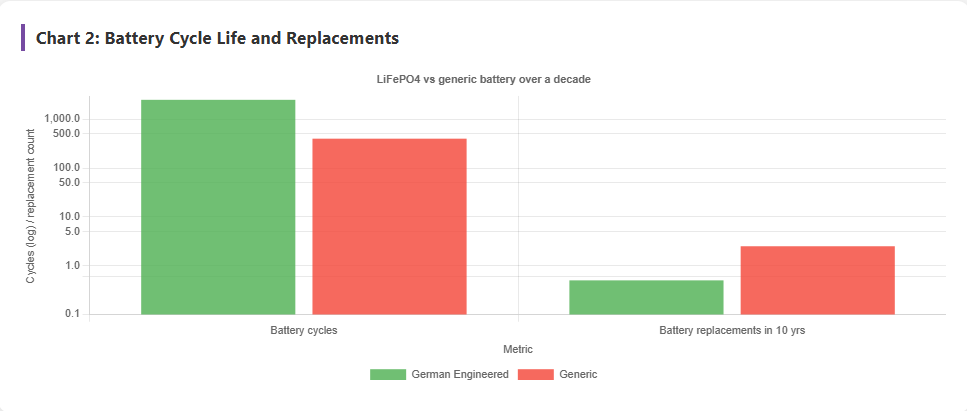
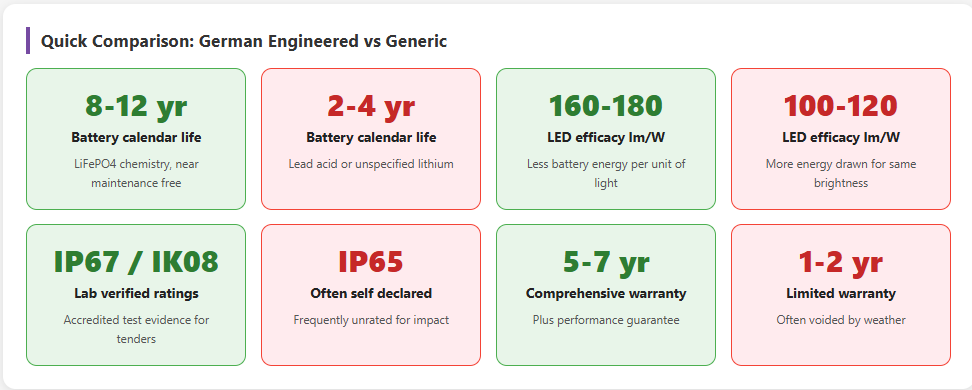
The single largest hidden driver is the battery. A generic lead acid or unspecified lithium pack typically delivers 300 to 500 charge cycles and a calendar life of two to four years. A German specified LiFePO4 pack, meaning lithium iron phosphate chemistry, delivers 2,000 to 3,000 cycles and an eight to twelve year calendar life. On a nightly cycle, the generic battery reaches end of life two or three times before the quality battery needs its first replacement.
Each of those replacements is not just a part cost. It is a technician, a vehicle, sometimes a crane, and a permit to work in a live carriageway. In many infrastructure projects the labour and access cost of a single battery swap exceeds the price of the battery itself. This is why total cost of ownership, not headline price, is the honest basis for comparing bids.
A useful way to picture it is that the purchase order buys perhaps a third of the decade long spend, while the remaining two thirds are decided by how rarely the system needs a human to visit the pole. Every avoided visit is money that stays in the project budget, and a disciplined total cost of ownership model makes those avoided visits visible before a single fixture is bought.
The Component Gap That Compounds Over Ten Years
Quality differences at the component level look small on a datasheet and compound sharply over a decade, and each one feeds directly into the total cost of ownership. Consider the four parts that fail most often.
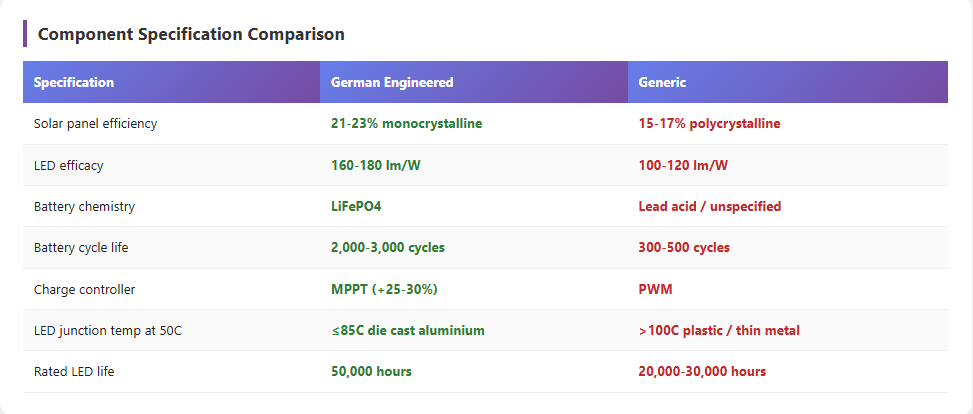
- Solar panel: German engineered systems use monocrystalline cells at 21 to 23 percent efficiency, against 15 to 17 percent for the polycrystalline panels common in generic units. Higher efficiency means the same energy is captured from a smaller, better sited panel, improving winter reliability.
- Charge controller: an MPPT solar street light controller, meaning maximum power point tracking, harvests roughly 25 to 30 percent more usable energy than the cheaper PWM type found in budget fixtures. Over ten years that margin decides whether lights survive the rainy season.
- LED module: premium modules deliver 160 to 180 lumens per watt against 100 to 120 for generic diodes, so less battery energy is spent for the same road brightness.
- Housing: die cast aluminium holds the LED junction temperature at or below 85 degrees Celsius in a 50 degree ambient, while thin metal or plastic housings let it climb past 100 degrees, accelerating lumen decay.
The compounding effect matters most in solar street lights for harsh climates. A generic fixture rated for 20,000 to 30,000 hours in practice may not reach its printed 50,000 hour claim once heat and deep discharge take hold. A well engineered system holds its rated 50,000 hour LED life because every component is sized to protect the others.
Certification Is a Cost Control, Not Paperwork
For EPC and government tenders, certification is where total cost of ownership is quietly won or lost. German engineering standards lean on rigorous, third party verified testing rather than self declared numbers, and that verification directly reduces lifetime risk.
An IP67 ingress rating verified by an accredited laboratory means the enclosure genuinely resists dust and immersion, where a self declared IP65 may fail its first monsoon. An IK08 impact rating protects against vandalism and debris that would crack an unrated housing. Compliance with recognised IEC and DIN standards, ISO 9001 quality management, and photometric lighting design tested to LM 79 and lumen maintenance to LM 80 gives buyers evidence, not adjectives.
Bankable solar street light certification requirements from development banks increasingly demand this evidence before release of payment. A fixture that cannot produce accredited test reports is not merely lower quality, it is a financing risk that can stall an entire disbursement. Warranty depth tells the same story. German suppliers commonly back systems with five to seven year comprehensive cover plus a performance guarantee, while generic warranties of one to two years are frequently voided by the very weather the light was installed to survive.
Running the Ten Year Numbers
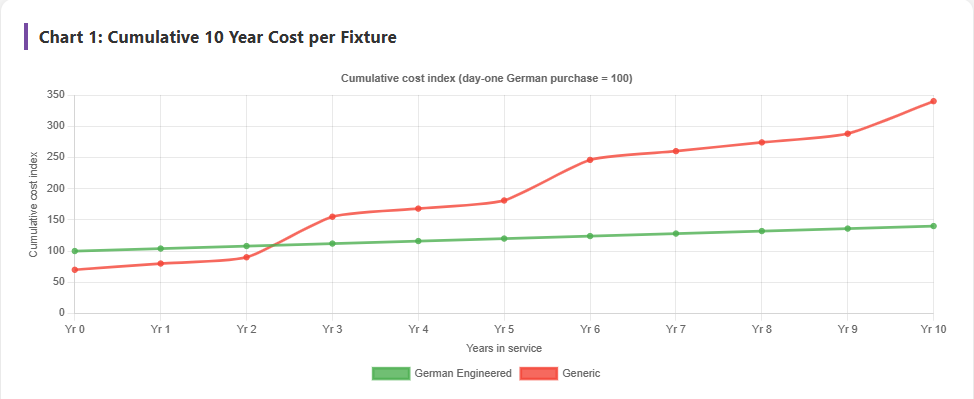
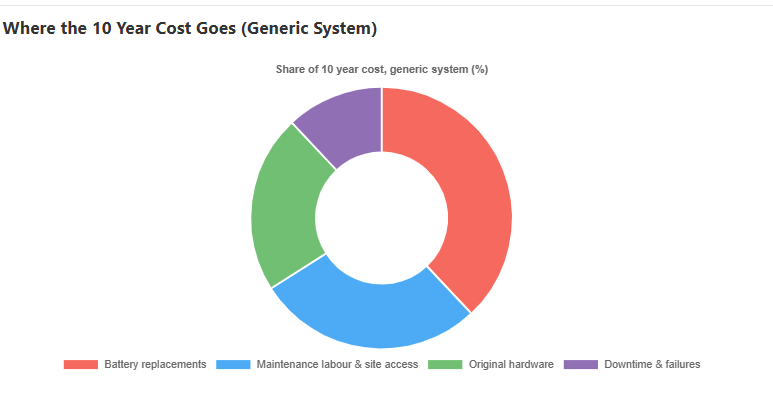
Put the two systems side by side across a decade and the arithmetic becomes clear. Assume a mid sized municipal solar street lighting deployment on a nightly charge and discharge cycle.
- Battery replacements: the generic system needs two to three battery changes over ten years, each carrying parts, labour, and site access cost. The German system typically needs zero or one.
- Driver and LED failures: higher junction temperatures and weaker components raise the generic failure rate, adding unplanned truck rolls that a stable system avoids.
- Energy reliability: MPPT harvesting and higher panel efficiency mean the quality system keeps its designed three to seven days of autonomy through poor weather, while an undersized generic system browns out and shortens its own battery life further.
The pattern is consistent across published field data. The generic fixture wins the purchase order and loses the decade, with replacement cycles driving a lifetime cost roughly two to three times higher than the German engineered equivalent, whose operational cost approaches zero once the payback period is passed. Lower upfront capital, in other words, routinely produces higher total capital.
When a finance team folds those replacement events, access charges, and downtime penalties into a single total cost of ownership figure, the ranking of bids often inverts completely. The bid that looked cheapest on the tender summary lands last once the decade is fully costed, and the German engineered option that looked expensive on day one settles into first place. For a public authority answerable for both budgets and safe streets, that inversion is the whole argument.
How to Compare Bids on TCO, Not Price
Procurement teams specifying solar street lights for EPC projects can protect a project by scoring bids on total cost of ownership from the start. A practical approach uses a few disciplined steps.
- Ask every bidder for accredited test reports covering IP rating, IK rating, LM 79, and LM 80, and reject self declared figures.
- Require battery chemistry, rated cycle life, and calendar life in writing, then model the number of replacements each product will need across the design life.
- Add the fully loaded cost of each replacement, including labour, vehicle, and traffic management, not just the spare part.
- Confirm warranty length and, critically, the exclusions that could void it in local weather.
- Compare the ten year totals rather than the purchase totals.
This discipline consistently reveals that a moderately higher upfront investment in a German engineered system returns a lower lifetime cost, higher uptime, and far less political risk from failed public lighting. Building the total cost of ownership into the tender scoring, rather than treating it as an afterthought, also changes supplier behaviour. When bidders know their products will be judged on a decade of performance and not a single line item, the incentive to cut corners on batteries and housings disappears, and the whole field of offers improves in quality.
Conclusion
Three takeaways stand out from a decade long view. First, the battery and the housing quietly control lifetime cost, so LiFePO4 chemistry and die cast aluminium are not luxuries but savings. Second, accredited certification converts vague quality claims into bankable, financeable evidence that keeps projects and payments on schedule. Third, the only fair way to compare bids is total cost of ownership, because the cheapest fixture on day one is usually the most expensive over ten years.
If you are specifying solar street lighting for an EPC, municipal, or infrastructure project, DEL Illumination can help you model the full ten year cost and match certified commercial solar street lighting systems to your site conditions. Visit solar-led-street-light.com or contact our team for a customised quote and a transparent lifetime cost comparison.
Frequently Asked Questions
What exactly is included in total cost of ownership for solar street lights?
TCO covers the purchase price plus installation, routine maintenance, battery and component replacements, warranty labour, site access, and the cost of downtime across the full service life. For solar street lights the replacement and access costs usually outweigh the original hardware price over ten years.
How much more do German engineered solar street lights cost upfront?
The premium varies by specification, but a quality system generally carries a moderately higher purchase price. That premium is typically recovered within the payback period through avoided battery replacements, lower failure rates, and reduced maintenance labour, after which operational cost approaches zero.
Why does battery chemistry make such a large difference to lifetime cost?
A lead acid or generic lithium pack lasts 300 to 500 cycles and two to four years, while LiFePO4 lasts 2,000 to 3,000 cycles and eight to twelve years. Because each replacement carries labour and site access cost on top of the part, avoiding two or three replacements saves far more than the battery price alone.
Do development bank funded projects require specific certifications?
Yes. Bankable and donor funded tenders increasingly require accredited test evidence such as verified IP and IK ratings, LM 79 photometric data, and LM 80 lumen maintenance results. Products that cannot supply this documentation can delay payment disbursement and create financing risk.
Is a longer warranty enough to guarantee lower total cost?
A longer warranty helps, but only if its exclusions do not void cover under local conditions. Buyers should read what weather, temperature, or installation factors nullify the warranty, since a two year policy voided by heat offers less protection than a shorter but genuinely honoured guarantee.
How can a procurement team verify TCO claims before awarding a contract?
Request written cycle life, calendar life, and accredited test reports, then model replacement counts and fully loaded replacement costs across the design life. Comparing ten year totals rather than purchase prices exposes the true cost difference between competing bids.
Does higher LED efficacy reduce total cost of ownership?
Yes. Modules at 160 to 180 lumens per watt draw less battery energy for the same road brightness, which allows smaller batteries and panels and eases thermal stress. Lower energy demand extends battery life and reduces the size and cost of the whole system.
References
International Energy Agency. (2025). Solar PV. https://www.iea.org/energy-system/renewables/solar-pv
International Electrotechnical Commission. (2024). IEC 60598 Luminaires standards. https://www.iec.ch/
U.S. Department of Energy. (2024). Solid State Lighting Program: LED Luminaire Efficacy. https://www.energy.gov/eere/ssl/solid-state-lighting
Illuminating Engineering Society. (2024). LM-79 and LM-80 testing standards. https://www.ies.org/
National Renewable Energy Laboratory. (2025). Best Research Cell Efficiency and PV performance data. https://www.nrel.gov/pv/cell-efficiency.html
International Organization for Standardization. (2024). ISO 9001 Quality management systems. https://www.iso.org/iso-9001-quality-management.html
World Bank. (2025). Procurement standards for infrastructure projects. https://www.worldbank.org/en/projects-operations/products-and-services/brief/procurement
International Renewable Energy Agency. (2024). Renewable Power Generation Costs. https://www.irena.org/Publications
Disclaimer
This article is for informational purposes only and does not constitute professional engineering, installation, or procurement advice. Performance specifications and costs may vary based on project requirements, location, and local regulations. Always consult qualified solar energy professionals and legal advisors before making procurement decisions.
For expert consultation on solar LED street lighting solutions, visit solar-led-street-light.com or contact our team for a customised quote.