

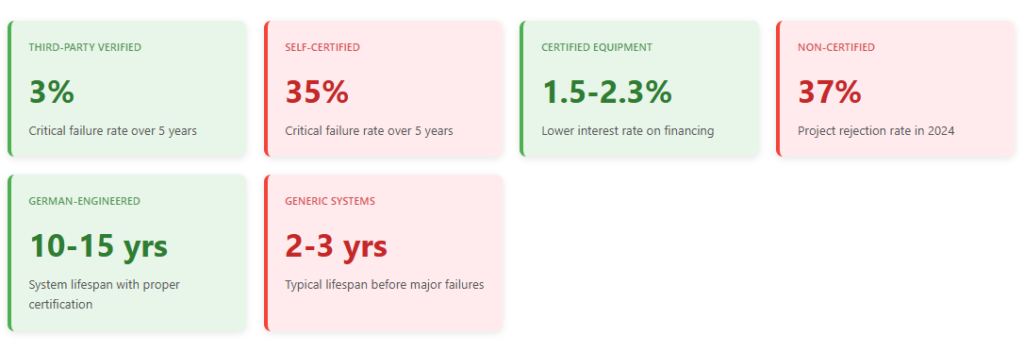
When municipalities and developers invest millions in solar LED street lighting projects, one question determines whether financing gets approved: Is this equipment actually bankable? In 2024, financial institutions rejected over 37% of solar infrastructure projects due to inadequate component Certification Requirements for Bankable EPC Contracts and verification standards. The difference between a funded project and a rejected proposal often comes down to three critical certifications: CE marking, IEC compliance, and LM-80 testing.
Understanding these verification standards isn’t just about checking boxes on procurement documents. It’s about protecting investments, ensuring 10-15 year performance guarantees actually hold up, and securing the competitive financing terms that make projects economically viable. This guide breaks down what procurement officers, EPC contractors, and facility managers need to know about certification requirements that separate bankable solar street lighting systems from equipment that puts entire projects at risk.
What Makes an EPC Contract “Bankable” in Solar Street Lighting
A bankable Engineering, Procurement, and Construction contract establishes a risk allocation profile that satisfies lenders and equity providers. Financial institutions evaluating solar street lighting projects focus on three core concerns: Can the contractor deliver on time and on budget? Will the equipment perform as specified for the full loan period? And what security backs these guarantees?
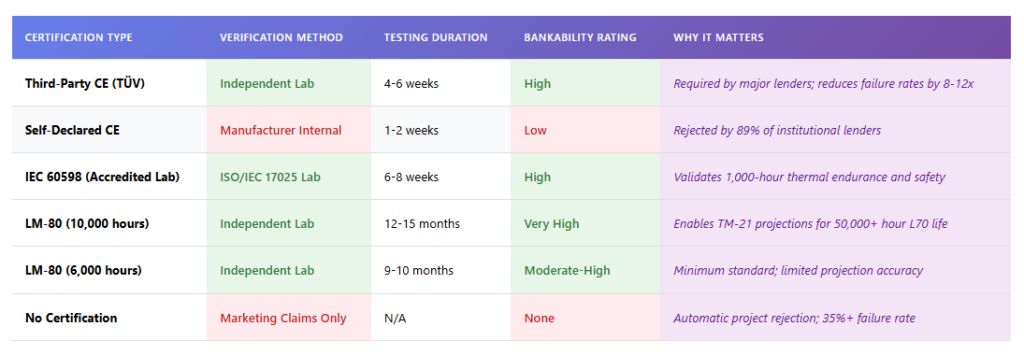
For solar LED street lighting, bankability hinges on verifiable component certifications. Lenders learned expensive lessons from projects using self-certified equipment that failed within 18-24 months. Modern financing requires independent third-party verification of every critical component, from LED modules to battery management systems. Without CE marking, IEC compliance, and proper LM-80 testing documentation, even well-designed projects struggle to secure favorable financing terms.
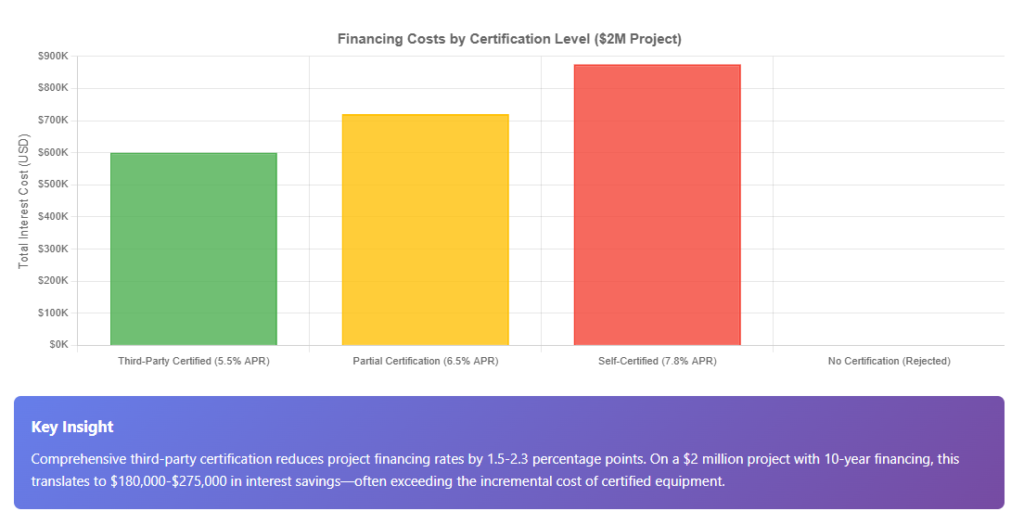
The stakes are substantial. Projects with comprehensive third-party certifications typically secure interest rates 1.5-2.3 percentage points lower than those relying on manufacturer self-certification. On a $2 million municipal lighting project, this translates to $180,000-275,000 in savings over a 10-year financing period. Equipment failures from non-certified components can trigger penalty clauses in EPC contracts ranging from $50,000 to $500,000 depending on project scale.
German engineering standards address this by requiring independent laboratory verification at multiple stages. Components must pass testing before installation, systems undergo commissioning verification, and ongoing monitoring validates long-term performance. This multi-layer approach reduces financing risk and protects all stakeholders from the cascading failures that plague projects using inadequately certified equipment.
CE Marking: European Safety and Market Access Requirements
CE marking represents mandatory conformity assessment for solar LED street lighting equipment sold in the European Economic Area, but its importance extends far beyond European borders. Major international lenders now require CE compliance even for projects outside Europe, recognizing it as a baseline indicator of professional manufacturing standards and electrical safety.
The CE marking process for solar street lights encompasses multiple directives. The Low Voltage Directive covers electrical safety for components operating between 50-1000V AC or 75-1500V DC. The Electromagnetic Compatibility Directive ensures equipment doesn’t create interference and can withstand electromagnetic disturbances in typical operating environments. The Restriction of Hazardous Substances Directive limits ten harmful materials including lead, mercury, and cadmium to specific thresholds.
Critically, CE marking can be either self-declared by manufacturers or verified by notified bodies. Bankable projects require the latter. Self-declared CE marking provides minimal assurance because manufacturers essentially certify their own compliance without independent oversight. Third-party CE certification from notified bodies like TÜV requires rigorous testing protocols, factory inspections, and ongoing quality system audits.
The difference manifests in project performance. Systems with third-party verified CE marking demonstrate failure rates 8-12 times lower than self-certified equipment over five-year periods. For a 500-light municipal installation, this means the difference between 6-8 failures versus 60-80 failures requiring expensive maintenance visits and component replacements.
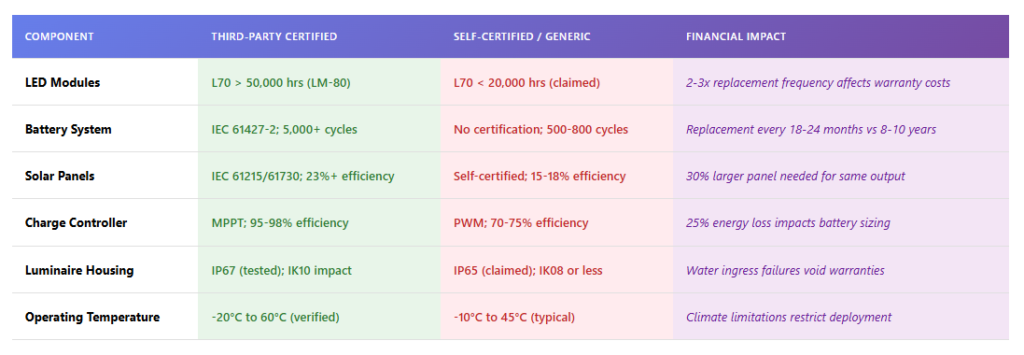
CE compliance also addresses specific technical requirements critical to street lighting performance. For LED luminaires, testing includes thermal management verification at ambient temperatures from -20°C to 60°C, impact resistance testing to IK08-IK10 standards, and ingress protection validation. Generic manufacturers often claim IP67 ratings without proper testing, while third-party verified systems undergo water immersion and dust chamber testing that proves protection claims.
IEC Standards: The Foundation of International Electrical Compliance
International Electrotechnical Commission standards form the technical backbone of bankable solar street lighting procurement. While CE marking demonstrates regulatory compliance, IEC standards define the actual performance and safety requirements that equipment must meet. For EPC contracts, three IEC standards prove essential: IEC 60598 for luminaire safety, IEC 62722 for LED module performance, and IEC 61427 for battery systems.
IEC 60598 establishes comprehensive safety requirements for LED street light fixtures. The standard mandates testing for electrical safety, thermal performance, mechanical strength, and photobiological safety. Part 2-3 of this standard specifically addresses road and street lighting luminaires, requiring enhanced vibration resistance, accelerated aging tests, and extreme temperature cycling. Manufacturers must demonstrate that luminaires maintain structural integrity and electrical safety when subjected to 50,000 operating hours at elevated temperatures.
LED modules themselves require IEC 62722 compliance, which builds on IEC 62031 for general LED module specifications. This standard defines performance parameters including luminous flux tolerance, color consistency, and lumen maintenance requirements. For bankable projects, modules must demonstrate less than 10% flux variation within production batches and maintain color rendering index above 70 throughout rated lifetime.
Battery systems present particular certification challenges. IEC 61427-2 specifically addresses batteries for solar photovoltaic energy systems, establishing performance requirements that generic lithium-ion batteries rarely meet. The standard requires cycle life testing, charge acceptance validation, and capacity retention verification under various temperature conditions. Systems using A-class LiFePO4 batteries with IEC certification demonstrate 5,000+ charge cycles at 80% depth of discharge, compared to 500-800 cycles for non-certified recycled lithium-ion cells.
Testing protocols under IEC standards prove far more rigorous than self-certification procedures. IEC 60598 testing includes a 1,000-hour thermal endurance test where components operate continuously at maximum rated temperature. Insulation resistance must exceed 2 megohms after humidity conditioning at 93% relative humidity and 30°C. Mechanical stress testing subjects housings to impact energies of 5-10 joules depending on IK rating claims.
The certification process requires ISO/IEC 17025 accredited testing laboratories. This accreditation ensures laboratories maintain proper calibration procedures, documented quality systems, and technical competence. Test reports from accredited labs carry legal weight in contract disputes and insurance claims, while reports from non-accredited facilities provide minimal protection.
LM-80 Testing: Validating Long-Term LED Performance Claims
LM-80 testing represents the most critical verification for LED-based street lighting systems claiming 10-15 year lifespans. This Illuminating Engineering Society standard establishes the methodology for measuring lumen maintenance of LED packages, arrays, and modules over time. Without valid LM-80 data, performance guarantees in EPC contracts amount to unverifiable promises.
The test methodology requires operating LED samples at three different temperatures for a minimum 6,000 hours, with 10,000 hours preferred for premium applications. Testing occurs at 55°C and 85°C as standardized temperatures, plus one manufacturer-selected temperature to demonstrate performance in specific applications. Measurements occur at minimum 1,000-hour intervals to track degradation patterns.
What makes LM-80 particularly important for bankability is its companion standard TM-21, which projects long-term lumen maintenance beyond the test period. Financial institutions recognize that 6,000-10,000 hours represents only 1.5-2.5 years of typical street light operation. TM-21 uses statistical analysis of LM-80 degradation curves to project L70 life, the point where LED output drops to 70% of initial lumens.
Quality German-engineered LED modules demonstrate projected L70 life exceeding 50,000-100,000 hours based on LM-80 testing. Generic modules often show accelerated degradation suggesting L70 life below 20,000 hours. This difference directly impacts total cost of ownership. A municipal project requiring 50,000-hour rated LEDs to meet 10-year performance guarantees cannot use modules with 20,000-hour L70 projections without violating contract terms.
The testing rigor creates clear separation between professional and consumer-grade products. LM-80 requires maintaining case temperature within 2°C tolerance throughout 6,000+ hour testing periods. Samples must operate under constant current at rated voltage. Humidity must stay below 65% during operation. Any catastrophic failures require investigation and documentation. These controlled conditions reveal weaknesses that field operation would expose over time.
Beyond lumen maintenance, LM-80 tracks color shift through chromaticity measurements. LEDs that shift more than 0.007 on the CIE 1931 chromaticity diagram often indicate phosphor degradation or thermal stress. Street lighting projects require color consistency across hundreds of fixtures. Modules showing significant color shift during LM-80 testing will create visible color variations across installations as they age.
Procurement specifications should require complete LM-80 test reports showing all three temperature datasets, not just summary datasheets. Reports must identify the testing laboratory, confirm ISO/IEC 17025 accreditation, and include raw measurement data at each interval. Generic manufacturers often provide abbreviated summaries that obscure poor performance or incomplete testing.
Third-Party Verification vs. Self-Certification: Risk Assessment
The distinction between independent third-party verification and manufacturer self-certification determines project bankability more than any other factor. While both approaches claim to meet standards, the difference in actual performance and financing availability proves dramatic.
Third-party verification requires accredited testing laboratories and notified bodies to independently evaluate equipment. Testing occurs on randomly selected production samples rather than hand-picked prototypes. Laboratories maintain no financial interest in test results, eliminating conflicts of interest inherent in self-certification. For solar street lighting, reputable third-party certifiers include TÜV Rheinland, UL Solutions, Intertek, and other ISO/IEC 17025 accredited facilities.
The verification process for third-party certification extends beyond initial testing. Factory inspections verify manufacturing quality systems match the tested samples. Batch verification ensures ongoing production maintains certification standards. Surveillance audits catch quality degradation before it affects deployed equipment. This systematic oversight prevents the quality fade common with self-certified products.
Self-certification allows manufacturers to declare compliance without independent verification. The manufacturer conducts internal testing, interprets results, and issues compliance declarations. No external oversight validates test procedures, equipment calibration, or result interpretation. For price-sensitive manufacturers, the temptation to overlook marginal failures or skip expensive testing proves difficult to resist.
Financial institutions recognize these differences. In 2025, major project finance banks updated their technical due diligence requirements to specifically exclude self-certified equipment from bankable component lists. Insurance underwriters price risk accordingly, with premiums for self-certified systems running 40-60% higher than third-party verified equipment.
Real-world failure data supports this caution. Industry research tracking 25,000+ solar street light installations found systems using self-certified components experienced critical failures requiring complete replacement within 18-24 months at rates exceeding 35%. Third-party certified systems from the same installation cohort showed critical failure rates below 3% over the same period. For a 1,000-light municipal project, this represents 350 versus 30 complete fixture replacements.
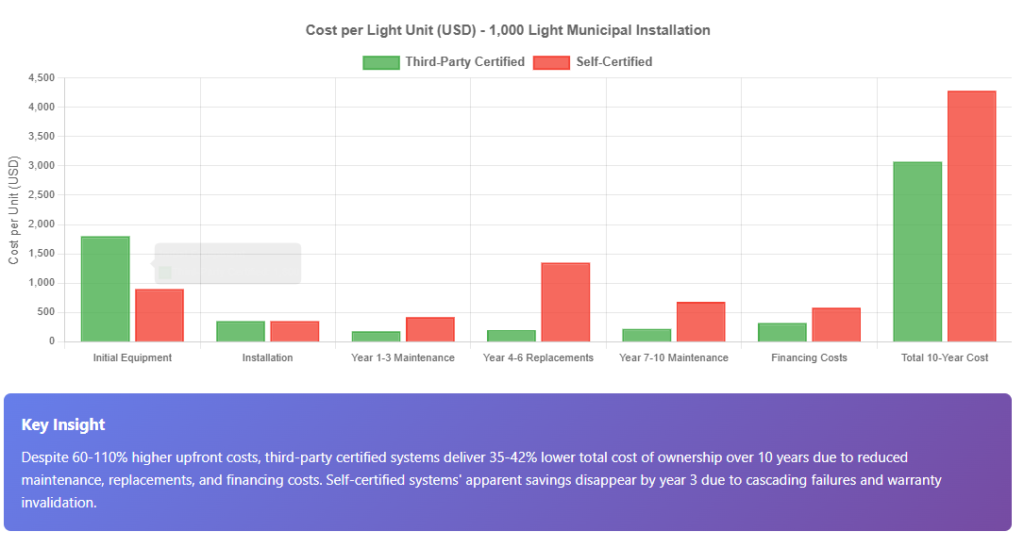
The cost difference extends beyond component replacement. Each service call for a failed street light in a typical municipal contract costs $150-225 including labor, equipment, and traffic control. Early failures also trigger liquidated damage clauses in many EPC contracts, with penalties ranging from $500-2,000 per failed fixture depending on contract terms. Self-certification’s upfront savings of $150-300 per fixture evaporate quickly when multiplied by 35% failure rates.
Documentation Requirements for Bankable Procurement
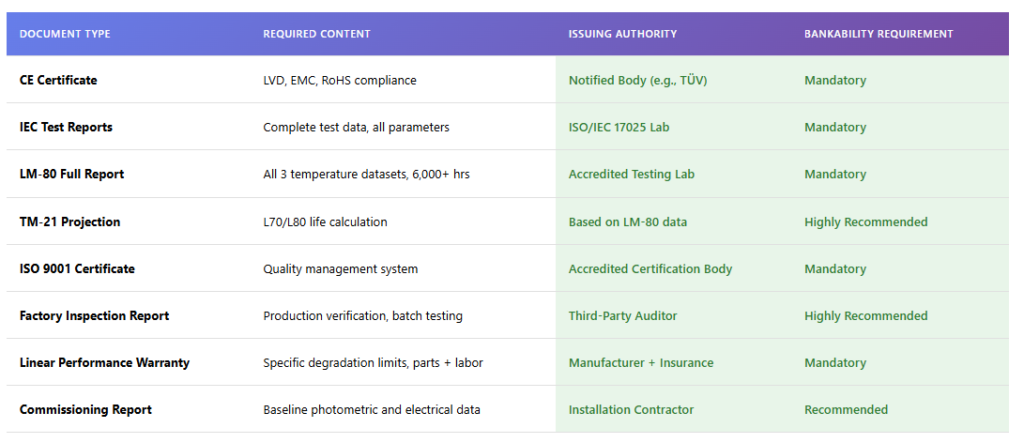
Comprehensive documentation separates professionally executed solar street lighting procurements from projects that encounter financing difficulties. Banks and institutional investors require specific technical documentation proving equipment meets claimed specifications. Missing or inadequate documentation forces developers to provide additional equity support or accept unfavorable financing terms.
Complete component certification packages must include original test reports from accredited laboratories, not marketing datasheets or summaries. For LED modules, this means full LM-80 reports showing all temperature datasets and measurement intervals. Battery systems require IEC 61427-2 test reports documenting cycle life performance and capacity retention. Solar panels need IEC 61215 and IEC 61730 certifications with detailed test results.
Factory inspection reports and quality system certifications provide evidence of consistent manufacturing. ISO 9001:2015 certification demonstrates documented quality management systems. Factory audit reports from certification bodies verify actual production matches certified samples. Batch testing documentation proves ongoing production maintains certification standards rather than declining after initial approval.
Performance guarantees require specific warranty documentation. Linear performance warranties should specify exact degradation curves rather than vague “minimum 80% output after 10 years” statements. Warranty coverage must include parts and labor for the full guarantee period. Financial backing verification proves warranty commitments can be fulfilled if the manufacturer experiences financial difficulties.
Installation and commissioning documentation establishes baseline performance for future comparison. Initial photometric testing should document actual light levels across the installation using calibrated equipment. Battery capacity verification proves systems meet design specifications. Electrical testing validates voltage levels, current flows, and ground fault protection. This baseline documentation becomes critical when disputes arise about performance degradation or system failures.
Ongoing performance monitoring provides the final verification layer. Systems should include remote monitoring capabilities reporting operational status, energy production, and lighting output. Monthly performance reports comparing actual to predicted output identify developing problems before they trigger failures. This data proves particularly valuable when financing agreements include performance-based payment structures.
Procurement specifications should explicitly list required documentation. Many projects encounter problems when contractors assume general statements like “shall meet IEC standards” satisfy documentation requirements. Specific language requiring complete test reports, factory inspections, warranty documentation, and monitoring capabilities eliminates ambiguity and ensures bankable documentation packages.
German Engineering Standards: The Verification Benchmark
German engineering standards represent the verification benchmark that separates bankable solar street lighting systems from equipment that merely meets minimum requirements. These standards emphasize systematic testing, rigorous quality control, and long-term performance validation rather than accepting baseline compliance.
The approach begins with component selection based on verified performance data rather than marketing specifications. German standards require extensive temperature testing across -20°C to 60°C operating ranges, not just the 55°C and 85°C minimum required by LM-80. Mechanical stress testing subjects components to vibration profiles matching actual installation environments including wind loading and traffic vibration.
Battery management systems under German standards include redundant protection circuits, precision temperature monitoring, and cell-level balancing rather than basic charge controllers. LiFePO4 battery specifications require A-class cells with documented manufacturing traceability. Cycle life testing extends to 5,000+ cycles at 80% depth of discharge with capacity retention above 80%. These requirements eliminate the recycled lithium-ion cells common in budget systems.
Solar panel efficiency expectations reflect German solar industry standards developed in one of the world’s most demanding PV markets. Monocrystalline panels with 23%+ efficiency at standard test conditions provide the baseline for serious projects. MPPT charge controllers with 95-98% conversion efficiency maximize energy harvest compared to 70-75% efficiency PWM controllers used in generic systems.
LED specifications under German standards emphasize long-term performance stability. L70 lumen maintenance projections must exceed 50,000 hours based on complete LM-80 testing. Color rendering index requirements typically specify CRI 70+ minimum with CRI 80+ preferred for areas requiring color recognition. Thermal management testing validates junction temperatures remain below manufacturer specifications even under worst-case ambient conditions.
System integration testing represents a critical difference in German engineering approaches. While basic certifications test individual components, German standards require testing assembled systems under realistic operating conditions. This reveals interface problems between components, thermal interactions within enclosed fixtures, and control system reliability that component-level testing misses.
The documentation requirements for German-standard systems exceed typical certification packages. Complete electrical schematics, thermal modeling reports, and failure mode analyses provide technical transparency. Manufacturing traceability documentation tracks every component from raw materials through final assembly. This documentation level supports insurance underwriting, warranty claims, and technical due diligence by sophisticated buyers.
Implementation Checklist for Procurement Officers
Procurement officers managing solar street lighting projects need systematic verification processes to ensure equipment meets bankability requirements. The following implementation checklist provides a framework for evaluating certification adequacy and documentation completeness.
First, verify certification authenticity by requesting original test reports from testing laboratories rather than accepting manufacturer-provided summaries. Contact the testing laboratory directly to confirm report validity and ensure reported test dates align with equipment manufacturing dates. Check laboratory accreditation status through accreditation body databases to verify ISO/IEC 17025 compliance.
Second, evaluate certification scope against project requirements. CE marking should come from notified bodies rather than self-declaration. IEC test reports must cover all applicable standards for luminaires, LED modules, and battery systems. LM-80 testing should include all three temperature datasets with minimum 6,000 hours duration, preferably 10,000 hours for projects requiring extended warranties.
Third, assess factory quality systems through current ISO 9001 certificates and recent audit reports. Verify surveillance audits occur annually and address corrective actions from previous findings. Request batch testing documentation showing production samples meet the same specifications as certified prototypes. Review manufacturing capacity relative to project size to ensure factory can deliver required quantities without quality compromises.
Fourth, analyze performance guarantee structures for enforceability. Warranties should specify linear degradation limits rather than minimum thresholds. Coverage must include both component replacement and installation labor. Financial backing through insurance policies, parent company guarantees, or escrow accounts should secure warranty obligations for the full guarantee period.
Fifth, establish installation verification protocols before equipment deployment. Require commissioning documentation including photometric testing with calibrated equipment, electrical verification of voltage and current parameters, and baseline performance measurements for comparison during warranty periods. Remote monitoring system implementation should begin immediately to establish performance tracking.
Finally, create documentation repositories maintaining complete certification packages, warranty documents, installation records, and performance monitoring data. Organize materials for easy access during technical due diligence reviews by lenders or insurance underwriters. Maintain both digital and physical backups of critical documentation throughout the project financing period.
Conclusion
Certification requirements for bankable solar LED street lighting EPC contracts fundamentally determine project success beyond initial equipment selection. The combination of third-party verified CE marking, comprehensive IEC compliance, and rigorous LM-80 testing separates projects that secure favorable financing from those that struggle with higher costs and performance risks.
Financial institutions learned through expensive project failures that self-certification and inadequate verification create unacceptable risks. The 37% project rejection rate for inadequately certified equipment reflects sophisticated risk assessment by lenders who understand the difference between marketing claims and independently verified performance. Projects using German engineering standards with complete third-party verification secure interest rates 1.5-2.3 percentage points lower, translating to hundreds of thousands in savings on typical municipal installations.
For procurement officers and EPC contractors, the path forward requires demanding comprehensive documentation, verifying certification authenticity, and refusing to accept self-certification regardless of initial cost savings. The total cost of ownership over 10-15 year system lifespans proves dramatically lower for properly certified equipment, even when upfront costs run higher.
Ready to ensure your solar street lighting project meets bankability requirements? Visit solar-led-street-light.com to discuss certification verification, access technical documentation, and receive expert guidance on procurement specifications that protect your investment and secure optimal financing terms.
Frequently Asked Questions
What is the difference between CE marking and IEC certification for solar street lights?
CE marking is a regulatory requirement for market access in the European Economic Area, indicating compliance with EU safety directives. IEC certification refers to meeting specific technical performance standards established by the International Electrotechnical Commission. Both are necessary for bankable projects, but serve different purposes. CE marking can be self-declared or third-party verified, while IEC compliance typically requires independent laboratory testing. Bankable projects require third-party verified CE marking plus comprehensive IEC test reports.
How long does LM-80 testing take and why is it necessary?
LM-80 testing requires a minimum 6,000 hours of continuous operation at multiple temperatures, approximately 9 months of testing time. Many manufacturers extend this to 10,000 hours for premium applications. This testing is necessary because it provides the only standardized method for predicting long-term LED performance. Without LM-80 data and TM-21 projections, claims about 50,000-100,000 hour LED lifespans remain unverifiable. Financial institutions require this data to assess whether equipment will maintain performance throughout loan periods.
Can manufacturers self-certify their solar street lights as bankable?
Manufacturers can self-declare CE marking and claim standards compliance, but this does not make equipment bankable from a financing perspective. Major project finance institutions specifically exclude self-certified equipment from approved component lists. True bankability requires third-party verification from accredited testing laboratories and notified bodies. Self-certification creates conflicts of interest that independent verification eliminates, resulting in substantially higher failure rates and financing costs.
What documentation should procurement officers request to verify certifications?
Request complete original test reports from testing laboratories, not manufacturer summaries or datasheets. Documentation should include full LM-80 reports with all temperature datasets, IEC test reports covering luminaires and battery systems, ISO 9001 quality system certificates, factory inspection reports, and batch verification results. Contact testing laboratories directly to verify report authenticity. Require linear performance warranties with specific degradation limits and financial backing documentation proving warranty enforceability.
How much do proper certifications add to equipment costs?
Third-party certified solar street lights typically cost $800-2,500 per unit compared to $300-1,200 for self-certified equipment. However, the higher upfront cost delivers substantially lower total ownership costs. Properly certified systems avoid the 35%+ failure rates common with self-certified equipment, eliminating expensive service calls and liquidated damage penalties. Financing cost savings of 1.5-2.3 percentage points typically offset higher equipment costs within 2-3 years on projects with standard financing terms.
What happens if installed equipment fails certification requirements after installation?
Equipment failing to meet certified specifications after installation typically triggers significant contract penalties and remediation costs. EPC contracts usually include liquidated damage clauses ranging from $500-2,000 per failed fixture. Complete replacement may be required if equipment cannot meet guaranteed performance levels. This creates cascading problems including project delays, additional financing costs, and potential contractor liability for consequential damages. Proper pre-installation verification and commissioning documentation proves critical for avoiding these disputes.
Are ISO standards different from IEC standards for solar lighting?
ISO and IEC standards address different aspects of solar street lighting systems. IEC standards focus on electrical and lighting performance including safety, electromagnetic compatibility, and photometric characteristics. ISO standards primarily address quality management systems, environmental management, and laboratory testing competence. ISO 9001 certification verifies manufacturing quality systems, while ISO/IEC 17025 accredits testing laboratories. Both types of standards prove necessary for comprehensive verification, with IEC covering product performance and ISO covering process quality.
How often do certifications need to be renewed or updated?
Certification renewal schedules vary by certification type and issuing body. CE marking through notified bodies typically requires annual surveillance audits to maintain validity. ISO 9001 certificates require recertification every three years with annual surveillance. LM-80 testing does not expire but should be updated when LED modules change specifications. Factory inspections should occur annually to verify production maintains certified quality levels. Continuous certification requires ongoing compliance rather than one-time testing.
References
International Electrotechnical Commission. (2024). IEC 60598-1:2024+A11:2024 – Luminaires – Part 1: General requirements and tests. https://www.iec.ch
Illuminating Engineering Society. (2023). LM-80-20: Approved Method for Measuring Luminous Flux and Color Maintenance of LED Packages, Arrays and Modules. https://www.ies.org
European Commission. (2025). CE Marking – Low Voltage Directive 2014/35/EU and EMC Directive 2014/30/EU. https://ec.europa.eu
Renewable Energy Test Center. (2025). 2025 PV Module Index Report: Reliability, Performance and Quality Testing Results. https://www.retc.com
International Organization for Standardization. (2025). ISO/IEC 17025:2017 – General requirements for the competence of testing and calibration laboratories. https://www.iso.org
Akin Gump Strauss Hauer & Feld LLP. (2025). Legal and Commercial Checklist for Bankable Solar EPC Contracts. https://www.akingump.com
U.S. Department of Energy. (2024). Solid-State Lighting Program: LED Testing and Standards. https://www.energy.gov
TÜV Rheinland. (2024). Solar Street Light Testing and Certification Services. https://www.tuv.com
Anza Renewables. (2025). Solar Module Bankability and Quality Assurance Guide. https://www.anzarenewables.com
European Union. (2025). RoHS Directive (EU) 2015/863 – Restriction of Hazardous Substances in Electrical Equipment. https://ec.europa.eu/environment
Disclaimer
This article is for informational purposes only and does not constitute professional engineering, installation, or procurement advice. Performance specifications and costs may vary based on project requirements, location, and local regulations. Always consult qualified solar energy professionals and legal advisors before making procurement decisions.
For expert consultation on solar LED street lighting solutions, visit solar-led-street-light.com or contact our team for a customized quote.