
More than half of Asia and the Pacific’s infrastructure financing needs remain unmet ,and the Asian Development Bank (ADB) is fundamentally changing how those billions of dollars get spent. As of 1 January 2026, every internationally advertised contract financed by the ADB must comply with a new 50% local labor mandate: at least half of all person-days worked on construction contracts must be performed by local workers. For solar street light EPC contractors, procurement officers, city planners, and facility managers bidding on ADB-financed projects, this is not a minor footnote ,it is a contract eligibility requirement that can determine whether your bid succeeds or fails.
This blog explains what the ADB’s local content requirements mean in practice, how they interact with the new Merit Point Criteria (MPC) scoring framework, and how German-engineered solar street light solutions are uniquely positioned to help international contractors meet ,and exceed ,these new standards.
What Changed on 1 January 2026: The ADB’s New Procurement Framework
The ADB announced its landmark procurement reform on 16 September 2025, with full implementation from 1 January 2026. The reform rests on two interconnected pillars: the mandatory adoption of Merit Point Criteria (MPC) for all internationally advertised contracts, and the introduction of a binding 50% local labor requirement for construction contracts.
Merit Point Criteria is an evaluation framework that replaces the traditional lowest-price-wins approach. Instead of awarding contracts based on cost alone, MPC applies weighted scoring across quality, technical capability, safety, innovation, environmental and social performance, and local participation. For high-risk procurements, technical criteria must account for a minimum of 50% of the total evaluation weighting. This shift means that a low-price bid from a supplier with poor technical credentials, no third-party certifications, and a weak local workforce plan will no longer automatically win.
The local labor mandate adds a separate, non-negotiable compliance threshold. Effective 1 January 2026, bidders on internationally advertised ADB-financed construction contracts must commit that at least 50% of total person-days will be performed by local workers. Importantly, bids that go further ,by incorporating local contractors, subcontractors, labor, equipment, and materials beyond the minimum ,can earn up to an additional 15% of available MPC points. This creates a competitive incentive structure that rewards contractors who invest genuinely in the local workforce rather than merely satisfying the baseline.
For solar street light projects specifically ,which involve site preparation, foundation work, pole installation, electrical connections, and ongoing maintenance ,this mandate has significant implications for how bidders structure their project teams and subcontracting arrangements.
Why Local Content Requirements Solar Street Light Exist and What They Mean for Solar Projects
The ADB’s local labor policy is designed to ensure that infrastructure investment creates lasting economic value within the communities it serves. The reasoning is straightforward: if the majority of skilled labor is imported for every project cycle, host countries accumulate infrastructure but not the human capital to maintain, repair, or replicate it. Skills development, knowledge transfer, and domestic market strengthening are explicit goals embedded in the new Procurement Directive.
For solar street light installations, the local content requirement is particularly meaningful because these projects are not one-time events ,they are long-term commitments. A well-designed solar street lighting system from a German-engineered manufacturer will operate for 10 to 15 years, with battery replacement every 8 to 10 years. Ongoing preventive maintenance, firmware updates on smart controllers, and periodic cleaning of monocrystalline solar panels are all tasks that benefit from a trained local workforce. When contractors build local capacity during installation, they simultaneously create the maintenance ecosystem that protects the project’s performance guarantee over its full lifespan.
This is why the ADB’s policy is not simply a labor allocation rule ,it is a quality and sustainability instrument. A solar street light project staffed entirely by imported labor that leaves no trained technicians behind is a project that may perform well for two years and then deteriorate for lack of capable maintenance. The local content requirement pushes contractors toward a model that delivers both infrastructure and institutional resilience.
Structuring a Compliant Bid: Practical Steps for Solar Street Light Contractors
Meeting the 50% local person-days threshold requires intentional project planning well before the bid submission date. ADB’s strategic procurement planning process ,which is now mandatory for all internationally advertised contracts ,requires bidders to demonstrate how the minimum local labor threshold will be met. Here is a practical framework for solar street light EPC contractors:
Phase 1 ,Site Preparation and Civil Works. Foundation excavation, concrete pole base construction, trenching for cable runs, and backfilling are civil works tasks that are well-suited for local labor. Engaging certified local civil contractors and trained laborers for these phases can account for a significant portion of total project person-days. German-engineered solar street lights are designed with standardized pole base specifications that simplify local civil work, reducing the risk of installation errors even when working with newly trained local teams.
Phase 2 ,Pole and Luminaire Installation. Pole erection, bracket installation, luminaire mounting, and solar panel positioning require intermediate technical skills. These tasks are teachable within a structured skills transfer program. International EPC contractors can partner with local electrical contractors and vocational training institutions to upskill local workers in solar street light installation, creating a compliant workforce pipeline while satisfying the ADB’s skills development objectives.
Phase 3 ,Electrical Connections and Commissioning. Battery wiring, charge controller (MPPT) configuration, and system commissioning require higher technical competency. Pairing experienced international technical leads with local electricians for these phases satisfies both quality Local content requirements solar street light and knowledge transfer goals ,precisely the model the ADB’s reform incentivizes.
Phase 4 ,Operations and Maintenance. Routine maintenance ,cleaning solar panels, checking LiFePO4 battery performance using the battery management system (BMS) interface, inspecting IP67-rated housings, and adjusting smart dimming schedules ,can be performed entirely by trained local technicians. A maintenance plan that commits to local O&M staffing demonstrates ongoing local content compliance and strengthens the long-term value proposition of your bid.
Bidders should also document their local subcontracting arrangements, local material sourcing where feasible, and any training programs offered to local workers, since these factors contribute to the additional 15% MPC points available for domestic market strengthening.
How German-Engineered Solar Street Lights Support Local Labor Compliance
One concern that frequently arises when contractors discuss Local content requirements for solar street light is whether locally executed installation work will compromise system quality. This concern is legitimate when applied to generic solar street lights ,products with self-claimed IP65 ratings, recycled lithium-ion batteries that last 18 to 24 months before replacement, and PWM controllers operating at 70 to 75% efficiency. These systems demand frequent technical intervention and carry high failure risk even when installed by experienced international crews.
German-engineered solar street lights are designed with a fundamentally different quality baseline that actually makes local installation safer and more reliable. Consider the key performance differences:
| Specification | German-Engineered | Generic Alternative |
|---|---|---|
| Battery Type | A-class LiFePO4 | Recycled Li-ion (D-class) |
| Battery Lifespan | 8–10 years / 5,000+ cycles | 1–2 years / 500–800 cycles |
| Solar Panel Efficiency | 23%+ (monocrystalline) | 15–18% (polycrystalline) |
| MPPT Controller Efficiency | 95–98% | 70–75% (PWM) |
| LED Lifespan | 50,000–100,000 hours (L70) | Under 20,000 hours |
| Operating Temperature | -20°C to 60°C | -10°C to 45°C |
| IP Rating | Third-party verified IP67 | Self-claimed IP65–67 |
| System Lifespan | 10–15 years | 2–3 years |
| Certifications | TÜV, CE, ISO 9001 | Self-certified or none |
The robustness of a German-engineered system translates directly into installation simplicity and maintenance efficiency. An all-in-one solar street light with TÜV-certified, factory-tested components and third-party verified IP67 weather protection is more tolerant of assembly variations during installation than a generic unit where tolerances are poorly controlled. MPPT controllers operating at 95 to 98% efficiency automatically optimize charging performance across varying weather conditions, meaning local maintenance staff spend less time troubleshooting underperforming systems and more time executing straightforward preventive checks.
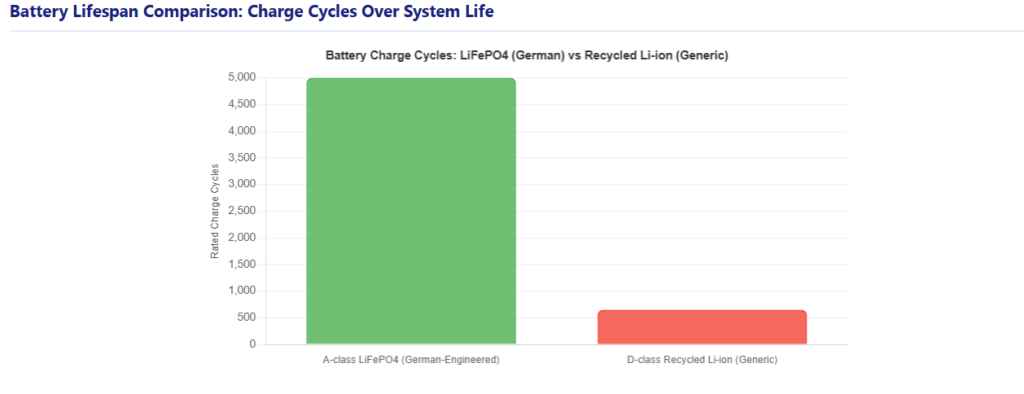
This reliability advantage becomes a strategic asset for ADB bids. German engineering standards emphasize designs that are not just high-performing but maintainable ,a critical distinction when the ADB’s procurement framework now explicitly rewards long-term value over short-term cost minimization.
The Competitive Scoring Advantage of a Strong Local Content Plan
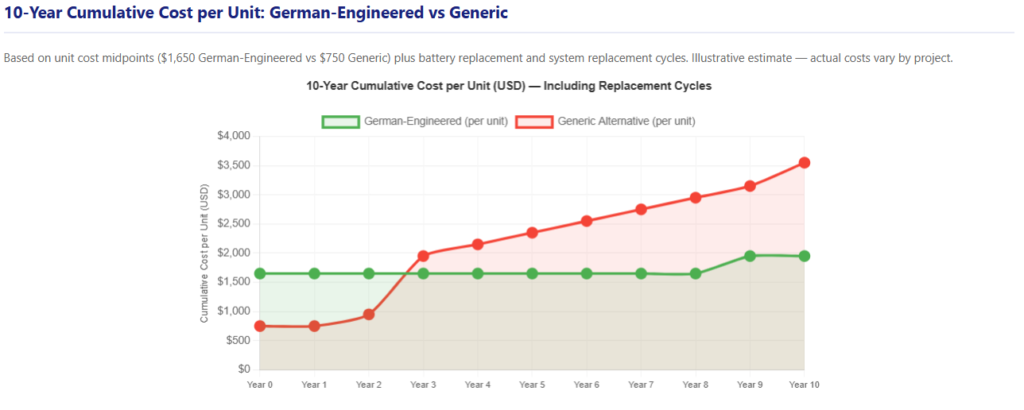
Understanding how MPC scoring works in practice helps contractors convert local content compliance from a minimum threshold into a maximum points opportunity. The ADB’s MPC framework awards points across multiple criteria. For solar street light contracts, relevant scoring categories typically include:
- Technical capability and product quality (verified through TÜV and CE certifications, third-party test reports, and product performance data)
- Experience and track record (prior ADB-financed or multilateral development bank projects)
- Innovation and sustainability (MPPT efficiency, LiFePO4 battery chemistry, ISO 9001 quality management, carbon footprint documentation)
- Local participation (the mandatory 50% person-days threshold plus additional points for exceeding it through local subcontracting, training programs, and local material sourcing)
A bid that meets only the 50% person-days floor captures the compliance threshold but leaves up to 15% of available points on the table. Contractors who pair compliant German-engineered products ,which score strongly on quality, certification, and innovation criteria ,with a comprehensive local workforce plan that exceeds the baseline threshold are positioned to win on total merit score, not just price. This is precisely the competitive dynamic the ADB’s reform is designed to create: quality-led differentiation rewarded over generic low-cost bids.
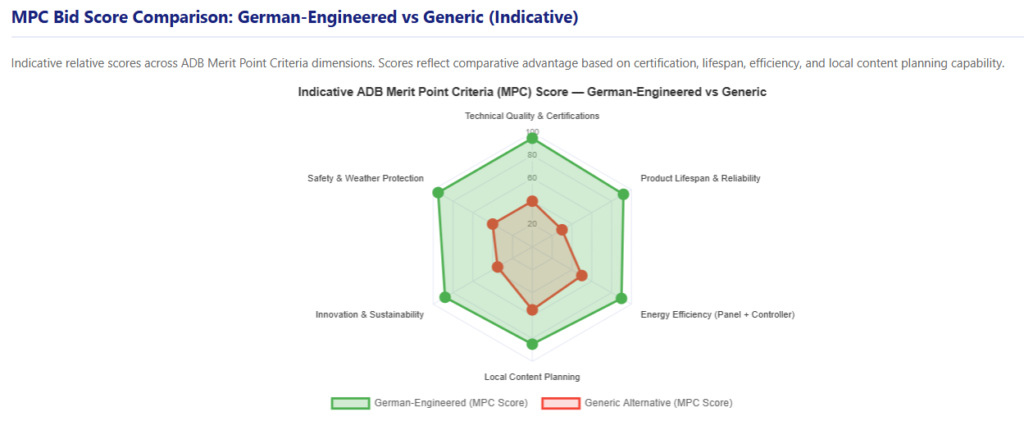
The total cost of ownership (TCO) analysis further strengthens this case. A German-engineered system priced at $800 to $2,500 per unit, operating for 10 to 15 years with battery replacement every 8 to 10 years, delivers a dramatically lower lifecycle cost than a generic system at $300 to $1,200 per unit requiring battery replacement every 18 to 24 months and system replacement every 2 to 3 years. When MPC scoring incorporates lifecycle value ,and under the ADB’s framework it increasingly does ,the total cost ownership calculation favors quality systems decisively.
Early Market Engagement: The New Pre-Bid Requirement
A procedural change that directly affects how solar street light contractors approach ADB bids from 2026 is the mandatory early market engagement requirement. Effective 1 January 2026, ADB borrowers must engage with potential suppliers before internationally advertised tenders are formally launched. This engagement ,through business opportunity seminars, roadshows, bilateral meetings, and surveys ,is designed to improve market understanding of local conditions, generate competition, and identify potential project risks and innovation opportunities before bid documents are finalized.
For solar street light suppliers and EPC contractors, early market engagement is a strategic window. It allows manufacturers with German engineering credentials to demonstrate their certification documentation, present their FIDIC EPC contract track record, and discuss local workforce training capabilities with borrowers before the tender specifications are locked. Suppliers who participate actively in early engagement are better positioned to shape tender Local content requirements, solar street lights that reflect quality standards ,and to develop the local partnership networks needed to meet the 50% labor mandate by bid submission day.
Procurement officers and project borrowers should prioritize early engagement sessions as an opportunity to assess market readiness for local content compliance ,identifying gaps in local technical capacity early allows for targeted skills development investment before project launch.
Conclusion: Compliance as Competitive Advantage
The ADB’s 2026 procurement reforms ,mandatory Merit Point Criteria and the 50% local labor mandate ,represent a structural shift in how international solar infrastructure contracts are won and delivered. Three takeaways matter most for decision-makers:
First, the lowest-price bid is no longer the winning bid. Technical quality, certification integrity, sustainability credentials, and local workforce commitment are all scored dimensions of bid evaluation. Suppliers offering German-engineered solar street lights with TÜV certification, third-party verified IP67 ratings, and 8 to 10 year LiFePO4 battery lifespans are objectively better positioned under MPC scoring than generic alternatives.
Second, local content compliance requires proactive planning. The 50% person-days threshold is non-negotiable for contract eligibility, and contractors who plan their workforce structure after bid award will struggle. Building local subcontracting partnerships, training programs, and maintenance workforce plans before bid submission is both a compliance requirement and a scoring opportunity.
Third, quality systems and local labor are complementary, not conflicting. German-engineered solar street lights are designed for reliability and maintainability ,qualities that make local installation and maintenance more effective, not less. Partnering quality-certified products with skilled local workforces creates the long-term project performance that the ADB’s reform is designed to incentivize.
For solar street light projects that meet the ADB’s 2026 procurement standards while delivering 10 to 15 years of reliable, low-maintenance performance, visit solar-led-street-light.com for a consultation or customized project quote. Our team brings German engineering standards and ADB procurement expertise to every project.
Frequently Asked Questions
1. What exactly is the ADB’s 50% local labor mandate? Effective 1 January 2026, all bidders on internationally advertised ADB-financed construction contracts must commit that at least 50% of total person-days worked on the project will be performed by local workers. This applies to works, non-consulting services, and goods contracts, with a limited number of exemptions in cases where strategic procurement planning demonstrates the threshold is unachievable ,for example, in small island developing states with limited local labor capacity.
2. Does the 50% mandate apply to solar street light supply-only contracts, or just installation work? The mandate applies primarily to construction and works contracts where physical labor is performed. For purely goods supply contracts (equipment-only procurement), the MPC framework still applies and local participation can be scored, but the 50% person-days requirement is specifically tied to construction and work components. EPC contracts that include supply, installation, and commissioning are clearly in scope.
3. How does the Merit Point Criteria scoring work for solar street light bids? MPC uses weighted scoring across technical quality, experience, capability, innovation, sustainability, and local participation. For high-risk procurements, technical criteria must account for at least 50% of the evaluation weight. Bids that strengthen domestic markets beyond the minimum ,through local subcontracting, training programs, and local materials ,can earn up to an additional 15% of available MPC points. Price is still evaluated, but it no longer dominates the outcome.
4. What certifications make a solar street light bid stronger under MPC evaluation? Third-party certifications are critical. TÜV certification verifies independent performance and safety testing. CE marking confirms conformity with European safety standards applicable in many ADB member countries. ISO 9001 certification demonstrates systematic quality management. Third-party verified IP67 ratings ,as opposed to self-claimed IP65 ,provide documented weather protection evidence. These credentials directly support technical quality scoring under MPC.
5. Can a local subcontractor perform the installation if the product is supplied by an international manufacturer? Yes, and this is actually the model the ADB’s local content framework is designed to promote. International manufacturers can supply German-engineered products while local contractors handle site preparation, installation, commissioning, and ongoing maintenance. This structure satisfies the 50% local person-days requirement while maintaining product quality, and it may qualify for additional MPC points under the domestic market strengthening provisions.
6. What is the difference between the MPPT controller and a PWM controller in a solar street light system? MPPT stands for Maximum Power Point Tracking. It is an intelligent charging controller that continuously optimizes the energy harvested from the solar panel, achieving 95 to 98% efficiency in German-engineered systems. PWM (Pulse Width Modulation) controllers, used in generic systems, operate at 70 to 75% efficiency and do not adapt dynamically to varying sunlight conditions. The difference in charging efficiency has a direct impact on battery performance, backup duration during cloudy periods, and overall system reliability ,all factors that affect long-term maintenance costs.
7. How does the LiFePO4 battery lifespan affect TCO calculations in ADB bids? A-class LiFePO4 batteries in German-engineered systems last 8 to 10 years with 5,000 or more charge cycles, meaning battery replacement is needed once over a 10 to 15 year project lifespan. Generic D-class recycled lithium-ion batteries last 1 to 2 years and require replacement every 18 to 24 months ,potentially five or more replacement cycles over the same project period. Each replacement involves procurement costs, local labor, logistics, and downtime. When ADB projects use lifecycle cost analysis as part of MPC evaluation, this gap makes a decisive difference.
8. What is early market engagement and how should contractors prepare for it? Early market engagement is now mandatory for all internationally advertised ADB contracts from 1 January 2026. It involves ADB borrowers consulting with potential suppliers ,through seminars, bilateral meetings, and surveys ,before tender documents are issued. For solar street light contractors, this is an opportunity to present product credentials, discuss local workforce training capabilities, and help shape tender specifications that reward quality and certification. Contractors should prepare comprehensive product documentation, local partnership plans, and case studies from prior multilateral development bank projects before these sessions.
References
- Asian Development Bank. (2025). ADB to Require Merit Point Criteria from 2026, Evolving its Procurement Approach to Enhance Quality and Create Local Jobs. https://www.adb.org/news/adb-require-merit-point-criteria-2026-evolving-its-procurement-approach-enhance-quality
- Asian Development Bank. (2025). Merit Point Criteria and ADB’s Evolving Procurement Approach. https://www.adb.org/news/features/merit-point-criteria-and-adbs-evolving-procurement-approach
- Asian Development Bank. (2025). Project Procurement ,Local Participation and MPC Requirements. https://www.adb.org/business/project-procurement
- Asian Development Bank. (2025). Guidance Notes on Procurement. https://www.adb.org/documents/guidance-notes-on-procurement
- Asian Development Bank. (2025). Merit Point Criteria (MPC Procurement Snapshot). https://www.adb.org/publications/merit-point-criteria
- Global Solar Council. (2024). GSC and GWO Launch Solar Training Standards Initiative. https://www.globalsolarcouncil.org/news/gsc-and-training-standards-body-gwo-launch-solar-training-standards-initiative/
- Fortune Business Insights. (2024). Solar Street Lighting Market ,Size, Share & Industry Analysis 2032. https://www.fortunebusinessinsights.com/industry-reports/solar-street-lighting-market-100585
- ScienceDirect / Energy Research & Social Science. (2025). Local Content Requirements for the Transfer of Knowledge and Skills in the Solar Photovoltaic Industry in Ghana. https://www.sciencedirect.com/science/article/abs/pii/S0973082625000328
- EconomyNext. (2025). ADB’s New Procurement Rules to Require Merit Point Criteria from 2026. https://economynext.com/adbs-new-procurement-rules-to-require-merit-point-criteria-from-2026-240722/
- Pacific Islands News Association. (2025). ADB Uses Merit Point Criteria to Enhance Its Procurement System in the Pacific. https://pina.com.fj/2025/05/14/adb-uses-merit-point-criteria-to-enhance-its-procurement-system-in-the-pacific/
Disclaimer
This article is for informational purposes only and does not constitute professional engineering, installation, or procurement advice. Performance specifications and costs may vary based on project Local content requirements solar street light, location, and local regulations. Always consult qualified solar energy professionals and legal advisors before making procurement decisions.
For expert consultation on solar LED street lighting solutions, visit solar-led-street-light.com or contact our team for a customized quote.