
In late November 2024, the northeast monsoon dumped the equivalent of six months of rainfall across parts of Thailand and Malaysia in just five days – displacing over 137,000 people, submerging roads, and knocking out public infrastructure across at least 25 districts. The economic damage from repair alone exceeded USD 224 million in Malaysia. For city planners and procurement officers across Vietnam, Indonesia, the Philippines, and beyond, this is not an anomaly. It is the operating baseline. And yet, thousands of solar street lights installed across Southeast Asia every year are designed for European or temperate climates – not for the brutal, unrelenting reality of the tropical monsoon belt.
This guide explains exactly what separates a solar street light that survives a monsoon season from one that fails within 18 months. From IP ratings and battery chemistry to corrosion engineering and charge controller logic, every design decision matters – and the engineering standards behind each choice determine whether your investment delivers 10+ years of reliable illumination or becomes a costly maintenance liability.
Why Southeast Asia’s Climate Demands a Different Design Philosophy
Southeast Asia sits within one of the most demanding outdoor lighting environments on Earth. The monsoon belt – stretching from Myanmar and Thailand through Vietnam, Malaysia, Indonesia, and the Philippines – delivers rainfall patterns that regularly overwhelm systems engineered for moderate climates. Annual rainfall in many parts of the region exceeds 2,000 mm, and coastal and highland zones in countries like the Philippines can receive over 5,000 mm per year. Humidity remains above 80–90% for months at a stretch. Ambient temperatures regularly reach 38–42°C before the wet season arrives.
What does this mean in practice for a solar street light? It means that every sealed junction, every battery enclosure, every LED driver board, and every solar panel connector is under constant environmental stress. It means that a poorly sealed fixture rated IP65 by a self-declaring manufacturer – rather than verified by an accredited laboratory – will experience moisture ingress within one or two monsoon cycles. It means that the humidity-driven corrosion that destroys uncoated metal hardware is not a distant risk; it is a scheduled event.
Industry research confirms that solar street lights in Thailand and the Philippines frequently fail to provide consistent illumination across consecutive rainy nights – a direct consequence of undersized battery systems and charge controllers that cannot efficiently harvest diffuse monsoon-season sunlight. A German-engineered design philosophy addresses this from the specification stage. The entire system – panel, battery, controller, housing, and fasteners – is designed as an integrated assembly for tropical extremes, not adapted from a European template after the fact.
The Asia Pacific solar street lighting market was valued at USD 0.36 billion in 2024 and is projected to grow to USD 1.29 billion by 2033, at a CAGR of 15.18%. Southeast Asian nations are among the fastest-growing contributors to this expansion. Getting the specification right is not just a technical question – it is a procurement and commercial one.
Ingress Protection Ratings: What IP67 Actually Means in a Flood Zone
When procurement officers compare solar street lights for Southeast Asia deployment, the IP (Ingress Protection) rating – defined under the international standard IEC 60529 – is the first line of technical defence against monsoon damage. The IP code uses two digits: the first indicates protection against solid particles (dust), and the second indicates protection against water. For street lighting in flood-prone tropical regions, the second digit is critical.
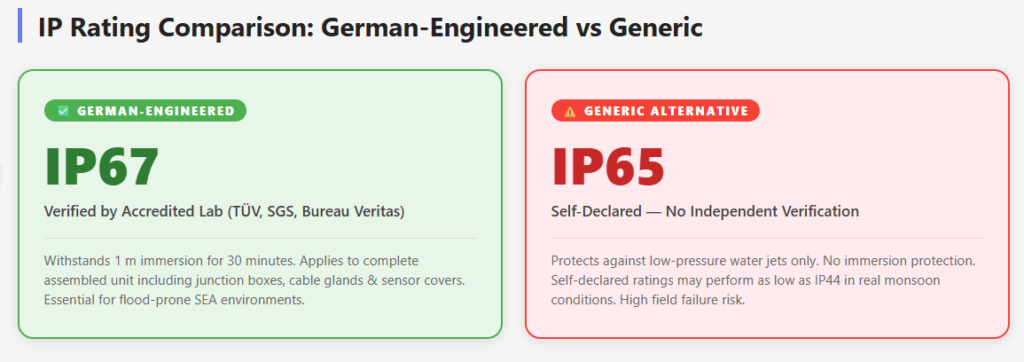
Here is what the relevant ratings mean in real terms:
- IP65 – Dust-tight. Protected against low-pressure water jets from any direction. Adequate for normal heavy rain in stable, elevated mounting positions.
- IP66 – Dust-tight. Protected against powerful, high-pressure water jets. Appropriate for locations exposed to driving rain or periodic washdown conditions.
- IP67 – Dust-tight. Survives immersion in up to 1 metre of water for 30 minutes. Essential for low-mounted fixtures or flood-prone ground-level environments.
- IP68 – Dust-tight. Survives continuous immersion beyond 1 metre depth (depth and duration defined by manufacturer). Reserved for partially submerged installations.
The critical distinction for Southeast Asia procurement is not just the number – it is whether the rating is verified by an independent accredited laboratory such as TÜV Rheinland or an equivalent body, or simply self-declared by the manufacturer. German-engineered systems carry IP67 ratings verified through accredited lab testing. Generic alternatives commonly claim IP65 – often without independent certification. In a monsoon environment, this difference translates directly into field failure rates.
Equally important: the entire luminaire assembly must carry the stated rating – not just the main housing. Cable entry glands, junction boxes, battery compartment seals, and motion sensor covers must all meet the same standard. A single unrated entry point becomes the failure location, regardless of how well the rest of the fixture is sealed. When reviewing product datasheets, always confirm that the IP rating applies to the complete assembled unit, not individual components.
For most urban road lighting applications in Vietnam, Indonesia, or the Philippines, IP67 verified by an accredited body represents the minimum specification for monsoon-proof reliability. For locations adjacent to rivers, in coastal lowlands, or in known flood corridors, IP67/IP68 dual-rated assemblies provide the necessary margin.
Battery Chemistry: Why LiFePO4 is the Only Rational Choice for Tropical Climates
The battery system is where monsoon-climate solar street lights most frequently fail – and where the specification gap between German-engineered and generic systems is most consequential. Southeast Asia’s tropical climate creates two simultaneous battery stresses: high ambient temperatures that accelerate chemical degradation, and extended periods of reduced solar irradiance during the monsoon season that require a larger usable capacity reserve.
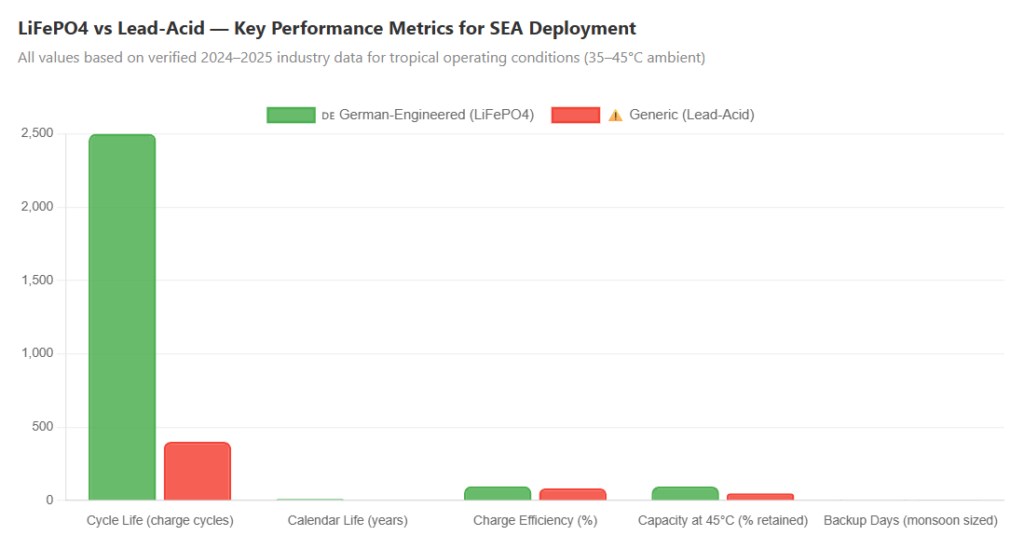
Lead-acid batteries – still common in low-cost generic systems – lose approximately 50% of their usable capacity at ambient temperatures of 45°C. In the conditions common across Thailand, Vietnam, and Indonesia during the pre-monsoon heat peak, this means a lead-acid battery nominally sized to provide three nights of backup may deliver fewer than 1.5 nights of effective illumination. Their cycle life of 300–500 full charge-discharge cycles translates to a real-world calendar life of 2–4 years in tropical deployment, after which total replacement is required.
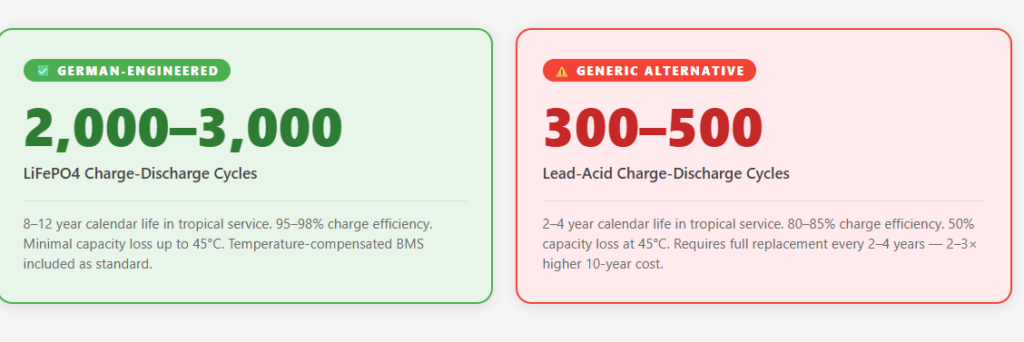
Lithium Iron Phosphate (LiFePO4) chemistry fundamentally changes this equation. LiFePO4 batteries exhibit minimal capacity loss up to 45°C, making them the chemistry of choice for high-ambient-temperature tropical deployment. Their charge-discharge efficiency reaches 95–98%, compared to 80–85% for lead-acid equivalents – meaning far less energy is wasted as heat within the battery itself, reducing self-heating in already-warm enclosures. Under the IEC 62133-2:2024 safety testing framework, quality LiFePO4 cells demonstrate 2,000–3,000 charge-discharge cycles before reaching 80% capacity retention, translating to a calendar life of 8–12 years in normal tropical service.
The structural importance of this chemistry for monsoon-season performance cannot be overstated. During extended overcast or rainy periods, a solar street light must maintain full illumination using stored energy across multiple consecutive nights without a full recharge. A properly sized LiFePO4 system, engineered against verified monsoon irradiance data for a specific location, can sustain 3–7 days of backup illumination. A lead-acid system of nominally equivalent capacity may fail to complete even two nights during a week-long monsoon event – precisely the failure mode that creates safety risks and public trust erosion for municipal lighting programmes.
Battery enclosures must achieve an independent IP67 rating in their own right, with silicone-sealed lids, stainless steel locking hardware, and a thermally managed internal environment. The Battery Management System (BMS) must implement temperature-compensated charging algorithms that reduce input current as temperatures exceed 40°C, protecting cell chemistry from accelerated degradation.
Solar Panel Specification: Harvesting Every Photon Through Cloud Cover
The monsoon season dramatically reduces solar irradiance across Southeast Asia. Under heavy overcast conditions, solar panel output can drop to as low as 10–25% of nameplate rating. This makes panel efficiency – not just rated wattage – the defining specification for monsoon-season performance.
German-engineered systems specify monocrystalline silicon panels rated at 21–23% conversion efficiency. Generic alternatives use polycrystalline panels at 15–17% efficiency. Under identical cloud cover conditions, this efficiency differential translates directly into more usable energy harvested per day – energy that goes directly into the battery reserve that sustains illumination through the night.
Equally critical is the charge controller technology paired with the panel. Maximum Power Point Tracking (MPPT) controllers – standard in German-engineered systems – continuously adjust the electrical operating point of the panel to extract maximum available power under variable irradiance conditions. In the rapidly changing light environments of a tropical monsoon day – where cloud density fluctuates moment to moment – MPPT controllers harvest 25–30% more energy than Pulse Width Modulation (PWM) alternatives used in generic systems. This is not a marginal gain; across a full monsoon season, it is the difference between a battery bank that enters each night adequately charged and one that is progressively depleted.
Panel mounting angle and orientation matter more in Southeast Asia than in temperate regions due to the high solar altitude angle throughout the year. Panels should be tilted at latitude-adjusted angles (typically 5–15° in equatorial Southeast Asia) to maximise irradiance capture while simultaneously allowing monsoon rainfall to self-clean accumulated surface dust – a compound benefit of proper design.
Panel glass must be tempered or anti-reflection-coated borosilicate, with aluminium alloy frames sealed to a minimum IP67 standard at all cable entry points. The panel surface and frame must be verified for salt spray resistance, particularly in coastal deployments in the Philippines, Malaysia, and Vietnam where marine aerosol exposure accelerates surface corrosion. This is consistent with the approach discussed in our guide to 5 benefits of IP65 solar street lights.
Corrosion Engineering: Designing for Humidity, Salt, and 10-Year Service Life
High ambient humidity and – in coastal zones – salt aerosol exposure represent the slow, invisible killers of inadequately engineered solar street lights in Southeast Asia. The combination of 85–95% relative humidity, temperatures of 35–42°C, and cyclical wetting and drying from monsoon rainfall creates an environment where untreated or inadequately treated metals corrode at rates significantly accelerated compared to temperate climates.
German-engineered systems address this through a layered approach to corrosion protection across every metallic component:
- Housing material: Precision die-cast aluminium alloy (ADC12 grade or equivalent), which naturally forms a dense oxide film providing baseline corrosion resistance. Housings are powder-coated or anodised post-casting to add a second protection layer rated for coastal salt spray exposure.
- Pole and mounting hardware: Hot-dip galvanised steel poles with a minimum zinc coating thickness of 85 μm, supplemented with epoxy primer and UV-stabilised topcoat. Stainless steel grade 316L for all fasteners, clamps, and brackets – the marine-grade specification that resists chloride-induced pitting corrosion in coastal environments.
- LED junction temperature management: Die-cast aluminium housings with integrated heat sink fins maintain LED junction temperatures at or below 85°C even at 50°C ambient temperatures. This is critical because every 10°C reduction in junction temperature doubles the rated operational lifespan of the LED array. Generic plastic or thin-metal housings allow junction temperatures to exceed 100°C in tropical conditions, reducing practical LED life from the rated 50,000 hours down to 20,000–30,000 hours.
- IK impact rating: IK08 or higher for luminaire body, providing resistance to 5-joule impacts – relevant in regions where tropical storms carry wind-borne debris. Generic systems are frequently unrated for impact.
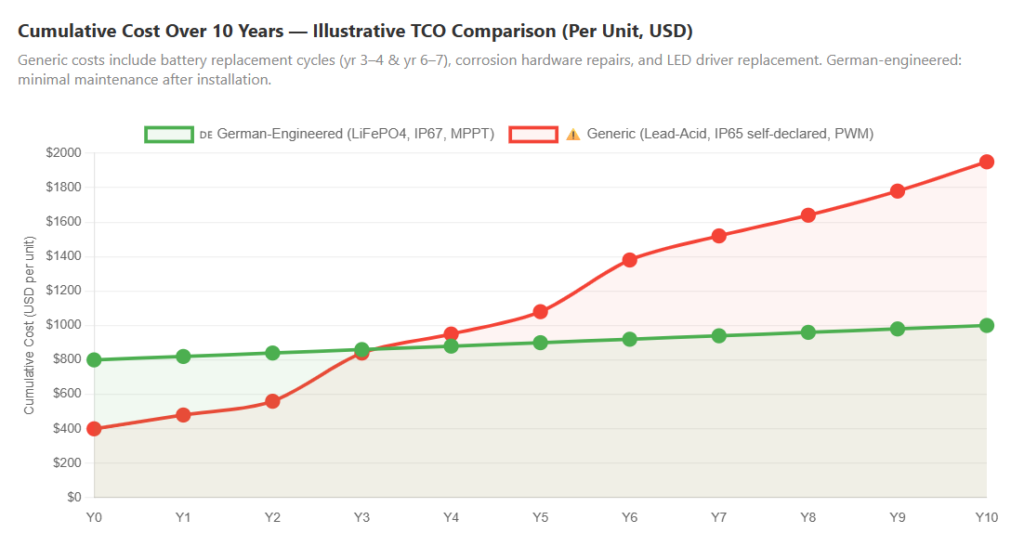
The total cost of ownership consequence of inadequate corrosion engineering is severe. Systems that require mechanical hardware replacement at year 3–4, pole repainting at year 5–6, or LED driver replacement due to humidity-induced PCB corrosion at year 4–6 carry 10-year lifecycle costs 2–3 times higher than properly specified German-engineered alternatives. For a comprehensive analysis of procurement cost methodology, see our detailed guide on total cost of ownership for EPC projects.
Monsoon-Proof Sizing: Backup Days, Lux Levels, and Pole Spacing
Engineering a monsoon-proof solar street lighting system for Southeast Asia is not simply a matter of specifying the right component standards – it requires a site-specific energy balance calculation that accounts for actual monsoon-season irradiance data, system losses, and lighting standard requirements for the road classification being illuminated.
The backup days specification – the number of consecutive cloudy or rainy nights the system can sustain full-rated illumination without recharging – is determined by the battery capacity divided by the nightly energy demand. For urban arterial roads in Vietnam or Indonesia, a minimum of 3 consecutive backup days is the recommended specification floor; for critical safety routes or areas with historically long monsoon events, 5–7 backup days should be targeted.
Lux level requirements for road lighting in Southeast Asia broadly follow the IEC/CIE standards adopted by national authorities. Main urban roads typically require a maintained average illuminance of 15–20 lux at road surface level with a minimum uniformity ratio of 0.4:1. For secondary roads and residential areas, 10–15 lux maintained with a minimum uniformity of 0.3:1 is standard. These targets must be achieved at end-of-life – accounting for LED lumen depreciation over the system’s rated service life.
LED efficacy of 160–180 lm/W in German-engineered systems – compared to 100–120 lm/W in generic alternatives – allows equivalent lux levels to be achieved with significantly lower wattage, reducing the battery capacity and panel area required to meet the specification. This creates a compound efficiency advantage: a smaller, lighter, lower-cost system that still exceeds the lighting standard requirement.
Pole spacing calculations for split-type systems should account for the specific optical distribution of the luminaire and the road width. For all-in-one integrated designs – which consolidate panel, battery, controller, and luminaire into a single pole-mounted unit – spacing is constrained by panel area optimisation and should be calculated using photometric simulation tools. Our detailed guide on how to calculate distance for LED solar area lights provides the methodology for this calculation. Similarly, our DIALux solar street light simulation guide walks EPC contractors through validated photometric verification workflows.
For procurement officers assessing ADB or World Bank-funded tenders in the region, the specification methodology described here aligns with the ADB and World Bank solar street light procurement criteria for 2026, which increasingly require verified technical specifications and third-party certification evidence.
Conclusion
Three principles define a genuinely monsoon-proof solar street light for Southeast Asia.
First, every component – panel, battery, housing, controller, hardware, and seals – must be specified for the actual operating environment, not a temperate benchmark. IP67 verified by an accredited laboratory, LiFePO4 battery chemistry rated for 2,000–3,000 cycles, MPPT charge control, and die-cast aluminium construction with marine-grade stainless steel hardware are not premium options. They are minimum viable specifications for 10-year service life in the tropics.
Second, the energy balance must be designed around real monsoon-season irradiance data with an adequate backup day margin – not nominal panel ratings tested under clear-sky standard conditions. A system that performs well in the lab but depletes its battery after two rainy nights has failed its fundamental purpose.
Third, the 10-year total cost of ownership – not the unit purchase price – is the only financially rational evaluation metric. German-engineered systems with verified specifications consistently outperform generic alternatives on this measure, even at higher initial unit cost, because they eliminate the repeated replacement, maintenance, and failure costs that generic systems accumulate across the monsoon belt.
Procurement officers, city planners, EPC contractors, and facility managers across Vietnam, Indonesia, the Philippines, Thailand, and Malaysia are investing in solar street lighting at a scale the region has never seen before. The decisions made at the specification stage today will determine whether that investment delivers a decade of reliable, safe illumination – or a recurring cycle of maintenance cost and public disappointment.
For expert consultation on specifying monsoon-proof solar LED street lighting systems for Southeast Asia, visit solar-led-street-light.com or contact our engineering team directly for a site-specific assessment and customised quote.
Frequently Asked Questions
1. Is IP65 sufficient for solar street lights in Southeast Asia, or do I need IP67?
For most road-level solar street light installations in urban or semi-urban Southeast Asian locations, IP67 is the recommended minimum. IP65 provides adequate protection against wind-driven rain and low-pressure water jets but does not protect against temporary immersion – a real risk in any location that experiences localised flooding during peak monsoon events. The critical caveat is that the IP rating must be verified by an accredited independent laboratory, not self-declared by the manufacturer. Self-declared IP65 in practice may perform no better than IP44 under real monsoon conditions.
2. How many backup days should I specify for a solar street light in the monsoon belt?
For urban arterial roads in the monsoon belt, a minimum of 3 consecutive backup days is a reasonable specification floor. However, for locations in flood corridors, coastal lowland areas, or regions with historically extended overcast periods – such as parts of the Philippines, Central Vietnam, and Sumatra – specifying 5 to 7 backup days provides a meaningful safety margin. Backup day calculations must be based on verified local irradiance data, not generic regional averages.
3. Why does MPPT matter more during the monsoon season than in the dry season?
An MPPT (Maximum Power Point Tracking) charge controller continuously adjusts the electrical operating point of the solar panel to extract maximum available power under variable light conditions. During the monsoon season, when cloud density changes rapidly throughout the day, the panel’s optimal operating point shifts constantly. MPPT controllers respond to these changes dynamically, harvesting 25–30% more energy than fixed-point PWM alternatives under the same cloudy conditions. This energy gain is critical precisely when irradiance is lowest and battery reserves are most stressed.
4. Can LiFePO4 batteries handle the high ambient temperatures common in Southeast Asia before the monsoon breaks?
Yes – LiFePO4 chemistry is significantly more tolerant of high ambient temperatures than lead-acid alternatives. LiFePO4 maintains minimal capacity loss up to approximately 45°C, while lead-acid batteries lose around 50% of their usable capacity at that temperature. That said, the battery enclosure must be independently rated to IP67, thermally managed to avoid sustained temperatures above 45°C, and managed by a BMS with temperature-compensated charging algorithms that reduce input current as temperatures rise. Enclosure design and BMS quality are as important as cell chemistry.
5. What wind load standard should I specify for solar street light poles in typhoon-prone areas of Southeast Asia?
Pole and mounting hardware for typhoon-exposed locations in the Philippines, Vietnam, and coastal Malaysia should be designed and verified to the relevant national wind load standard for the specific deployment zone. Many of these national standards align with IEC or ISO structural loading frameworks. As a minimum, poles for high-wind-risk areas should be hot-dip galvanised steel with a wall thickness and base plate design verified by structural calculation for the site’s design wind speed. Solar panel tilt angle and mounting bracket geometry directly affect the wind load experienced by the system and should be included in the structural review.
6. How does humidity affect LED driver boards, and what design features mitigate this risk?
High sustained humidity – common throughout Southeast Asia’s monsoon season – promotes condensation inside inadequately sealed luminaire housings, leading to corrosion of printed circuit board (PCB) tracks, electrolytic capacitor degradation, and oxidation of connector contacts on LED driver boards. The primary mitigation is a verified IP67 housing seal that prevents moisture ingress entirely. Secondary measures include conformal coating of PCB assemblies with silicone or acrylic resin, the use of sealed M-type waterproof connectors for all internal wiring, and the inclusion of desiccant packs within sealed battery and driver enclosures during initial assembly.
7. Are all-in-one integrated solar street lights or split-type systems more appropriate for Southeast Asia?
Both configurations can be engineered for monsoon performance, but the choice depends on site conditions. All-in-one systems – where panel, battery, controller, and luminaire are integrated into a single pole-mounted unit – offer simpler installation and lower labour cost, which is attractive in remote or difficult-access locations common across rural Indonesia or the Philippines. Split-type systems allow the battery enclosure to be independently positioned at pole base or underground level, reducing thermal stress on the battery from direct solar exposure – a meaningful advantage in extremely hot, high-irradiance pre-monsoon environments. The all-in-one format is covered in detail in our guide to 7 benefits of all-in-one street light technology.
8. What certifications should I require in a procurement specification for monsoon-proof solar street lights?
At a minimum, procurement specifications for Southeast Asian deployments should require: IP67 verification certificate from an accredited laboratory (TÜV Rheinland, Bureau Veritas, SGS, or equivalent); IK08 impact rating certificate; LiFePO4 battery certification to IEC 62133-2; solar panel certification to IEC 61215 and IEC 61730; LED driver certification to IEC 61347-2-13; and ISO 9001 quality management system certification from the manufacturer. For ADB or World Bank-funded projects, additional documentation requirements apply – see our guide to certification requirements for bankable EPC contracts.