
When nearly 70% of solar EPC contractors fall short on quality standards and 85% of projects contain major issues requiring urgent corrective action, the choice of lighting technology becomes critical. According to HelioVolta’s 2025 report analyzing over 5 gigawatts of solar assets, the industry faces a quality crisis that directly impacts project budgets and timelines. For EPC contractors managing solar street light installations, one decision significantly affects risk exposure: choosing between patent design solar street lights with exclusive technology versus copied models flooding the market.
This choice extends beyond initial procurement costs. It determines component traceability, intellectual property liability, insurance premiums, warranty enforceability, and ultimately whether your project meets performance guarantees without triggering costly liquidated damages.
The Hidden Liability of Copied Solar Technology
The solar industry faces unprecedented patent litigation. In 2024-2025, major manufacturers including First Solar, Maxeon, and Trina Solar filed dozens of infringement lawsuits targeting copied TOPCon technology, with patents extending through 2030. The U.S. Patent and Trademark Office denied attempts to invalidate these patents in late 2025, establishing clear legal precedent.
For EPC contractors, the implications are severe. When you install solar street lights using copied technology, you inherit liability chains extending through your entire project. Most EPC contracts include intellectual property indemnity clauses requiring contractors to defend against infringement claims and compensate clients for losses. Industry research indicates counterfeit electronic components cost the electronics sector over $100 billion annually, with solar components particularly vulnerable.
Patent designs all in one solar street light from established manufacturers provide documented freedom to operate. These companies invest millions in research and development, securing comprehensive patent portfolios protecting both their technology and their customers. When disputes arise, the manufacturer bears the legal burden, not the EPC contractor.
Generic copied models offer no such protection. Manufacturers producing unlicensed versions typically lack resources to defend against infringement claims. When litigation occurs, financial exposure falls to the project owner and EPC contractor. With performance liquidated damages in solar EPC contracts typically capped at 10-15% of contract value, a single patent dispute can eliminate project profitability entirely.
Component Traceability and Supply Chain Transparency
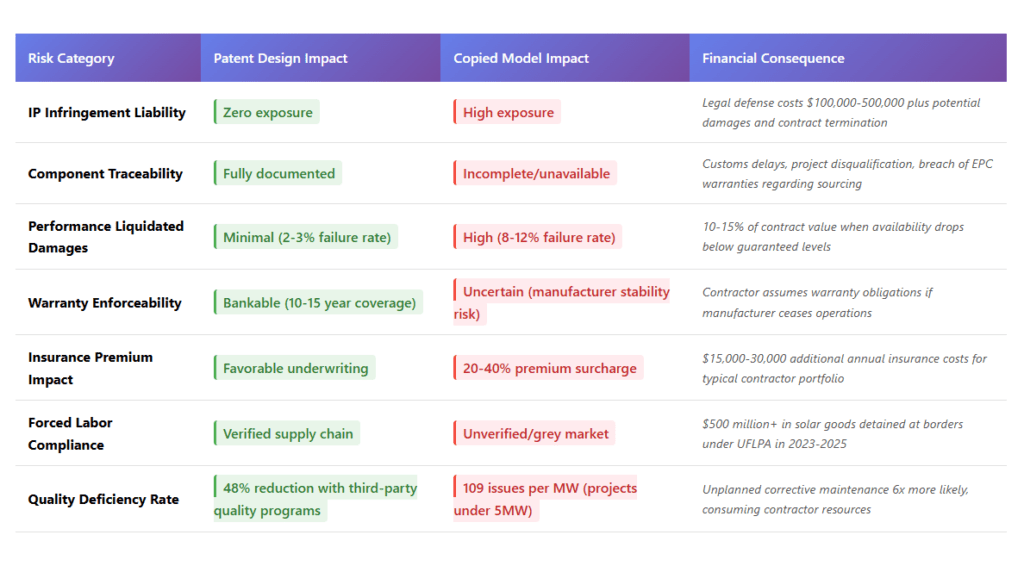
The 2025 regulatory environment demands unprecedented supply chain visibility. The Uyghur Forced Labor Prevention Act resulted in over $500 million worth of solar-related goods detained at U.S. borders in just two years. The European Union’s forthcoming forced labor ban, expected by 2027, establishes similar requirements globally.
Patent design manufacturers maintain vertically integrated supply chains with documented component origins. Every battery cell, solar panel, LED chip, and controller carries verified provenance from raw materials through final assembly. This traceability protects EPC contractors from project delays, customs seizures, and contract penalties.
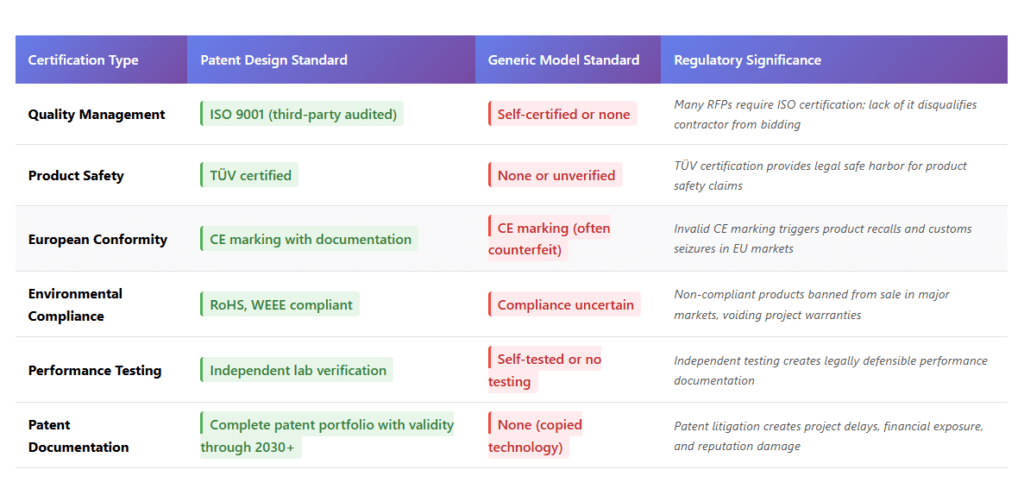
German-engineered solar street lights following rigorous standards provide complete component documentation including third-party certification for every major subsystem. TÜV certification, ISO 9001 compliance, and CE marking aren’t marketing claims but legally verifiable commitments backed by regular audits.
Copied models frequently lack such transparency. Generic manufacturers often source components through gray market channels where counterfeit risk is high. When projects cannot verify component origins, they risk exclusion from incentive programs, disqualification from government contracts, and breach of EPC agreement warranties.
Performance Guarantees and Liquidated Damages Exposure
EPC contracts for solar installations typically include strict performance guarantees. Contractors guarantee minimum capacity output, operational deadlines, and system reliability over multi-year periods. Failure to meet these commitments triggers performance liquidated damages reaching 15% of contract value.
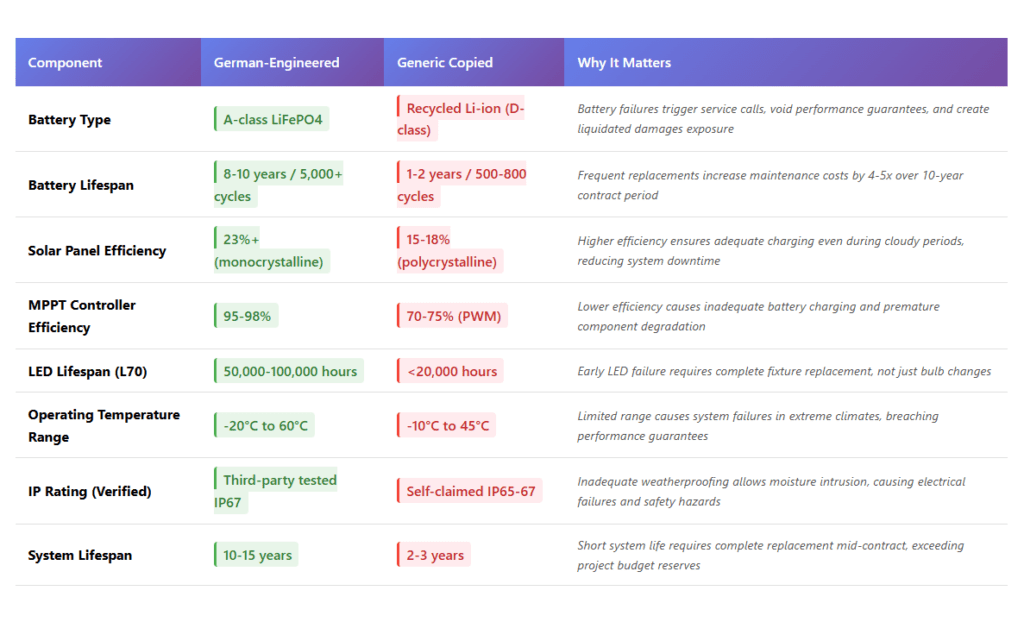
Patent design solar street lights reduce performance risk through proven engineering and comprehensive testing. German engineering standards require validation across temperature ranges from -20°C to 60°C, verification of 50,000 to 100,000-hour LED lifespans at L70 standard, and third-party testing of IP67 weatherproofing. These aren’t aspirational specifications but contractually guaranteed performance levels backed by manufacturer warranties extending 8-10 years.
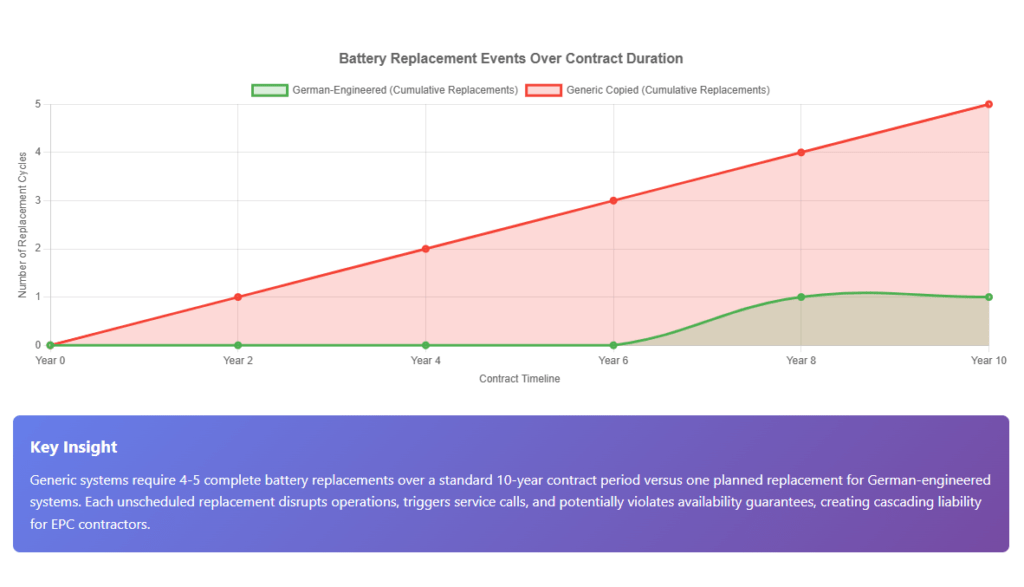
Consider battery technology, the critical determinant of solar street light reliability. A-class LiFePO4 batteries engineered to German standards deliver 5,000+ charge cycles over 8-10 year lifespans. Generic alternatives using recycled D-class lithium-ion cells typically provide 500-800 cycles and require replacement every 18-24 months. For a 100-unit street lighting project, this difference translates to 4-5 complete battery replacements over a 10-year contract versus one scheduled replacement.
Each unplanned battery failure triggers service calls, disrupts lighting coverage, and potentially violates performance guarantees. If your EPC contract guarantees 95% system uptime and battery failures drop availability to 88%, you face liquidated damages calculated across the entire project duration. At typical rates, a $500,000 street lighting project could incur $50,000-75,000 in penalties from component failures.
Insurance carriers increasingly recognize this risk differential. Professional liability policies for EPC contractors now include specific exclusions for projects using unverified components. When claims arise and insurers discover copied technology or gray market procurement, coverage can be voided entirely.
Quality Assurance and Long-Term System Reliability
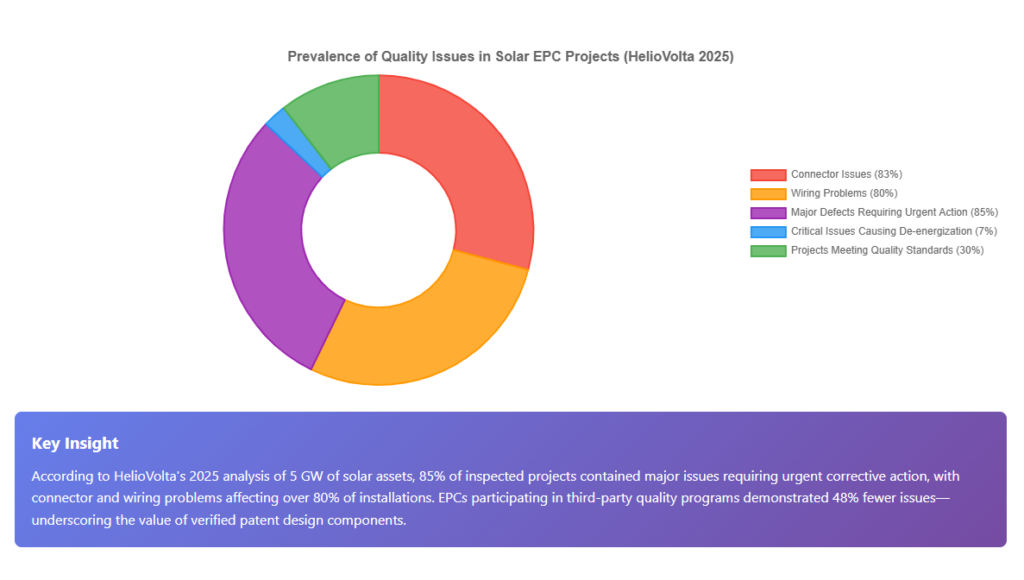
The 2025 HelioVolta quality analysis revealed connector-related issues in 83% of inspected solar projects, with wiring problems affecting 80%. Projects under 5 megawatts averaged 109 issues per megawatt, while projects participating in third-party quality programs demonstrated 48% fewer issues over time.
Patent design solar street lights undergo rigorous quality assurance that copied products cannot match. German engineering standards mandate testing protocols verifying every critical parameter before products leave the factory. MPPT controller efficiency of 95-98% isn’t a marketing claim but a measured specification with test certificates. Solar panel efficiency exceeding 23% using monocrystalline technology comes with performance warranties guaranteeing minimum output over 25-year periods.
Generic manufacturers producing copied designs typically lack facilities for comprehensive testing. Visual similarity to premium products masks fundamental differences in component quality, assembly precision, and long-term durability. Minor issues originating during construction exponentially increase failure risk if uncorrected, creating timing problems for EPC contractors managing cure periods.
Patent design products minimize this exposure through proven reliability. When a German-engineered solar street light carries a 10-year system warranty backed by an established manufacturer with global operations, the risk transfer is complete. Component failures during the warranty period are the manufacturer’s responsibility, not the contractor’s.
Real-World Project Impact: Cost-Benefit Analysis
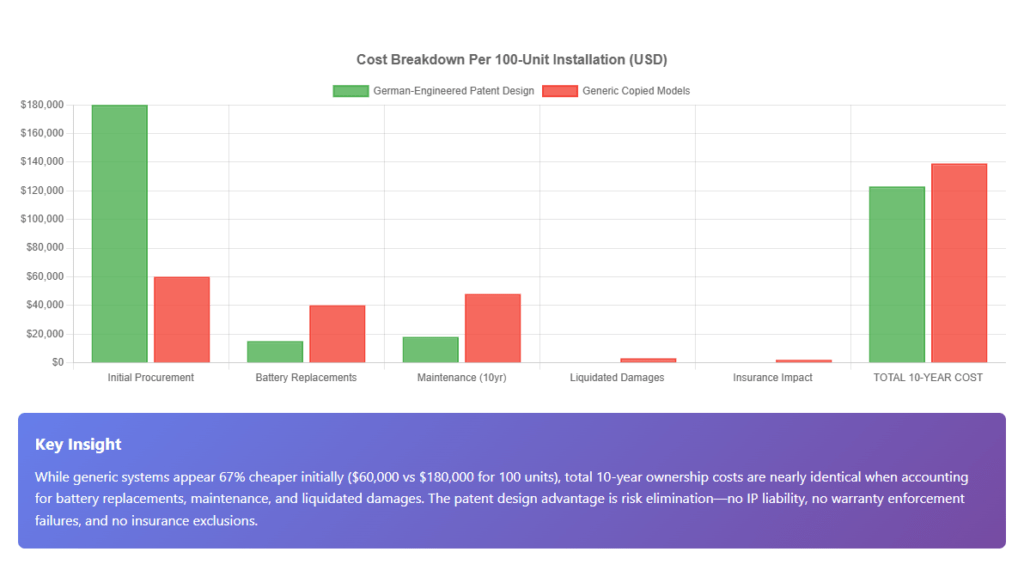
Consider two scenarios for a 500-unit municipal street lighting project. The EPC contractor can specify German-engineered patent design solar street lights at $1,800 per unit or generic copied models at $600 per unit. Initial procurement shows a $600,000 cost difference favoring generic equipment.
Over the 10-year contract term, the financial picture reverses. Patent design systems require one battery replacement at year 8, costing approximately $150,000 for 500 units. Maintenance calls average 2% of installations annually, totaling $18,000 yearly or $180,000 over contract. Total 10-year cost: $900,000 initial procurement plus $330,000 lifecycle costs equals $1,230,000.
Generic systems require battery replacement every 24 months, creating four replacement cycles at $100,000 each, totaling $400,000. Higher failure rates generate maintenance calls affecting 8% of installations annually, totaling $48,000 yearly or $480,000 over contract duration. Additionally, component failures trigger performance liquidated damages of $30,000. Total 10-year cost: $300,000 initial procurement plus $910,000 lifecycle costs equals $1,210,000.
While total costs appear similar, risk exposure differs dramatically. The patent design scenario includes no liquidated damages exposure, no IP infringement risk, no insurance exclusions, and no warranty enforcement challenges. The generic scenario includes all these risks plus administrative burden managing frequent component replacements.
Factor in opportunity cost of contractor resources managing problematic installations senior project managers spending 20% of their time addressing generic equipment failures represent $50,000-80,000 in unproductive overhead annually.
Conclusion
The choice between patent design solar street lights and copied models fundamentally determines EPC project risk exposure. While generic equipment offers lower initial costs, it introduces liability chains spanning IP infringement, supply chain compliance, performance guarantee failures, warranty enforceability, and insurance coverage exclusions that often exceed any procurement savings.
Patent design solar street lights from manufacturers following German engineering standards provide comprehensive risk mitigation through documented component traceability, verified performance specifications, defendable IP portfolios, and bankable warranties. For EPC contractors managing complex projects with strict performance requirements and limited liability caps, this risk reduction is essential to sustainable profitability.
As the solar industry matures and quality standards tighten, contractors who build reputations for reliability through superior equipment selection will capture premium opportunities. In an environment where 70% of EPCs fall short on quality and 85% of projects contain major deficiencies, differentiation through verified excellence becomes a competitive advantage worth pursuing.
For expert consultation on solar LED street lighting solutions engineered to minimize EPC project risk while maximizing long-term value, visit solar-led-street-light.com or contact our team for a customized assessment.
____________________________________________________________________________
Frequently Asked Questions
What makes patent design solar street lights less risky for EPC contractors than copied models?
Patent design products come from manufacturers with documented intellectual property rights, eliminating infringement liability that could expose contractors to lawsuits. These manufacturers also maintain comprehensive component traceability, verified supply chains, and defendable warranties that generic producers cannot match. When equipment failures occur, patent holders have resources and legal obligations to remedy defects, protecting contractors from warranty enforcement failures.
How do component traceability requirements affect solar street light procurement?
Current regulations including the Uyghur Forced Labor Prevention Act require documented component origins from raw materials through final assembly. Patent design manufacturers maintain this documentation as standard practice, enabling immediate compliance verification. Generic products often lack adequate traceability, exposing contractors to customs delays, project disqualification from incentive programs, and potential breach of EPC contract warranties regarding component sourcing.
What is the typical cost difference between patent design and generic solar street lights?
Initial procurement costs for German-engineered patent design solar street lights typically range from $800-2,500 per unit depending on specifications, while generic alternatives cost $300-1,200 per unit. However, lifecycle analysis reveals that patent designs often deliver lower total ownership costs through reduced replacement frequency, fewer maintenance interventions, and elimination of performance liquidated damages exposure from component failures.
How do insurance companies view projects using patent design versus copied solar equipment?
Insurance carriers increasingly scrutinize equipment sourcing when underwriting EPC professional liability and errors & omissions policies. Projects using verified patent design equipment from manufacturers with defendable IP portfolios qualify for favorable premium treatment and broader coverage. Projects using copied technology or components from unverified sources may face premium surcharges of 20-40% or coverage exclusions for equipment-related claims.
What happens if a solar street light manufacturer goes out of business during the warranty period?
When manufacturers cease operations, their warranties become unenforceable. Project owners then seek remedy from EPC contractors under the original installation contract. Patent design manufacturers from established companies with global operations, substantial reserves, and business continuity planning pose minimal closure risk. Generic manufacturers operating on thin margins in competitive markets face higher failure rates, leaving contractors exposed to warranty obligations that should have been manufacturer responsibilities.
How do performance liquidated damages in EPC contracts relate to equipment quality?
Most EPC contracts cap performance liquidated damages at 10-15% of contract value when guaranteed performance levels aren’t met. Equipment failures directly impact system availability and output capacity. If budget solar street lights with inferior components cause system availability to drop below guaranteed levels, contractors pay penalties potentially totaling hundreds of thousands of dollars. Patent design equipment with verified reliability specifications minimizes this exposure through proven component quality.
What documentation should EPC contractors require from solar street light manufacturers?
Contractors should require complete bills of material with manufacturer certifications, third-party test reports verifying performance specifications, patent documentation proving freedom to operate, supply chain traceability demonstrating forced labor compliance, ISO 9001 and other quality certifications, product liability insurance certificates, and warranty terms including reserve fund verification. Manufacturers unable to provide this documentation introduce unacceptable risk to EPC projects.
How does German engineering differ from generic solar street light manufacturing?
German engineering standards require rigorous testing protocols, third-party certification, and verified component specifications. Products must perform across extreme temperature ranges, deliver guaranteed lifespans with documented testing, and maintain performance standards through regular audits. Generic manufacturing typically lacks comprehensive testing infrastructure, relies on self-certification rather than independent verification, and uses lower-grade components to achieve competitive pricing. The resulting quality difference directly impacts long-term system reliability and contractor risk exposure.
References
- U.S. Energy Information Administration. (2025). Fewer U.S. solar projects are reporting delays in their expected online date. https://www.eia.gov/todayinenergy/detail.php?id=66604
- Solar Builder Magazine. (2025). Nearly 70% of U.S. solar EPCs fall short on quality, HelioVolta report finds. https://solarbuildermag.com/operations-maintenance/nearly-70-of-u-s-solar-epcs-fall-short-on-workmanship-heliovolta-report-finds/
- The Business Research Company. (2025). Solar EPC Market Report 2025 – Statistics & Analysis. https://www.thebusinessresearchcompany.com/market-insights/solar-epc-market-overview-2025
- Solar Power World. (2025). Solar panel patent battles could alter domestic manufacturing landscape. https://www.solarpowerworldonline.com/2025/01/solar-panel-patent-battles-could-alter-domestic-manufacturing-landscape/
- Norton Rose Fulbright. (2024). Maxeon Claims Solar Panel Patent Infringement. https://www.projectfinance.law/publications/2024/april/maxeon-claims-solar-panel-patent-infringement/
- Business Wire. (2026). US Patent & Trademark Office Rejects Attempts to Challenge Validity of First Solar TOPCon Patents. https://www.businesswire.com/news/home/20260119166413/en/
- Astute Group. (2025). Counterfeit electronics threaten supply chain sustainability across global industries. https://www.astutegroup.com/news/industrial/counterfeit-electronics-threaten-supply-chain-sustainability-across-global-industries/
- Solar Power World. (2024). The responsible solar supply chain. https://www.solarpowerworldonline.com/2024/11/the-responsible-solar-supply-chain/
- WTW. (2024). Contractor essentials for renewable projects: Owners and financiers. https://www.wtwco.com/en-us/insights/2024/08/renewable-projects-what-project-owners-and-financiers-should-require-of-their-contractors
- Climate Solutions Legal Digest. (2025). Performance Guarantees and Liquidated Damages in Solar EPC Contracts. https://www.climatesolutionslaw.com/2025/05/powerful-promises-performance-guarantees-and-liquidated-damages-in-solar-and-biogas-epc-contracts/
Disclaimer
This article is for informational purposes only and does not constitute professional engineering, installation, or procurement advice. Performance specifications and costs may vary based on project requirements, location, and local regulations. Always consult qualified solar energy professionals and legal advisors before making procurement decisions.
For expert consultation on solar LED street lighting solutions, visit solar-led-street-light.com or contact our team for a customized quote.