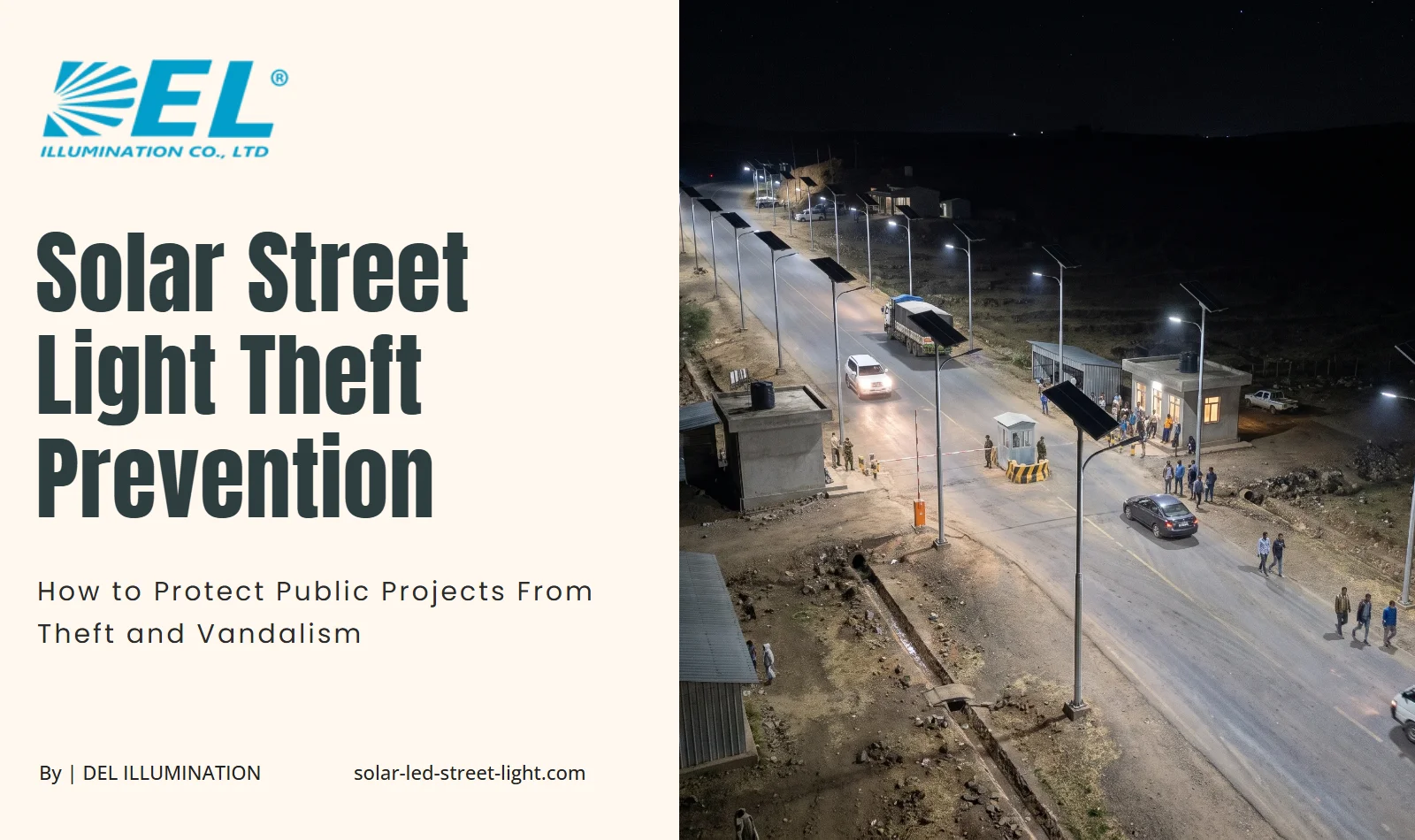
Solar street light theft is one of the fastest ways to turn a successful public project into a row of dark poles. A battery disappears one night, a panel the next, and within a few months a road that was lit at handover is dark again, with the authority facing complaints, replacement costs and awkward questions from funders. Vandalism adds to the problem: a broken lens or a damaged light head can put a light out of service just as surely as theft.
The good news is that most losses are preventable. This guide explains why solar street light theft happens, and how anti-theft design, careful site planning, monitoring and clear tender wording keep public lights where they belong: on the pole, working.
Why Solar Street Light Theft Happens
Solar street lights carry valuable parts out in the open, often on roads where few people pass at night. The parts most often targeted are:
- Batteries: lithium and lead-acid batteries can be reused at home or sold, which makes them the most common target, especially when they sit in a box at the foot of the pole.
- Solar panels: panels can power homes, shops and phone-charging businesses, so they have a ready market.
- Light heads and controllers: less common, but still taken where they are easy to unbolt.
- Cables: copper cable between separate components is easy to cut and sell for scrap.
Three conditions make solar street light theft more likely: parts that are easy to reach, parts that are easy to remove with ordinary tools, and parts that are useful or sellable once removed. Every way to prevent solar street light theft works by removing one or more of these conditions.
The Real Cost of Solar Street Light Theft and Vandalism
The direct cost is the replacement part and the crew to fit it. The indirect costs are usually larger:
- Roads, junctions and footpaths go dark, which undermines the safety benefits the project was meant to deliver.
- Residents lose confidence in the project, and future lighting programmes become harder to justify.
- Funders and auditors see failed assets, which can affect the next round of funding.
- Maintenance budgets are spent replacing stolen parts instead of planned servicing.
On a large project, even a low rate of solar street light theft adds up quickly. That is why theft prevention belongs in the design and the tender, not just in the maintenance plan.
Anti-Theft Solar Street Light Design
The single most effective protection is choosing an anti-theft solar street light design from the start. Several features make a real difference.
Keep the battery at the top of the pole
Ground-level battery boxes are the easiest target on any solar project. Designs that integrate the battery into the light head or mount it at height remove the most valuable part from easy reach. All-in-one solar street lights, which combine the panel, battery, controller and LED in one housing at the top of the pole, are popular on high-risk sites for exactly this reason.
Use tamper-resistant fixings
Standard bolts can be removed with a spanner in seconds. Anti-theft fasteners, which need special tools, and fixings that are hidden inside the housing or bracket slow thieves down and make casual theft impractical.
Specify impact and ingress ratings
Vandalism often means stones, sticks or deliberate blows to the light head. An impact rating such as IK08 or higher shows the luminaire has been tested against mechanical impact, while IP66 protection keeps out dust and water if the housing is struck. Both ratings should be backed by test reports, not just a datasheet claim.
Avoid exposed cables
Every visible cable is a weak point. Integrated designs have little or no external cabling. Where a separate panel is needed, as on many split type solar street lights for main roads, cables should run inside the pole and bracket rather than along the outside.
Choose a pole that resists climbing and tampering
Smooth poles with no footholds, enough height to keep components out of reach, and a locked handhole cover all help. Our solar street light pole guide covers height, material and foundations in more detail.
Site Planning That Deters Solar Street Light Theft
Where and how the lights are placed affects risk as much as the hardware. The principles of crime prevention through environmental design apply well to street lighting:
- Visibility: poles that are visible from homes, shops and passing traffic are less attractive targets than those on isolated stretches.
- Height: a mounting height that keeps the panel and light head well above reach removes the opportunity for quick theft.
- Clear surroundings: walls, fences and trees next to a pole can act as ladders or cover, so pole positions should avoid them where possible.
- Risk mapping: on large projects, identify the highest-risk sections early and apply stronger measures there, rather than treating every road the same.
Monitoring and Community Involvement
Technology and people both help protect lights after installation.
- Remote monitoring: lights that report their status can alert the maintenance team as soon as one goes offline, so a theft is noticed the next morning, not weeks later.
- Marking and records: serial numbers and visible marking on panels and batteries make stolen parts harder to sell and easier to trace.
- Community ownership: when residents understand that the lights are theirs, and know who to call when one is damaged, they become the first line of protection. Local leaders, schools and businesses can help spread the message.
- Local maintenance contracts: a local team that visits regularly is a visible presence and can respond quickly.
Writing Anti-Theft Requirements Into the Tender
The tender is where the authority sets the standard. Clear, measurable requirements help prevent solar street light theft before a single pole goes up. A strong specification can ask for:
- Battery integrated into the luminaire or mounted at a minimum height, with no ground-level battery boxes on high-risk roads.
- Anti-theft fasteners on all external fixings, with the special tools handed over to the maintenance team.
- Minimum ingress and impact ratings, such as IP66 and IK08, supported by test reports.
- Internal cable routing through the pole and bracket.
- Serial numbers on major components and an asset register at handover.
- Remote monitoring or, at minimum, a clear inspection schedule.
- A warranty and spare-parts plan that states how quickly damaged lights will be repaired.
For more on structuring specifications, see our guide to technical specs and a BOQ for solar street lights and our overview of government solar street lighting projects.
Installation Practices That Matter
Even the best anti-theft solar street light can be undone by careless installation. Make sure anti-theft fasteners are actually fitted and tightened, that no spare fixings or tools are left on site, that cables are routed internally as specified, and that each light’s serial number and location are recorded at installation. A quick handover inspection, pole by pole, catches problems while the contractor is still on site.
What to Do When Solar Street Light Theft Happens
Even well-protected projects can lose the occasional light. A clear response plan limits the damage:
- Report the theft to the local police with the serial numbers of the missing parts.
- Keep a small stock of spare parts so the light can be restored quickly.
- Review the location: if one section suffers repeated incidents, upgrade the protection there.
- Record every incident, so patterns become visible over time.
Common Mistakes
- Choosing designs with ground-level battery boxes on remote or high-risk roads.
- Using standard bolts because anti-theft fixings were left out of the specification.
- Leaving theft prevention to the maintenance budget instead of the design stage.
- Installing lights without recording serial numbers or locations.
- Ignoring the community, who see the lights every day.
- Assuming a product is an anti-theft solar street light because the brochure says so, without checking the fixings, the battery position and the test reports.
Frequently Asked Questions
What is the most common target in solar street light theft?
Batteries, especially when they are housed in boxes at ground level. Panels are the second most common target.
Are all-in-one solar street lights harder to steal?
Generally, yes. With the battery and controller sealed inside the light head at the top of the pole, there is no ground-level box to break into and very little external cabling.
Does remote monitoring prevent theft?
It does not stop a determined thief, but it shortens the time a road stays dark and helps identify high-risk areas, so protection can be improved where it is needed most.
What should a tender say about anti-theft solar street lights?
It should set measurable requirements: battery location, anti-theft fixings, IP and IK ratings with test reports, internal cabling, serial numbers and a repair response time.
Does anti-theft design make the lights much more expensive?
Usually not by much. Anti-theft fixings, internal cabling and an integrated battery add little to the price of anti-theft solar street lights compared with the cost of replacing stolen batteries and panels, sending crews out and leaving roads dark.
Protect the Project From Day One
Preventing solar street light theft starts long before installation, with the choice of design, the position of each pole and the wording of the tender. DEL’s German-engineered all-in-one and split type solar street lights are built with anti-theft, corrosion-resistant and wind-resistant construction, IP66 protection and IK08-tested impact resistance. If you are planning a project in an area where theft or vandalism is a concern, talk to a DEL project engineer for a free consultation and a design that keeps your roads lit.
References
- International Electrotechnical Commission. (2013). IEC 60529: Degrees of protection provided by enclosures (IP Code). https://www.iec.ch/ip-ratings
- International Electrotechnical Commission. (2021). IEC 62262: Degrees of protection provided by enclosures for electrical equipment against external mechanical impacts (IK code). https://en.wikipedia.org/wiki/IK_code
- European Committee for Standardization. (2015). EN 13201: Road lighting. https://www.cen.eu
- International CPTED Association. (2025). Crime Prevention Through Environmental Design. https://www.cpted.net
- World Bank. (2025). Procurement Framework and Regulations for Investment Project Financing. https://www.worldbank.org/en/projects-operations/products-and-services/brief/procurement-new-framework
- U.S. Department of Energy. (2024). Solar Photovoltaic Technology Basics. https://www.energy.gov/eere/solar/solar-photovoltaic-technology-basics
Disclaimer
This article is for general information only and does not constitute professional engineering, security, legal or procurement advice. Requirements for road lighting, security measures and tender documents differ by country and project. Always confirm specifications with qualified engineers and the relevant authorities before purchase or installation.