If you search for solar street lights, you will quickly meet three names that sound almost the same: all-in-one, 2 in 1 (also called all-in-two) and split type. Suppliers use them in different ways, product pages rarely explain them, and buyers are left guessing which design fits their road. Choosing the wrong one can mean dark nights in the rainy season, or paying for more system than the road needs.
This guide explains what a 2 in 1 solar street light is, how it compares with all-in-one and fully split systems, and how to decide which one belongs on your project.
What Is a 2 in 1 (All-in-Two) Solar Street Light?
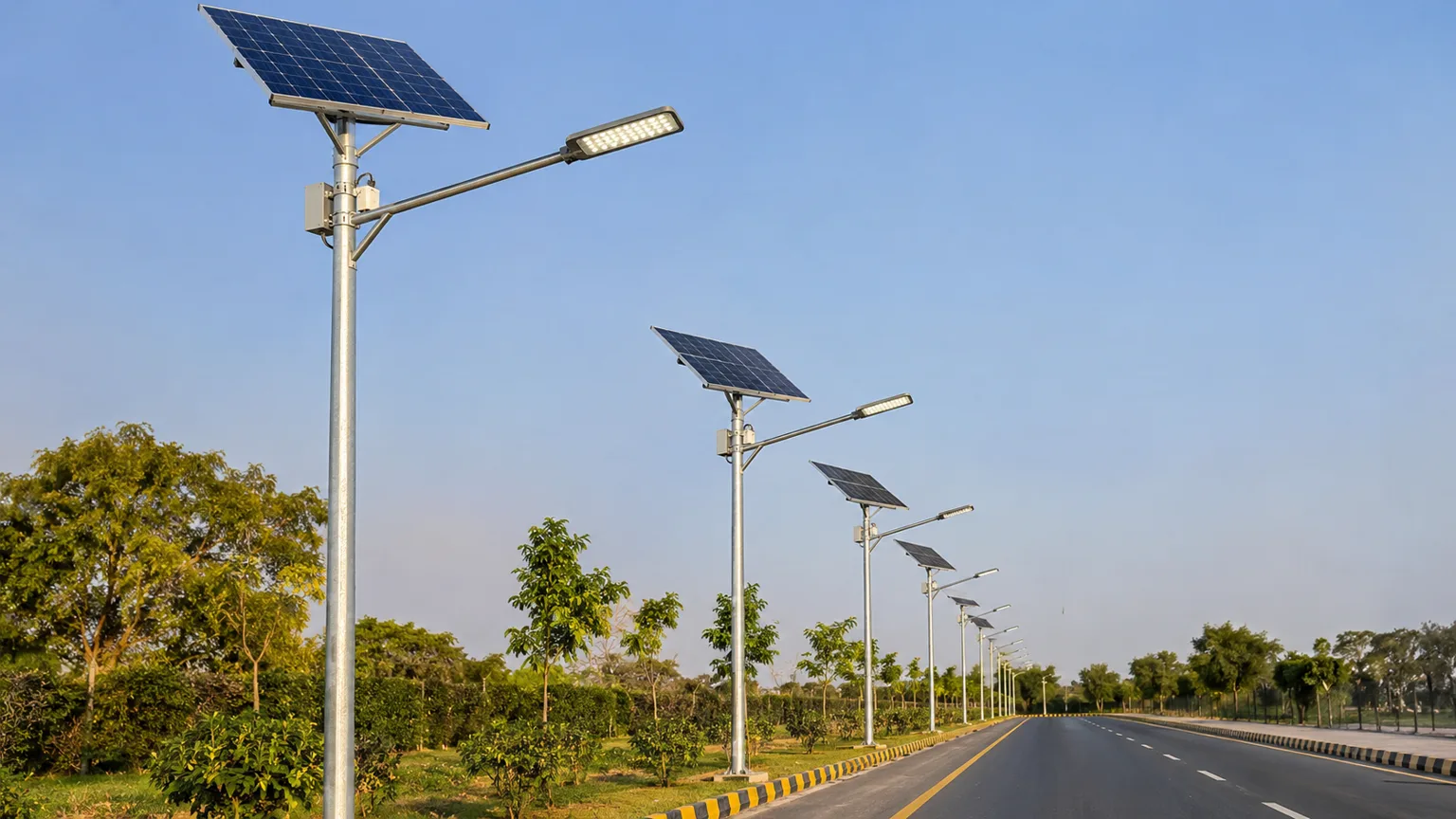
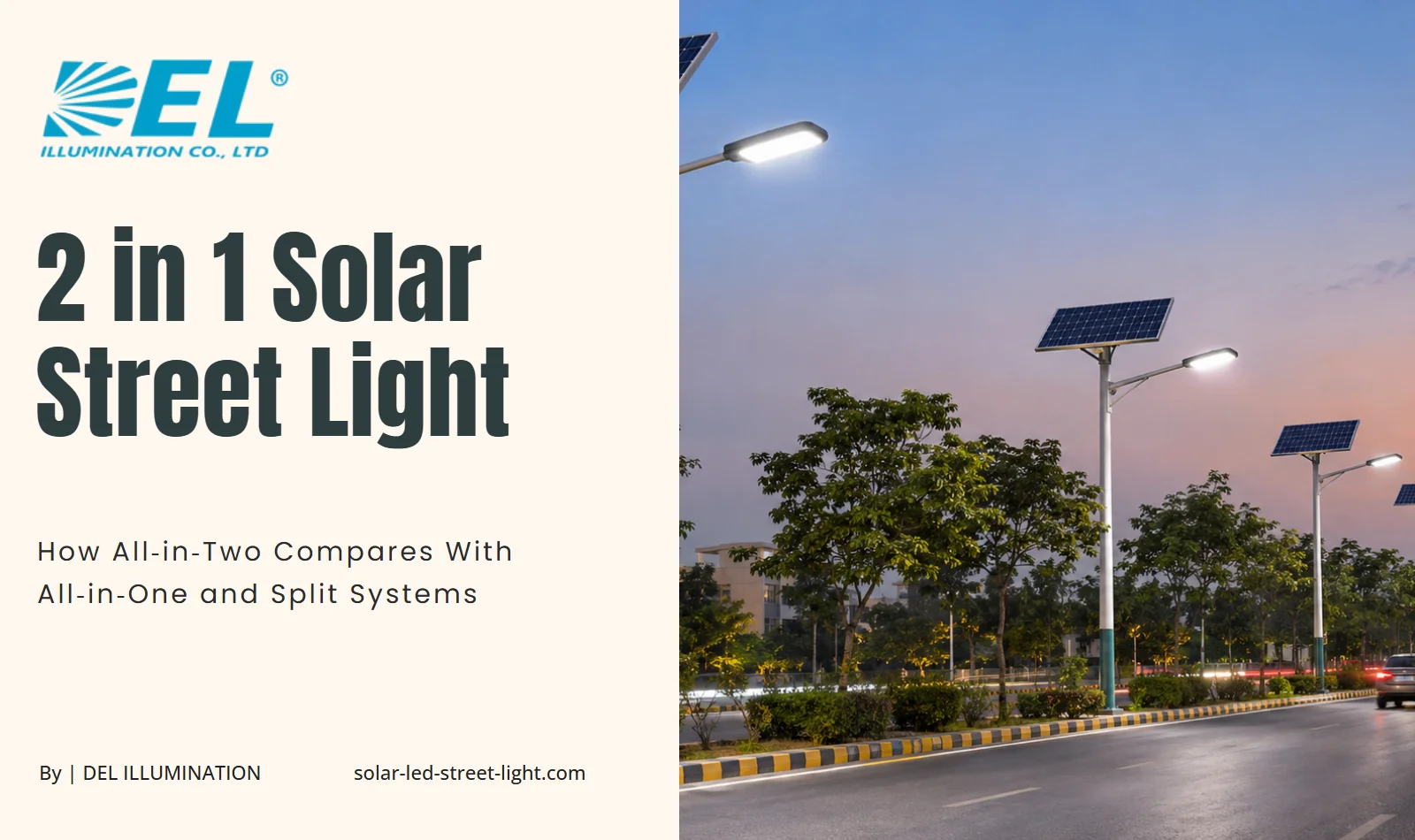
A 2 in 1 solar street light is built from two main parts instead of one: the LED light head and a separate solar panel. Because the panel is no longer locked into the same housing as the light, it can be larger and can be mounted at its own angle, facing the sun, while the light head points down at the road.
The battery and controller are built into one of the two parts, depending on the manufacturer’s design. Either way, the system stays simple to install: two units on one pole, connected by a short cable, with no separate battery box at the base of the pole.
You will see the same design described as “2 in 1”, “all-in-two” or “split type” by different suppliers. At DEL, this family is called the Split Type Solar Street Light (All-in-Two).
The Three Designs Side by Side
All-in-one solar street light
- Build: solar panel, battery, controller and LED in one compact housing.
- Strengths: fastest installation, neat look, fewest parts, lowest handling cost.
- Limits: the panel size is fixed by the housing and its angle is tied to the light, so power and autonomy have a ceiling.
- Best for: residential streets, village roads, paths and parks in sunny regions.
2 in 1 (all-in-two) solar street light
- Build: LED light head plus a separate solar panel on the same pole, with the battery integrated into the system.
- Strengths: larger panel, adjustable panel angle, higher wattage and longer backup, while installation stays almost as simple as all-in-one.
- Limits: two units to mount and a larger wind area at the top of the pole.
- Best for: main roads, highways, ports, industrial areas and regions with less sunshine or long rainy seasons.
Fully split system
- Build: panel, battery box, controller and light all separate, often with the battery at the pole base or underground.
- Strengths: maximum flexibility in battery size and panel area.
- Limits: most cabling, most installation work and, with ground-level batteries, a higher theft risk.
- Best for: special cases where very large batteries are needed and the site is secure.
Why the Separate Panel Matters
The single biggest advantage of a 2 in 1 design is the panel. On an all-in-one light, the panel sits in the same housing as the LED, so it usually lies almost flat. That works near the equator, where the sun is high, but further from the equator a flat panel collects much less energy, especially in winter.
A separate panel can be tilted to suit the latitude of the project, which increases the energy collected over the year. It can also be larger, because it is not limited by the size of the light head. DEL’s Split Type range, for example, uses panels from 60 W up to 360 W on lights from 30 W to 180 W, with an adjustable mount so the panel angle can be set for each site.
More energy in means more light out and more nights of backup. That is why 2 in 1 systems are the usual choice when a road needs high output or must stay lit through several cloudy days in a row.
Power, Battery and Backup
Because the panel and battery can be sized more generously, 2 in 1 systems typically offer higher wattages and longer autonomy than all-in-one lights. As an illustration, DEL’s Split Type range covers:
- LED power from 30 W to 180 W, at 200 to 240 lumens per watt.
- LiFePO4 lithium batteries from 384 Wh to 2,304 Wh, rated for over 5,000 charge cycles.
- 5 to 7 rainy days of backup, compared with 3 to 5 nights for DEL’s all-in-one range.
- An MPPT charge controller and a programmable lighting schedule for 12 to 15 hours of light per night.
Exact figures depend on the model and are confirmed on the datasheet for each project, but the pattern is the same across the industry: when the road needs more light or more autonomy, the separate-panel design has the headroom.
Pole Height and Spacing
Higher output allows taller poles and wider spacing, which can reduce the number of poles on a long road. DEL’s Split Type models, for example, are specified for mounting heights from about 2 metres on the smallest model up to 14 metres on the largest, with recommended spacing growing from 10 to 20 metres up to 40 to 50 metres.
The right height and spacing for a specific road always come from a lighting calculation. A DIALux lighting design checks the proposed model, height and spacing against the required lighting class, so the road is lit evenly without paying for extra poles. For the structural side, our guide to solar street light poles covers height, wind rating and foundations, which matter more when a separate panel adds wind load at the top of the pole.
When to Choose a 2 in 1 Solar Street Light
A 2 in 1 design is usually the better choice when one or more of these apply:
- The road is wide or busy: main roads, highways and interchanges that need higher output and taller poles. See our highway and main road lighting solutions.
- The site is far from the equator or has long winters, where a tilted panel collects noticeably more energy.
- Long rainy seasons or frequent cloud cover call for more days of backup.
- The road must meet a strict lighting class, such as those in EN 13201 or IESNA, where an undersized system would fail the calculation.
- Large public projects where reliability through the worst month of the year matters more than the lowest unit price.
DEL’s Split Type lights are used on exactly these kinds of projects, from freight terminal roads in Nigeria with more than 1,200 lights to airport roads in Papua New Guinea and port routes in the Philippines.
When All-in-One Is Enough
A 2 in 1 system is not always necessary. For residential streets, village roads, paths and parks in sunny regions, an all-in-one solar street light is often the simpler and more economical choice. It installs faster, has fewer parts and looks neat on lower poles. Many projects use both: 2 in 1 lights on the main road and all-in-one lights on the side streets and paths.
Common Mistakes When Choosing Between the Designs
- Comparing names, not specifications. Two products both called “split” can be very different. Compare panel wattage, battery capacity and autonomy instead.
- Using all-in-one lights on a main road because they are cheaper per unit, then finding the road too dark or the lights off after a few cloudy days.
- Leaving the panel flat far from the equator. A separate panel only helps if its angle is set for the site’s latitude during installation.
- Forgetting the pole. A larger separate panel adds wind load, so the pole and foundation must be rated for it.
Questions to Ask Before You Buy
- Where is the battery located, and what is its chemistry, capacity and rated cycle life?
- What is the panel wattage, and can its angle be adjusted for our latitude?
- How many days of backup does the system give in our worst month?
- What mounting height and spacing does the lighting design recommend for our road?
- Is the pole rated for the wind load of the separate panel?
- Which test reports, certificates and warranty terms come with the offer?
Frequently Asked Questions
Is a 2 in 1 solar street light the same as a split type?
Often, yes. Many suppliers use “2 in 1”, “all-in-two” and “split type” for the same idea: a light head and a separate solar panel on one pole. Some suppliers use “split” only for systems with a separate battery box as well, so always check where the battery sits.
Is 2 in 1 better than all-in-one?
Neither is better in every case. 2 in 1 gives more power, a tiltable panel and longer backup, which suits main roads and less sunny regions. All-in-one is simpler and cheaper to install, which suits residential streets and paths in sunny areas.
Is a 2 in 1 solar street light harder to install?
Only slightly. It has two units to mount instead of one and a short cable between them, but there is no battery box or underground cabling, so installation is still much simpler than a fully split system.
How long do 2 in 1 solar street lights last?
With quality components, the main parts are designed for long service. On DEL’s Split Type range, for example, the LEDs are rated for 50,000 hours, the solar panels for 25 years and the LiFePO4 batteries and controllers for around 12 years.
Choose the Design That Fits the Road
The best solar street light is the one sized for the road, the climate and the lighting class, not the one with the biggest number on the datasheet. If your project includes main roads, highways or sites with long rainy seasons, a 2 in 1 design gives the power and backup headroom you need. If you are not sure which design fits, talk to a DEL project engineer for a free consultation and a DIALux design for your roads, or compare the full range on our solar street light products page.