
Solar street lighting is fast becoming a mainstream infrastructure priority for governments, smart cities, and infrastructure developers worldwide. According to a Future Market Insights (FMI) report, the solar street lighting industry is valued at 5.4 billion in 2025. And it is expected to hit 11 billion by 2035.
That growth reflects one thing clearly: governments and project developers are rapidly shifting toward energy-efficient outdoor lighting systems.
But even though the technology and demand get most of the attention, the real success of a solar street lighting project still depends on the planning phase. A well-structured BOQ for solar street light projects and clear technical specifications determine everything from project cost accuracy to system performance, compliance, and lifecycle value.
In this blog, we will explore how to craft a professional BOQ for solar street light projects that covers every nut, bolt, and watt.
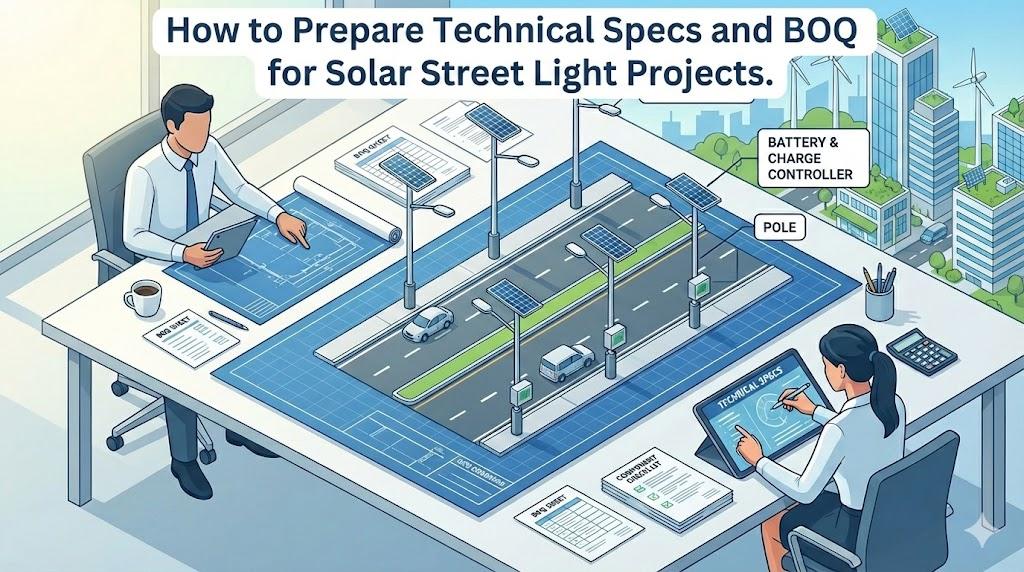
What is Bill of Quantities (BOQ)?
A Bill of Quantities (BOQ) is a structured document that lists all materials, components, and work items required in a project, along with their quantities and units. As far as solar lighting projects are concerned, a BOQ for solar street lights helps:
- Estimate costs
- Compare vendor bids
- Plan procurement accurately
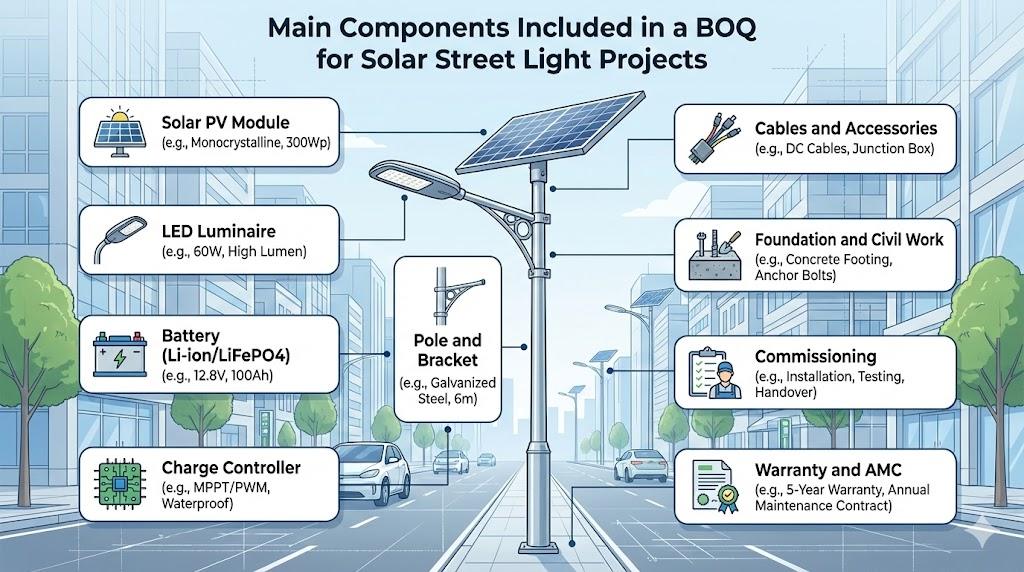
Main Components Included in a BOQ for Solar Street Light Projects
When you prepare a BOQ for solar street light projects, it’s important to clearly list every major component and activity. Below are the key elements normally included in a solar LED street lighting BOQ:
- Solar PV Module
The solar panel is the power generator of the system. Its capacity, efficiency, and type (mono or poly) determine how much energy is produced each day. Your BOQ must specify the capacity in Watt-peak (Wp) rating and the technology type (Monocrystalline or Polycrystalline) clearly.
- LED Luminaire
The wattage is important, but the Luminous Efficacy (lumens per watt) is the real measure of performance. Specify the IP rating (minimum IP65) and the LED chip brand to ensure the light output remains consistent over years of service.
- Battery
The street light battery stores solar energy for nighttime operation. In BOQ, the capacity (Ah), voltage, technology type, depth of discharge, backup autonomy, and cycle life are specified. Batteries directly affect reliability, maintenance, and lifecycle cost.
- Charge Controller
The controller manages charging and protects the battery from overcharging or deep discharge. BOQ details include controller type (PWM/MPPT), protections, efficiency, and lighting control features such as dimming or dusk-to-dawn operation.
- Pole and Bracket
Poles support the luminaire and panel safely under wind load. Your BOQ must detail the height (e.g., 6M), thickness, and, crucially, the Hot-Dipped Galvanization standard to prevent rust. If possible, include wind load resistance specs to ensure safety during storms.
- Cables and Accessories
This includes DC cables, junction boxes, connectors, lugs, and earthing materials. BOQ defines sizes, insulation type, UV resistance, routing method, and standards to ensure electrical safety and minimum loss.
- Foundation and Civil Work
This component covers excavation, concreting, grouting, and base-plate installation. BOQ mentions foundation depth, concrete mix, and site preparation. If you ignore the civil works cost in your solar project cost estimation, your installation budget will bleed.
- Commissioning
Labor, tools, transport, testing, and system integration fall here. It is the practical cost of turning components into a working system.
- Warranty and AMC
Define the warranty period for each component (e.g., 25 years for panels, 5 years for batteries) and include an Annual Maintenance Contract (AMC) provision for long-term service stability.
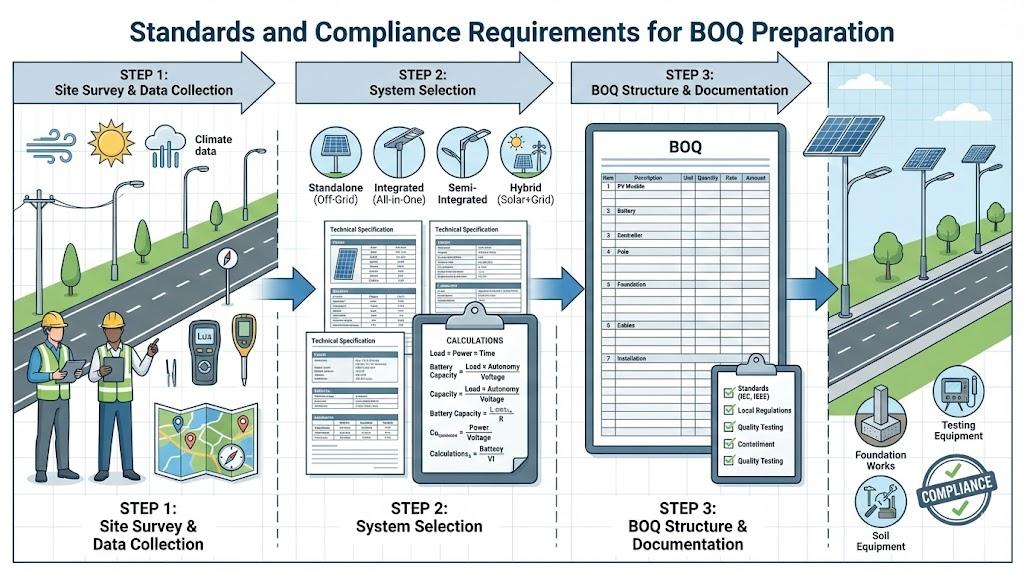
Step-by-Step Guide: How to Prepare a BOQ for Solar Street Light Projects
Creating an accurate BOQ for solar street light installations requires systematic planning and technical precision. Let’s break down this process into simple steps:
1. Conduct a Thorough Site Survey and Project Assessment
Before numbers, understand the context. A BOQ is only as accurate as the project scope behind it.
A detailed site survey gives you a realistic image of the project conditions. You must walk the installation route with your technical team and document critical parameters like:
- Total road length
- Existing infrastructure
- Soil conditions
- Shadowing obstacles like trees or buildings
- Accessibility for construction equipment
Pay special attention to geographic and climatic factors. Is this a coastal area with high humidity? A desert region with extreme temperatures? These conditions directly impact component selection and quantities. For instance, coastal installations require marine-grade materials and additional anti-corrosion treatments, which must reflect in your BOQ line items.
2. Finalize the Type of Solar Street Light System
There are mainly four types of solar street lighting systems:
- Standalone Solar Street Light: A standalone solar street light operates completely off-grid. Each light has its own solar panel, battery, controller, and LED luminaire, making it ideal for remote or rural locations where grid power is unavailable.
- Integrated solar street light: In an all-in-one (integrated) system, the solar panel, battery, charge controller, and LED light are housed in a single compact unit. It is easy to install and requires less maintenance, making it popular for large urban projects.
- Semi-integrated solar street light: In semi-integrated systems, the battery and controller are built into the LED luminaire, while the solar panel is mounted separately on the pole. This offers design flexibility with higher panel capacity compared to fully integrated lights. For more details, check out our blog on semi-integrated vs integrated street light systems.
- Hybrid solar street light: Hybrid systems use solar energy as the primary source and the power grid as backup. They are suitable for locations with inconsistent sunlight or critical lighting applications where downtime is not acceptable.
Your BOQ will change depending on the system type. Each option affects the battery sizing, controller type, mounting design, wiring layout, and so on.
3. Define Technical Specifications for Each System Component
Break down your solar street light system into distinct components with precise specifications. Have a look at the main solar street light BOQ components that you need to specify:
| Component | Description Elements |
| Solar Panel | Wattage (typically 80W-200W), type (monocrystalline/polycrystalline), efficiency rating, temperature coefficient, and warranty terms |
| LED Luminaire | Lumen output, color temperature (usually 5000K-6500K for street lighting), IP rating (minimum IP65), beam angle, and lifespan hours |
| Battery System | Capacity (Ah), type (lithium-ion/LiFePO4), depth of discharge, cycle life, and backup days (usually 2-3 rainy days) |
| Charge Controller | MPPT/PWM type, voltage rating, and overcharge/discharge protection features |
| Pole Structure | Height (6m-12m based on road width), material (hot-dip galvanized steel/aluminum), wind resistance rating, foundation depth |
4. Calculate Quantities with Precision
Now comes the mathematical heart of your BOQ for solar street light projects. Start with pole spacing calculations. The formula is:
Distance between poles= pole height × 3.5 to 4
For an 8-meter pole, you’d space poles 28-32 meters apart. Divide your total road length by this spacing to determine the number of light points required.
Never forget the multiplier effect. Each light point requires not just one pole and fixture, but also:
- Foundation materials like cement and sand
- Electrical accessories
- Installation hardware
- Civil work quantities
Always include a 5-10% contingency factor for material wastage, damaged components during transportation, and field modifications. This buffer prevents mid-project procurement crises.
5. Structure Your BOQ Document Professionally
Structure your BOQ hierarchically with clear item codes, detailed descriptions, units of measurement, quantities, and rate columns. And you must group related items together. For instance, all solar panels under one section and all civil works under another.
You must also include separate sections for supply, installation, testing and commissioning, and annual maintenance requirements. This modular approach gives stakeholders flexibility in procurement strategies and helps in accurate solar lighting cost estimation during financial planning phases.
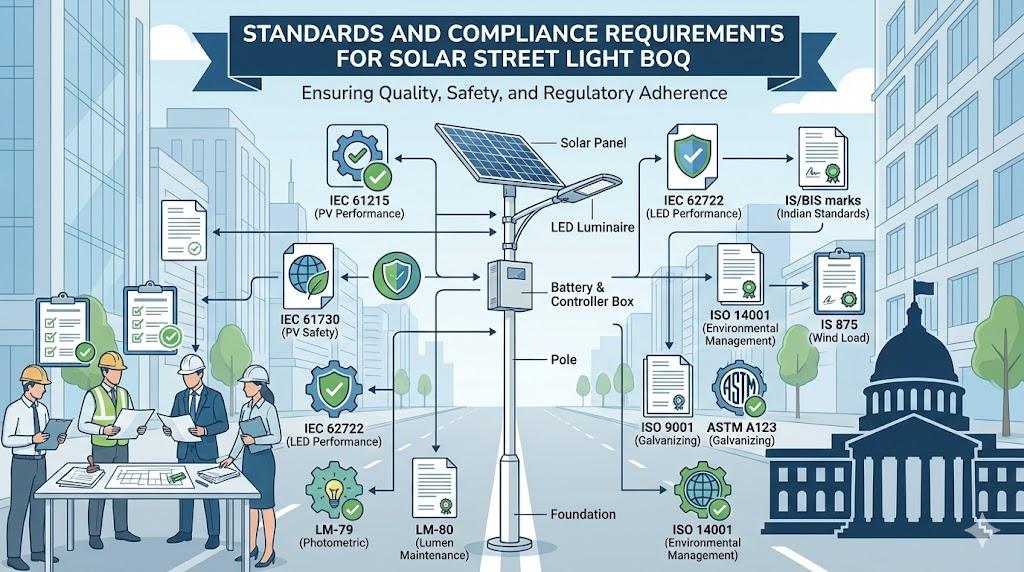
Standards and Compliance Requirements to Follow in A BOQ for Street Light Projects
When preparing a BOQ for solar street light projects, compliance is as important as the components themselves. Here are the key requirements you should always check and clearly mention in your BOQ:
1. International Quality Standards
Even though these aren’t mandatory rules, following international standards lets you prove that your product meets all the industry benchmarks. Have a look at the main international quality standards that applies for solar street lighting projects:
- IEC 61215 & IEC 61730: It covers design qualification and safety testing, and is mandatory for solar PV modules.
- IEC 62722: Specific standard for solar LED luminaires that ensures performance.
- IS 16897 (Bureau of Indian Standards): Governs standalone solar photovoltaic systems for India-based projects.
- LM-79 & LM-80: LED testing protocols for photometric performance and lumen maintenance.
2. Electrical Safety Compliance
Your solar street light technical specifications must reference IEC 60529 for ingress protection ratings and IEC 61643 for surge protective devices. These aren’t optional. They’re very important for insurance claims and warranty enforcement.
3. Environmental and Structural Standards
Just like any other project, solar street lighting constructions are also required to meet environmental standards like:
- ISO 9001: Quality management certification for component manufacturers
- ISO 14001: Environmental management for sustainable procurement
- ASTM A123: Hot-dip galvanization standards for pole structures
- IS 875 (Part 3): Wind load calculations for structural stability
4. Government-Specific Requirements
Many municipalities mandate compliance with local building codes, MNRE (Ministry of New Energy and Renewable Energy) guidelines for subsidy eligibility, and specific luminaire classifications per ANSI C136 standards. Always verify regional requirements during your solar lighting project planning phase. Missing even one compliance certificate can stall procurement for months.
Frequently Asked Questions (FAQs)
- What is the difference between a BOM and a BOQ?
A BOM (Bill of Materials) lists only the raw components needed to build a product (e.g., the battery, panel, and chip). On the other hand, a BOQ goes further by including service-related costs like civil foundation work, installation labor, machinery rental, and logistics, giving a complete financial picture of the turnkey solar solution.
- Should installation charges be included in the BOQ?
Yes, but they should be listed separately from the material supply. In professional solar street lighting tenders, separating ‘Supply’ from ‘Erection and Commissioning’ ensures transparency in tax calculations (like GST/VAT) and prevents hidden labor costs from eating into your budget.
- How do I ensure quality in my solar street light BOQ?
Don’t just list the item name; list the standard. Adding specific technical compliance standards prevents contractors from supplying inferior, low-cost substitutes.
- Which battery is best for solar street lights?
LiFePO4 batteries are widely preferred due to long cycle life, higher safety, and lower maintenance. You can also use GEL or VRLA batteries to reduce cost.
Conclusion
A solid BOQ for solar street light projects eliminates the confusion where projects usually fall apart. When you define every single parameter clearly, you take full control of the outcome, without any surprises or hidden costs. You simply get a project that works exactly as planned.
That reliability starts with the details. At DEL Illumination, we help you lock in those details. We ensure your specifications match the real-world needs of your site, from the battery chemistry to the foundation depth. Contact us now to know more!