

Industry data confirms a stark reality: 90% of solar street light field failures are not caused by panel degradation or LED burnout they are caused by battery mismanagement, poor enclosure design, and incorrect controller programming. The battery is the dominant life limiting component in any solar street light system. Panels routinely operate for 20–30 years; LED modules rated at 50,000 hours can serve 11+ years at 12 hours per night. Yet even a quality LiFePO4 (Lithium Iron Phosphate) battery, if subjected to avoidable thermal stress and deep discharge cycles, can lose 30–40% of its expected service life.
For city planners overseeing thousands of street lighting units, procurement officers evaluating 10 year lifecycle costs, and EPC contractors responsible for long term project performance, the ability to extend solar street light battery life by two to three additional years is not a marginal gain it is a measurable financial and operational result. Three extra years on a LiFePO4 battery that might otherwise serve eight years translates to deferred replacement costs across entire fleets, reduced maintenance mobilisation, and stronger project ROI.
This blog covers the five most impactful, field proven strategies for extend solar street light battery life each grounded in verified engineering data from 2024–2026.
Strategy 1: Control Depth of Discharge The Single Most Powerful Lever
Depth of Discharge (DoD) the percentage of battery capacity drawn down before recharging is the single most influential variable in determining how many total charge discharge cycles a battery will deliver over its lifetime. Understanding and managing DoD is the foundation of any serious battery life extension programme.
The relationship is direct and well established: shallower daily discharge cycles produce substantially more total operating cycles. A LiFePO4 battery operated at 80% DoD nightly delivers approximately 2,000–3,000 cycles before capacity degrades to 80% of original rating. The same battery operated at 50% DoD can reach 4,000–6,000+ cycles more than double the number of full cycles at the deeper setting. For a system cycling once per day, the difference between 3,000 cycles and 6,000 cycles is the difference between an 8 year and a 16 year battery life.
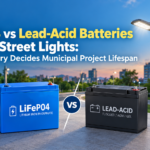
Generic solar street lights using lead acid chemistry have a fundamentally different relationship with DoD. Lead acid batteries degrade severely if regularly discharged beyond 50%, which limits usable capacity to half the rated value while simultaneously shortening the already compressed 300–500 cycle life. This is why the shift from lead acid to LiFePO4 represents a 5–10× improvement in practical battery service life not just a chemistry upgrade but a fundamentally different operating window.
The practical application for facility managers and EPC contractors is to configure the charge controller’s low voltage cutoff to prevent discharge below a minimum State of Charge (SoC) threshold. For LiFePO4 systems, a discharge cutoff voltage of 11.2–11.5V on a 12.8V nominal pack (equivalent to roughly 20–30% SoC remaining) is the standard industry setting. This single controller configuration, requiring no additional hardware, prevents cell reversal damage and preserves cycle longevity across the battery’s full calendar life.
Strategy 2: Implement Adaptive Dimming to Reduce Nightly Energy Draw
Even with a correctly sized battery and appropriate chemistry, the nightly energy demand placed on the battery determines how deeply it discharges on a given night. The more energy the LED load draws between dusk and dawn, the deeper the nightly discharge. Adaptive dimming programming the charge controller to reduce LED drive current during low traffic periods of the night is one of the most cost effective battery life extension tools available to operators of solar street light fleets.
A standard adaptive dimming profile operates the LED at 100% output from dusk for the first four to six hours (covering the evening high traffic period), then steps down to 50–60% brightness from midnight until dawn. This profile reduces nightly energy consumption significantly without compromising road safety during peak pedestrian and vehicle activity. Industry data confirms that adaptive lighting strategies can reduce total battery energy draw by up to 30–40% per night, which directly reduces the average nightly DoD by a proportional amount. Shallower nightly discharge means more total cycles, which means a longer battery calendar life.
More advanced implementations use motion sensor triggered adaptive lighting where the LED returns to 100% output when a vehicle or pedestrian is detected within the sensor’s range and reverts to 50–60% otherwise. This technology, covered in detail in our guide to the benefits of solar light remote control technology, can reduce energy draw by up to 60–70% in low traffic periods, substantially extending battery autonomy on overcast days and extending the nightly operating window without additional battery capacity.
For off grid solar street lighting projects in remote areas, or for installations in equatorial regions where consecutive cloudy days are common, adaptive dimming is also the primary mechanism by which backup autonomy the number of consecutive nights a system can operate without solar recharging is maintained. German engineered systems typically specify 3–7 backup days of climate dependent sizing; this is only achievable with a precisely programmed adaptive dimming profile.
Strategy 3: Manage Battery Temperature The Hidden Destroyer
Temperature is the second most powerful determinant of battery cycle life, and it is the most commonly underestimated factor in field deployments. Industry research confirms that for every 10°C rise in ambient temperature above 25°C, battery cycle life approximately halves. A battery enclosure exposed to direct sunlight in a tropical environment as is the case in many solar street light projects in Africa, Southeast Asia, and the Middle East can easily reach internal temperatures of 50–60°C on a summer afternoon, far exceeding the optimal 15–25°C operating range.
At the other extreme, sub zero temperatures increase a battery’s internal resistance by up to 50%, which causes the charge controller to terminate charging prematurely. This forces the battery into a deeper than intended nightly discharge cycle a thermal problem that manifests as a DoD problem and compounds both degradation mechanisms simultaneously.
The practical countermeasures available to facility managers and EPC contractors fall into two categories. The first is installation and enclosure design: batteries should be mounted on the shaded side of the pole or in an enclosure with reflective white or silver coating on sun facing surfaces, which can reduce enclosure temperature by 10–15°C compared to bare metal or dark coloured housings. Ventilation slots or passive convection channels in the enclosure allow accumulated heat to escape. In climates below −10°C, battery enclosures should incorporate foam insulation to retain heat generated during discharge preventing the internal resistance rise that triggers premature charging cutoff.
The second countermeasure is BMS (Battery Management System) temperature protection: a well specified BMS monitors cell temperature in real time and restricts charging when the battery is below 0°C (preventing lithium plating, which permanently reduces capacity) and reduces the maximum charge rate above 40°C to protect the cathode chemistry. German engineered solar street light systems include a certified BMS as a standard component; this is rarely the case in generic systems, where the “BMS” may be a basic voltage only protection circuit with no thermal sensing capability.
Strategy 4: Optimise the Charge Controller MPPT and Correct Voltage Settings
The charge controller is the component that directly determines the quality of every charge cycle the battery receives over its lifetime. A controller that routinely overcharges, undercharges, or delivers current at inappropriate voltage set points does gradual, irreversible damage to the battery chemistry with every single cycle. Across 3,000 cycles over 8+ years, even a small per cycle degradation compounds significantly.
The first controller specification that directly affects battery life is the controller type. MPPT (Maximum Power Point Tracking) charge controllers standard in German engineered solar street lights continuously calculate the solar panel’s maximum power output point and adjust the circuit accordingly, harvesting 25–30% more energy from the same panel under real world conditions compared to PWM (Pulse Width Modulation) controllers. This efficiency advantage means the battery reaches a fuller state of charge on every day with adequate solar irradiation, reducing the number of consecutive nights where the battery starts from a partially depleted state. A battery that frequently begins the night at 70–80% SoC (rather than 90–100%) because the PWM controller under harvested the available solar energy is, in effect, running at a higher average DoD accelerating degradation without the operator noticing.
The second controller factor is voltage set point accuracy: the charge controller must be programmed with the correct bulk charge, absorption, and float voltage values for the specific battery chemistry and cell configuration. For a 12.8V LiFePO4 pack, the standard parameters are a bulk charge voltage of 14.2–14.6V and a float voltage of 13.6V. Using voltage settings calibrated for lead acid chemistry on a LiFePO4 battery a common error on generic systems with undocumented controllers either overcharges the cells (inducing electrolyte stress) or consistently undercharges them (leaving the battery in a chronic partial state of charge, which accelerates capacity fade).
For project teams evaluating controller specifications during procurement, our comprehensive guide to German engineered versus generic solar street lights includes a detailed comparison of MPPT and PWM controller performance benchmarks relevant to battery longevity.
Strategy 5: Correctly Size the Battery at Design Stage Oversizing Pays
Many premature battery failures in solar street light systems trace back to a decision made at the procurement and design stage: the battery was undersized relative to the installation’s actual energy demand profile. An undersized battery is forced into deep discharge every single night, operating at 80–90%+ DoD as a matter of routine rather than exception. At those discharge depths, even a quality LiFePO4 battery’s cycle life is compressed significantly, and the system begins exhibiting brightness reduction and shortened operating hours within three to four years.
The correct battery sizing methodology accounts for four parameters simultaneously: the LED load’s Watt hours per night consumption (wattage × operating hours), the required number of backup days of autonomy (typically 3–7 days depending on climate never leave this uncalculated), a DoD limit of no more than 80% to preserve cycle life, and a temperature derating factor for the deployment climate. A 50W LED running 12 hours per night requires 600 Wh of usable energy per night. For five days’ autonomy at 80% DoD in a 25°C environment, the minimum battery capacity is 600 × 5 ÷ 0.80 = 3,750 Wh. In a hot climate where 40°C ambient temperatures apply a 10–15% capacity derating, this figure needs to be increased by a corresponding margin.
German engineered systems are specified with this full calculation applied; the result is often a battery that appears 20–30% larger than the generic competitor’s specification but this apparent oversizing is precisely what prevents chronic deep discharge and delivers the full 8–12 year battery calendar life. For detailed methodology on how to test a solar street light battery to verify whether an existing installation is correctly sized, our dedicated guide walks through the field measurement process step by step.
Projects that have experienced solar street lights losing brightness before year five are often the result of a combination of battery undersizing and controller misconfiguration two design stage decisions that can be corrected in the next procurement cycle. Our guide on resetting a solar street light controller covers how to re programme cut off voltage and dimming parameters on existing installations.
Conclusion: Three Extra Years Begins at the Design Specification, Not the Maintenance Visit
Extend solar street light battery life by three additional years is achievable not through a single intervention, but through the coordinated application of five evidence based strategies: controlling DoD through controller programming, implementing adaptive dimming to reduce nightly energy draw, managing battery enclosure temperature, using MPPT controllers with correct voltage set points, and correctly sizing the battery at the design stage.
The two most critical takeaways for decision makers are these. First, battery life is almost entirely a design and configuration outcome, not a maintenance outcome. The decisions made at procurement and commissioning chemistry, sizing, controller type, dimming programme determine whether the battery serves eight years or eleven. Maintenance can preserve a well designed system; it cannot rescue a fundamentally undersized or misconfigured one.
Second, the 10 year total cost of ownership calculation changes dramatically when battery replacement is deferred by three years. Battery replacement in a solar street light fleet involves not just component cost but labour, access equipment, traffic management, and downtime. Avoiding one replacement cycle per unit across a fleet of 1,000 units represents tens of thousands of dollars in operational savings all achievable through specification and commissioning decisions that add negligible cost at procurement.
For expert guidance on specifying solar street light systems designed for maximum battery longevity, or for a full fleet assessment and maintenance consultation, visit solar led street light.com or contact our engineering team for a customised quote.
FAQ
Q1: What is the most common reason solar street light batteries fail prematurely? The leading cause of premature battery failure in solar street lights is chronic deep discharge the battery is routinely drained to 80–100% DoD every night because it was undersized or the controller’s low voltage cutoff was not correctly configured. The second most common cause is heat stress from inadequately ventilated or uninsulated battery enclosures. Both are design stage issues, not maintenance failures, and both are fully preventable in a correctly specified system.
Q2: Can I extend the life of an existing battery that is already degraded? Mild degradation (battery still retaining 70–80% of original capacity) can be managed by adjusting the controller’s dimming programme to reduce nightly energy draw and raising the low voltage cutoff threshold so the battery cycles shallower. This will not restore lost capacity, but it will slow the rate of further degradation and extend the time before replacement is necessary. For a battery below 60% of original capacity, replacement is the only viable path to restoring system performance.
Q3: Does LiFePO4 chemistry genuinely last longer than other lithium types, or is it marketing? LiFePO4’s longevity advantage is grounded in its molecular structure the iron phosphate cathode forms extremely stable covalent bonds that resist breakdown during repeated cycling. Industry data from 2024–2025 consistently shows LiFePO4 delivering 3,000–5,000 cycles to 80% capacity retention at 80% DoD, versus 1,000–2,000 cycles for NMC (nickel manganese cobalt) and 300–500 for lead acid under equivalent conditions. LiFePO4 also has a thermal runaway threshold above 270°C, eliminating the fire risk that disqualifies some lithium chemistries for public infrastructure deployments.
Q4: How does dimming at midnight actually extend battery life can you give a practical example? Consider a 50W solar street light running 12 hours per night. Without dimming, it draws 600 Wh at 80% DoD, this requires a 750 Wh battery. With a midnight dimming profile to 50% output for the second six hours, the total draw falls to 450 Wh a 25% reduction. This means the same battery now operates at approximately 60% DoD rather than 80% DoD, which can more than double the number of total cycles delivered. Over a fleet of 500 units, this represents a direct deferral of battery replacement costs without any additional hardware investment.
Q5: At what temperature does battery degradation become a serious concern? Industry research confirms that every 10°C rise above 25°C approximately halves battery cycle life. At 35°C ambient common in tropical regions during summer cycle life is roughly halved relative to a 25°C baseline. At 45°C, it is quartered. In the Middle East and parts of Africa, battery enclosures exposed to direct afternoon sunlight can reach 55–60°C internally during summer months, which is why enclosure shading, reflective coatings, and ventilation are non negotiable engineering requirements in those climates, not optional upgrades.
Q6: Should I replace a lead acid battery with LiFePO4 in an existing generic system? In most cases, yes provided the charge controller is also upgraded to one correctly programmed for LiFePO4 voltage set points. Using LiFePO4 cells with a controller calibrated for lead acid will either chronically undercharge the pack or overcharge it, negating the chemistry upgrade. The combined cost of a LiFePO4 battery and MPPT controller replacement for a single unit is typically recovered within 2–3 years through avoided repeat lead acid replacements, and the system then delivers 8–12 years of service on the new battery rather than the original 2–4 years on lead acid. Our guide to the 5 ways to fix a solar light not working covers the controller reconfiguration steps in detail.
Q7: How many days of battery autonomy should I specify for a project in a high rainfall climate? The standard specification for high rainfall or equatorial climates is a minimum of five consecutive overcast days of autonomy meaning the battery must be able to power the LED load for five nights at its standard dimming profile without any solar recharging. This requires the combined effect of correct battery sizing, adaptive dimming on nights 3–5 to reduce energy draw, and an MPPT controller that maximises energy harvest on partially cloudy days when solar irradiation is reduced but not zero. For rural solar street lighting where maintenance access is limited, specifying seven days of autonomy is the preferred standard.
Q8: Does regular solar panel cleaning affect battery life, or only brightness? Panel cleaning affects both. A soiled solar panel delivering 20% less output than its rated capacity leaves the battery chronically undercharged it ends each day at 70–75% SoC rather than 90–95%. A battery that consistently begins the night at 70% SoC rather than 90% SoC is effectively operating at a higher average DoD, which accelerates degradation in exactly the same way as running a DoD intensive dimming profile. Our guide to how to clean a solar panel on a street light covers the correct procedure and frequency for different environments.
References
- Clodesun. (2026). The Beating Heart of the Grid: The Definitive Guide to Solar Street Light Batteries [Updated 2026]. https://www.clodesun.com/solar street light battery lifespan and maintenance/
- MANLY Battery. (2025). How Long Do Solar Street Light Batteries Last In 2025. https://manlybattery.com/how long do solar street light batteries last/
- Inlux Solar. (2026). LiFePO4 Battery Lifespan for Solar Street Lights: Buyer Guide. https://www.inluxsolar.com/solar street light/guides/lifepo4 battery lifespan/
- Anern. (2025). Depth of Discharge: How It Affects LiFePO4 Battery Life. https://www.anernstore.com/blogs/diy solar guides/depth of discharge lifepo4 battery life
- Origotek. (2025). Maximize Battery Lifespan: LiFePO4 Cycle Life Guide. https://www.origotek.com/understanding lithium battery cycle life and its impact on energy storage
- Wiltson Energy. (2025). Cold Climate Battery Guide: 5 Parameters for Solar Street Lights. https://www.wiltsonenergy.com/Cold Weather Batteries for Solar Street Lights.html
- NSZLAMP. (2025). How To Maintain Solar Street Light Batteries To Extend Their Lifespan? https://www.nszlamp.com/info/how to maintain solar street light batteries t 103161054.html
- Sungreat Energy. (2026). Key Parameters of Integrated Solar Street Lights: A Comprehensive Guide for 2026. https://www.sungreatenergy.com/blog/key parameters of integrated solar street lights a comprehensive guide for 2026/
- Sigostreetlight. (2025). How Many Years Do Solar Street Lights Last? https://sigostreetlight.com/blogs/average lifespan of solar street lights/
- U Fine Battery. (2025). What’s the LiFePO4 Cycle Life and DoD? https://www.ufinebattery.com/blog/lifepo4 cycle life/
Disclaimer
This article is for informational purposes only and does not constitute professional engineering, installation, or procurement advice. Performance specifications and costs may vary based on project requirements, location, and local regulations. Always consult qualified solar energy professionals and legal advisors before making procurement decisions.
For expert consultation on solar LED street lighting solutions, visit solar led street light.com or contact our team for a customised quote.