
A solar street light installed today may be delivering only 60–70% of its original light output within five years not because it is broken, but because of predictable, preventable degradation processes that most procurement officers never account for. When a public road drops below the minimum illuminance required by street lighting standards, the consequences range from increased accident risk to legal liability for the authority responsible. Understanding why solar street lights lose brightness and knowing how to prevent or reverse it is therefore not merely a technical matter; it is a public safety and financial imperative.
This blog examines the four primary causes of brightness loss in solar LED street lights: LED lumen depreciation, battery capacity decline, solar panel soiling and degradation, and charge controller inefficiency. It explains the engineering mechanisms behind each cause, quantifies the losses using current industry data, and shows how German engineered systems are designed to minimise these effects over a 10 year operational lifespan.
Understanding LED Lumen Depreciation: The Silent Dimming
The most fundamental reason solar street lights lose brightness is a process known as lumen depreciation the gradual, irreversible decline in light output from an LED chip over time. Unlike older lamp technologies that fail abruptly, LEDs dim slowly, making the problem easy to ignore until the loss becomes dangerous.
The industry standard for measuring this decline is the L70 rating, defined by IES LM 80 and projected using TM 21 methodology. L70 represents the operating hours at which a fixture retains just 70% of its initial lumen output. A fixture that starts at 10,000 lumens and reaches L70 at 50,000 hours will produce only 7,000 lumens at that point a 3,000 lumen reduction that significantly affects road surface uniformity and lux levels.
Heat is the primary driver of lumen depreciation. Every 10°C increase in LED junction temperature above the rated threshold measurably accelerates the rate of depreciation. In a generic solar street light using a plastic or thin metal housing, the LED junction temperature at a 50°C ambient can exceed 100°C far beyond the safe operating range. In contrast, German engineered fixtures using precision die cast aluminium housings are designed to maintain LED junction temperatures at or below 85°C at 50°C ambient, directly extending the L70 lifespan.
LED efficacy also plays a defining role. Generic fixtures typically use LEDs with an efficacy of 100–120 lm/W. German engineered systems specify LEDs rated at 160–180 lm/W. Higher efficacy means more light produced per watt of input, which allows the driver to run the LED chips at lower current levels to achieve the same output and lower current means lower junction temperature, which means slower depreciation. When specifying fixtures for a project lasting 10 or more years, this interplay between efficacy, thermal management, and lumen maintenance should be a primary evaluation criterion, not an afterthought. For a detailed discussion of how lighting simulation tools can verify these values before procurement, see our DIALux solar street light simulation guide and DIALux luminaire spacing optimisation for EPC projects.
How Battery Degradation Reduces Effective Brightness
The second major cause of brightness loss is frequently misunderstood: the solar street light’s LED may be functioning perfectly, yet the light output still drops because the battery can no longer store or deliver sufficient energy to power the fixture at its rated wattage for the full programmed operating hours.
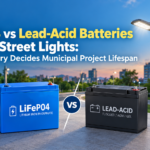
Battery degradation is a chemical process that progresses with every charge discharge cycle and with sustained exposure to heat. Lead acid batteries, still used in many generic solar street lights, typically support only 300–500 charge discharge cycles at standard depth of discharge before their usable capacity falls below acceptable thresholds. In a solar street light application where the battery cycles daily, every night of the year 500 cycles translates to roughly 16 months of real world operation before capacity begins to collapse. A battery at 60% of its original capacity will power the LED fixture for fewer hours each night, or will force the charge controller to dim the output progressively after midnight to conserve charge, resulting in exactly the kind of brightness reduction that makes roads unsafe.
LiFePO4 (lithium iron phosphate) batteries, specified in German engineered solar street light systems, deliver between 2,000 and 3,000 charge discharge cycles at 80% depth of discharge, with a calendar life of 8–12 years. At a daily cycling rate, this translates to 5–8 years of consistent performance before any meaningful capacity loss appears. LiFePO4 cells also maintain stable performance across a wide temperature range of 20°C to +60°C, whereas lead acid batteries lose significant capacity in high heat degrading up to 60% faster in climates where ambient temperatures regularly exceed 40°C, such as in the Middle East, South Asia, and sub Saharan Africa. For projects in those regions, this chemistry difference is not a preference; it is a project risk factor. Our dedicated resources on solar street lights for Middle East climates and solar street lights in Africa explore these requirements further.
Battery degradation is non linear, following what engineers refer to as a “knee curve” capacity may drop only 10% in the first two years, remain relatively stable for several more years, then decline sharply. This makes routine battery monitoring, rather than reactive replacement, the appropriate maintenance strategy for long life installations.
Solar Panel Soiling and Power Degradation
A solar street light’s panel is its primary energy source. Any reduction in the panel’s energy harvest directly reduces the energy available to charge the battery, which in turn reduces the energy available to power the LED at full rated wattage through the night. Solar panel brightness loss, therefore, starts with the panel not the light fixture itself.
Two mechanisms are at work. The first is soiling: the accumulation of dust, dirt, bird droppings, pollen, and industrial particulates on the panel surface. Industry research compiled across multiple studies confirms that soiling related energy losses range from 3–5% in temperate climates to over 30% in arid or high dust environments such as the Sahara, Arabian Peninsula, and the Indian subcontract dust belt. In extremely dusty regions, panel output can fall by 10–30% within a few months without cleaning. For a solar street light system where the panel is sized precisely to charge the battery to full capacity during available peak sun hours, even a 10% soiling loss can translate to chronic undercharging and a battery that starts every night at 85% state of charge rather than 100% will exhaust its usable energy earlier, causing the fixture to dim or switch off before dawn.
The second mechanism is photovoltaic degradation the gradual reduction in a panel’s maximum power output caused by UV exposure, thermal cycling, and microcracking of cells. Industry data from 2024 indicates that quality monocrystalline solar panels degrade at approximately 0.5–1% per year, which means a panel loses around 10–15% of its original output over a 25 year lifespan. For a well designed system, this is manageable. However, generic polycrystalline panels with baseline efficiency of only 15–17% compared to 21–23% for monocrystalline begin at a lower energy yield and degrade faster under thermal stress, compounding the problem.
German engineered systems address this through panel oversizing buffers calculated into the design, self cleaning low reflectance glass coatings on some premium models, and mounting angles optimised not just for energy harvest but also for natural rainwater rinsing. For installers and EPC contractors seeking to optimise panel placement and spacing, our guide on how to calculate distance for LED solar area lights provides relevant geometric and energy modelling methodology.
Charge Controller Inefficiency: The Hidden Energy Drain
Even when the solar panel and battery are performing well, an inefficient charge controller can silently reduce the energy available to the LED driver resulting in reduced output brightness, shorter operating hours, or both.
The two principal charge controller technologies are PWM (Pulse Width Modulation) and MPPT (Maximum Power Point Tracking). PWM controllers are simpler and cheaper, operating at a typical real world efficiency of 76–79%. MPPT controllers continuously track the panel’s optimal operating voltage and current point, adjusting in real time as temperature, cloud cover, and irradiance change. MPPT controllers achieve 95–97% efficiency in the field and can harvest 20–30% more usable energy from the same solar panel compared to PWM, particularly in cold climates and low light conditions. In sub zero conditions, solar panels generate higher open circuit voltages, and MPPT controllers are specifically designed to capture this additional power a capability PWM controllers cannot replicate.
For a solar street light system sized to charge a battery in 5–6 peak sun hours, the difference between a 77% and 96% efficient controller represents a significant portion of available daily energy. Over a 10 year operational life, this efficiency gap compounds: MPPT systems maintain consistent battery state of charge across variable weather days, while PWM systems accumulate chronic undercharge events that accelerate battery degradation and reduce effective light output on consecutive overcast days.
German engineered solar street lights are specified with MPPT charge controllers as standard. Generic systems routinely use PWM controllers to reduce unit cost a saving of perhaps €15–25 per unit that generates disproportionately higher replacement and maintenance costs over the project lifetime. When evaluating total cost of ownership across a 200 unit municipal deployment, the energy yield difference alone can represent tens of thousands of euros in avoided battery replacements. Our comprehensive analysis of total cost of ownership for EPC projects quantifies these lifecycle cost differences in detail. EPC contractors submitting bids for World Bank or ADB funded infrastructure projects should also review our guidance on certification requirements for bankable EPC contracts and ADB World Bank solar street light procurement 2026.
How to Fix Brightness Loss: A Practical Maintenance and Upgrade Roadmap
For procurement officers and facility managers managing existing solar street light deployments, brightness loss is not always irreversible. The correct intervention depends on accurately diagnosing which component is responsible.
A structured diagnostic process should include:
- Lux level measurement at the road surface using a calibrated lux meter, compared against the original design specification and applicable national standard (e.g., EN 13201 in Europe or equivalent). A reading below 70% of the design value at mid life confirms degradation beyond expected norms.
- Battery capacity test using a discharge test protocol to measure actual available capacity (Ah) against the nameplate rating. Any battery delivering less than 80% of its rated capacity should be replaced.
- Panel output measurement using a clamp meter or IV curve tracer to compare actual short circuit current (Isc) against the panel’s rated value under current irradiance conditions, adjusted for the soiling ratio.
- Controller log review modern MPPT controllers with data logging capability record daily energy harvest, battery voltage peaks, and any fault events. Reviewing 30–60 days of log data reveals chronic undercharge patterns invisible to visual inspection.
Where the LED module itself has depreciated beyond the L70 threshold, the most cost effective intervention in premium specification fixtures is LED module replacement rather than full fixture replacement, provided the housing, driver, and controller remain within specification. German engineered fixtures are designed with modular LED assemblies precisely to enable this. For generic fixtures where the housing and driver have also degraded, full replacement is usually the economically rational choice when measured against the cost of ongoing maintenance interventions.
For facilities managers dealing with lights that are not turning on at all rather than simply dimming, our dedicated troubleshooting resources cover solar street light not turning on, solar street light flickering, and 5 ways to fix a solar light not working covering fault finding procedures for each major component subsystem.
Preventive maintenance remains the most cost effective strategy. A biannual panel cleaning schedule, annual battery capacity check, and firmware update check for smart MPPT controllers will preserve system output at or above 90% of rated specification throughout the warranty period and well beyond.
Conclusion
Solar street lights lose brightness through four interconnected mechanisms: LED lumen depreciation accelerated by poor thermal management, battery capacity decline caused by excessive cycling and heat exposure, solar panel output reduction from soiling and photovoltaic degradation, and charge controller energy losses from inefficient PWM technology. Each of these mechanisms operates on its own timeline, but their combined effect on a generic system can reduce effective road illumination to unsafe levels within three to five years of installation.
The three most important takeaways for procurement decision makers are: first, specify LED systems with documented LM 80/TM 21 lumen maintenance data and a minimum L70 rating of 50,000 hours; second, require LiFePO4 batteries rated for at least 2,000 cycles and validated across the deployment climate range; and third, insist on MPPT charge controllers with data logging, which protect battery health and provide actionable diagnostic data throughout the system’s operational life.
German engineered solar street lights from solar led street light.com are designed, tested, and warranted to address every one of the brightness loss mechanisms described in this article with 5–7 year comprehensive warranties backed by TÜV certification, ISO 9001 quality management, and full IEC standards compliance.
Ready to specify solar street lights that maintain their brightness for a decade? Visit solar led street light.com today to consult with our engineering team or request a customised quote for your project.
FAQ
1. How quickly do solar street lights typically lose brightness? In well engineered systems, lumen output should remain above 90% for the first three years and above 80% for the first five, declining to approximately 70% (the L70 threshold) at or beyond 50,000 operating hours. In generic systems with poor thermal management or lead acid batteries, visible brightness loss can occur within 18–24 months due to battery capacity collapse rather than LED depreciation itself.
2. What is the L70 rating and why does it matter for street lighting? L70 is the number of hours at which an LED fixture retains 70% of its original light output, measured under the IES LM 80 standard and projected using TM 21 methodology. For street lighting applications, L70 is widely accepted as the minimum practical service threshold because road surface uniformity and lux levels below 70% of design values typically fall outside the tolerance bands of EN 13201 and equivalent standards. Always request an LM 80 test report and TM 21 projection from suppliers before specifying fixtures for long duration contracts.
3. Can a dimming solar street light be restored to its original brightness? In some cases, yes. If the primary cause is battery degradation, replacing the battery pack with a correctly specified LiFePO4 unit will immediately restore full duration operation. If the panel output has been reduced by soiling, a thorough cleaning can recover 10–25% of lost output in high dust environments. LED module depreciation itself is irreversible, but in modular fixture designs, the LED board can be replaced without replacing the entire luminaire. A proper diagnostic assessment should precede any hardware investment.
4. Does temperature affect how fast a solar street light loses brightness? Yes, significantly. Both LED chips and batteries degrade faster at elevated temperatures. LED junction temperatures above the rated threshold accelerate lumen depreciation in a predictable but non linear way. Lead acid batteries exposed to sustained temperatures above 35°C lose cycle life at a rate that is two to three times faster than in temperate conditions. LiFePO4 batteries are substantially more temperature resilient, maintaining over 80% of their rated capacity even at 10°C. Installations in climates with extreme heat the Gulf, South Asia, West Africa should specifically request thermal performance data validated for high ambient conditions.
5. How often should solar street light panels be cleaned? In temperate climates with regular rainfall, annual cleaning is typically sufficient to keep soiling losses below 5%. In arid, dusty, or industrial environments including large parts of South Asia, the Middle East, North Africa, and sub Saharan Africa biannual or quarterly cleaning may be necessary to prevent soiling losses from exceeding 15–20%. The optimal cleaning frequency should be calculated based on local dust deposition rates and the panel’s nominal tilt angle, with steeper tilt angles benefiting more from natural rainwater rinsing.
6. What is the difference between PWM and MPPT controllers in terms of brightness maintenance? A PWM charge controller operates at 76–79% efficiency and cannot adapt to changing panel voltage conditions caused by temperature or partial shading. An MPPT controller achieves 95–97% efficiency and tracks the panel’s maximum power point continuously, harvesting up to 30% more energy per day from the same panel. Over time, this efficiency difference means batteries charged by PWM systems accumulate chronic undercharge events, reducing the energy available to power the LED at full rated output throughout the night producing de facto brightness reduction even if the LED itself is undegraded.
7. How do IP and IK ratings affect long term brightness retention? IP (Ingress Protection) and IK (impact protection) ratings determine how well the fixture housing protects the LED module and driver electronics from moisture, dust, and mechanical damage over time. A fixture rated IP65 (often self declared by generic manufacturers) provides surface level moisture protection; IP67, independently verified by an accredited laboratory, ensures full temporary submersion protection. Moisture ingress accelerates both LED depreciation and driver failure. Similarly, a housing rated IK08 or above can withstand vandalism and accidental impact without cracking cracks in the housing allow moisture and insects to enter, causing rapid and irreversible LED degradation. Learn more in our detailed guide to IP65 solar street lights and their 5 key benefits.
8. What certifications should I look for to ensure long term brightness performance? At minimum, specify fixtures with IEC 62717 (LED module performance), IEC 62722 (luminaire performance), and IEC 62493 (photobiological safety) certifications. For European public procurement, EN 13201 road lighting standard compliance is mandatory. TÜV certification and ISO 9001 quality management system accreditation are key indicators of consistent manufacturing quality. Fixtures backed by verified LM 80/TM 21 lumen maintenance documentation and an independent photometric report (LM 79) provide the strongest assurance of long term brightness performance. See also our street lighting standards comparison for a full regulatory overview.
References
- IES. (2021). IES LM 80 21: Measuring Lumen Maintenance of LED Light Sources. https://www.ies.org/standards/
- IES. (2021). IES TM 21 21: Projecting Long Term Lumen, Photon, and Radiant Flux Maintenance of LED Light Sources. https://www.ies.org/standards/
- Wikipedia / IES. (2026). Lumen maintenance LED lifetime standards overview. https://en.wikipedia.org/wiki/Lumen_maintenance
- MANLY Battery. (2025). How Long Do Solar Street Light Batteries Last? https://manlybattery.com/how long do solar street light batteries last/
- ScienceDirect / Elsevier. (2024). Impacts of soiling on solar panel performance and state of the art effective cleaning methods. https://www.sciencedirect.com/science/article/abs/pii/S095965262500469X
- ScienceDirect / Elsevier. (2024). A holistic review of the effects of dust buildup on solar photovoltaic panel efficiency. https://www.sciencedirect.com/science/article/pii/S2772940024000353
- MakeSkyBlue Solar. (2025). MPPT vs PWM Solar Charge Controllers: Real World Performance Data 2024–2025. https://makeskyblue.com/blogs/news/what is the difference between mppt and pwm solar charge controllers
- Renogy. (2025). What is the Difference Between MPPT and PWM Charge Controllers? https://www.renogy.com/blogs/buyers guide/what is the difference between mppt and pwm charge controllers
- InluxSolar. (2026). Thermal Management & Lumen Depreciation in Solar Street Lights. https://www.inluxsolar.com/solar street light/guides/thermal management lumen depreciation/
- MDPI. (2025). Assessing the Effects of Dust on Solar Panel Performance: A Comprehensive Review. https://www.mdpi.com/2673 4591/112/1/9
Disclaimer
This article is for informational purposes only and does not constitute professional engineering, installation, or procurement advice. Performance specifications and costs may vary based on project requirements, location, and local regulations. Always consult qualified solar energy professionals and legal advisors before making procurement decisions.
For expert consultation on solar LED street lighting solutions, visit solar led street light.com or contact our team for a customised quote.