
The power of solar street lamp is transforming how cities and communities illuminate their streets, roads, and public spaces. In today’s world, where energy efficiency and sustainability are top priorities, solar street lamps have emerged as the most reliable and eco-friendly lighting solution. According to a 2017 survey, solar LED street lamps dominated the global lighting market with 1.9 million units sold, and those numbers have been rising exponentially ever since.
With the power of solar street lamp technology, communities are reducing their dependence on conventional electricity grids, cutting energy costs, and contributing to a cleaner planet. These lamps are no longer a luxury; they are a necessity for modern, sustainable infrastructure.
What Is the Power of Solar Street Lamp?
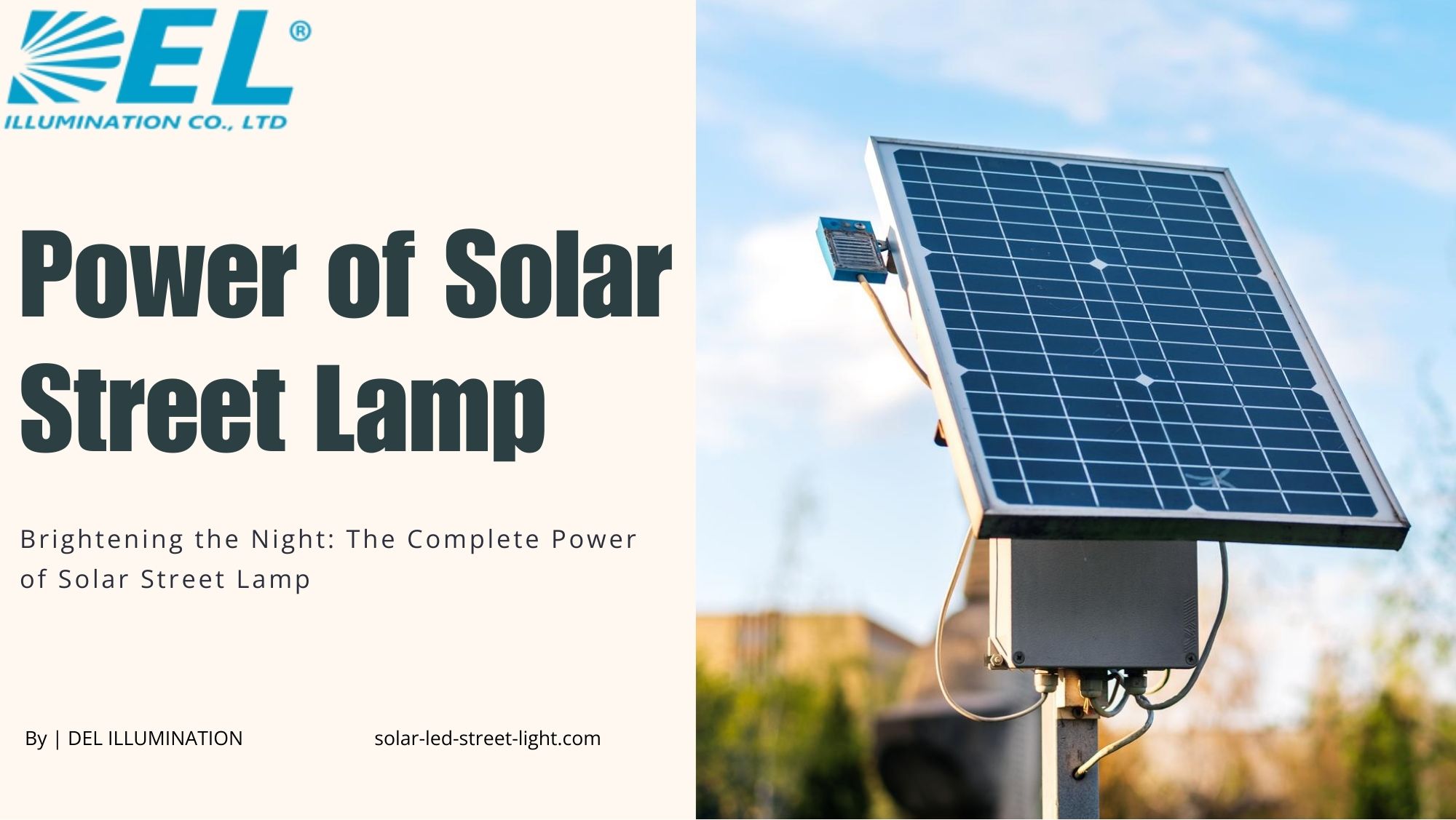
The power of solar street lamp lies in its ability to harness clean, renewable sunlight and convert it into electrical energy completely eliminating the need for grid-based power. A solar street lamp uses photovoltaic (PV) panels to absorb sunlight during the day, stores that energy in a rechargeable battery, and then powers LED lights throughout the night automatically.
There are five core components that define the power of solar street lamp systems:
1. Solar Panel
The solar panel is the heart of the system. It converts sunlight into DC (direct current) power. The performance of the solar panel depends on the luminaire capacity and the required autonomy days meaning how many consecutive cloudy days the system can operate without direct sunlight. High-efficiency monocrystalline panels are now widely used to maximize the power of solar street lamp systems even in low-light conditions.
2. Luminaires
Luminaires provide the actual lighting. While CFL luminaires were common in the past, LED luminaires have taken over due to their superior energy efficiency, longer lifespan, and better light quality. The size and lumen output of the luminaire should be chosen based on the specific lighting requirements of the area.
3. Charge Controller
The charge controller is the brain of the system. It regulates the voltage and current flowing from the solar panel to the battery, preventing overcharging and deep discharging. Modern MPPT (Maximum Power Point Tracking) charge controllers significantly improve the efficiency of the power of solar street lamp installations.
4. Rechargeable Battery
The battery stores the electrical energy generated during daylight hours and supplies it to the LED lights at night. Lithium-ion and lithium iron phosphate (LiFePO4) batteries are now the preferred choice due to their higher energy density, longer cycle life, and better performance in extreme temperatures further enhancing the power of solar street lamp systems.
5. Strong Mounting Pole
A robust pole provides structural support for the solar panel, battery housing, and luminaire. Poles are engineered to withstand harsh weather conditions including strong winds, heavy rain, and extreme temperatures. Some modern designs integrate all components into the pole itself, creating a clean, all-in-one unit.
How Does the Power of Solar Street Lamp Work?
The working mechanism behind the power of solar street lamp is elegantly simple. During the day, the solar panel absorbs sunlight and converts it into DC electricity, which is stored in the rechargeable battery via the charge controller. As evening falls, a light sensor or smart timer automatically switches on the LED luminaire, drawing power from the stored battery energy.
Advanced solar street lamp systems now come equipped with motion sensors, dimming capabilities, and remote monitoring via IoT (Internet of Things) platforms making the power of solar street lamp smarter and more efficient than ever before. Some systems can even communicate wirelessly to adjust brightness levels based on pedestrian or vehicular traffic in real time.
Key Benefits That Highlight the Power of Solar Street Lamp
1. Zero Electricity Bills
One of the most compelling advantages of the power of solar street lamp is the complete elimination of electricity costs. Since sunlight is the energy source and it is freely available, municipalities and property owners do not pay monthly electricity bills for street lighting. This is a one-time capital investment that pays for itself in just a few years through energy savings.
2. Minimal Maintenance Requirements
The power of solar street lamp includes long operational lifespans with minimal upkeep. LED lights can last 50,000+ hours, solar panels carry 25-year warranties, and modern lithium batteries last 5–10 years. There are no underground cables to maintain, no streetlight poles to re-wire, and no transformer stations to service, dramatically reducing long-term operational costs.
3. Enhanced Safety and Security
The power of solar street lamp extends beyond energy savings; it also enhances public safety. Well-lit streets deter criminal activity, reduce traffic accidents, and allow residents to safely use parks, footpaths, and public spaces after dark. Areas previously without electricity access can now enjoy reliable street lighting for the first time.
4. Cost-Effective Long-Term Solution
Although the upfront installation cost of solar street lamps may be higher than traditional lights, the power of solar street lamp delivers significant long-term savings. With no electricity bills, reduced maintenance, and no need for costly trenching and cabling infrastructure, the total cost of ownership is far lower over a 10-20 year period.
5. Clean and Sustainable Energy
The power of solar street lamp is 100% renewable. Solar energy produces zero carbon emissions during operation, helping governments and communities meet their climate goals and sustainability targets. Replacing conventional streetlights with solar alternatives is one of the most impactful steps local authorities can take to reduce their environmental footprint.
Types of Solar Street Lamps
Understanding the types of solar street lamps helps you choose the best solution for your specific needs:
Traditional (Split) Solar Street Lights
In traditional solar street lights, each component of the solar panel, battery, charge controller, and luminaire is placed separately. The solar panel is usually mounted on the pole top, with the battery housed in a box below. This design allows for larger panel and battery sizes, which is useful for high-power applications or areas with limited sunlight.
All-in-One Solar Street Lights
All-in-one solar street lamps integrate the solar panel, battery, charge controller, LED light, and motion sensor into a single compact unit. This makes installation extremely simple, reduces theft risk, and results in a sleeker aesthetic. The power of solar street lamp in all-in-one units is increasingly popular for residential roads, parking areas, and smart city projects.
Solar Street Lamp vs. Traditional Street Lights: A Clear Winner
When comparing the power of solar street lamp to conventional grid-powered lights, the advantages are clear across every dimension:
Energy Costs: Traditional lights incur monthly electricity bills; solar street lamps operate at zero energy cost.
Lifespan: Solar lamps last 5-8 years or more, while traditional bulbs often last only 5,000-8,000 hours.
Environmental Impact: Solar street lamps produce zero carbon emissions, while traditional lights contribute to pollution.
Durability: Solar lamps are engineered for harsh weather, while many traditional lights fail under extreme conditions.
Installation: Solar lamps require no trenching or underground cabling, making them faster and cheaper to install in remote or rural areas.
Government Initiatives Supporting the Power of Solar Street Lamp
Governments worldwide are recognizing the power of solar street lamp as a key driver of energy transition and sustainable urban development.
United States: Local Government Solar Installations
According to a 2015 survey of U.S. local governments, 18.5% of respondents had already installed solar panels on government facilities, with solar street lighting being a key component of many of these projects. The trend has only accelerated since then, with cities like Los Angeles, Phoenix, and Denver leading large-scale solar street lamp rollouts.
India: Off-Grid Solar Photovoltaic Program
In March 2020, the Government of India launched a landmark off-grid solar photovoltaic program. Under this initiative, nearly 7.8 million solar lanterns and study lamps were distributed to rural households, with the objective of replacing kerosene-based lighting systems. This program powerfully demonstrated how the power of solar street lamp can transform lives and promote clean energy access at the grassroots level.
The Future of the Power of Solar Street Lamp
The future is extraordinarily bright for solar street lighting. Manufacturers are continuously improving solar panel efficiency, battery energy density, and LED lumen output making the power of solar street lamp more accessible and cost-effective for communities around the world. Smart city integrations, AI-powered lighting controls, and predictive maintenance systems are now being incorporated into next-generation solar street lamp solutions.
As global warming accelerates and the urgency of transitioning away from fossil fuels intensifies, solar energy is at the center of the solution. Industry forecasts predict that solar products could meet nearly half of the world’s total energy needs by 2050 and the power of solar street lamp will play a significant role in achieving that milestone.
Conclusion
The power of solar street lamp represents one of the most practical, impactful, and cost-effective applications of renewable energy technology available today. From reducing electricity bills to improving public safety, from fighting climate change to enabling energy access in remote regions the benefits are undeniable and far-reaching.
Coal, oil, and natural gas are finite resources that are rapidly depleting and causing irreversible damage to our planet. Sunlight, however, is an infinite, clean, and universally available energy source. It is time to harness the power of solar street lamp at scale and light the way toward a sustainable future for all.
If you are looking to invest in high-quality all-in-one solar street lamps, we are here to help. Feel free to contact us today to learn more about our range of solar lighting solutions.
FAQs About the Power of Solar Street Lamp
Q1. How many hours can a solar street lamp operate on a full charge?
A fully charged solar street lamp can typically operate for 8 to 14 hours, depending on the battery capacity, LED power consumption, and the use of motion-sensing or dimming features. High-capacity systems with lithium batteries can even operate for 2–3 consecutive nights without direct sunlight, making the power of solar street lamp reliable even during cloudy periods.
Q2. Do solar street lamps work in cloudy or rainy weather?
Yes, the power of solar street lamp systems is designed to work in overcast and rainy conditions. Solar panels can still generate electricity from diffused sunlight on cloudy days, though at reduced efficiency. The battery backup ensures continuous lighting even during extended periods of low sunlight. It is recommended to size the system with sufficient battery autonomy (typically 2-3 days) for such conditions.
Q3. What is the average lifespan of a solar street lamp?
The average lifespan of a solar street lamp ranges from 5 to 10 years for the battery, 10 to 25 years for the solar panel, and 50,000+ hours for the LED luminaire. The overall system life expectancy is generally 10-15 years with minimal maintenance. This long operational life is one of the strongest aspects of the power of solar street lamp and contributes to its impressive return on investment.
Q4. Are solar street lamps suitable for all geographic locations?
The power of solar street lamp technology is suitable for most geographic locations, including tropical, subtropical, and temperate regions that receive adequate sunlight. In regions with very short winter daylight hours or extreme cold, the system must be designed with larger solar panels and higher-capacity batteries. Advances in solar panel efficiency and cold-weather battery performance have made solar street lamps viable in far northern and southern latitudes as well.
Q5. How does an all-in-one solar street lamp differ from a traditional solar street lamp?
An all-in-one solar street lamp integrates the solar panel, battery, charge controller, LED light, and motion sensor into a single compact unit mounted on the pole. Traditional (split) solar street lamps have each component installed separately, allowing for larger panel and battery configurations suited to high-demand applications. All-in-one units offer easier installation, lower theft risk, and a cleaner appearance, while split systems offer greater flexibility and scalability. Both fully harness the power of solar street lamp technology to deliver efficient, sustainable lighting.