
Municipal and EPC solar street light programs that specify lead acid batteries typically face full battery replacement within three to five years, while comparable LiFePO4 solar street light systems can run eight to twelve years on the original battery pack. For procurement officers and EPC contractors sizing multi year infrastructure contracts, that gap in service life is often the single biggest driver of total project cost, larger than the price difference on the pole itself.
Battery chemistry is not a minor line item buried in a technical datasheet. It decides how many times a battery bank gets replaced across a project lifecycle, how much field service a distributed lighting network requires, and whether a municipal program stays within budget after year five. This article compares LiFePO4 solar street light batteries against lead acid across cycle life, depth of discharge, charging efficiency, total cost of ownership, and certification standards, so EPC contractors and municipal buyers can specify the right chemistry with confidence.
Why Battery Chemistry Decides Street Light Lifespan
Solar panels typically degrade at around 0.5 percent per year and maintain more than 90 percent output after a decade, and quality LED modules are commonly rated for 50,000 hours of service. Neither component is usually the reason a solar street light network needs major intervention. The battery is.
Because it cycles every single night, absorbing charge through the day and discharging through the dark hours, the battery ages faster than any other part of the system and sets the practical ceiling on how long the light performs without intervention. This pressure is compounding globally: according to the International Energy Agency, global battery storage capacity additions rose about 40 percent in 2025 alone, making battery performance and reliability an increasingly central concern for infrastructure planners, not just a component level detail.
This matters most in distributed infrastructure, where a light is one of hundreds or thousands spread across roads, campuses, industrial parks, and rural corridors. A battery that fails at year three does not just need a replacement part.
It needs a technician, a vehicle, pole access, and a service window, repeated across the network. For EPC contractors bidding on multi year maintenance obligations, and municipal buyers holding a fixed operating budget, the chemistry decision made at procurement stage effectively locks in a maintenance schedule for the life of the contract.
This is why a LiFePO4 solar street light specification is increasingly treated as a baseline requirement in EPC tenders rather than a premium upgrade. The chemistry does not just extend battery life on paper. It changes how many service visits a network requires and how predictable that maintenance budget is over a ten year horizon
Cycle Life and Depth of Discharge: LiFePO4 vs Lead Acid
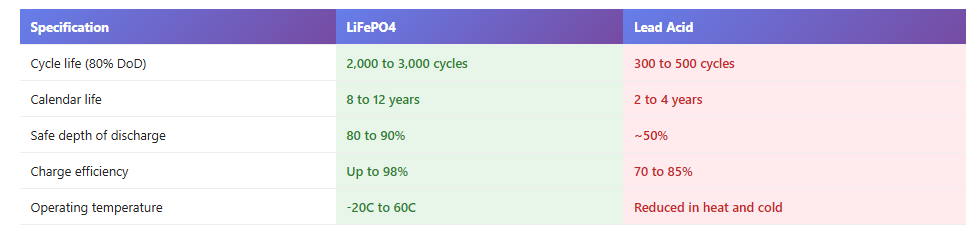
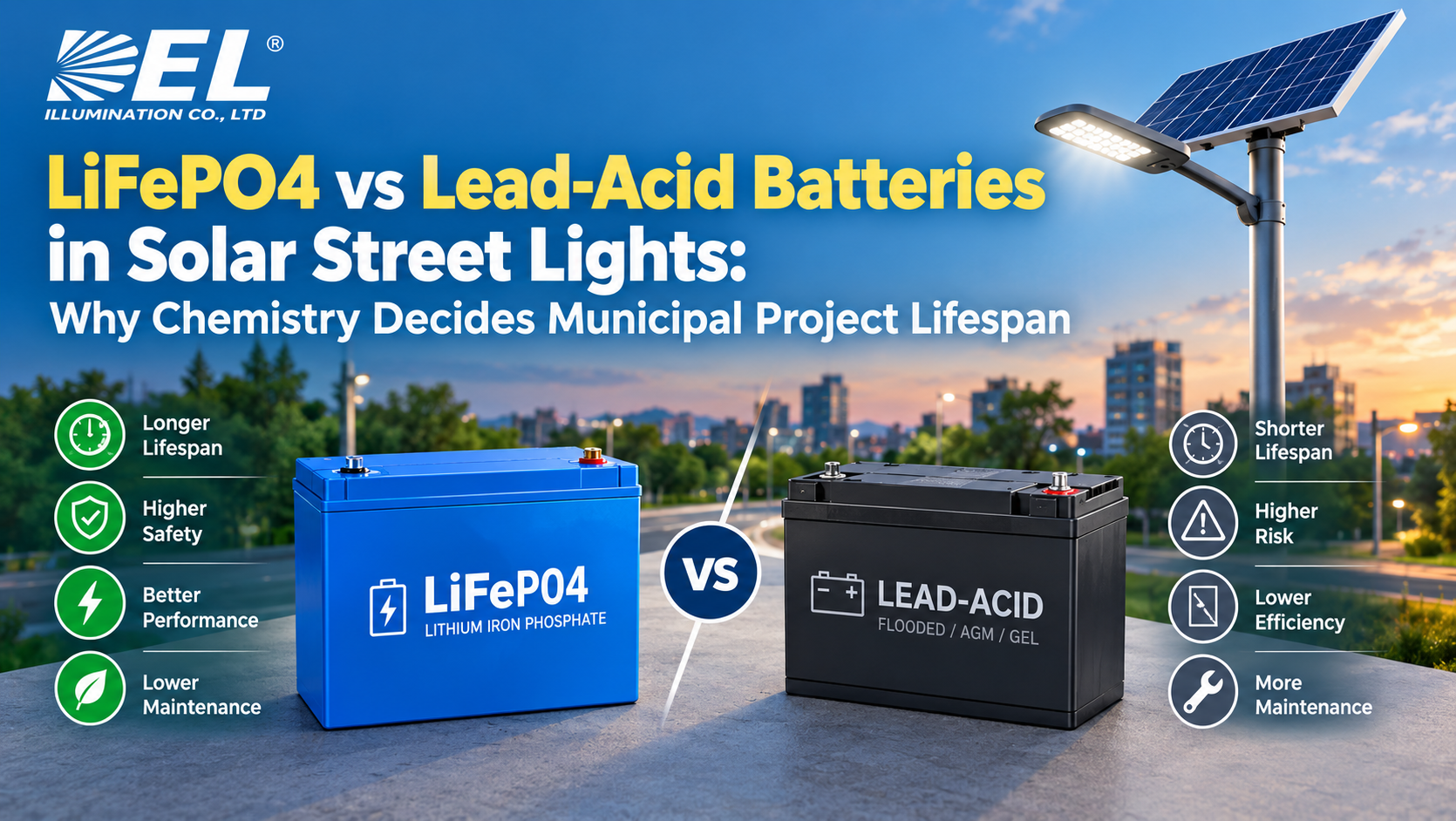
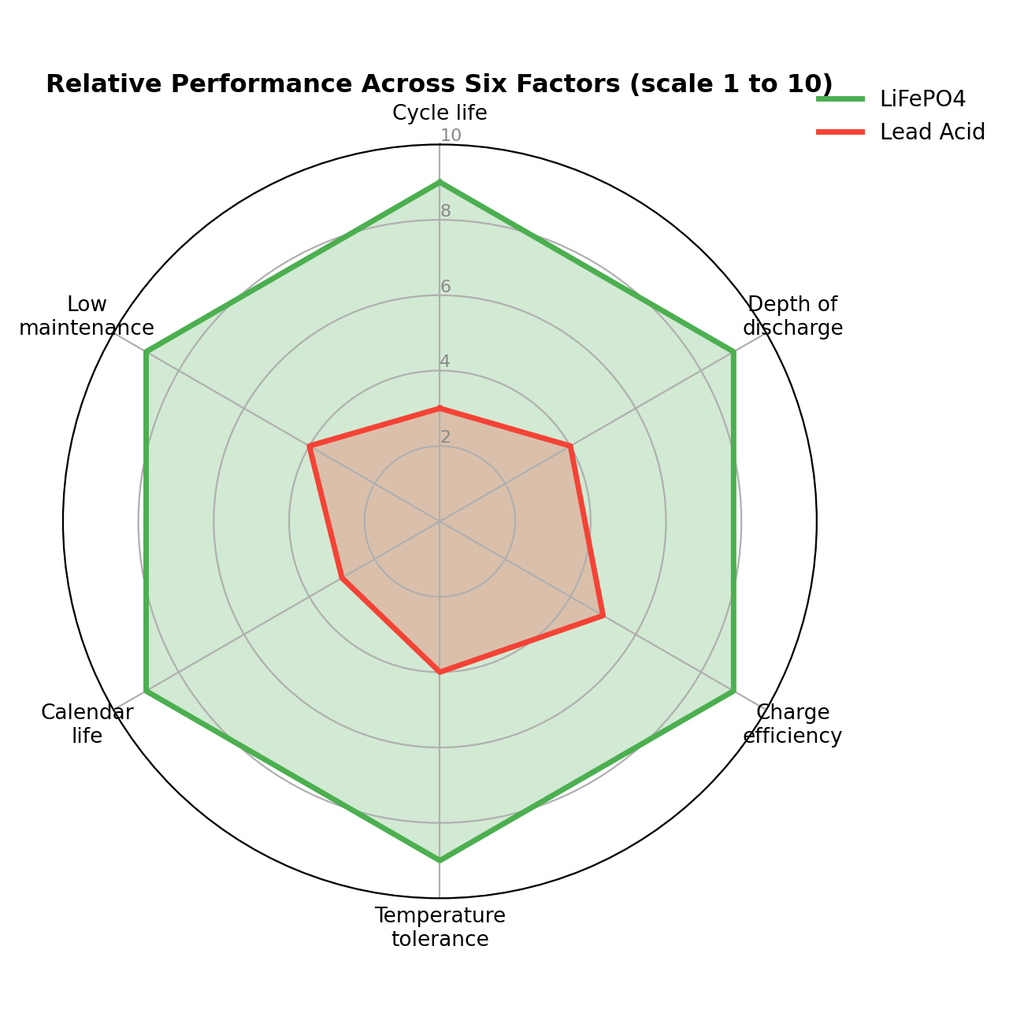
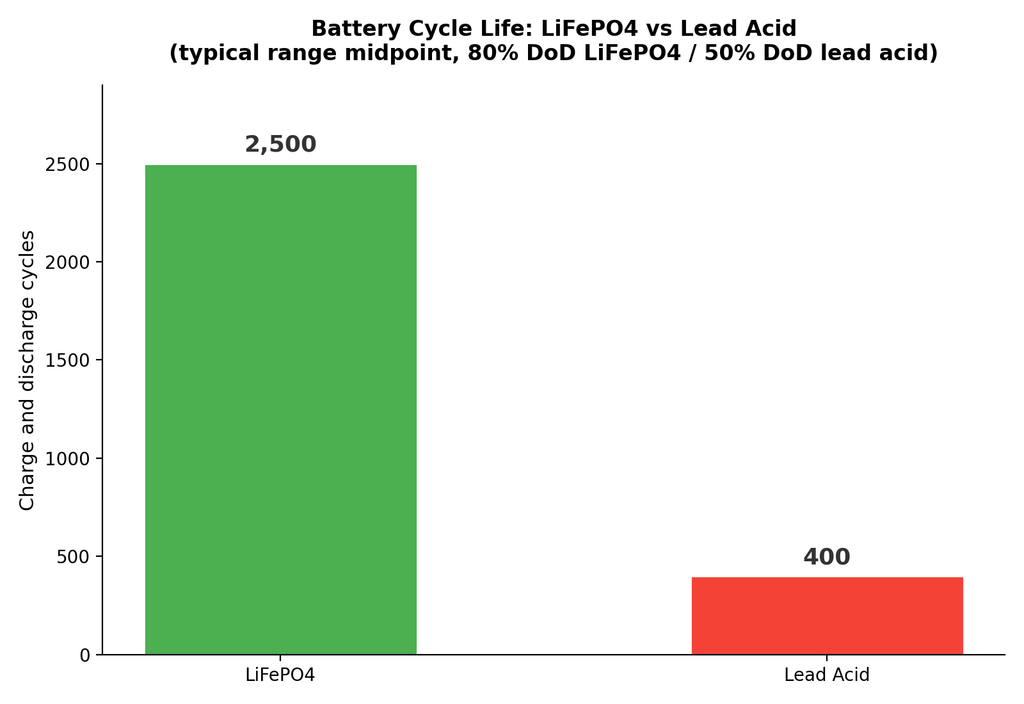
The clearest technical difference between the two chemistries is cycle life, meaning how many full charge and discharge cycles a battery can complete before its usable capacity drops below a workable threshold. Lead acid batteries used in street lighting typically deliver 300 to 500 cycles when discharged to around 50 percent depth of discharge, translating to roughly two to four years of daily service in the field. LiFePO4 batteries typically deliver 2,000 to 3,000 cycles under comparable duty, and some manufacturer test data cites figures as high as 3,000 to 5,000 cycles at moderated depth of discharge, translating to eight to twelve years of calendar life.
Depth of discharge compounds the difference. Lead acid batteries need to stay above roughly 50 percent state of charge to avoid accelerated sulfation and premature failure, which means a large share of the nameplate capacity is never actually usable. LiFePO4 batteries can be safely discharged to 80 or even 90 percent depth of discharge without meaningfully shortening their service life, so a LiFePO4 solar street light system delivers far more usable energy from the same rated capacity. For a procurement team sizing autonomy days, that means a LiFePO4 battery can be specified smaller for the same backup performance, or the same size battery can carry more backup days through cloudy weather.
Temperature adds a further gap. LiFePO4 cells generally maintain stable performance from around minus 20 to plus 60 degrees Celsius, while lead acid capacity and charge acceptance drop noticeably in both cold and hot climates, a meaningful factor for projects spanning desert, coastal, or high altitude sites.
MPPT Charging and Energy Efficiency Gains
Battery chemistry does not operate in isolation. It is paired with a charge controller that governs how efficiently solar energy actually reaches the battery, and this is where a second major efficiency gap appears. Maximum Power Point Tracking, commonly abbreviated MPPT, continuously adjusts the electrical operating point of the solar panel to extract the maximum available power under changing light and temperature conditions. Pulse Width Modulation, commonly abbreviated PWM, is a simpler and cheaper switching technology that does not track this optimal point.
In practice, MPPT controllers commonly reach charging efficiencies close to 98 percent, while PWM controllers typically operate in the 70 to 80 percent range, meaning a share of the panel’s potential output is never captured. Industry testing generally places the real world MPPT advantage at roughly 25 to 30 percent more usable energy delivered to the battery compared with PWM, with the gap widening in cold weather, partial shading, or where panel voltage sits well above battery voltage.
For a LiFePO4 solar street light, pairing the battery with an MPPT charge controller compounds the chemistry advantage rather than simply adding to it. A battery that already accepts a deeper, more efficient charge benefits more from a controller that delivers more of the panel’s rated output in the first place, which is one reason MPPT and LiFePO4 are increasingly specified together as a matched pair in EPC grade solar street light systems rather than evaluated separately.

Total Cost of Ownership for EPC and Municipal Lighting Projects
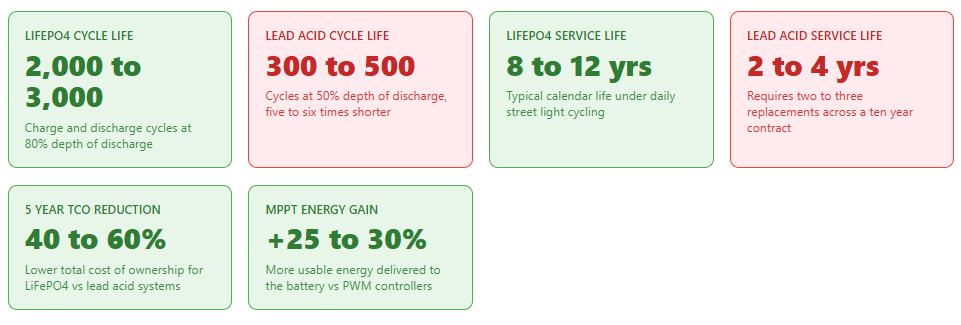
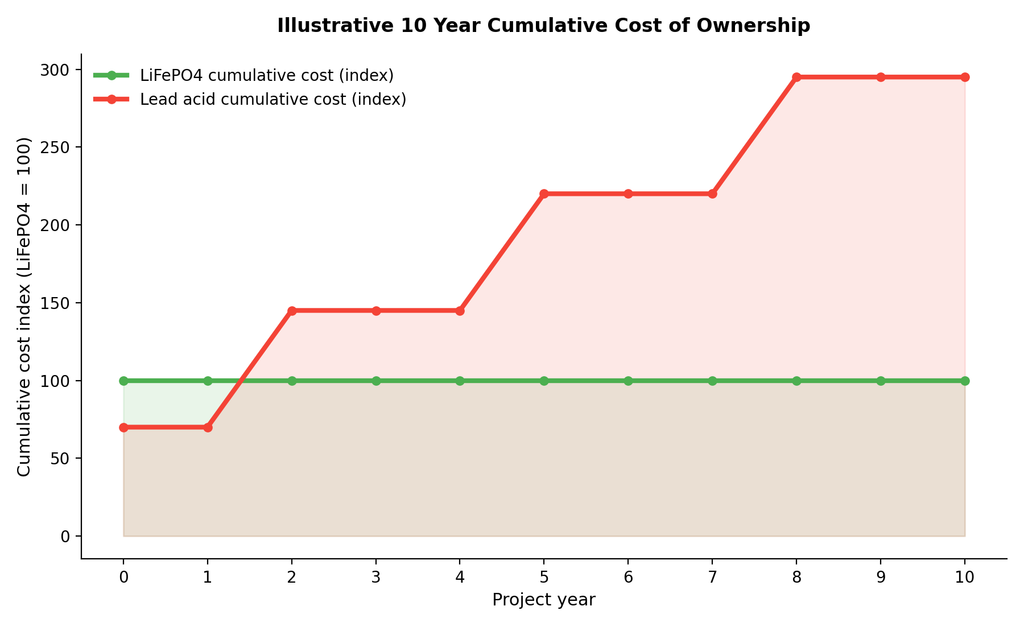
Upfront unit price still favors lead acid, which is exactly why total cost of ownership, not sticker price, is the correct basis for specifying a LiFePO4 solar street light program. Because lead acid batteries typically need replacement every two to four years against a LiFePO4 service life of eight to twelve years, a lead acid specification usually means two to three full battery replacement cycles across a single ten year project term, compared with zero or one for LiFePO4.
Each replacement cycle carries far more than the cost of the battery itself, including technician time, transport across a distributed network, pole access equipment, disposal, and a period where the light underperforms before the fault is caught. Industry cost modeling generally places the five year total cost of ownership for a LiFePO4 solar street light system 40 to 60 percent lower than comparable lead acid systems once these factors are included, and the gap widens further across a ten year contract term.
This is precisely the calculation EPC contractors need to walk procurement committees through, since municipal budgets are frequently evaluated on capital cost alone at tender stage, without full visibility into the maintenance liability a lead acid specification creates over the contract’s remaining years. A transparent lifecycle comparison, not just a per unit price comparison, is what protects both the contractor’s maintenance obligation and the municipality’s long term budget.
Certification Standards for Bankable EPC Projects
Chemistry claims are only as reliable as the testing behind them, which is why certification documentation matters as much as the datasheet numbers for any project seeking financing or tender approval. Lead acid and other older chemistries are commonly evaluated against IEC 61427 Part 1, covering general requirements and test methods for batteries in photovoltaic off grid applications. LiFePO4 falls under IEC 62619, the safety standard covering cell construction, thermal abuse testing, and battery management system evaluation for industrial and stationary lithium systems.
Beyond the battery itself, a bankable LiFePO4 solar street light system should carry documented compliance across the full assembly: ISO9001 for manufacturing quality management, CE marking, RoHS for restricted substances, and enclosure ratings such as IP66 or IP67 for dust and water ingress and IK08 for impact resistance. These are the documents development banks, EPC main contractors, and municipal procurement teams typically request before releasing funds, and German engineering standards place particular weight on third party verified test reports rather than self declared specifications.
For EPC contractors managing multi country rollouts, requesting this certification package upfront for every LiFePO4 solar street light order, rather than after contract award, is one of the simplest ways to reduce field failure risk.

Conclusion
Battery chemistry is the specification that most determines how a solar street lighting network performs and costs over its real operating life, not just at handover. LiFePO4 solar street light systems deliver roughly five to ten times the cycle life of lead acid, tolerate far deeper discharge without damage, pair more effectively with MPPT charging, and typically cut total cost of ownership by 40 to 60 percent over five years, even though the upfront unit price is higher. For EPC contractors and municipal buyers evaluating tenders, the certification package behind that chemistry is what separates a bankable proposal from an unverifiable one.
For a project specific chemistry comparison, cycle life sizing, or certification package for an upcoming EPC tender, visit solar-led-street-light.com to speak with our engineering team for a customised quote.
Frequently Asked Questions
How long does a LiFePO4 solar street light battery actually last in the field?
Most manufacturer test data places a LiFePO4 solar street light battery at eight to twelve years of calendar life under normal daily cycling, with cycle counts in the 2,000 to 3,000 range at moderated depth of discharge. Actual field life depends on ambient temperature, charge controller quality, and how conservatively the depth of discharge is managed.
Can lead acid batteries still be used in solar street lighting projects?
Yes, lead acid remains a viable option for very low budget projects, short term installations, or sites with easy maintenance access where frequent replacement is not a major burden. It becomes a weaker choice as project scale, remoteness, or contract length increases, since replacement frequency and service cost scale with the network size.
What depth of discharge should EPC contractors specify for battery sizing?
For lead acid, keep planned depth of discharge at or below 50 percent to protect service life. For LiFePO4, 80 percent is a commonly accepted safe target, with some systems rated for deeper discharge, which allows a smaller rated battery to deliver the same usable backup autonomy.
Does LiFePO4 need a battery management system?
Yes. LiFePO4 cells require an integrated battery management system to monitor individual cell voltage, prevent overcharge and overdischarge, and manage thermal protection. This is standard in quality LiFePO4 solar street light products and is part of what IEC 62619 testing evaluates.
How does temperature affect LiFePO4 versus lead acid battery performance?
LiFePO4 maintains stable capacity across a wide range, commonly cited from around minus 20 to plus 60 degrees Celsius, while lead acid loses usable capacity in cold weather and ages faster in sustained high heat. This makes chemistry selection climate dependent, particularly for desert and high altitude EPC projects.
What certification documents should procurement teams request for bankable EPC contracts?
At minimum, request third party test reports against IEC 62619 for lithium batteries or IEC 61427 Part 1 for lead acid, along with ISO9001 manufacturing certification, CE marking, RoHS compliance, and IP and IK enclosure ratings. Self declared specifications without accredited lab verification carry higher field failure risk.
Is the higher upfront cost of LiFePO4 justified for small rural lighting projects?
It depends on site access. If a rural site is remote enough that a lead acid replacement visit is expensive or logistically difficult, the maintenance savings from LiFePO4 usually justify the higher initial cost within the first replacement cycle. For easily accessible sites with tight upfront budgets, lead acid can still be a defensible short term choice.
How many backup days should municipal solar street light projects plan for?
This depends on regional weather patterns rather than battery chemistry alone, but three to seven days of autonomy is a common planning range for climate dependent sizing. LiFePO4’s higher usable depth of discharge generally allows more backup days to be specified within a smaller and lighter battery pack compared with lead acid.
References
Golden Cell Power. (2026). Lead acid vs LiFePO4 batteries for solar street lights: a technical comparison for municipal and commercial buyers. https://goldencellpower.com/lead-acid-vs-lifepo4-batteries-for-solar-street-lights-a-technical-comparison-for-municipal-and-commercial-buyers/
Haichang Light. (2026). Solar LED street light complete guide 2026: all in one vs split system, LiFePO4 battery, rainy day performance. https://www.haichanglight.com/solar-led-street-light-complete-guide-2026-all-in-one-vs-split-system-lifepo4-battery-rainy-day-performance/
Inlux Solar. (2026). Best battery for solar street lights: LiFePO4 vs AGM vs lead acid. https://www.inluxsolar.com/lifepo4-vs-lead-acid-agm-solar-street-lights/
International Electrotechnical Commission via AFNOR. (2017). IEC 62619:2017, safety requirements for secondary lithium cells and batteries for industrial applications. https://www.boutique.afnor.org/en-gb/standard/iec-626192017/secondary-cells-and-batteries-containing-alkaline-or-other-nonacid-electrol/xs129525/247008
International Energy Agency. (2023). Lighting Africa solar lantern project in Burkina Faso. https://www.iea.org/policies/17782-lighting-africa-solar-lantern-project-in-burkina-faso
MANLY Battery. (2025). How long do solar street light batteries last in 2025. https://manlybattery.com/how-long-do-solar-street-light-batteries-last/
MANLY Battery. (2025). Solar street light battery: LiFePO4 vs lead acid, how to select battery chemistry. https://manlybattery.com/how-to-select-solar-street-light-battery-chemistry-lifepo4-vs-lead-acid/
National Research Council Canada. (2013). IEC 61427-1:2013, secondary cells and batteries for renewable energy storage, part 1: photovoltaic off grid application. https://csres-cnrse.nrc-cnrc.gc.ca/en/projects-stage/operation?page=5
Sinovoltaics. (2025). Solar battery certification: IEC 61427 explained. https://sinovoltaics.com/learning-center/certifications/solar-battery-and-energy-storage-certification-iec-61427/
TWAICE. (2024). IEC 62619, battery encyclopedia. https://www.twaice.com/battery-encyclopedia/iec-62619
Disclaimer
This article is for informational purposes only and does not constitute professional engineering, installation, or procurement advice. Performance specifications and costs may vary based on project requirements, location, and local regulations. Always consult qualified solar energy professionals and legal advisors before making procurement decisions.
For expert consultation on solar LED street lighting solutions, visit solar-led-street-light.com or contact our team for a customised quote.