
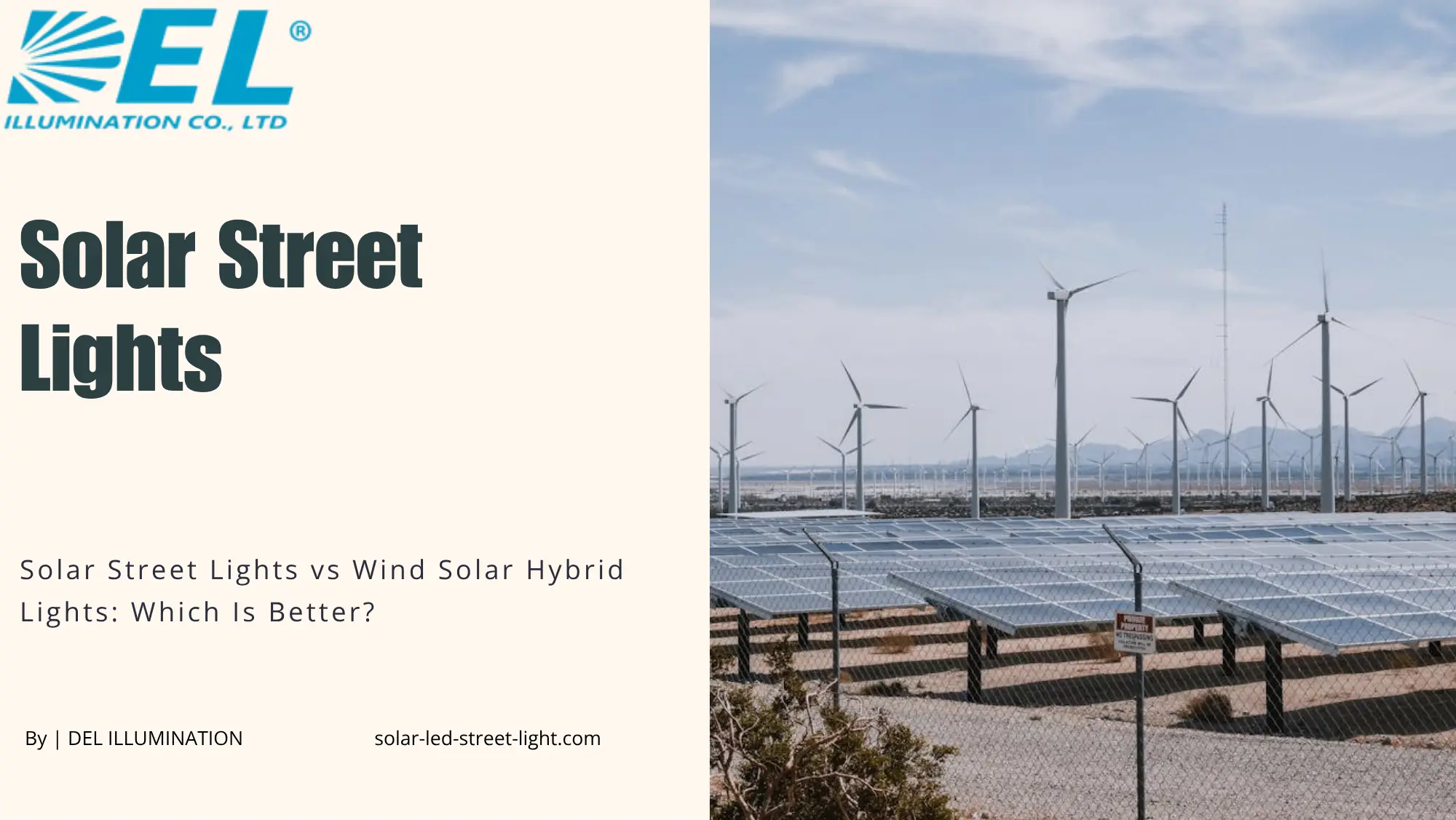
A 100W solar panel combined with a 400W vertical axis wind turbine can generate 800–1,000 kWh of electricity per year enough to power an LED street light for 10–12 hours every night, 365 nights a year, regardless of weather. That is a compelling headline for wind solar hybrid street lights. But here is the equally compelling counter case: a correctly specified pure solar street light, installed in the right location, delivers the same all night reliability at 40–60% lower capital cost, with significantly simpler installation, fewer moving parts, and a lower lifetime maintenance burden.
The choice between a solar street light and a wind solar hybrid street light is one of the most practically important decisions a city planner, facility manager, or EPC contractor can make when specifying off grid street lighting infrastructure. Get it right and you have a system that outperforms the alternative for its full 10–15 year life. Get it wrong by specifying a hybrid in a low wind urban location, or specifying solar only in a region where wind supplements critical winter performance and the project will underperform its design specification from day one.
This blog provides a rigorous, data driven comparison of solar street lights versus wind solar hybrid street lights across the dimensions that matter most to infrastructure procurement: energy generation, capital cost, maintenance, installation complexity, environmental suitability, and total cost of ownership over 10 years.
How Each System Generates and Stores Energy
Understanding the fundamental engineering of each system is essential before comparing their performance in the field.
A solar street light operates on the photovoltaic (PV) effect. A monocrystalline solar panel rated at 21–23% conversion efficiency in German engineered systems absorbs solar irradiance during daylight hours and converts it into direct current (DC) electricity. An MPPT (Maximum Power Point Tracking) charge controller achieving up to 97% harvesting efficiency compared to 76–79% for PWM alternatives manages the energy flow into a LiFePO4 battery rated for 2,000–3,000 charge discharge cycles at 80% depth of discharge. The battery powers a high efficacy LED fixture (160–180 lm/W in German engineered specifications) from dusk to dawn via the charge controller’s photosensor switching function. The entire system is passive no moving parts, no mechanical wear.
A wind solar hybrid street light adds a second generation layer: a small wind turbine, typically a Vertical Axis Wind Turbine (VAWT) for urban and semi urban applications. VAWTs capture wind from any direction without directional alignment, operate at noise levels below 40 dB, and begin generating useful power at wind speeds as low as 2.5–3 m/s in premium designs. The turbine output is routed through a dual MPPT hybrid charge controller that simultaneously manages solar PV input and wind generator input, optimising battery charging from whichever source is available at any given moment. In conditions where both wind and solar are available simultaneously, the hybrid controller blends both inputs to maximise battery state of charge.
The key engineering insight is complementarity: solar PV generates strongly during daylight in clear conditions, while wind often peaks at night, during storms, and in winter months when solar irradiance is weakest. In locations where this complementarity is genuine coastal zones, mountain passes, open plains, high latitude regions the hybrid system can maintain battery charge through periods that would significantly stress a solar only system. For related context on how solar only systems handle low irradiance periods, see our guide on reliable solar energy street light systems.
Capital Cost and Installation Complexity
Capital cost is where the two systems diverge most sharply and where procurement officers need the clearest data.
A mid range solar street light for main road lighting (50–80W LED equivalent) carries a typical FOB unit cost of USD 400–800 per unit, based on 2024–2025 market data. A premium German engineered system with verified monocrystalline panels, LiFePO4 batteries, MPPT controllers, and IP67 rated enclosures sits toward the upper end of this range. Installation is straightforward: set the pole, mount the integrated fixture, and the system begins operating autonomously. No underground cabling, no specialist electrical contractors, no grid infrastructure.
A comparable wind solar hybrid street light with a vertical axis turbine, dual MPPT controller, and equivalent LED output carries a significantly higher unit cost typically 1.5–2.5× the cost of a pure solar equivalent, depending on turbine wattage and blade quality. Installation complexity increases substantially: the turbine assembly must be mounted and aligned, turbine wiring routed through the pole to the dual MPPT controller, and the pole itself must be rated for the additional wind loads generated by the turbine structure. Industry guidance specifies poles for hybrid systems should be designed for wind loads of at least 150 km/h survival wind speed a requirement that affects both pole specification and foundation design. For high volume projects, this cost differential has a significant impact on total project budget.
Installation time is also a meaningful factor in large deployments. A solar only all in one unit can typically be installed by a two person team in under two hours per pole. A hybrid system requiring turbine assembly, dual input wiring, and additional pole load verification requires more specialist time per unit. For projects in challenging terrain coastal highways, rural mountain roads this installation complexity difference translates directly into higher labour costs. For guidance on specifying the right pole system for high load applications, see our article on 5 advantages of solar light pole systems.
Where Each System Genuinely Performs Better
The most honest answer to “which is better?” is: it depends entirely on the deployment location’s wind resource.
A solar street light performs at or above its design specification in any location where annual average solar irradiance is sufficient to fully charge its LiFePO4 battery within the available daily peak sun hours. This covers the vast majority of locations globally including most of Asia, Africa, the Middle East, Latin America, and large parts of Europe and North America. In these locations, a German engineered solar street light with 3–7 days of battery backup capacity will sustain reliable all night operation through normal overcast periods without any wind supplement. The solar only solution is simpler, lower cost, lower maintenance, and fully adequate for the application. For regional specific performance data, our guides on solar street lights for Middle East climates and solar street lights in Africa provide detailed irradiance based system sizing guidance.
A wind solar hybrid street light genuinely adds value in specific, identifiable environments where the solar only solution faces real limitations:
- Coastal locations where consistent maritime winds averaging 4–6 m/s or higher supplement solar generation during winter months when daylight is limited
- High altitude mountain roads where tree cover or terrain shading reduces available solar irradiance but stable wind conditions are reliable
- High latitude regions (above 55°N or below 45°S) where winter solar irradiance falls significantly below design levels for extended periods
- Industrial or remote sites with consistent prevailing winds where 24/7 lighting reliability is critical regardless of weather
- Monsoon climate zones in South and Southeast Asia where extended rainy seasons suppress solar yield for weeks at a time
The critical assessment before specifying a hybrid system is whether the site’s actual average wind speed not the regional peak wind speed justifies the cost premium. The average wind speed in most urban and suburban environments globally is 3–5 m/s, and many city centre locations fall below 3 m/s due to building interference. A turbine that requires 3 m/s to begin generating useful power will produce little measurable energy in many urban installations, making the hybrid premium unjustifiable in those specific sites. For off grid and remote deployments where hybrid systems genuinely add value, our resource on off grid solar street lighting provides a useful baseline framework.
Maintenance Requirements Over 10 Years
Maintenance is the dimension of this comparison that most procurement officers underweight at the specification stage and overweight in the operational phase when actual costs materialise.
A solar street light with German engineered LiFePO4 batteries and IP67 rated enclosures has a maintenance profile that is minimal by design. The primary recurring task is solar panel cleaning, which in high dust environments should occur every 2–4 weeks and in temperate climates every 2–3 months. Annual battery capacity testing using a discharge protocol verifies that the battery is maintaining above 80% of its rated capacity, allowing predictive replacement planning before performance falls below road lighting standards. The LED module rated for 50,000 hours in quality systems typically does not require replacement within a 10 year operational horizon. No moving parts means no mechanical wear, no bearing degradation, no blade inspection, and no lubrication schedule. For the complete maintenance framework, see our detailed guide on how to clean a solar panel on a street light.
A wind solar hybrid street light adds the wind turbine maintenance requirement to this baseline. Small wind turbines used in hybrid street light applications require periodic bearing inspection and lubrication, blade inspection for cracks or leading edge erosion, generator output testing, and physical checking of blade mounting bolts all of which require elevated access to the turbine head at height. Bearing replacement cycles vary by turbine quality but industry data indicates replacement intervals of 3–5 years in continuously operating turbines. Blade degradation from UV exposure and particulate impact is also a factor in high wind or coastal deployments, with some turbine blades requiring replacement within 5–8 years of continuous operation. These maintenance tasks require specialist skills that may not be available in remote deployment locations, adding logistics costs to the direct maintenance spend. A 100 unit hybrid deployment may face 2–3× higher annual maintenance costs compared to an equivalent solar only deployment.
10 Year Total Cost of Ownership Comparison
For procurement officers conducting the financial appraisal that determines which system a municipality or development finance institution will fund, total cost of ownership (TCO) is the decisive metric.
For a 100 unit deployment of 60W equivalent LED street lights on main roads, the 10 year TCO comparison breaks down as follows, based on verified 2024–2025 pricing benchmarks:
Solar street light (German engineered):
- Unit hardware cost: USD 600 per unit × 100 = USD 60,000
- Installation (2 person hours per unit at USD 30/hour): USD 6,000
- Panel cleaning, annual battery testing, 10 years: USD 8,000
- Zero electricity cost across 10 years
- No turbine maintenance
- 10 year TCO: approximately USD 74,000
Wind solar hybrid street light (comparable specification):
- Unit hardware cost: USD 1,200 per unit × 100 = USD 120,000
- Installation (4 person hours per unit at USD 30/hour): USD 12,000
- Panel cleaning, turbine maintenance (bearings, blades, 10 years): USD 25,000
- Zero electricity cost
- 10 year TCO: approximately USD 157,000
The hybrid system’s 10 year TCO is approximately 2.1× higher in a standard urban deployment. This premium is justifiable only when the hybrid system’s additional energy yield materially reduces battery replacement frequency or prevents system downtime that would carry its own cost which is only the case in genuinely high wind environments. For a full lifecycle cost methodology applicable to EPC project submissions, see our comprehensive guide on total cost of ownership for EPC projects.
Conclusion
The choice between a solar street light and a wind solar hybrid street light is not a question of which technology is superior in the abstract it is a question of which system is correctly matched to the specific deployment environment. In most urban, suburban, and rural locations globally where average wind speeds fall below 4 m/s, a German engineered solar street light with LiFePO4 batteries, MPPT charge controller, and 3–7 days of backup capacity delivers equal or better reliability than a hybrid system at substantially lower capital cost, simpler installation, and significantly lower 10 year maintenance expenditure.
The three most important takeaways for procurement decision makers are: first, always measure or verify actual site wind speed data before specifying a hybrid system regional wind resource maps are not a substitute for site level assessment; second, evaluate TCO rather than unit hardware cost, since the hybrid premium in high wind locations may be recovered through reduced battery replacement cycles and improved winter performance; and third, never specify a hybrid system in a location where the average wind speed falls below the turbine’s cut in speed, as the wind component will generate negligible energy and the investment is wasted.
Ready to specify the right solar street lighting system for your project environment? Visit solar led street light.com to consult with our engineering team or request a customised quote matched to your site’s irradiance and wind data.
FAQ
1. What average wind speed is needed for a wind solar hybrid street light to be cost effective? Industry data confirms that wind solar hybrid street lights deliver meaningful additional energy generation at sustained average wind speeds of 4 m/s or higher. Below this threshold, the turbine’s contribution to total battery charging is minimal relative to the additional capital cost and maintenance burden the turbine adds. In most urban and suburban environments globally, average wind speeds measured at street pole height (6–10 metres) fall in the 2.5–4 m/s range below the cost effectiveness threshold for hybrid systems. A high quality VAWT with maglev or carbon fibre blades can begin rotating at 1.5–2.5 m/s, but generating useful wattage consistently requires sustained wind, not occasional gusts.
2. Can a solar street light work through a full monsoon season without a wind supplement? Yes, provided the battery is correctly sized for the local climate. A well engineered solar street light for South or Southeast Asian monsoon deployment should carry 5–7 days of battery backup capacity using LiFePO4 chemistry, and specify monocrystalline panels for superior diffuse light performance relative to polycrystalline alternatives. MPPT charge controllers which extract 25–30% more energy than PWM controllers from the same panel in low irradiance conditions are essential for monsoon climate deployments. In particularly challenging locations such as Bangladesh or coastal Vietnam, solar only systems with these specifications consistently outperform hybrid systems whose turbines cannot generate meaningful power during low wind monsoon conditions. Our dedicated guide on solar street lights for Southeast Asia covers monsoon season sizing in detail.
3. Are wind solar hybrid street lights louder than solar only street lights? Solar street lights produce zero noise during operation they have no moving parts. Wind solar hybrid street lights incorporating a VAWT turbine generate measurable sound at the turbine head. Quality VAWT designs for urban street light applications are rated at below 40 dB of noise output at a 1 metre distance, which is comparable to ambient urban background noise levels at night. However, in quiet residential environments, low frequency vibration from the rotating turbine can be perceptible, and turbine noise increases with wind speed. This is a relevant consideration for residential colony and school zone deployments where noise sensitivity is higher.
4. Which system is better for a coastal highway project? A coastal highway is one of the most appropriate applications for a wind solar hybrid street light. Coastal zones typically provide consistent maritime wind resources averaging 5–7 m/s or higher, which directly complements the reduced solar yield from frequent marine cloud cover and sea mist. The hybrid system’s ability to generate from wind during overcast and overnight periods maintains battery state of charge through conditions that would stress a solar only system sized for inland irradiance data. However, coastal deployments require additional attention to corrosion protection duplex protected poles (hot dip galvanised plus powder coated), IP67 verified enclosures for all electronics, and stainless steel hardware throughout. For guidance on corrosion protection in solar street light pole specifications, see our article on solar street light pole rusting prevention and maintenance.
5. Do wind solar hybrid street lights qualify for the same development finance incentives as solar only systems? In most multilateral development bank (MDB) frameworks including those of the World Bank and Asian Development Bank wind solar hybrid street lights qualify under the same renewable energy infrastructure categories as solar only street lights, as both are off grid, zero emission LED lighting systems. However, the higher unit cost of hybrid systems may require more detailed cost justification in the technical and financial sections of an MDB funded project proposal, particularly in regions where solar irradiance data demonstrates that a solar only system would meet the lighting standard without wind supplement. For guidance on MDB procurement documentation requirements for solar street light projects, see our resource on ADB and World Bank solar street light procurement 2026.
6. How do I decide whether to specify solar only or hybrid for a remote rural road project? The decision framework involves three sequential questions: What is the site’s annual average wind speed at 8–10 metre height? If it is consistently above 4 m/s, a hybrid system may be cost justified. What is the site’s daily peak sun hours (PSH)? If PSH falls below 4 hours for more than 60 days per year, a hybrid system provides meaningful additional energy security. And does the project budget accommodate the 1.5–2.5× hardware cost premium and higher maintenance cost over the operational life? If all three answers are positive, a hybrid system should be evaluated seriously. If any one answer is negative, a solar only system with correctly sized LiFePO4 battery backup is the more reliable and cost effective choice. For rural road projects specifically, our guide on solar street lights for rural communities provides detailed siting and specification guidance.
7. What certifications should I verify for a wind solar hybrid street light? At minimum, verify IEC 61215 and IEC 61730 for the solar panel, IEC 60598 for the LED luminaire, IP67 ingress protection verified by an accredited laboratory for all electronics enclosures including the hybrid charge controller and junction box, and IEC 61400 2 for small wind turbines where applicable. The turbine itself should carry documentation of its cut in wind speed, rated wind speed, survival wind speed, and noise level at rated output. For hybrid systems destined for development bank funded projects, TÜV certification and ISO 9001 quality management documentation for the complete system should be requested as standard. For a comprehensive overview of the certifications relevant to bankable solar street light projects, see our article on certification requirements for bankable EPC contracts.
References
- BOSUN Lighting. (2025). Solar Wind Turbine Street Light: The Hybrid Power of Nature. https://www.bosunlighting.com/clarification about solar wind turbine street light preferred choice for remote area lighting system.html
- BOSUN Lighting. (2025). Pros, Cons, and Development Prospects of Solar and Hybrid Energy Street Lights. https://www.bosunlighting.com/solar vs wind energy pros cons future of hybrid street lighting.html
- Sungreat Energy. (2026). A Guide to Choosing the Best Hybrid Solar and Wind Street Lights. https://www.sungreatenergy.com/blog/a guide to choosing the best hybrid solar and wind street lights/
- SurgePV. (2026). Wind Turbine vs Solar: Cost, ROI & Output Compared 2026 Data. https://www.surgepv.com/blog/wind turbine vs solar
- Quenen Lighting. (2026). Solar Street Light Cost Guide 2024: All in One & Split Systems. https://www.quenenglighting.com/guides/solar street light cost guide 2024.html
- Alltop Group. (2024). Are Wind Solar Street Lights Really Better Than Solar Street Lights? https://www.alltopgroup.com/are wind solar street lights really better than solar street lights.html
- Anethic. (2025). The Advantages of Hybrid Solar Street Lighting in Cold Regions. https://www.anethic.com/blog/shedding light on the benefits of hybrid solar street lighting in northern climates
- PV Solar First Energy. (2025). Discover the Advantages of Renowned Wind Solar Hybrid Street Lights. https://www.pvsolarfirst.com/news_detail/173.html
- Inlux Solar. (2026). Solar Street Light Price Guide 2026: Retail vs Wholesale Costs. https://www.inluxsolar.com/solar street light price guide 2026/
- Beyond Solar. (2025). Solar Street Lights vs Traditional: Cost, ROI & Efficiency. https://beyondsolar.net/blogs/news/solar vs traditional street lights cost performance comparison
Disclaimer
This article is for informational purposes only and does not constitute professional engineering, installation, or procurement advice. Performance specifications and costs may vary based on project requirements, location, and local regulations. Always consult qualified solar energy professionals and legal advisors before making procurement decisions.
For expert consultation on solar LED street lighting solutions, visit solar led street light.com or contact our team for a customised quote.