
Ask a supplier “how long do solar street lights last?” and you will hear anything from 5 to 25 years a range so wide it is almost useless for budgeting. The reason is that a solar street light is not one product with one lifespan; it is five components that age at completely different rates. The solar panel can still be working at 25 years while the cheap battery beneath it has already failed three times. That single mismatch is why so many “20 year” installations go dark in year three, and why how long do solar street lights last has no honest one line answer. In truth, how long solar street lights last is decided component by component, not by the fixture as a whole.
For city planners, EPC (engineering, procurement, and construction) contractors, and facility managers, this distinction is the whole game. A realistic answer to how long do solar street lights last drives your replacement budget, your warranty negotiations, and your 10 year total cost of ownership (TCO) model. Knowing how long solar street lights last also shapes maintenance scheduling and spare parts planning. This guide breaks the question down the only way that produces a useful answer: component by component. We will cover the true service life of the LED, battery, solar panel, charge controller, and pole, explain which part fails first and why, compare German engineered durability against generic alternatives, and show how the right specifications turn a vague guess into a dependable decade or more of light.
Why “Lifespan” Is the Wrong Question
The honest starting point is that no single number describes how long do solar street lights last, because each component has its own clock. Industry data consistently places whole system service life between 10 and 25 years, but that span exists precisely because the parts wear out at different speeds. Asking “how long does the light last?” is less useful than asking “which component fails first, and how soon?” that is the real key to how long solar street lights last in practice.
In almost every installation, the answer is the battery. It is the only component that fully cycles every single day charging by sun and discharging through the night so it endures thermal and voltage stress the panel and pole never face. A solar panel degrades gently at roughly 0.5% per year; a battery is worked hard from the first night, and this imbalance is the real reason how long do solar street lights last varies so widely between products.
- LED luminaire: ~50,000 hours, roughly 10–13 years at dusk to dawn duty
- Battery: the limiting component, from 2–4 years (generic) to 8–12 years (premium)
- Solar panel: 25–30 years with gradual output fade
- Charge controller: 5–10 years
- Pole: 20+ years with proper corrosion protection
The practical takeaway for procurement is that the first replacement event is almost always a battery swap, not a whole fixture replacement. Because solar systems are modular, you can often replace just the battery pack rather than the entire unit which means battery quality, more than any other factor, determines both your maintenance schedule and how long do solar street lights last in real world service.
The LED Luminaire: Long Lived but Heat Sensitive
The LED (light emitting diode) is the part most buyers worry about when they ask how long do solar street lights last, yet it is usually one of the longest lasting components in the system. Quality LED engines are rated for about 50,000 hours to L70 the point at which output has fallen to 70% of its original brightness, the industry’s standard end of life marker. At a typical 10 hour nightly run, that translates to roughly 13.7 years of service before the light reaches that threshold, so the LED rarely sets the limit on how long solar street lights last.
Crucially, LEDs rarely fail outright. They fade gradually through lumen depreciation rather than burning out like old high pressure sodium lamps, which often dropped below half their brightness within a year. So when a solar street light dims, the LED is almost never the culprit the battery is.
What does shorten LED life is heat. Junction temperature is the deciding variable, and this is where engineering quality shows:
- German engineered: die cast aluminium housing keeps LED junction temperature at or below 85°C in 50°C ambient heat, protecting the rated 50,000 hours
- Generic: thin metal or plastic housings let junction temperatures exceed 100°C, eroding lumen maintenance and cutting practical life to 20,000–30,000 hours
- Efficacy difference: premium LEDs deliver 160–180 lm/W versus 100–120 lm/W for generic chips
Poor heat sinking can effectively halve an LED’s working life, which is why thermal design has such an outsized effect on how long do solar street lights last. A fixture engineered with proper thermal paths and a robust aluminium body will hold its brightness for over a decade, while a cheaply housed equivalent fades years earlier even though both may advertise the same 50,000 hour rating on paper. If a chip does eventually fail, it is often possible to replace the LED chip rather than the whole fixture, which extends how long solar street lights last without a full swap.
The Battery: The Component That Sets the Ceiling
If you remember one thing about how long do solar street lights last, make it this: the battery sets the ceiling for the entire system. Because it reaches end of life years before the panel, pole, or LED, the battery dictates when the first costly maintenance visit happens and largely defines how long solar street lights last before that visit.
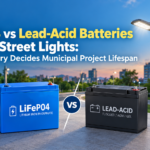
The lifespan gap between chemistries is dramatic. Lead acid batteries, common in budget units, deliver only about 300–500 cycles at 50% depth of discharge (DoD) and last 2–4 years, degrading fast above 40°C. LiFePO4 (lithium iron phosphate) batteries used in German engineered systems deliver 2,000–3,000 cycles and an 8–12 year calendar life, operating reliably from −20°C to 60°C with minimal capacity loss and round trip efficiency near 95%. This chemistry choice alone can double or triple how long solar street lights last.
- Lead acid (generic): 300–500 cycles, 2–4 years, heat sensitive
- LiFePO4 (premium): 2,000–3,000 cycles, 8–12 years, wide temperature tolerance
- Key stressors: depth of discharge, nightly cycle count, and ambient temperature
Three measurable factors govern battery longevity: how deeply it discharges each night, how many cycles it accumulates, and how hot it gets. Shallower discharges and cooler enclosures extend battery life significantly, which is why intelligent dimming and correct sizing matter. A lead acid pack over discharged repeatedly can collapse from a 3 year life to as little as 18 months. This is the core of the cost argument: a generic battery forces two or three replacements across a decade, each a truck roll to a remote pole, while a correctly specified LiFePO4 pack often survives the full deployment which is ultimately what determines how long do solar street lights last before major maintenance.
The Solar Panel, Controller, and Pole: The Long Haul Components
The remaining three components are the marathon runners of the system, typically outlasting several battery cycles. Understanding their real durability prevents over budgeting for replacements that will not happen for decades, and explains why how long do solar street lights last depends far more on the battery than on these parts.
The solar panel is among the longest lived parts. A quality monocrystalline module degrades only about 2–3% in its first year and then roughly 0.5–0.7% annually, retaining over 80% of its output after 25 years. Generic polycrystalline panels can lose more than 20% within 3–5 years, especially if dust, shading, or hot spots accelerate decline. Even 1mm of dust can cut generation by 20–30%, so periodic cleaning is the single most valuable maintenance habit regular cleaning keeps annual degradation under 2%, while neglected panels can exceed 5%. Kept clean, the panel rarely limits how long solar street lights last.
- Solar panel: 25–30 years; ≤10% degradation over 10 years for Grade A monocrystalline
- Charge controller: 5–10 years; MPPT (Maximum Power Point Tracking) units protect the battery and harvest 25–30% more energy than PWM
- Pole: 20+ years when hot dip galvanized or made of corrosion resistant aluminium alloy
The charge controller, often overlooked, lasts 5–10 years and quietly determines battery health by preventing overcharge and deep discharge. The pole is frequently the most durable element of all: a hot dip galvanized steel or aluminium pole, matched to its environment and mounted on a proper foundation, routinely serves 20 years or more and can outlast several battery replacements. Coastal salt and industrial pollution speed corrosion, so a quick coating check every few years protects this long term asset and helps maximise how long do solar street lights last on exposed sites.
Conclusion
Three takeaways should anchor any assessment of how long do solar street lights last. First, stop asking how long do solar street lights last as a single number the system runs 10–25 years, but each component ages on its own clock, and the battery is almost always the first to need replacement. Second, the gap between generic and German engineered components is decisive: a LiFePO4 battery (8–12 years) versus lead acid (2–4 years), an LED held below 85°C versus one cooking past 100°C, and a Grade A panel losing under 10% over a decade versus a generic one fading 20% in a few years. Third, because the panel, controller, and pole are long haul components, how long solar street lights last comes down to battery quality and simple maintenance like panel cleaning.
Specify each component for its true service life and you convert a vague guess into a reliable decade plus of illumination at the lowest total cost of ownership. So when a client asks how long do solar street lights last, the most accurate answer is that solar street lights last as long as their best matched components allow. For a component by component lifespan assessment and a transparent 10 year TCO comparison tailored to your project, visit solar led street light.com for expert consultation or a customised quote.
FAQ
1. Which part of a solar street light fails first? The battery almost always fails first because it is the only component that fully charges and discharges every day, enduring constant thermal and voltage stress. Lead acid batteries typically fail in 2–4 years and LiFePO4 in 8–12 years, while panels and poles last decades. Planning your maintenance budget around the battery is the most realistic approach.
2. If my light is getting dimmer, does that mean the LED is dying? Usually not. LEDs fade very gradually and rarely cause sudden dimming; a noticeable drop in brightness or runtime almost always points to a battery that can no longer hold a full charge. Dirty panels reducing the daily charge are another common cause. Check the battery and clean the panel before assuming the LED has failed.
3. Can I replace just the battery instead of the whole light? Yes, and this is one of the biggest advantages of solar street lights. Because the system is modular, a worn battery pack can usually be swapped without replacing the panel, LED, or pole. This makes battery replacement far more cost effective than buying a new fixture.
4. How does climate affect how long do solar street lights last? Heat is the main enemy high temperatures accelerate battery aging and can push LED junction temperatures past safe limits, while humidity and salt spray cause corrosion. Cold climates reduce lead acid performance more than LiFePO4. Specifying components rated for your local temperature range is essential for reaching the upper end of how long solar street lights last.
5. Do solar street lights last longer than traditional grid powered lights? Modern solar street lights now match or exceed the lifespan of high pressure sodium or metal halide fixtures, which often needed bulb replacements every year or two. Quality LED engines run for over a decade, and with no grid wiring to maintain, ongoing costs are lower. The main scheduled task is periodic battery replacement.
6. How often should solar panels be cleaned to protect lifespan? In many climates rainfall keeps panels reasonably clean, but an annual inspection and cleaning is recommended, more often in dusty or polluted areas. Even a thin dust layer can cut generation by 20–30%, which strains the battery and shortens its life. Regular cleaning keeps annual panel degradation below 2%.
7. What warranty should I expect on a quality solar street light? German engineered systems typically carry 5–7 year comprehensive warranties plus performance guarantees, while generic units often offer only 1–2 years that may be voided by weather damage. Panels are frequently guaranteed for 20–25 years separately. Always confirm what each component’s warranty covers before purchase.
8. Does a longer lifespan justify the higher upfront cost? In nearly all cases, yes. Premium components eliminate the repeated replacement cycles that drive generic systems to 2–3× higher cost over ten years, and after payback the system runs at near zero operational cost. The lowest purchase price rarely produces the lowest lifetime cost.
References
- International Electrotechnical Commission. (2025). IEC 62619: Safety requirements for secondary lithium cells and batteries for industrial applications. https://www.iec.ch
- International Electrotechnical Commission. (2025). IEC 61215: Photovoltaic module design qualification and type approval. https://www.iec.ch
- Illuminating Engineering Society. (2024). LM 80 & TM 21: LED lumen maintenance and life projection. https://www.ies.org
- U.S. Department of Energy. (2024). Solar Photovoltaic Technology Basics. https://www.energy.gov/eere/solar/solar photovoltaic technology basics
- National Renewable Energy Laboratory. (2024). Photovoltaic Module Degradation Rates. https://www.nrel.gov/pv
- Fortune Business Insights. (2025). Solar Street Lighting Market Size, Share & Industry Report 2032. https://www.fortunebusinessinsights.com/industry reports/solar street lighting market 100585
- American Galvanizers Association. (2024). Hot Dip Galvanizing for Corrosion Protection. https://galvanizeit.org
- International Energy Agency. (2025). Access to electricity stagnates, leaving globally 730 million in the dark. https://www.iea.org/commentaries/access to electricity stagnates leaving globally 730 million in the dark
Disclaimer
This article is for informational purposes only and does not constitute professional engineering, installation, or procurement advice. Performance specifications and costs may vary based on project requirements, location, and local regulations. Always consult qualified solar energy professionals and legal advisors before making procurement decisions.
For expert consultation on solar LED street lighting solutions, visit solar led street light.com or contact our team for a customised quote.