
A poorly chosen bracket configuration is one of the most common and most avoidable causes of uneven road illumination and failed photometric compliance in solar street light deployments. According to a 2024 report by the US Solar Energy Industries Association (SEIA), 34% of solar street light system failures originate from non standardised installation, with structural and configuration errors among the primary contributing factors. For procurement officers specifying 200 unit municipal deployments, EPC contractors delivering performance guaranteed projects, and city planners accountable for public road safety standards, bracket configuration is not a detail it is a foundational design decision that determines whether the installation meets its required lux levels and uniformity ratios from day one.
The choice between a single arm solar street light bracket and a double arm solar street light bracket affects road surface illuminance, pole spacing intervals, panel wind load calculations, installation time, and total capital cost per kilometre of road. Yet this decision is frequently made on aesthetic preference or unit price rather than on the engineering criteria that actually determine long term performance and regulatory compliance.
This blog provides a rigorous, application based comparison of single arm and double arm solar street light brackets covering structural specifications, lighting performance implications, road width suitability, wind load considerations, and the specific project contexts where each configuration delivers the best value.
What Are Single Arm and Double Arm Solar Street Light Brackets?
A solar street light bracket also referred to as a mounting arm, light pole arm, or luminaire bracket is the structural component that extends from the top of the mounting pole to position the LED fixture at the correct horizontal offset above the road surface. This horizontal offset is critical: it determines both the optical distance from the luminaire to the road surface and the lateral coverage the fixture delivers across the road width.
A single arm solar street light bracket has one arm extending from the pole in a single direction, supporting one LED fixture. The arm geometry can be straight (horizontal extension), curved (aesthetic swan neck profile), or angled (inclined at 5–15 degrees for optimised optical projection). Single arm brackets are the most widely deployed configuration globally they represent the standard specification for residential roads, walkways, rural roads, single carriageway routes, and pathway lighting applications. The rod body is typically fabricated from Q235 low carbon steel, welded and formed in a single bending process to ensure weld seam continuity. In German engineered specifications, weld quality is verified against GB/T3323 1989 Class III inspection standards, with flatness tolerance between the weld seam and adjacent flat sections not exceeding ±1mm.
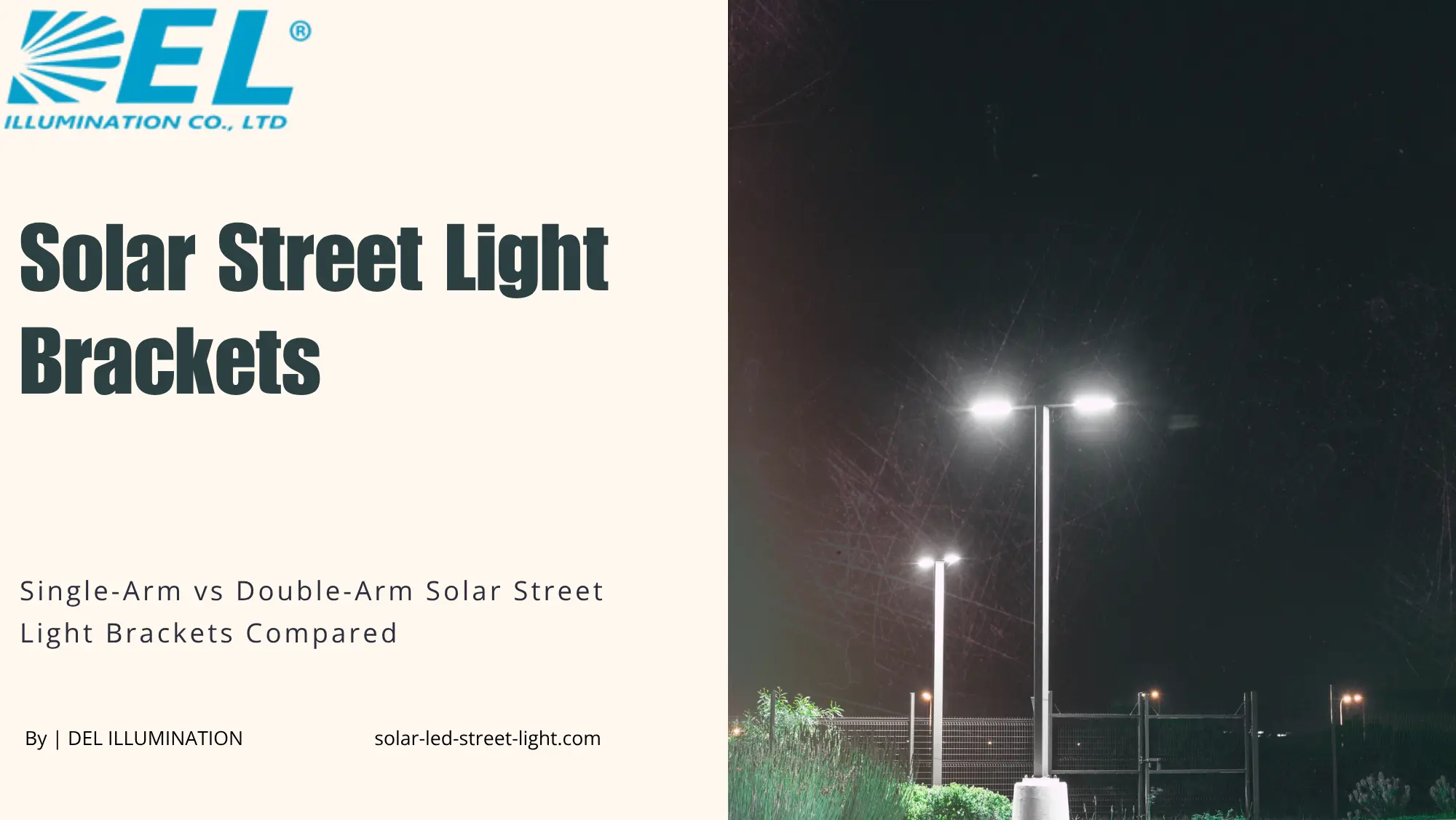
A double arm solar street light bracket extends two arms from the pole, positioned symmetrically 180 degrees apart on opposite sides. Each arm supports an independent LED fixture, meaning one pole delivers two illumination points simultaneously one projecting across each carriageway of a two way road. The double arm configuration uses the same Q235 steel fabrication as single arm brackets but requires careful structural design to ensure that the additional bending moment from two cantilevered arm loads combined with two LED fixture wind loads does not exceed the pole’s rated structural capacity.
Both bracket configurations in quality solar street light systems are surface treated with hot dip galvanising immersion in molten zinc at approximately 500°C to create a metallurgical zinc iron bond and powder coated as a secondary protective layer. The anti corrosion requirements for outdoor structural components like brackets are the same as for poles: minimum 70µm zinc coating thickness in German engineered specifications, with independent verification. For further context on how pole and bracket corrosion affects long term system performance, see our guide on solar street light pole rusting prevention and maintenance.
Structural Engineering: Load Calculations and Wind Resistance
The most technically demanding aspect of the single arm vs double arm solar street light bracket comparison is structural engineering specifically the calculation of wind loads on the bracket fixture assembly and the resulting bending moment at the pole bracket junction.
For a single arm bracket, the effective projected area (EPA) facing wind forces comprises the arm itself plus the LED fixture. At a wind speed of 150 km/h (the survival wind speed specified for coastal and hurricane prone zones), a 60W LED fixture with a projected area of 0.08m² generates a wind force of approximately 150–200N at the fixture mounting point. This force creates a bending moment at the bracket pole junction that the pole must be designed to accommodate within its rated flexural strength 215 MPa for Q235 steel (the standard structural steel for solar street light poles globally).
For a double arm bracket, the structural loading is more complex. Two fixtures on opposing arms create two simultaneous wind loads, but because they act in opposing directions when wind strikes the pole at 90 degrees to the arm axis, the net bending moment from the fixtures may partially cancel. However, when wind strikes parallel to the arm axis, both fixtures generate additive drag loads on the same structural axis. The critical load case for double arm bracket design is therefore the parallel wind condition both fixture wind loads acting simultaneously in the same direction. German engineering specifications for double arm brackets require the pole to be designed for this worst case loading condition and validated at survival wind speed, typically 150 km/h or higher in coastal and typhoon belt deployments.
The solar panel bracket creates a third structural consideration. In split type solar street light systems where the panel is mounted on a separate arm above the fixtures, the panel’s large surface area (typically 0.5–1.2m² for systems in the 60–120W range) creates significantly larger wind loads than the LED fixture itself. Industry specifications require solar panel brackets to handle wind pressures of at least 3,000 Pa equivalent to approximately 155 km/h wind speed to maintain system stability. For double arm solar street light configurations in high wind environments such as coastal highways, ports, or industrial zones, a structural engineer’s sign off on the combined bracket loading is advisable before specification. For guidance on pole and bracket selection for these applications, our resource on solar street lights for highways covers the structural and photometric requirements in detail.
Lighting Performance: Road Width, Lux Levels, and Uniformity
The most immediately practical difference between single arm and double arm configurations is their effect on road surface illuminance and uniformity the metrics that determine whether a solar street light installation complies with the applicable road lighting standard (EN 13201 in Europe, CIE 115, or equivalent national standards).
A single arm solar street light bracket is optimised for single side or staggered arrangement on roads up to approximately 9 metres wide. At a standard mounting height of 6–8 metres with a 1.5–2.0 metre arm overhang, a single arm fixture with Type II or Type III photometric distribution can achieve the required average horizontal illuminance (typically 10–30 lux depending on road classification) and uniformity ratio (U ≥ 0.25–0.40) for residential and collector roads. The industry standard guidance for pole spacing in single side arrangements is S/H ≤ 3.0 (pole spacing to mounting height ratio), meaning an 8 metre pole should not be spaced more than 24 metres apart in single side arrangement to maintain compliant uniformity. On narrower roads of 4–6 metres width, single arm configurations consistently achieve EN 13201 compliance with less engineering complexity.
A double arm solar street light bracket delivers measurably better uniformity on wider roads two way roads of 9–14 metres or more, intersections, highway medians, and large open areas such as industrial parks, sports grounds, and port access roads. Two fixtures on opposing arms from a single central pole produce symmetric illumination on both carriageways simultaneously, reducing the number of poles required per kilometre of road compared to single arm arrangements and proportionally reducing capital cost for large scale deployments.
The uniformity advantage of double arm configurations is quantifiable: a double arm pole with two 60W LED fixtures (combined output 14,000–18,000 lumens for quality systems at 160 lm/W) achieves significantly better Emin/Eavg uniformity ratios on wide roads than a single arm fixture of equivalent total lumen output. This is because the two opposing light sources eliminate the directional bias inherent in a single arm arrangement, where the near side of the road is over illuminated relative to the far side.
For photometric verification before procurement finalisation, DIALux simulation is the standard professional tool allowing engineers to model the exact lux distribution, uniformity ratio, and glare index for the proposed bracket configuration, fixture type, and pole spacing before a single unit is purchased. For a comprehensive guide to using DIALux for solar street light projects, our article on DIALux solar street light simulation covers the methodology in full.
Application Matrix: Which Configuration for Which Project?
The selection between single arm and double arm solar street light brackets should be driven by a structured decision matrix based on road geometry, traffic volume, lighting standard requirements, and project budget.
Single arm brackets are the correct specification for:
- Residential and local roads up to 9 metres wide
- Rural roads, village paths, and agricultural access tracks
- Footpaths, cycle paths, and pedestrian walkways
- Single carriageway routes with staggered or single side pole arrangement
- School zones, park pathways, and residential colony roads
- Any application where minimising unit cost and installation weight are priorities
Double arm brackets are the correct specification for:
- Two way arterial roads and collector roads 9–14 metres wide or wider
- Intersections where two directional illumination from a single pole is required
- Highway median installations where poles serve both carriageways simultaneously
- Industrial park perimeters and logistics zone access roads
- Sports grounds, toll plazas, and port access roads where broad uniform coverage is required
- Large open areas parking lots, bus depots where symmetrical coverage from centrally placed poles reduces total pole count
Real world cost analysis consistently shows that double arm configurations on two way roads wider than 9 metres reduce the total number of poles per kilometre by 30–40% compared to single arm staggered arrangements providing equivalent lighting performance. This pole count reduction offsets the higher per unit bracket cost and can deliver lower total capital cost per kilometre despite the higher fixture hardware cost. For applications where the pole count reduction is significant such as large industrial park or highway deployments this calculation should be verified through a formal cost per kilometre analysis. Our resource on total cost of ownership for EPC projects provides the lifecycle costing framework for this type of analysis. For specific deployment contexts, our application specific guides on solar street lights for industrial parks, solar street lights for sports grounds, and solar street lights for toll plazas provide further context.
Quality Specification: German Engineered vs Generic Brackets
The quality gap between German engineered and generic solar street light brackets is most apparent in two areas: weld integrity and corrosion protection.
Generic brackets manufactured to minimum price points rather than verified engineering standards frequently show weld seam defects including porosity, undercut, and non uniform penetration that are invisible on the surface but reduce the bracket’s resistance to fatigue under cyclic wind loading. Over a 10–15 year operational life in which the bracket is subjected to millions of wind load cycles, these weld defects propagate as micro cracks that eventually cause structural failure sometimes without any visible surface warning. German engineered brackets are fabricated using automatic submerged arc welding, inspected against GB/T3323 1989 Class III radiographic standards, and subject to dimensional verification with flatness tolerances of ±1mm across the full weld length.
Corrosion protection in generic brackets often consists of standard atmospheric spray painting rather than hot dip galvanising. Paint coatings on steel brackets are subject to chipping, cracking, and UV degradation exposing bare steel to corrosion within 2–5 years in outdoor environments. Hot dip galvanising, as used in German engineered bracket specifications, creates a zinc iron metallurgical bond that cannot peel or chip and provides sacrificial cathodic protection even when the surface is mechanically abraded.
For EPC contractors managing warranty obligations and procurement officers responsible for infrastructure longevity, the bracket specification is not a peripheral detail it is a primary determinant of whether the installation requires intervention within 3–5 years or performs within specification across its full 20–30 year design life. For a broader comparison of how German engineered quality translates across all solar street light system components, see our dedicated analysis on German engineering vs generic solar street lights.
Conclusion
The choice between a single arm and double arm solar street light bracket is fundamentally an engineering decision not a cost or aesthetic one. Single arm brackets are the correct specification for roads up to 9 metres wide, single carriageway applications, residential colonies, rural roads, and any project where pole count and installation weight should be minimised. Double arm brackets deliver the correct solution for roads wider than 9 metres, two way arterials, intersections, highways, and large open areas where symmetric illumination from a reduced number of central poles reduces both capital cost per kilometre and ongoing maintenance scope.
The three most important takeaways for procurement decision makers are: first, always validate bracket selection against the photometric requirement use DIALux or equivalent simulation to confirm that the configuration, fixture, and spacing achieve the required lux and uniformity before specifying; second, require hot dip galvanising to a minimum 70µm zinc thickness for all brackets, and verify this against an independent inspection report rather than a manufacturer’s self declaration; and third, evaluate total cost per kilometre rather than per unit bracket cost double arm configurations on wide roads frequently deliver lower total project cost despite higher hardware cost per pole.
Ready to specify the right bracket configuration for your solar street light project? Visit solar led street light.com to consult with our engineering team or request a customised photometric layout and project quote.
FAQ
1. Can a single arm solar street light bracket be used on a wide two way road? A single arm bracket can be used on a wide two way road only if the poles are arranged in a staggered or opposing configuration on both sides of the road with poles on alternate sides spaced closely enough to maintain compliant uniformity across the full road width. The industry standard for single side arrangement is a spacing to height ratio (S/H) of ≤3.0, meaning an 8 metre pole should not be spaced more than 24 metres apart. On roads wider than 9 metres, maintaining this ratio with single arm fixtures on both sides typically requires more poles per kilometre than a centre median double arm arrangement increasing total capital cost. A DIALux simulation for your specific road geometry will confirm the minimum configuration required. Our guide on DIALux luminaire spacing optimisation for EPC projects covers this calculation in detail.
2. What is the maximum wind speed a standard solar street light bracket must withstand? Industry specifications for solar street light poles and brackets typically require a survival wind speed of 120–150 km/h for standard urban applications, with 150 km/h or higher required for coastal, typhoon belt, and hurricane prone installations. Solar panel brackets specifically must handle wind pressures of at least 3,000 Pa equivalent to approximately 155 km/h to maintain system stability under the worst case loading condition. For double arm configurations in high wind environments, the critical load case is wind striking parallel to the arm axis, where both fixture wind loads act additively. German engineered systems are designed and verified against this worst case condition, with pole and bracket structural calculations validated against Q235 steel’s rated flexural strength of 215 MPa.
3. Do double arm brackets require a larger pole foundation than single arm brackets? Yes a double arm bracket applies greater bending moment to the pole base than a single arm bracket, particularly in the parallel wind load case. This increased loading transfers to the pole foundation, which must be sized accordingly. In practice, for poles up to 8 metres with standard arm overhangs in typical urban environments, the foundation sizing difference between single and double arm configurations is modest. For poles above 8 metres, poles in high wind environments, or double arm configurations with larger (80–120W) fixtures, an engineered foundation design is advisable. Most professional solar street light manufacturers provide pole structural calculations on request that specify the required footing dimensions for both bracket configurations.
4. Can I replace a single arm bracket with a double arm bracket on an existing pole? In principle, yes provided the existing pole’s structural capacity accommodates the additional loading of the second arm and fixture. However, retrofitting a double arm bracket onto a pole designed for single arm loading requires a structural assessment of the pole’s rated capacity and the existing foundation’s bearing capacity. Generic poles without verified structural documentation should not have double arm brackets retrofitted without independent engineering sign off. German engineered poles supplied with full structural calculations make this assessment straightforward. If your existing installation is experiencing performance issues that a bracket upgrade might address, our troubleshooting resource on 5 advantages of solar light pole systems covers structural and system level considerations.
5. How does the bracket arm length affect solar street light performance? Bracket arm length the horizontal distance from the pole centreline to the fixture mounting point determines the lateral offset of the LED fixture above the road. A longer arm (1.5–2.5 metres) positions the fixture closer to the road centreline, improving coverage of the far lane on wide roads and allowing Type II distribution optics to be used rather than the wider Type III distribution required when the fixture is closer to the road edge. However, longer arms increase the bending moment at the bracket pole junction and require more robust bracket wall thickness and weld specification to maintain structural integrity under wind loading. For roads wider than 9 metres, a 1.5–2.0 metre arm extension on a single arm bracket can achieve better centreline coverage without requiring a full double arm configuration though this should always be validated through photometric simulation.
6. What materials are used in quality solar street light brackets and why does it matter? Quality solar street light brackets are fabricated from Q235 low carbon structural steel (yield strength 235 N/mm², flexural strength 215 MPa), formed by single pass bending to ensure weld seam continuity, and inspected using automatic submerged arc welding against radiographic acceptance standards. The surface treatment hot dip galvanising to 70µm minimum zinc coating, plus outdoor grade powder coat provides the metallurgical bond and UV resistant outer barrier needed for 20–30 year outdoor service life. Generic brackets using standard spray paint rather than hot dip galvanising begin surface rust degradation within 2–5 years, with weld line corrosion compromising structural integrity significantly earlier than the pole’s intended design life. This material quality difference invisible at the procurement stage becomes highly visible within the first operational decade.
7. For a school zone or residential colony road, which bracket is recommended? A single arm solar street light bracket is the standard recommendation for school zones and residential colony roads, where road widths are typically 6–8 metres and aesthetic considerations are important alongside lighting performance. Single arm configurations on residential roads achieve EN 13201 Class ME6 compliance (minimum 5 lux average, uniformity U ≥ 0.25) with pole heights of 5–7 metres and spacings of 20–25 metres using quality LED fixtures rated at 30–60W. The lower visual mass of single arm poles is also preferable in residential and educational environments where the street lighting should complement rather than dominate the streetscape. For detailed guidance on school zone and residential colony solar street light specifications, see our resources on solar street lights for school zones and solar street lights for residential colonies.
References
- Leap Pole. (2025). Single Arm Street Lamp Poles vs Double Arm Street Lamp Poles: Comparison of Lighting Effects. https://www.leappole.com/blog/single arm street lamp poles vs double arm street lamp poles comparison of lighting effects/
- CHZ Lighting. (2025). What Are the Solar Street Light Pole Types? https://www.chz lighting.com/blog/what are the solar street light pole types.html
- Leap Pole. (2025). Solar Light Pole Design: Essential Engineering Specifications for 2025. https://www.leappole.com/blog/solar light pole design essential engineering specifications for 2025/
- Infralumin. (2026). Solar Street Light Design for Municipal Roads: A Lumen Planning, Pole Layout, and Battery Autonomy Guide. https://infralumin.com/blogs/solar street light design for municipal roads a lumen planning pole layout and battery autonomy guide
- LUXMAN Light. (2026). Solar Street Light Pole Inspection and Acceptance Standard. https://luxmanlight.com/inspection of solar street light pole/
- RCTraffic. (2025). Light Pole Brackets: Functions and Installation Guide. https://www.rctraffic.com/exhibition news/news/light pole brackets functions and installation guide.html
- ALLTOP Group. (2024). The Difference Between Double Arm Solar Street Light and Single Arm Light. https://www.alltopgroup.com/the difference between double arm solar street light and single arm light where is it suitable for.html
- Rackorapro. (2025). Solar Street Light Installation Process and Safety Standards. https://rackorapro.com/blogs/lights/solar street light installation process and safety standards a comprehensive guide for north america
- Bosunsolar. (2025). Professional Guide: Illuminance, Brightness, and Uniformity Requirements for Solar Street Lights. https://www.bosunsolar.com/news/professional guide illuminance brightness and uniformity requirements for solar street lights/
- Inlux Solar. (2025). LED Solar Street Light Design Guide 2025 Edition. https://luxmanlight.com/led solar street light design guide 2025 edition/
Disclaimer
This article is for informational purposes only and does not constitute professional engineering, installation, or procurement advice. Performance specifications and costs may vary based on project requirements, location, and local regulations. Always consult qualified solar energy professionals and legal advisors before making procurement decisions.
For expert consultation on solar LED street lighting solutions, visit solar led street light.com or contact our team for a customised quote.