
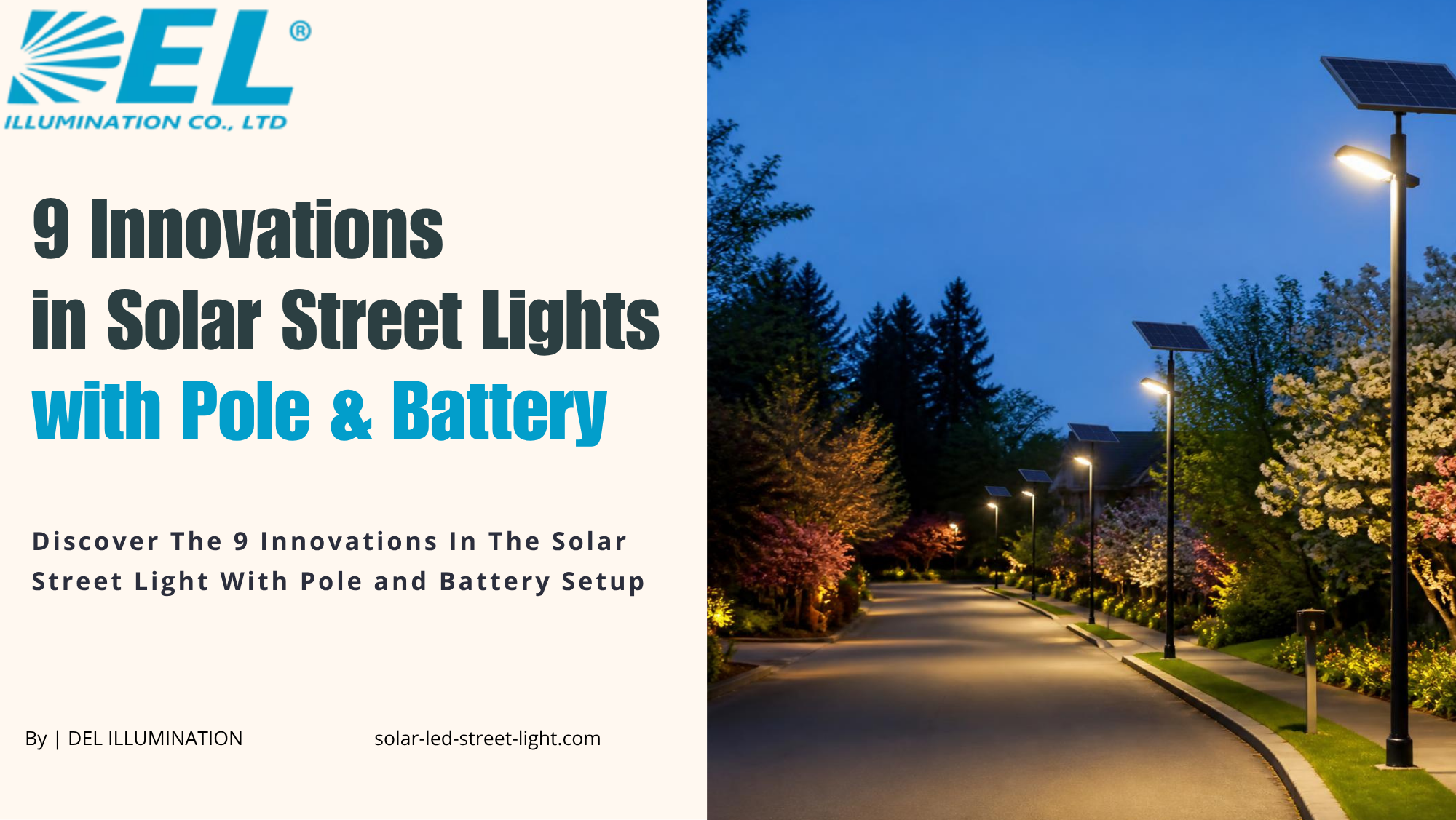
In this technological era, the marriage of renewable energy and urban infrastructure has given rise to a revolutionary solution for illuminating our streets.
A solar street light with pole and battery stands as a testament to sustainable progress, offering an independent and efficient means of lighting our public spaces. Let us dive in and discover the remarkable features that are reshaping how we illuminate our landscapes.
Innovations In The Solar Street Light With Pole And Battery Space
What are some of the innovations that have changed this lighting system over the past few years?
1. High Efficiency Solar Panels
Incorporating high efficiency panels into a solar street light with pole and battery setup amplifies effectiveness in several key ways. These panels use cutting edge photovoltaic technology, allowing them to capture sunlight even in low light conditions such as overcast skies or early mornings. This extended capture window ensures a more consistent power supply.
Moreover, high efficiency panels contribute to a smaller physical footprint, since fewer panels are required to generate the same energy compared to older technology. This saves space and enhances the appearance of the installation.
The reduced panel count also simplifies maintenance, as there are fewer components to inspect and keep clean. Our all in one solar street lights use monocrystalline cells for exactly this reason.
2. Energy Storage And Battery Technology
Traditionally these systems relied on basic battery setups that stored daytime energy for night use. However, those arrangements often faced inefficient energy conversion, limited storage capacity, and rapid degradation. This prompted the need for a more advanced storage solution.
The innovation lies in lithium iron phosphate battery technology designed specifically for solar applications. These high performance packs offer higher energy density, faster charging, and far longer cycle life.
That means they store more energy in a compact form, charge quickly during daylight hours, and endure a significantly greater number of charge and discharge cycles without losing capacity. A modern solar street light with pole and battery can now run eight years or more on its original pack.
3. Smart Energy Management Systems
In a traditional setup, excess energy generated during the day often goes to waste. Smart management systems tackle this by incorporating sophisticated sensors and controllers.
These sensors detect ambient light levels, allowing the system to adjust brightness automatically. When natural light is sufficient, the system dims the fixture, conserving energy without compromising safety.
Adaptive dimming profiles are now standard on any quality solar street light with pole and battery, cutting nightly consumption by up to half while keeping the road safely visible throughout the night.
4. LED Lighting Technology
One of the most notable innovations is the integration of high efficiency LED chips into the solar street light with pole and battery setup. These chips produce intense illumination while consuming minimal energy.
This translates to higher lumen output per watt, resulting in brighter and more efficient lighting for streets, pathways, and public spaces. Visibility and safety improve during nighttime hours without significantly draining the battery reserves.
Advancements in LED thermal management have also improved longevity. Excessive heat degrades LED performance and shortens lifespan, so modern fixtures incorporate engineered heat sinks that dissipate heat effectively. This extends component life and reduces maintenance costs. Our lifespan tips guide covers how thermal design affects real world service years.
5. Remote Monitoring And Control
A key breakthrough is the integration of smart sensors and communication technologies into the solar street light with pole and battery system. These sensors capture real time data on ambient light levels, battery status, and energy consumption, then transmit it wirelessly to a centralized hub.
At the heart of this lies a control hub powered by Internet of Things technology, acting as the command centre for every connected solar street light with pole and battery in a designated area.
Through advanced algorithms it analyses the sensor data, enabling dynamic adjustments to lighting intensity based on conditions. Faults are identified quickly, which reduces downtime and eliminates unnecessary site visits.
6. Modular Design
One notable advancement is the use of easily interchangeable components. Older units were difficult to repair or upgrade because of their tightly integrated structures.
Modular design allows panels, batteries, LED modules, and even pole sections on a solar street light with pole and battery to be replaced individually, minimizing downtime and maintenance costs.
Another groundbreaking aspect is scalability. With the ability to add or remove modules as needed, you can tailor each solar street light with pole and battery to the specific requirements of a site, whether that means extending coverage along a road or adjusting output for different conditions.
7. Aesthetic Design
A solar street light with pole and battery now features components that allow easier customization and adaptation to different environments. Poles can be combined with various fixtures, panels, and storage arrangements to create a visually coherent structure.
Battery systems have also been redesigned to stay unobtrusive. Packs are concealed within the pole base or integrated into the fixture housing, reducing visual clutter.
Smart lighting features have become an integral part of the design process. Fixtures can be programmed to adjust brightness based on ambient light or human presence, so the installation stays discreet by day and effective by night.
8. Solar Tracking Systems
In traditional installations, fixed panels are mounted on top of the poles, capturing sunlight from a single angle. This limits energy generation because the panels cannot adapt to the changing position of the sun.
The breakthrough lies in solar tracking, where mechanisms allow the panels on a solar street light with pole and battery to reorient through the day, staying aligned perpendicular to incoming sunlight.
A pivotal component is the combination of light sensors and motors. The sensors monitor the sun position while the motors adjust panel angle to capture optimal sunlight from dawn to dusk.
9. Wind And Rain Resistance
One key innovation lies in the design of the pole itself. Engineers now build poles from reinforced steel and aluminium alloys that provide greater structural integrity, allowing them to withstand strong winds and adverse weather. The streamlined profile also minimizes wind loading.
Moreover, the panels integrated into a solar street light with pole and battery have been improved to be highly water resistant. Advanced coatings and sealing prevent water ingress that would otherwise compromise efficiency.
An IP66 rating on the fixture and IK08 impact resistance are now the practical benchmark for any outdoor installation. Before ordering, run through our solar lighting project checklist to confirm the environmental ratings match your site conditions.
Conclusion
With ongoing research and development, we can anticipate that these innovations will continue to evolve, further pushing the boundaries of what a solar street light with pole and battery can achieve for our communities and our planet.
Each advance builds on the last, and the systems available today are far more capable than those sold even five years ago. Browse more guides on our solar LED street light blogs hub, or contact us to discuss your requirements.
Frequently Asked Questions
How long does the battery last in a modern system?
A lithium iron phosphate pack typically delivers eight to ten years of service under normal conditions, considerably longer than the lead acid packs used in earlier designs.
Is solar tracking worth the extra cost?
Tracking increases daily energy capture but adds moving parts that require maintenance. For most street lighting projects, a correctly tilted fixed panel is the more practical choice.
Can these systems be monitored remotely?
Yes. Units with Internet of Things connectivity report battery status, energy use, and faults to a central dashboard, so teams can diagnose problems without visiting the site.
What happens during several consecutive cloudy days?
Quality systems are sized for three to five days of autonomy. Smart energy management also lowers output automatically to stretch the remaining charge further.
Are modular components interchangeable between models?
Within a manufacturer range, usually yes. Across brands it varies, so confirm compatibility before ordering replacement modules for an existing installation.