
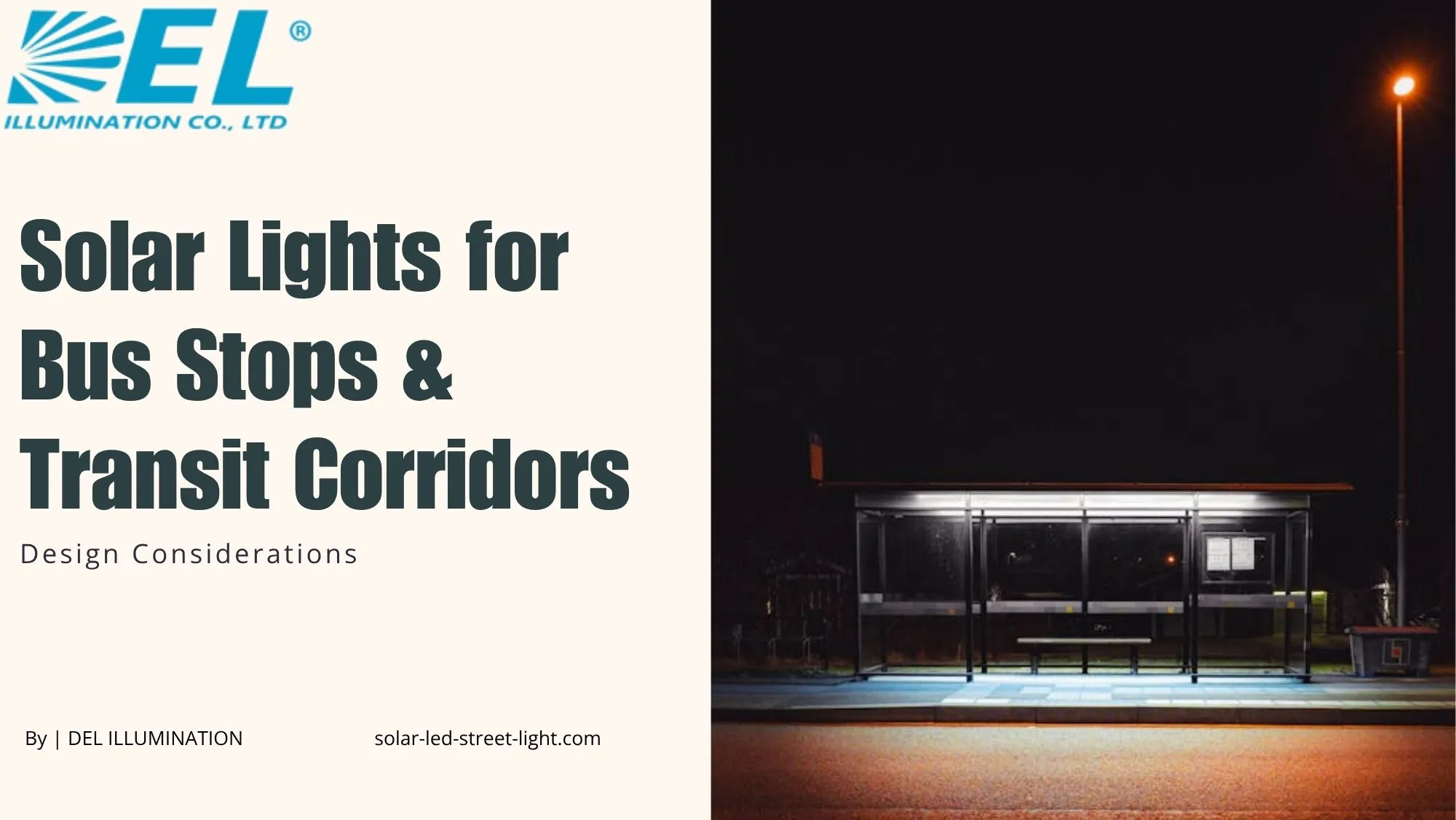
More than one billion public transit journeys take place every single day worldwide – yet a significant proportion of bus stops and transit corridors still lack adequate nighttime lighting. For procurement officers and city planners, this represents more than a comfort issue: inadequately lit transit stops are directly associated with elevated crime rates, passenger deterrence, and increased accident risk. As global solar street lighting deployment surpasses 120 million units and the market accelerates toward an estimated USD 19.57 billion by 2032, decision-makers are recognising solar-powered illumination as the most practical and cost-effective way to close the transit lighting gap – one stop at a time.
This blog examines the key design considerations for solar lights deployed at bus stops and transit corridors, covering illumination standards, system engineering, battery technology, vandal resistance, smart controls, and the long-term financial case for German-engineered solutions.
Why Transit Lighting Is a Safety and Ridership Issue
Poor lighting at bus stops is not merely an inconvenience. Industry research and transit authority data consistently show that well-illuminated transit environments reduce criminal incidents, improve driver visibility, and directly increase passenger confidence after dark. San Diego’s Metropolitan Transit System, which introduced dedicated solar lighting at bus stops as part of a wider infrastructure upgrade, reported a 25% reduction in crime across its system in 2024–2025 – a programme that earned it the Gold Standard Award from the U.S. Department of Homeland Security’s Transportation Security Administration.
The relationship between lighting and ridership is particularly significant for women, elderly passengers, and people with disabilities, all of whom are disproportionately deterred from using public transit after dark when stops are inadequately lit. Well-designed solar lights for bus stops eliminate dark corners, improve facial recognition at distance, and make approaching vehicles easier to identify – all critical factors in a passenger’s subjective feeling of safety.
Transit corridors present a different but equally important challenge. Long stretches of road connecting stops must maintain consistent luminance uniformity so that drivers can identify pedestrians, cyclists, and transit infrastructure well in advance. Breaks in illumination along a corridor – common where grid extension is cost-prohibitive – create exactly the hazard zones that German-engineered solar LED systems are designed to eliminate.
Illumination Standards for Bus Stops and Transit Corridors
Understanding the lighting requirements that govern transit environments is essential before specifying any solar lighting system. The European standard EN 13201, which defines road lighting performance classes and is referenced across international procurement frameworks including those of the Asian Development Bank and World Bank, establishes pedestrian zone and conflict area requirements under its P and C classification categories. For high-pedestrian-flow bus stop environments, maintained horizontal illuminance targets typically sit between 10–20 lux, while vertical illuminance – critical for face recognition and identification of approaching vehicles – should meet a minimum of 10 lux at 1.5 metres height.
The Caltrans Traffic Operations Manual (2024 edition) recommends 2–3 footcandles (approximately 21–32 lux) at passenger loading and waiting areas, reinforcing the principle that bus stop zones warrant enhanced treatment compared to standard roadway segments. For transit corridors connecting stops, S-class designations under EN 13201 typically require an average maintained luminance of 0.5–1.0 cd/m², depending on traffic mix and pedestrian conflict density.
For German-engineered solar LED street lights, achieving these targets is routine. With LED efficacy of 160–180 lm/W and MPPT charge controllers delivering 25–30% more harvested energy compared to conventional PWM controllers, systems can be precisely sized to deliver the required lux levels across the widest transit stop geometries – including harbour-style docking stations, covered shelters, and open-platform stops – without compromise on backup autonomy.
When specifying solar lighting for transit applications, always request a photometric simulation using software such as DIALux, which allows designers to verify that illuminance distribution meets the applicable standard before procurement. Explore how to approach DIALux luminaire spacing optimisation for EPC projects to understand how spacing calculations translate directly to compliant transit lighting layouts.
System Engineering: Sizing for Transit Environments
Transit stops and corridors impose specific engineering demands that differ from standard roadway lighting. Planners must account for:
- Extended operating hours. Many bus networks operate from 05:00 to midnight or beyond – up to 19 hours of required lighting in winter months at higher latitudes. Systems must be sized for worst-case consecutive cloudy days with a minimum of 3–5 backup days of autonomy at medium dimming.
- Variable geometry. Harbour-style docking bays, sheltered platforms, and open kerb stops each have different pole placement constraints. Pole heights typically range from 5 to 8 metres for stop zones and 8 to 12 metres for corridor sections.
- High ambient temperature operation. Covered bus shelters in tropical and desert climates can elevate ambient temperatures significantly. German-engineered die-cast aluminium housings maintain LED junction temperatures at or below 85°C even when ambient air reaches 50°C – a critical distinction from plastic-housed generic units where junction temperatures routinely exceed 100°C, accelerating lumen depreciation.
- Panel orientation and shading. Urban transit corridors often feature overhead obstructions from trees, elevated structures, or adjacent buildings. Monocrystalline panels rated at 21–23% efficiency lose less output under partial shading compared to polycrystalline alternatives at 15–17% – a meaningful advantage in dense urban environments.
Correctly sizing the photovoltaic panel and LiFePO4 battery pack is the most critical engineering step. For a typical 30W LED luminaire operating at 8 hours per night at full power, transitioning to 30% adaptive dimming for the remaining nighttime hours, a properly engineered system requires approximately 80–100W of panel capacity and a battery pack with at least 200–250 Wh capacity at the installation latitude. Systems designed around these parameters achieve 3–5 nights of backup in most climates.
For a deeper understanding of how distance and spacing calculations affect transit lighting coverage, refer to the guide on calculating the distance between LED solar area lights.
Battery Technology and Reliability in Transit Applications
No design consideration is more consequential for transit lighting continuity than battery chemistry. Bus stop solar lights must operate reliably through seasons, power outages, and extended periods of reduced insolation – circumstances where inferior battery technology consistently fails.
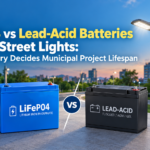
LiFePO4 (lithium iron phosphate) batteries, the standard chemistry specified in German-engineered solar street lights, deliver 2,000–3,000 charge-discharge cycles and a calendar life of 8–12 years. This is categorically different from lead-acid alternatives (300–500 cycles, 2–4 years), which are still found in many generic systems purchased on upfront price alone. For transit applications where battery replacement requires specialist maintenance teams, traffic management, and potentially traffic interruption at busy stops, the total cost difference across a 10-year operational period is substantial.
LiFePO4 chemistry also maintains stable discharge curves across a wider temperature range, making it the preferred choice for transit corridors in extreme climates – from Southeast Asia’s monsoon humidity to the Middle East’s summer heat. Facilities managers procuring for solar street lights for Middle East climates will particularly recognise the temperature stability argument, as thermal degradation of conventional batteries is one of the primary causes of premature system failure in these regions.
The comparison is direct: over a 10-year project lifecycle, a German-engineered system with a single battery pack meeting its warranted 8–12 year lifespan incurs near-zero battery replacement cost, while a generic system requiring two or three lead-acid replacements in the same period generates 2–3 times higher total maintenance expenditure – before accounting for the disruption costs of repeated stop closures.
Vandal Resistance and Durability at Transit Stops
Bus stops are among the highest-risk environments for outdoor luminaire damage. Vandalism, accidental mechanical impact from buses, and deliberate tampering are all documented challenges for transit lighting management teams. Specifying adequate physical protection ratings is therefore not optional – it is a core design requirement.
For solar lights at bus stops, the minimum impact protection rating should be IK08 (able to withstand a 5-joule impact), while stops in known high-vandalism urban areas should specify IK10 (20-joule rated). German-engineered systems meeting IK08 or above pair this mechanical robustness with IP67 ingress protection – independently verified by accredited testing laboratories – ensuring that dust and water cannot compromise electronics even in the most demanding wash-down or flooding conditions. Generic alternatives frequently claim IP65 through self-declaration, without independent laboratory verification.
Die-cast aluminium housing also plays a dual role: it provides the structural integrity to resist mechanical impacts while simultaneously acting as a passive heat sink that manages LED thermal performance. Polycarbonate-glazed LED modules with UV-stabilised diffusers prevent yellowing in harsh solar environments, maintaining optical output throughout the rated 50,000-hour LED lifetime.
Transit authorities undertaking large-scale stop upgrades should also consider pole specifications. Galvanised steel poles rated to AASHTO wind load standards, or equivalent national engineering norms, ensure that the entire system – not just the luminaire – is designed for the long term. The broader discussion of solar light pole systems explores pole selection considerations that apply equally to transit corridor deployments.
Smart Controls and Adaptive Dimming for Transit Corridors
Modern transit lighting extends well beyond static illumination. Adaptive dimming systems – controlled by MPPT charge controllers integrated with motion sensors and programmable schedules – allow solar lights to operate at 100% output during peak passenger hours, reduce to 30–50% during low-traffic periods, and return to full brightness when motion triggers are activated.
This adaptive approach has two direct benefits for transit operators. First, it conserves battery reserves, extending autonomy by up to 40% compared to constant full-power operation – a critical margin in winter months at higher latitudes. Second, it aligns light output with actual passenger presence, meaning that a passenger arriving at a stop at 02:00 triggers full illumination within milliseconds, while reducing light pollution and energy consumption when the stop is unoccupied.
Remote monitoring capabilities – increasingly standard on German-engineered systems – allow facility managers to receive real-time performance data on individual luminaires across an entire transit network. Fault alerts, battery state-of-health reporting, and scheduled dimming profile adjustments can all be managed from a central operations dashboard without requiring site visits. For transit networks spanning hundreds or thousands of stops, this remote management capability delivers significant operational savings. Explore how solar light remote control technology creates measurable maintenance efficiencies across large transit portfolios.
From a procurement perspective, transit projects financed through multilateral lenders such as the ADB or World Bank increasingly specify smart control capability as a tender requirement. Understanding ADB and World Bank solar street light procurement frameworks for 2026 helps EPC contractors align product specifications with financier expectations from the outset.
Conclusion
Solar lights for bus stops and transit corridors sit at the intersection of public safety, infrastructure economics, and sustainable urban development. The design considerations covered in this blog – illumination standards, system sizing, LiFePO4 battery chemistry, vandal resistance, and smart adaptive controls – form a coherent engineering framework that procurement officers, city planners, and EPC contractors must evaluate together, not in isolation.
The data is clear: German-engineered solar LED systems, with monocrystalline panels at 21–23% efficiency, LED efficacy of 160–180 lm/W, independently verified IP67 protection, IK08-or-above impact ratings, and LiFePO4 batteries warranted for 8–12 years, deliver measurably superior performance and significantly lower 10-year total cost of ownership compared to generic alternatives. For transit authorities managing hundreds of stops across diverse climatic and operational conditions, this engineering margin is not a premium – it is a procurement necessity.
Ready to specify solar lighting for your bus stop or transit corridor project? Visit solar-led-street-light.com to consult with our engineering team, request a customised photometric study, or obtain a project-specific quotation. Our German-engineered solutions are specified to meet EN 13201, IEC, and major international procurement standards – backed by comprehensive 5–7 year warranties and full performance guarantees.
Frequently Asked Questions
1. What lux level is required for solar lighting at bus stops?
Internationally recognised standards such as EN 13201 and the Caltrans Traffic Operations Manual (2024) recommend maintained horizontal illuminance of 21–32 lux (2–3 footcandles) at passenger waiting and loading areas, with vertical illuminance of at least 10 lux at 1.5 metres height to support facial recognition. German-engineered solar LED systems can consistently achieve these targets with correctly sized panels and photometrically optimised optics verified through DIALux simulation.
2. How many backup days should a bus stop solar light provide?
A minimum of 3 consecutive cloudy days of full-night operation is the baseline for transit applications in most climates. In regions with extended monsoon seasons or high-latitude winters – where solar irradiance may be significantly reduced for weeks – 5–7 days of backup autonomy is the recommended specification. LiFePO4 batteries with MPPT charge controllers achieve this at far lower long-term cost than lead-acid alternatives.
3. Are solar lights suitable for covered bus shelters where the panel may be shaded?
Yes, but panel placement requires careful engineering. For sheltered stops, the solar panel is typically mounted on a separate arm extended above or beside the shelter canopy, or on an adjacent pole, to ensure unobstructed solar access. Monocrystalline panels at 21–23% efficiency perform better under partial shade conditions than polycrystalline alternatives, making them the preferred choice for constrained urban shelter geometries.
4. What impact rating should I specify for bus stop solar lights?
IK08 (5-joule impact resistance) is the minimum recommended rating for standard transit stop environments. Stops in high-density urban areas with documented vandalism history should specify IK10 (20-joule rated). The housing material matters equally: die-cast aluminium provides superior resistance to both impact and thermal stress compared to thin-gauge metals or plastic composites used in generic luminaires.
5. Can solar transit lighting be integrated with CCTV cameras or emergency call points?
Yes. Modern solar power assemblies for transit stops can be designed with sufficient capacity to power not only the LED luminaire but also CCTV cameras, emergency call buttons, USB charging points, and digital passenger information displays. Each additional load must be factored into the system energy budget during the design phase, with panel and battery capacity sized accordingly. This integration is increasingly common in smart city transit infrastructure deployments.
6. How does adaptive dimming affect passenger safety at transit stops?
Adaptive dimming is designed to preserve battery reserves during low-traffic periods while ensuring full illuminance whenever a passenger is present. Motion sensors – typically PIR (passive infrared) rated for transit environments – detect passenger arrival within seconds and restore 100% light output immediately. Between activations, the system may reduce to 30–50% output. This behaviour is transparent to waiting passengers and does not compromise safety at the moment of passenger presence.
7. What certifications should I require when procuring solar lights for a transit corridor project?
At minimum, procurement specifications should require: TÜV or equivalent third-party certification for the LED luminaire and solar panel, ISO 9001 quality management certification for the manufacturer, independent laboratory verification of IP67 and IK08/IK10 ratings, IEC 62133 or equivalent certification for the LiFePO4 battery, and photometric data in IES format for DIALux verification. For ADB- or World Bank-financed projects, additional documentation requirements apply. Review the certification requirements for bankable EPC contracts for a comprehensive compliance checklist.
8. How does the total cost of ownership of solar transit lighting compare to grid-connected alternatives?
Over a 10-year period, German-engineered solar LED systems typically reach grid-parity or better within 3–5 years in locations where grid extension costs exceed USD 10,000–20,000 per kilometre. After payback, operational costs are near-zero – no electricity bills, no transformer maintenance, and a single battery replacement at most over the 10-year horizon with LiFePO4 chemistry. Generic solar alternatives, with lead-acid batteries requiring replacement every 2–4 years, generate 2–3 times higher maintenance expenditure over the same period. For a full lifecycle cost framework, refer to the total cost of ownership analysis for EPC projects.
References
- California Department of Transportation. (2024). Traffic Operations Manual – Chapter 205: Lighting and Sign Illumination Systems. https://dot.ca.gov/-/media/dot-media/programs/traffic-operations/documents/trafficops/202501-ch-205-part-1-roadway-lighting-a11y.pdf
- Fortune Business Insights. (2024). Solar Street Lighting Market Size, Share & Industry Analysis, 2025–2032. https://www.fortunebusinessinsights.com/industry-reports/solar-street-lighting-market-100585
- SNS Insider. (2025). Solar Street Lighting Market Size to Grow USD 43.27 Billion by 2033. https://www.globenewswire.com/news-release/2025/11/28/3195986/0/en/Solar-Street-Lighting-Market-Size-to-Grow-USD-43-27-Billion-by-2033-Research-by-SNS-Insider.html
- DEL Illumination / solar-led-street-light.com. (2026). Road Lighting Standards 2026: EN 13201 And IESNA Guide. https://solar-led-street-light.com/road-lighting-standards-en-13201-iesna/
- APTA – American Public Transportation Association. (2010, updated). Security Lighting for Transit Passenger Facilities (APTA-SS-SIS-RP-001-10). https://www.apta.com/wp-content/uploads/Standards_Documents/APTA-SS-SIS-RP-001-10.pdf
- San Diego Metropolitan Transit System. (2025). MTS Issues Report Showing Crime on Public Transit Down Nearly 25%. https://www.sdmts.com/inside-mts/media-center/news-releases/san-diego-mts-issuing-report-showing-crime-public-transit
- SEPCO Solar Electric Power Company. (2024). The Ultimate Guide to Solar Lighting for Transit Systems. https://www.sepco-solarlighting.com/blog/the-ultimate-guide-to-solar-lighting-for-transit-systems
- Daily Hive / Urbanized. (2025). TransLink Testing New Solar-Powered Lights atop Bus Stop Signs. https://dailyhive.com/vancouver/translink-bus-stop-signs-urban-solar-lights
- MarketsandMarkets. (2026). Solar Lighting System Market – Global Forecast to 2034. https://www.marketsandmarkets.com/Market-Reports/solar-lighting-system-market-207347790.html
- BEGA Lighting. (2024). Maintained Illuminance According to DIN EN 13201. https://www.bega.com/en/knowledge/lighting-theory/reference-values-for-illumination/maintained-illuminance-according-to-dinen13201/
Disclaimer
This article is for informational purposes only and does not constitute professional engineering, installation, or procurement advice. Performance specifications and costs may vary based on project requirements, location, and local regulations. Always consult qualified solar energy professionals and legal advisors before making procurement decisions.
For expert consultation on solar LED street lighting solutions, visit solar-led-street-light.com or contact our team for a customised quote.