
Every school day, millions of children walk, cycle, and wait at roadsides where visibility and driver behaviour determine whether they arrive home safely. According to the U.S. National Highway Traffic Safety Administration (NHTSA), in 2024 alone, 7,080 pedestrians were killed and more than 71,000 were injured nationwide – a sobering figure that underscores how much the physical environment around schools matters. A 2024 National Center for Education Statistics survey found that 38% of school leaders consider traffic patterns around their campuses a direct threat to student safety. Yet one of the most cost-effective, grid-independent tools available to city planners and facility managers – solar LED street lighting – remains systematically underdeployed in solar street lights for school zones globally.
This blog examines why properly engineered solar street lights are not just an energy-saving measure but a compliance-critical safety infrastructure for school zones. We cover the lighting standards that apply, the technical specifications that matter, how German-engineered systems outperform generic alternatives, and what the full financial case looks like for municipalities, EPC contractors, and procurement officers.
Why Lighting Is a Non-Negotiable School Zone Safety Factor
The link between inadequate lighting and pedestrian injury is well-documented. A child struck by a vehicle travelling at 50 km/h has a dramatically lower chance of survival than one struck at 30 km/h – and driver reaction time at night is fundamentally constrained by how far ahead hazards become visible. Industry research consistently shows that the majority of vehicle-pedestrian conflicts in school zones occur during early morning arrival and late afternoon departure windows, precisely when seasonal low-light conditions or overcast skies reduce natural visibility.
Inadequate street lighting creates three compounding problems in school zones. First, it reduces driver detection distance for pedestrians crossing or waiting at kerbsides. Second, it impairs a driver’s ability to identify approaching children who may step unexpectedly into the road – a behaviour well-documented among younger age groups whose spatial-cognitive development is still incomplete. Third, poor lighting at crosswalks undermines the effectiveness of road markings, signage, and traffic calming infrastructure that municipalities invest in separately.
Data from Safe Kids Worldwide confirms that one in three drivers engages in unsafe behaviours during school drop-offs. Add low ambient light to the equation and the risk profile escalates substantially. Solar street lights that deliver consistent, standards-compliant illuminance – maintained every night, independent of grid connectivity – directly counter each of these risks. The safety case is not theoretical. It is measurable, quantifiable, and increasingly a procurement requirement in government tender specifications.
Understanding Lighting Standards for School Zones
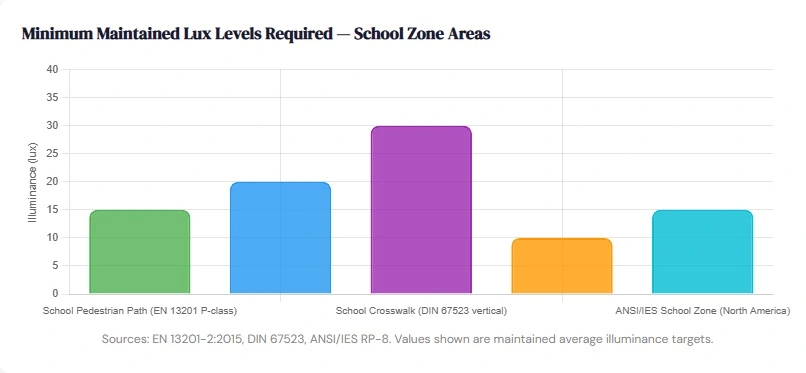
Any procurement officer or EPC contractor specifying street lighting for school zones must work from a defined compliance baseline, not from general brightness assumptions. In Europe and across many international development bank-funded projects, the governing framework is EN 13201, the five-part road lighting standard developed by the European Committee for Standardization. For pedestrian zones – which includes school drop-off areas, footpaths, crosswalks, and mixed-use access roads – EN 13201 defines the P-class (Pedestrian class) and the C-class (Conflict zone class).
For active school zone pedestrian paths, the EN 13201 P-class typically requires a maintained average horizontal illuminance of 15–20 lux, with an overall uniformity ratio (Uo) of at least 0.40. At controlled crossings adjacent to school entrances – where facial recognition and hazard detection are critical – the German standard DIN 67523, referenced under DIN EN 13201, mandates a minimum mean vertical illuminance of 30 lux, with no point in the evaluation field falling below 4 lux. This vertical illuminance requirement is specifically designed to ensure that pedestrians are visible to approaching drivers, not merely that the road surface is lit.
For conflict zones where vehicles and children interact – including school gates, bus drop-off bays, and car park access routes – the C-class illuminance requirements typically fall in the 20–30 lux range with a uniformity ratio of 0.40 or above. Under the ANSI/IES RP-8 standard used in North America, comparable pedestrian conflict areas require 10–20 average maintained lux, with higher values for high-activity urban sites.
Procurement officers should note that compliance is not a one-time installation check. EN 13201-4 mandates on-site performance measurement after installation, and EN 13201-5 adds energy performance indicators. Systems that meet these standards on paper but degrade rapidly in the field – a common issue with generic solar products – create ongoing compliance liability. You can explore the full comparison of applicable global standards in our dedicated guide: street lighting standards comparison.
Technical Specifications That Determine Real-World School Zone Performance
Meeting a lux target on a datasheets is only half the picture. The specifications of the solar system itself determine whether those lux levels are actually delivered, night after night, including during cloudy periods, extreme heat, and the multiple-year operational life of the installation.
Solar panel efficiency is the starting point. German-engineered systems use monocrystalline panels rated at 21–23% conversion efficiency, compared to the 15–17% typical of generic polycrystalline panels. In practical terms, a higher-efficiency panel generates more charge from the same surface area, which is especially significant in regions with shorter winter days or partial cloud cover – exactly the conditions that cause generic systems to fail.
LED efficacy determines how much usable light a given watt of stored energy produces. High-quality German-engineered LED modules achieve 160–180 lumens per watt (lm/W), compared to 100–120 lm/W in generic alternatives. At a school zone wattage of, say, 60W, the difference translates to 9,600–10,800 lumens (German-engineered) versus 6,000–7,200 lumens (generic) – a gap that determines whether a 30 lux crosswalk target is met or missed.
Battery chemistry is where the most critical long-term performance differences emerge. German-engineered systems specify lithium iron phosphate (LiFePO4) batteries, rated for 2,000–3,000 charge cycles and a calendar life of 8–12 years. Generic systems typically ship with lead-acid or unspecified lithium cells rated for just 300–500 cycles and a 2–4 year calendar life. A school zone installation is expected to operate for 10+ years; a generic battery system will require full replacement at least twice within that period, driving total cost of ownership (TCO) far above its initial price advantage.
Charge controllers matter more than most procurement briefs acknowledge. Maximum Power Point Tracking (MPPT) controllers – standard in German-engineered systems – capture 25–30% more energy from the same solar panel compared to the Pulse Width Modulation (PWM) controllers found in generic systems. In a school zone with a backup autonomy requirement of 3–7 consecutive cloudy days, that efficiency gap can be the difference between a light that stays on and one that goes dark exactly when students need it most.
IP and IK ratings complete the durability picture. A minimum of IP67 (fully dust-tight and submersion-resistant to 1 metre) is required for school zone installations in any climate. IK08 impact resistance ensures the luminaire housing can withstand physical contact – an important consideration near play areas and bus drop-off zones. Generic products frequently self-declare IP65 without independent laboratory verification, which leaves procurement officers exposed to post-installation warranty disputes. Refer to our analysis of 5 benefits of IP65 solar street lights for a broader context on why verified ingress ratings matter.
Smart Control and Adaptive Lighting in School Zones
Modern solar street lights for school zones should not operate at a fixed output throughout the night. Smart dimming and remote control technology allows lighting systems to be programmed with time-based or motion-triggered profiles, delivering full output during peak pedestrian hours – typically 06:30–08:30 and 15:00–18:00 – and reducing to 30–50% during off-peak hours. This adaptive approach delivers three simultaneous benefits: it extends battery life, reduces light pollution during low-traffic hours, and allows the system to be sized more accurately, reducing capital cost.
Remote monitoring capability – increasingly standard in German-engineered systems – allows facility managers to receive real-time status reports, fault alerts, and energy consumption data for each luminaire in a school zone network. This eliminates the reliance on reactive maintenance, where a failed light may go unreported for days and a school zone operates below its compliance threshold without the responsible authority being aware. For procurement officers specifying systems under FIDIC EPC contract structures, remote monitoring data also provides the performance documentation required for contract compliance sign-off. Learn more about FIDIC EPC contract requirements for solar projects at fidic-epc-contract-solar-street-light.
The Colour Rendering Index (CRI) of school zone luminaires is a technical specification that rarely appears prominently in generic product brochures but is critical for child pedestrian safety. EN 13201 guidance recommends a minimum CRI of 70 for pedestrian areas where facial recognition at short distances is relevant; a CRI of 80 or above, which is standard in quality LED modules, delivers meaningfully better object contrast and colour differentiation, helping drivers distinguish children in varied clothing colours under artificial light. A junction temperature specification is equally important: at an ambient temperature of 50°C, German-engineered die-cast aluminium housings maintain LED junction temperatures at or below 85°C, preserving lumen output and rated life. Generic plastic or thin-metal housings at the same ambient temperature allow junction temperatures to exceed 100°C, accelerating lumen depreciation and shortening the effective rated life from 50,000 hours to 20,000–30,000 hours in practice.
For a detailed guide on calculating pole spacing and light distribution for campus and school environments, see our luminaire spacing optimisation guide for EPC projects.
Total Cost of Ownership: The 10-Year Financial Case for Schools and Municipalities
City planners and procurement officers are under pressure to justify every infrastructure decision against tight budgets. The instinct to accept the lowest tender price is understandable, but in solar street lighting for school zones, upfront cost comparisons systematically understate the true financial risk of generic systems.
A grid-connected street light in a school zone incurs ongoing electricity costs of approximately $150–$250 per luminaire per year in utility bills alone, with additional maintenance costs of $50–$100 per unit annually for bulb replacement and servicing. Across a typical school zone deployment of 20–30 luminaires, this translates to $4,000–$10,500 per year in operational costs that disappear entirely with properly specified solar systems.
The installation cost comparison is equally significant. Grid-tied systems require civil trenching, underground cabling, and connection to the grid – costs that can add $500–$2,000 per luminaire depending on the distance from the nearest supply point. Solar street lights, being self-contained autonomous units, eliminate these infrastructure costs entirely. Industry data from multiple municipal deployments confirms that municipalities can achieve up to 75% savings on combined installation and lifetime maintenance costs by switching to solar.
For German-engineered systems with LiFePO4 batteries rated for 8–12 years, the 10-year total cost of ownership (TCO) analysis is particularly favourable. A project that requires two generic battery replacement cycles within 10 years – each representing 60–80% of the original hardware cost – will significantly exceed the TCO of a premium system that operates without major intervention throughout the same period. A detailed model of how this calculation works in practice is available at our total cost of ownership for EPC projects page.
Where applicable, solar street light installations for school zones may qualify for renewable energy incentives, green infrastructure grants, or development bank financing – particularly in markets receiving Asian Development Bank or World Bank-funded programmes. Understanding procurement criteria for these funding streams can significantly improve the financial case. Our guide to ADB and World Bank solar street light procurement in 2026 is an essential reference for public sector decision-makers.
Conclusion
Solar street lights for school zones are not a niche infrastructure upgrade – they are a safety-critical, compliance-driven investment that municipalities, facility managers, and EPC contractors can no longer afford to underspecify. The data is clear: inadequate lighting around schools elevates pedestrian risk, and that risk is quantifiable and preventable. Standards including EN 13201, DIN 67523, and ANSI/IES RP-8 define exactly what performance levels are required, and German-engineered solar systems – combining 21–23% panel efficiency, 160–180 lm/W LED efficacy, LiFePO4 battery chemistry rated for 2,000–3,000 cycles, MPPT charge control, and verified IP67 and IK08 ratings – are the specification tier designed to meet and maintain those standards reliably over a 10+ year operational life.
The financial case is equally compelling. With grid-connected systems imposing $150–$250 per luminaire per year in utility costs, and generic solar systems requiring repeat battery replacement that compounds their TCO, the 10-year ownership advantage of a properly specified German-engineered solar system is substantial. Combine that with the zero-trenching installation benefit and the elimination of ongoing grid dependency, and the procurement decision becomes straightforward.
If you are planning a school zone lighting project – whether a single campus, a city-wide rollout, or a development bank-funded programme – visit solar-led-street-light.com to speak with our engineering team about a customised photometric design, specification review, or project quote.
Frequently Asked Questions
1. What lux level is required for solar street lights in a school zone?
Under EN 13201, pedestrian zones (P-class) in school areas typically require a maintained average horizontal illuminance of 15–20 lux with a uniformity ratio of 0.40 or above. For school crosswalks, DIN 67523 (the German pedestrian crossing lighting standard) requires a mean vertical illuminance of at least 30 lux to ensure adequate facial recognition and driver detection of children. North American projects governed by ANSI/IES RP-8 typically target 10–20 maintained average lux for comparable pedestrian conflict zones.
2. Can solar street lights operate reliably in all weather conditions around schools?
Yes, provided the system is correctly sized. German-engineered solar street lights are designed with 3-7 days of battery backup autonomy to cover consecutive cloudy periods. LiFePO4 batteries maintain reliable performance from -20°C to +60°C, and die-cast aluminium housings with IP67 ratings prevent moisture and dust ingress in rain, fog, and dusty environments. Generic systems with lead-acid batteries or self-declared IP65 ratings are far more vulnerable to weather-related degradation.
3. What certifications should I require when procuring solar street lights for a school zone?
At a minimum, procurement specifications should require TÜV or equivalent third-party certification for the complete system, ISO 9001 quality management certification from the manufacturer, independently verified IP67 ingress protection (not self-declared), IK08 or above impact resistance, and compliance documentation referencing EN 13201 or the applicable national road lighting standard. For development bank-funded projects, refer to our certification requirements for bankable EPC contracts guide.
4. How do smart dimming features benefit school zone installations specifically?
Smart dimming allows the system to run at full output during peak pedestrian hours – typically morning arrival and afternoon departure windows – and reduce to 30–50% during off-peak overnight periods. This extends battery life, allows the solar array and battery to be correctly sized without over-engineering for peak output all night, and supports local light pollution guidelines. Some systems also integrate motion detection, bringing luminaires back to full output when activity is detected outside of programmed peak hours. Explore the full range of benefits in our remote control technology guide.
5. How long does it take for a solar school zone lighting installation to pay back its investment?
Payback periods vary by electricity tariff, installation complexity, and system specification. In most markets, properly specified solar systems for school zones reach full ROI within 3–5 years, after which operational costs are near zero. A municipality deploying 500 solar streetlights can realistically generate over $1.25 million in combined energy and maintenance savings over 10 years, against a net cost of investment after subsidies. See the full methodology at our ROI calculation guide.
6. Are solar street lights suitable for school zones in tropical and desert climates?
Yes. High ambient temperatures are actually where the quality gap between German-engineered and generic systems is most pronounced. German-engineered die-cast aluminium housings maintain LED junction temperatures at or below 85°C even at 50°C ambient, preserving rated luminaire life of 50,000 hours. Generic plastic or thin-metal housings allow junction temperatures to exceed 100°C at the same ambient, dramatically accelerating lumen depreciation. Our guides on solar street lights for Middle East climates and Southeast Asia cover climate-specific specification in detail.
7. What pole height and spacing is recommended for school zone solar street lights? Pole height for school zone pedestrian paths typically ranges from 5–8 metres depending on the road width and required lux level. A height-to-spacing ratio of no more than 3.5:1 is recommended to ensure adequate light overlap and meet EN 13201 uniformity requirements. At school crossings, poles should be positioned to provide vertical illuminance toward approaching drivers, not merely downward illuminance on the road surface. Our DIALux simulation guide explains how photometric modelling can be used to verify compliance before installation.
8. What happens to a solar school zone light during an extended grid outage?
Nothing – because German-engineered solar street lights operate entirely independently of the grid. This is a critical advantage over grid-connected alternatives, which fail during power outages precisely when emergency lighting is needed most. With 3–7 days of LiFePO4 battery backup, properly sized solar lights continue to illuminate school zones throughout extended outages. This off-grid reliability is explored further in our off-grid solar street lighting overview.
References
- National Highway Traffic Safety Administration (NHTSA). (2024). Pedestrian Safety. https://www.nhtsa.gov/road-safety/pedestrian-safety
- National Center for Education Statistics (NCES). (2024–25). School Pulse Survey: Traffic and Safety. https://nces.ed.gov/
- RadarSign. (2025). Protect the Zone: School Zone Safety Guide 2025–2026. https://www.radarsign.com/school-zone-safety-guide-2025-2026/
- European Committee for Standardization. (2015). BS EN 13201-2: Road Lighting – Part 2: Performance Requirements. https://www.en-standard.eu/csn-en-13201-1-4-road-lighting/
- BEGA Lighting. (2024). Maintained Illuminance According to DIN EN 13201. https://www.bega.com/en/knowledge/lighting-theory/reference-values-for-illumination/maintained-illuminance-according-to-dinen13201/
- Safe Routes Info / UNC Highway Safety Research Center. (2025). Update 2025: Safe Routes to School. https://www.saferoutesinfo.org/update-2025/
- solar-led-street-light.com. (2026). Road Lighting Standards 2026: EN 13201 and IESNA Guide. https://solar-led-street-light.com/road-lighting-standards-en-13201-iesna/
- Fonroche Solar Lighting. (2025). How Solar Street Lights Cut Costs for California Municipalities. https://www.fonrochesolarlighting.com/california-solar-street-lighting-cost-savings/
- solar-led-street-light.com. (2025). Step-by-Step ROI Calculation for Solar Streetlights. https://solar-led-street-light.com/blog/roi-calculation-for-solar-streetlights/
- ScienceDirect / Transportation Research Part F. (2025). Safety of Children in School Zones – A Systematic Review. https://www.sciencedirect.com/science/article/abs/pii/S1369847825001846
Disclaimer
This article is for informational purposes only and does not constitute professional engineering, installation, or procurement advice. Performance specifications and costs may vary based on project requirements, location, and local regulations. Always consult qualified solar energy professionals and legal advisors before making procurement decisions.
For expert consultation on solar LED street lighting solutions, visit solar-led-street-light.com or contact our team for a customised quote.