
Every year, billions of dollars flow through World Bank-financed infrastructure projects that include solar panels and solar components. Behind that clean, renewable energy, however, lies a supply chain with a documented and serious problem: a significant and verified risk of forced labor ( World Bank forced labor declaration), concentrated in the upstream production of polysilicon, the foundational raw material of nearly every solar panel on the market today. Approximately 35-50% of the world’s polysilicon originates from the Xinjiang Uyghur Autonomous Region of China, a region where international organizations and investigative bodies have documented coercive labor practices at industrial scale.
For procurement officers, EPC contractors, city planners, and facility managers participating in World Bank-financed projects, this is no longer a background issue. Since January 1, 2022, the World Bank has mandated a structured set of forced labor declarations, qualification requirements, and contractual provisions for all procurements involving solar panels and solar components under its Investment Project Financing (IPF) framework. Non-compliance is not a minor procedural oversight ,it can result in bid disqualification, contract termination, or sanctions by the Bank. This blog breaks down exactly what is required, why it matters, and how ethically sourced solar procurement protects your project.
Why the World Bank Intervened: The Scale of the Supply Chain Risk
To understand why the World Bank introduced mandatory forced labor safeguards, you need to understand where solar panels come from at a molecular level. The production chain moves from raw quartzite mining, through metallurgical-grade silicon smelting, to solar-grade polysilicon production, then into ingots, wafers, solar cells, and finally assembled modules. Every step of this chain ,from mining through wafer production ,is concentrated in regions with documented labor rights concerns.
Industry research estimates that 97% of global wafer manufacturing is conducted in China, and a substantial share of polysilicon originates from Xinjiang. The World Bank’s own procurement framework explicitly acknowledges “a significant risk of forced labor in the global supply chain for solar panels and solar components.” The International Labour Organization (ILO) has long-established conventions ,including Forced Labour Convention No. 29 and the Abolition of Forced Labour Convention No. 105 ,that form the legal basis for these obligations under international public law.
Beyond the human rights dimension, the supply chain risk creates direct procurement risk. The U.S. Uyghur Forced Labor Prevention Act (UFLPA), which took effect in June 2022, establishes a rebuttable presumption that any goods involving Xinjiang inputs were produced with forced labor. U.S. Customs and Border Protection has detained over 12,500 shipments valued at more than $3.68 billion since enforcement began. The EU Forced Labour Regulation introduces parallel restrictions across European markets. Any contractor sourcing components without rigorous supply chain tracing faces real exposure ,not only moral, but legal and financial.
The World Bank’s Four-Part Mandatory Framework
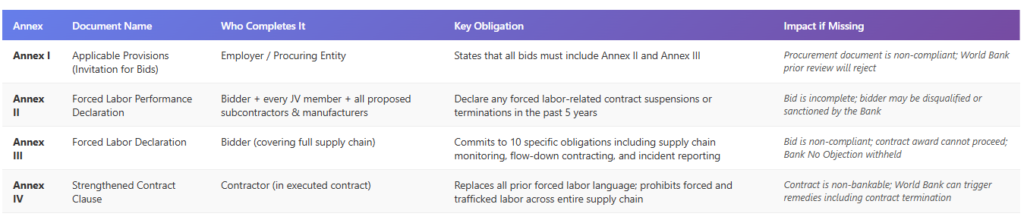
The World Bank’s forced labor provisions are not aspirational language buried in an annex. They are binding, structured, and subject to mandatory prior review by the Bank before procurement proceeds. Effective January 1, 2022, all Investment Project Financing that includes solar panels or solar components for the “core functions of a project” must incorporate four specific elements.
Annex I: Applicable Provisions requires that every invitation for bids explicitly states that all submissions must be accompanied by both a Forced Labor Performance Declaration and a Forced Labor Declaration. These are not optional supporting documents ,they are bid requirements without which a submission is incomplete.
Annex II: Forced Labor Performance Declaration requires every bidder, each member of a joint venture, and every proposed subcontractor, supplier, and manufacturer of solar panels or components to declare whether any of their contracts have been suspended, terminated, or subjected to contractual remedies ,including the calling of performance security ,for forced labor breaches in the past five years. Bidders with such a history must provide evidence of adequate remediation capacity and ongoing commitment to compliance.
Annex III: Forced Labor Declaration goes further. It requires the bidder to commit ,in writing ,to a cascade of obligations covering their entire supply chain. These include: accepting zero forced labor among all workers engaged on the contract; flowing forced labor prohibitions down into contracts with all subcontractors and manufacturers; actively monitoring all subcontractors for compliance; requiring subcontractors to monitor their own upstream suppliers; notifying the Employer immediately of any forced labor incident; and including sufficient forced labor compliance details in all periodic progress reports. Critically, bidders must also identify all proposed subcontractors, suppliers, and manufacturers of solar panels and components, with contact details and links to their corporate websites, prior to contract signing.
Annex IV: Strengthened Contract Clause replaces any prior forced labor language in the contract in its entirety. It defines forced labor broadly ,covering any involuntary or compulsory work including indentured labor, bonded labor, and trafficking in persons ,and establishes the contractor’s ongoing contractual obligation to ensure that no worker at any tier of their supply chain is subjected to it.
All procurements falling within this scope are subject to mandatory Bank prior review, which includes the procurement documents before issue, approval of all proposed subcontractors and manufacturers, and review of any post-award changes to the supply chain.
What Bidders Must Actually Submit: A Practical Checklist
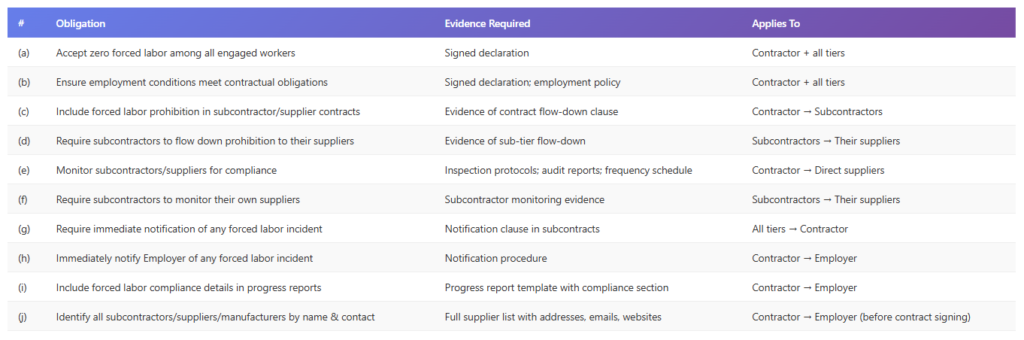
For procurement officers preparing bids on World Bank-financed solar projects, the compliance requirements translate into a concrete documentation exercise. This is where many bidders ,particularly those relying on low-cost, opaque supply chains ,face disqualifying gaps.
At the bid stage, your submission package must include:
- A completed Forced Labor Performance Declaration (Annex II) signed by the authorized representative, covering the bidder entity, every JV member, and every proposed subcontractor and manufacturer in the solar supply chain
- A completed Forced Labor Declaration (Annex III) committing to all ten enumerated obligations, with supporting evidence of how monitoring, inspection, and flow-down contracting is or will be implemented
- For any bidder who has had a forced labor-related contract suspension or termination in the past five years: documentation evidencing adequate remediation
Before contract signing, you must further provide a complete list of all subcontractors, suppliers, and manufacturers of solar panels and components ,names, addresses, primary contacts, email addresses, and website links. If this list was not finalized at bid submission, it must be submitted with documentation of forced labor compliance for each entity before the contract is executed.
During contract execution, you must include forced labor compliance updates in every periodic progress report, immediately notify the Employer of any forced labor incident discovered at any level of the supply chain, and ensure that your own subcontractors maintain the same monitoring and reporting obligations downstream.
For EPC project managers working on World Bank-financed solar infrastructure, this level of supply chain transparency is not bureaucratic overhead ,it is a prerequisite for project bankability. The documentation trail you create through this process is also the same documentation that protects your project from import bans, customs detentions, and reputational harm.
Supply Chain Verification: The Technical Challenge and Practical Solutions
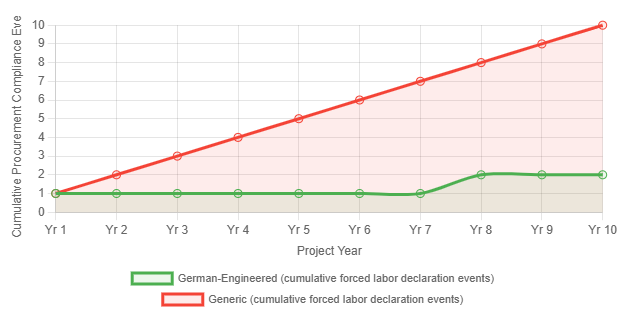
Complying with the World Bank’s declarations is a commitment. Verifying that commitment in practice is the harder challenge. Supply chains for solar panels are long, often opaque, and subject to a specific risk that regulators have termed “supply chain washing” ,where manufacturers route Xinjiang-origin materials through third countries or secondary processing facilities to obscure their geographic origin.
Effective supply chain verification for solar components requires traceability at each of the following tiers: quartzite source mines, metallurgical-grade silicon producers, polysilicon manufacturers, ingot and wafer producers, cell manufacturers, and module assemblers. For each tier, the documentation required under UFLPA guidance ,which parallels the World Bank’s compliance expectations ,includes transaction records, flowcharts mapping each production step to a specific geographic origin, and a list of all entities at each stage.
Third-party auditing has emerged as the primary verification mechanism. Credible audit firms conduct factory-level social compliance audits against internationally recognized standards ,including ILO conventions and the Social Audit Coalition’s frameworks. However, audits alone are insufficient where access to upstream facilities is restricted. This is why leading procurement specifications increasingly require third-party test reports and third-party social compliance documentation rather than self-certified declarations.
German-engineered solar systems ,including the solar LED street light systems designed to German engineering standards ,address this challenge through manufacturing structures that maintain documented, auditable supply chains. When solar components are manufactured under ISO 9001 quality management systems and TÜV-certified processes, the supply chain documentation required for World Bank compliance is a natural output of quality operations, not an after-the-fact reconstruction.
The contrast with generic alternatives is significant. Generic solar components sourced at minimum cost through multi-tier spot markets typically cannot produce the full-tier supply chain documentation the World Bank framework requires. For bidders relying on such sources, the declaration forms become either false declarations ,which expose the signatory to disqualification and sanctions ,or honest admissions of an incomplete supply chain tracing capability that makes qualification impossible.
How German Engineering Standards Align with World Bank Compliance
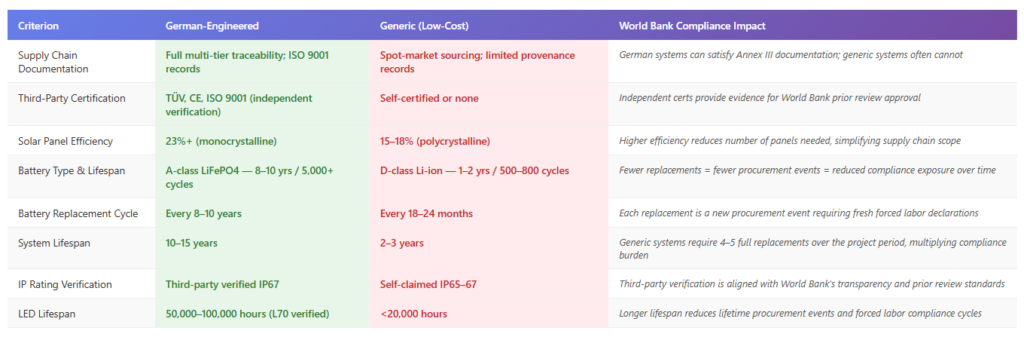
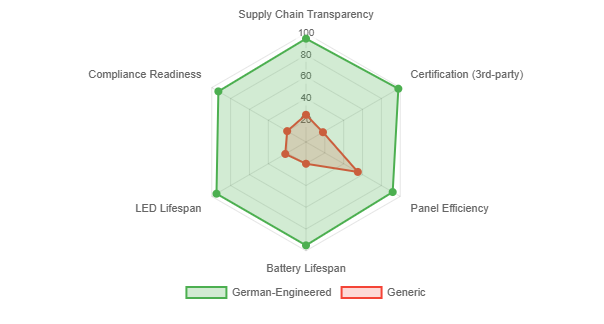
There is a meaningful structural reason why German-engineered solar street lights versus generic alternatives behave differently in World Bank procurement compliance: the same engineering discipline that produces superior hardware also produces a supply chain designed for transparency, accountability, and long-term reliability.
German engineering standards require manufacturers to document component provenance at every stage of production ,not for regulatory compliance as an afterthought, but as a foundational element of quality management. An ISO 9001-certified facility maintains records of all material inputs, including their sources, across production batches. A TÜV-certified product has passed independent third-party verification of its material specifications and manufacturing process. These certifications, which generic suppliers often lack or self-certify without independent verification, are exactly what the World Bank’s prior review process examines.
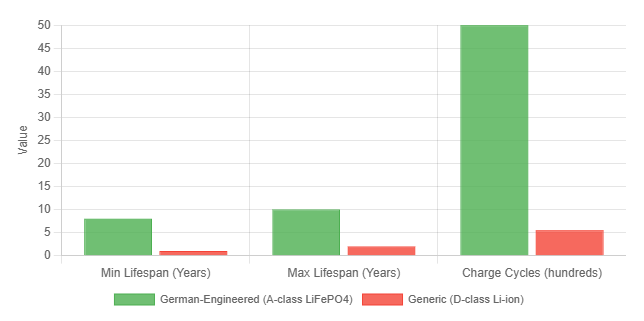
Beyond documentation, the performance specifications of German-engineered solar street lights directly support the total cost and risk calculations that procurement decision-makers use. Consider the comparison between a system built on A-class LiFePO4 batteries with a lifespan of 8–10 years and 5,000+ charge cycles, versus a generic system relying on recycled or D-class lithium-ion cells rated at 500–800 cycles with an 18–24 month replacement interval. A project that passes World Bank forced labor review but installs generic systems with an effective lifespan of 2–3 years ,against a 10–15 year design life for quality alternatives ,has complied with one requirement while creating a hidden total cost of ownership problem.
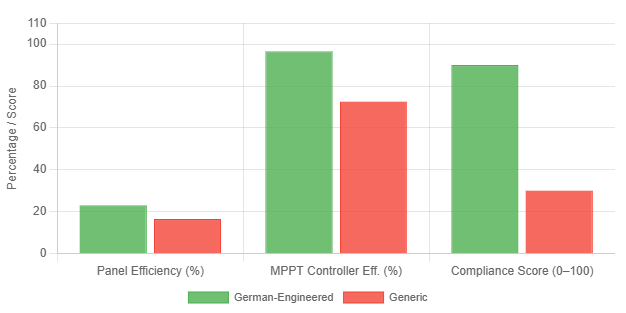
Similarly, the monocrystalline solar panels used in German-engineered systems operate at 23%+ efficiency with third-party verified IP67 ratings and a panel sizing of 3–4 times load power to ensure performance through cloudy periods. Generic systems typically use polycrystalline panels at 15–18% efficiency, self-claimed IP65–67 ratings, and a panel-to-load ratio under 2.5x ,meaning the system underperforms exactly when energy storage is critical. These performance gaps, combined with the supply chain transparency gap, mean that generic alternatives create compounding risk for procurement officers.
Practical Implications for Project Procurement Teams
Understanding the World Bank’s forced labor framework is only valuable if it translates into action before the bid is submitted. For procurement officers, EPC contractors, and project managers working on World Bank-financed projects with solar components, the following practical steps are critical.
First, initiate supply chain mapping early ,well before bid preparation begins. Request from prospective panel suppliers a full multi-tier supply chain disclosure, including the geographic origins of polysilicon and all upstream inputs. Suppliers who cannot provide this within a reasonable timeframe are unlikely to satisfy the Annex III documentation requirements.
Second, include forced labor compliance as a supplier qualification criterion during vendor prequalification, not only at bid submission. This aligns with the ADB and World Bank solar street light procurement frameworks that increasingly treat supply chain integrity as a rated criterion rather than a pass/fail checkbox.
Third, establish internal audit mechanisms for monitoring subcontractor compliance during contract execution. The Annex III obligations do not end at contract award ,they persist throughout the project lifecycle, including in progress reporting.
Fourth, engage your legal and procurement advisors to review the forced labor contract clauses before signing, ensuring the flow-down language in your subcontract agreements is consistent with the Annex IV requirements. This is particularly important for projects that involve both international and national competitive procurement segments, since the World Bank’s requirements apply to both.
Finally, when evaluating suppliers, treat certification requirements for bankable EPC contracts ,including TÜV certification, ISO 9001 compliance, and third-party social audits ,as indicators of supply chain trustworthiness, not merely product quality markers.
Conclusion
The World Bank’s forced labor declaration framework for solar procurement is not a compliance formality ,it is a structural response to a documented and serious supply chain integrity problem that affects a significant proportion of the global solar component market. For every procurement officer, contractor, or city planner participating in a World Bank-financed project with solar components, these mandatory declarations represent real obligations with real consequences for non-compliance.
The most important takeaways are these: the four-part framework ,covering performance declarations, forward-looking declarations, supply chain identification, and strengthened contract clauses ,applies to all new solar procurement under World Bank IPF from January 1, 2022 onward, covering both international and national competitive procurement. Verification of these declarations is not self-certification ,all procurements in scope are subject to mandatory World Bank prior review. And the supplier who can meet these documentation requirements is almost certainly the same supplier who manufactures a higher-quality, longer-lasting product ,because supply chain discipline and product quality share the same root: accountability.
For procurement teams that want to win World Bank-financed projects and deliver long-term value, the starting point is a supplier whose supply chain is as transparent as their product specifications. Visit solar-led-street-light.com to request a consultation and learn how our German-engineered solar LED street light systems are designed to meet World Bank forced labor compliance requirements from the ground up.
Frequently Asked Questions
Q1: What is the World Bank’s Forced Labor Bidder Declaration and who must complete it?
The Forced Labor Bidder Declaration is a mandatory document required under the World Bank’s Investment Project Financing framework for all procurements involving solar panels or solar components. It must be completed and signed by the bidder, every member of a joint venture, and every proposed subcontractor, supplier, and manufacturer in the solar supply chain. Failure to include a completed declaration renders a bid non-compliant.
Q2: When did the World Bank’s forced labor requirements for solar procurement take effect?
The requirements took effect on January 1, 2022, applying to all new procurement advertised, invited, or awarded through direct contracting on or after that date. They apply equally to international competitive procurement and national competitive procurement, as well as any direct selection or direct contracting within scope.
Q3: What is polysilicon and why is it at the center of the forced labor risk in solar supply chains?
Polysilicon is the high-purity silicon compound that forms the foundational material in virtually all solar photovoltaic cells. A substantial share of global polysilicon production ,estimated between 35–50% ,originates from the Xinjiang Uyghur Autonomous Region of China, where international organizations have documented coercive labor practices. Because polysilicon enters the solar panel supply chain at the earliest stage, its geographic origin can be difficult to trace through downstream processing without explicit documentation.
Q4: What happens if a bidder has had a forced labor-related contract suspension in the past five years?
Such bidders must disclose the details in the Forced Labor Performance Declaration (Annex II), including the year, contract identification, name of the employer, and the nature of the remedy applied. They are not automatically disqualified, but must provide evidence demonstrating that they have adequate capacity and commitment to comply with forced labor obligations going forward. The World Bank’s prior review will evaluate this evidence.
Q5: Does the World Bank’s forced labor framework require third-party audits of suppliers?
The framework requires bidders to provide evidence of how monitoring and due diligence will be conducted, including inspection protocols, use of inspection agents, frequency of inspections, and examples of previous factory or labor inspection reports. While third-party audits are not explicitly mandated by name, they are the primary mechanism used by compliant bidders to satisfy the monitoring evidence requirements. Self-declared compliance without independent verification is generally insufficient.
Q6: How does the UFLPA relate to the World Bank’s forced labor framework?
The U.S. Uyghur Forced Labor Prevention Act (UFLPA) is a U.S. import law enforced by Customs and Border Protection that establishes a rebuttable presumption that goods involving Xinjiang inputs were produced with forced labor. The World Bank’s framework is a separate, institution-specific procurement requirement. However, the documentation standards are complementary ,importers and contractors who maintain full-tier supply chain traceability to satisfy UFLPA requirements will generally have the documentation needed to support World Bank forced labor declarations as well.
Q7: Are solar street lights included in the World Bank’s forced labor declaration requirements?
Yes. The World Bank’s framework covers solar panels and solar components used for the “core functions of a project” under Investment Project Financing. Solar street light systems that incorporate solar panels, charge controllers, and battery storage systems fall within this definition when they are the primary technology being procured for a project’s core purpose. Any EPC contractor supplying solar LED street lights under a World Bank-financed contract must ensure all four declaration annexes are included in the bid documentation.
Q8: How can procurement teams verify that a solar supplier’s forced labor declaration is credible?
Credibility verification should focus on three areas: first, whether the supplier can provide a documented multi-tier supply chain map showing the geographic origin of polysilicon and all upstream inputs; second, whether the supplier holds third-party certifications such as ISO 9001 and TÜV that evidence a quality management system generating supply chain documentation as a natural byproduct; and third, whether the supplier has undergone independent social compliance audits conducted by recognized audit firms at the factory level.
References
- World Bank. (2022). IPF Solar Procurement: Bidder Declaration ,Forced Labor. World Bank Group. https://thedocs.worldbank.org/en/doc/0dc2d3635eb75d5371cab93a3873ad02-0290032022/original/Forced-Labor-Solar-Declarations-and-provisions-for-Procurement-Documents-ext-1.pdf
- World Bank. (2025). Project Procurement Framework ,Standard Procurement Documents. World Bank Group. https://www.worldbank.org/ext/en/what-we-do/project-procurement/framework
- FIDIC. (2023). Combating Forced Labour in the Global Solar Supply Chain. International Federation of Consulting Engineers. https://www.fidic.org/node/36900
- U.S. Customs and Border Protection. (2025). FAQs: Uyghur Forced Labor Prevention Act (UFLPA) Enforcement. CBP. https://www.cbp.gov/trade/forced-labor/faqs-uflpa-enforcement
- Coalition to End Forced Labour in the Uyghur Region. (2025). Solar Industry FAQ. https://enduyghurforcedlabour.org/about/solar-industry-faq/
- ISS ESG. (2023). Forced Labor in the Solar Supply Chain: Concerns about the Transition to Renewables. https://insights.issgovernance.com/posts/forced-labor-in-the-solar-supply-chain-concerns-about-the-transition-to-renewables/
- U.S. Department of Labor. (2022). Traced to Forced Labor: Solar Supply Chains. https://www.dol.gov/sites/dolgov/files/ILAB/images/storyboards/solar/Solar.pdf
- Interos. (2022). Mapping the Solar Panel Supply Chain is Key to Avoiding Forced Labor Risks. https://www.interos.ai/mapping-the-solar-panel-supply-chain-is-key-to-avoiding-forced-labor-risks/
- Morgan Lewis. (2023). How Responsible Labor and Trade Issues Affect the Solar Energy Industry. https://www.morganlewis.com/blogs/powerandpipes/2023/02/how-responsible-labor-and-trade-issues-affect-the-solar-energy-industry
- Global Supply Chain Law Blog. (2025). Forced Labor Update & Analysis ,Fresh Names for the UFLPA Entity List. https://www.globalsupplychainlawblog.com/supply-chain/forced-labor-update-analysis-fresh-names-for-the-uflpa-entity-list/
Disclaimer
This article is for informational purposes only and does not constitute professional engineering, installation, or procurement advice. Performance specifications and costs may vary based on project requirements, location, and local regulations. Always consult qualified solar energy professionals and legal advisors before making procurement decisions.
For expert consultation on solar LED street lighting solutions, visit solar-led-street-light.com or contact our team for a customized quote.