
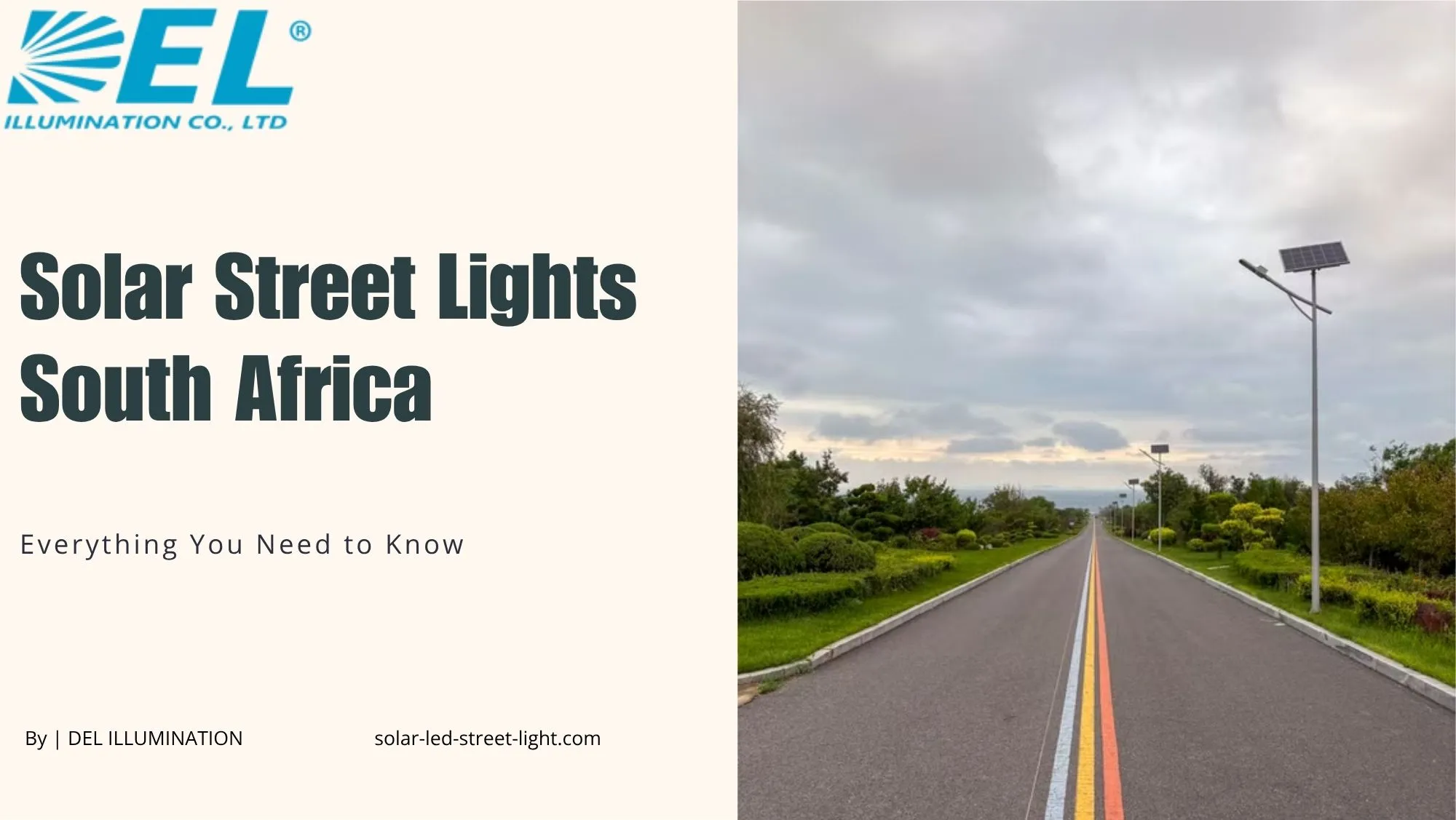
South Africa has an insolation value that ranges from 5 to 6.9. This means that there is plenty of solar energy that can be converted to power solar street lights South Africa products. Besides, solar energy is clean, environment-friendly, and endless. This abundant sunshine makes solar street lights South Africa one of the most practical lighting investments in the region. For the fundamentals of how these systems work, our guide on the solar street light working principle is a helpful companion read.
The solar street light product installation does not require trenching, cabling, and grid electricity consumption. In South Africa, solar street lights are an excellent investment for any private or public property usage. Solar street lights South Africa products are suitable for commercial or residential street lighting, car park illumination, and ideal for lighting highways and other roadways or streets.
Nature of Solar Street Lights
Some of the solar street lights South Africa services use more than 50% of local content, which supports the solar industry in the country. It is best to go for solar street lights products and services that are locally made, since products tailored for the region provide the best results.
Solar street lights products have high luminance, long lifespan, minimal maintenance, and easy installation. You will find all-in-one or fully integrated streetlight systems that merge the PV solar panel, solar charge controller, and battery. They can be combined with human infrared sensors and high-output LEDs of your preferred wattage, which ranges from 8 to 100 watts. Learn more about integrated designs in our post on the 7 benefits of all-in-one street light technology.
Design of Solar Street Lights
Most of the solar street lights South Africa devices are split in design, where the light source, the solar panel, and the battery are independent. There are also modern designs such as the semi-integrated and fully integrated or all-in-one solar street lights.
Most of the solar street lights products are designed to illuminate a wide surface area. Their robust build allows them to function in extreme environments, especially during winter and summer months. Most of the solar street lights South Africa products are wind resistant. Some manufacturers have designed their solar street lights to withstand wind speeds of up to 200 km/h.
Solar Street Lights Technology
What makes solar street lights South Africa products and services accessible is the use of next-generation technology that allows one to adjust the angle and rotation of the solar panel, for optimal charging of the battery, and LED light to suit the application. This eliminates all constraints with regards to lamp pole positioning.
The solar street lights South Africa products use reflective technology. Different from refractive technology, the new technology provides light that is focused on the area that needs illumination. There is no glare nor wasted light. Our comparison of HPS lights vs LEDs in outdoor solar street lamps explores lighting technology in more depth.
You do not have to physically switch on any solar street lights South Africa products on sale. They come with day or night sensors which enable the street lights to automatically switch on at dusk and off at dawn. Furthermore, you may find others that come with motion sensors that dim the light when there is little or no activity below the street light and turn to full power when movement is detected below it. Discover more in our post on the 8 benefits of a solar sensor street light.
The Components of Solar Street Lights
The best solar street lights South Africa lighting fixtures come with high power LED modules of high Colour Rendering Index (CRI). The use of Light Emitting Diode (LED) bulbs in solar street lights makes it a profitable investment. You can get your solar street lights South Africa fixture of wattage between the range of 20 to 120 watts. The lumens can vary between 2400 and 14400 lm. Many street lights in South Africa offer a colour intensity of either 3000K, 4000K, or 6000K.
The solar street lights designs come with a lead-acid battery, free maintenance type. The battery is valve-regulated, fully sealed, and has a deep cycle. These batteries are known to have a lifespan of between five and six years. Modern designs come with a Lithium-Ion battery that can withstand higher temperatures and ensures a longer lifespan. To get the most from either type, follow our 10 tips to maintain your solar street light battery.
The solar street lights products come with solar panels made of high-efficiency crystalline PV modules. The thin-film solar panels are designed in such a way that they are immune to very high temperatures and extreme weather conditions such as hail.
The solar street lights products come with street poles that vary in height ranging from between 4 m to 12 m. These poles are hot-dip galvanized and treated for corrosion to give a lifespan of up to 20 years. The solar street lights features should fit on any pole or wall. Our 9 factors for choosing solar power light poles can guide this decision.
In the installation of solar street lights South Africa products, the light distribution depends on the height of the pole. Also, the more the height, the higher the wattage. For example, a four-meter pole has a power requirement of 20 watts, while that of 10 m requires 120 watts to produce efficient lighting.
The Quality of Solar Street Lights
Most split solar street lights South Africa come with galvanized and powder-coated finish. The finishing makes the street light materials corrosion-resistant. The solar streets may come in tubular or square-based designs and by SANS standards. The solar panels are built per the IEC 61215 standards.
The IP rating still applies in solar street lights equipment. The solar street lights come with IP65 ratings or above. The rating tends to describe the level of waterproofing of the product. In our case, these street lights are shielded from dust and jet water. Learn more in our post on the 5 benefits of IP65 solar street lights.
The warranty of solar street lights products is applicable as per the component. Warranty is available for the fixture, solar panel, controller, battery, and pole. The warranty can be as low as 2 years and as high as 5 years.
Solar Street Lights South Africa: Conclusion
The cost of installation of solar street light could be more than the traditional on-grid street lights, mainly because of the expensive nature of the batteries, solar panels, and technology used. However, the benefits of solar street lights are long-term. According to the U.S. Department of Energy, solar adoption delivers significant long-term savings and environmental benefits.
Solar street lights South Africa equipment provides a more cost-effective solution with less maintenance. Solar street lights are not only satisfactory, but they can also exceed your expectations in terms of lighting outdoor space. Generally, solar street lights South Africa installation is all about environmental and cost-saving gains.
If you have any requirement for solar LED street light, please feel free to contact us.
Frequently Asked Questions (FAQs)
1. Are solar street lights South Africa a good investment?
Yes. With South Africa’s high insolation value of 5 to 6.9, there is abundant sunlight to power solar street lights efficiently. Solar street lights South Africa require no trenching, cabling, or grid electricity, making them a cost-effective, low-maintenance, and environmentally friendly investment for both private and public properties.
2. What wattage of solar street lights South Africa do I need?
The wattage of solar street lights South Africa depends on the pole height and coverage area. As a guide, a four-meter pole typically requires around 20 watts, while a 10-meter pole needs around 120 watts. Available options generally range from 20 to 120 watts, with lumens between 2400 and 14400 lm.
3. Do solar street lights South Africa work during load shedding?
Yes. Because solar street lights South Africa operate independently of the grid, they continue working during load shedding and power outages. They charge their batteries from the sun during the day and provide reliable illumination at night without any connection to the electricity grid.
4. How long do the batteries in solar street lights South Africa last?
Lead-acid batteries in solar street lights South Africa typically last between five and six years, while modern lithium-ion batteries can withstand higher temperatures and offer an even longer lifespan. Good battery maintenance significantly extends how long they last.
5. Are solar street lights South Africa able to withstand harsh weather?
Yes. Solar street lights South Africa are built for extreme conditions, with many wind-resistant up to 200 km/h, hail-immune panels, IP65 or higher waterproof ratings, and corrosion-resistant galvanized, powder-coated poles rated for up to 20 years of service.