
Street lighting accounts for roughly 35 TWh of electricity consumption across EU member states every year – roughly 1.3% of total electricity use – costing public authorities close to €4 billion annually. For city planners and procurement officers facing rising energy tariffs and binding carbon targets, that figure represents both a problem and an opportunity. Solar street lighting in Europe is no longer a niche alternative; it is rapidly becoming the infrastructure standard of choice across a continent committed to decarbonisation. This blog unpacks the key technical standards, regulatory drivers, and market forces shaping solar street lighting in Europe today – giving decision-makers the intelligence they need to procure confidently and strategically.
The European Regulatory Landscape for Solar Street Lighting
Solar street lighting in Europe operates within a layered regulatory framework that simultaneously raises performance expectations and accelerates market adoption. Understanding these layers is essential for procurement officers, EPC contractors, and facility managers who need compliant, bankable solutions.
The cornerstone of European road lighting design is EN 13201, a five-part standard developed by the European Committee for Standardisation (CEN). EN 13201-2 defines the performance requirements – luminance classes for motorway applications (M-class), illuminance requirements for conflict and pedestrian areas (C and P classes) – while EN 13201-5 introduces energy performance indicators including the Annual Energy Consumption Indicator (AECI, in kWh/year). For any solar street lighting deployment on European public roads, EN 13201 compliance is non-negotiable.
At the luminaire level, IEC 62722-2-1:2023 governs LED luminaire performance, covering efficacy, lumen maintenance, and colour quality over rated life. The updated EN IEC 60598-1 (2024 edition) introduced Annex W – a mandatory normative section specifically addressing battery-powered luminaires, requiring battery management systems (BMS) that prevent over-discharge, short-circuits, and thermal runaway. Mandatory compliance with Annex W was required by 31 December 2025, directly impacting all integrated solar street light designs sold in Europe.
On the battery side, EU Battery Regulation 2023/1542 entered force in February 2024, requiring CE marking of all batteries from August 2024 and mandating carbon footprint declarations. Lithium battery packs in solar street lights must comply with IEC 62133-2:2017 safety testing – covering thermal abuse, external short circuit, overcharge, and mechanical stress – as a prerequisite for CE marking under the Low Voltage Directive.
Meanwhile, the revised EU Energy Efficiency Directive (2023/1791) demands that member states achieve cumulative end-use energy savings of at least 1.3% of final energy consumption annually in 2024–2025, rising to 1.9% by 2028–2030. Solar street lighting projects directly contribute to these national targets, which is why EU Recovery and Resilience Facility grants – totalling €69.6 million in recent municipal lighting programmes – continue to flow to compliant solar infrastructure upgrades.
For procurement teams, the EU Green Public Procurement (GPP) criteria for road lighting require specified minimum luminaire efficacy and zero upward light output (ULOR = 0%), both easily met by well-engineered solar LED fixtures. Understanding certification requirements for bankable EPC contracts ensures your project clears procurement audits from the outset.
Key Technical Standards: What European Compliance Actually Means
Regulatory compliance is only as meaningful as the technical specifications that underpin it. For solar street lighting in Europe, three technical benchmarks define the difference between genuine compliance and paper-thin certification.
Photometric performance under EN 13201 requires that average maintained luminance for M-class roads (arterial roads with motorised traffic) typically falls between 0.5 cd/m² (M6) and 2.0 cd/m² (M1), with overall uniformity ratios of at least 0.4. For pedestrian and cycle paths (P-class), maintained average illuminance of 7.5 lux to 50 lux applies depending on the zone. Systems sized correctly for backup autonomy of 3 to 7 days – factoring in seasonal variations in peak sun hours – are necessary to guarantee these values on the lowest-irradiance nights of the year.
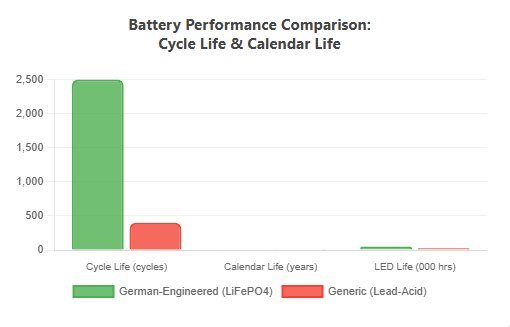
LED efficacy and lumen maintenance under IEC 62722-2-1 require manufacturers to document luminous flux output at 6,000 hours and project L70 lifespan – the point at which output falls to 70% of initial flux. German-engineered solar street lights achieve 160–180 lm/W efficacy with rated LED life of 50,000 hours, compared to 100–120 lm/W and often only 20,000–30,000 hours in practice for generic alternatives. This is not a marginal difference; it translates directly to maintenance intervals, replacement costs, and lifecycle carbon footprint.
IP and IK ratings are particularly important in the European context given wide climatic variation, from coastal salt-spray environments in the Netherlands and Denmark to sub-zero winter temperatures in Poland and the Baltic states. EN 60529 defines IP ratings: IP67 (verified by an accredited laboratory) means total dust ingress protection and temporary submersion to 1 metre. IK ratings under EN 62262 measure resistance to mechanical impact – IK08 (5 joules) represents the minimum credible standard for public road environments. Generic products frequently carry self-declared IP65 ratings that have not been verified by independent labs, a significant procurement risk.
MPPT charge controllers are mandatory for European-grade systems. Maximum Power Point Tracking (MPPT) extracts 25–30% more energy from the solar panel compared to older PWM (Pulse Width Modulation) controllers – a critical advantage during partial cloud cover or sub-optimal panel angles. On a system rated at 60W, this translates to 15–18 additional watts of usable power on overcast days, directly extending backup days and improving lux levels without enlarging the panel or battery capacity.
Learn how street lighting standards compare globally to understand where European EN 13201 sits relative to IES and CIE frameworks.
The European Solar Street Lighting Market: 2024-2026 Snapshot
Europe’s solar street lighting market is growing with remarkable momentum. Europe accounted for around 28% of the global solar LED street lighting market in 2024, driven by aggressive carbon reduction objectives, elevated energy prices, and EU directives for off-grid and energy-saving street infrastructure. The global solar LED street lighting market was valued at approximately USD 5.6 billion in 2024 and is projected to reach USD 19.7 billion by 2034, reflecting a compound annual growth rate of 13.4%.
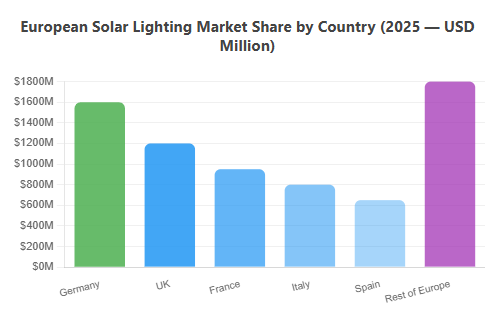
Germany holds the largest European share with a projected market size of USD 1,600 million in 2025, representing 24.2% of the European solar lighting market. The UK follows with USD 1,200 million and an 18.2% share, while France holds USD 950 million at 14.4%. Italy, Spain, and the broader Rest of Europe – including rapidly expanding Eastern European markets – collectively account for the remainder.
Germany, France, the UK, and the Netherlands are at the vanguard, incorporating solar LED lighting into urban renewal projects and highway lighting schemes. The EU Green Deal, which requires a significant reduction of greenhouse gas emissions by 2030, has driven local governments to shift from conventional to renewable lighting.
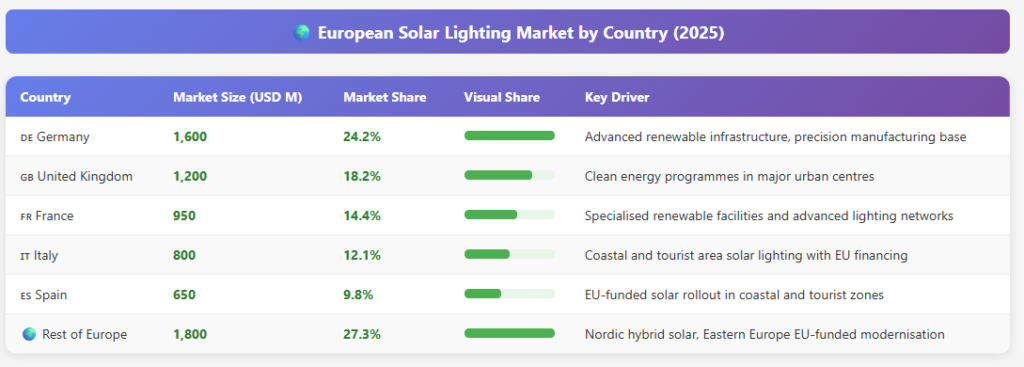
Eastern Europe represents a particularly dynamic opportunity. Countries such as Poland and Romania are seeing increased adoption, fuelled largely by EU-funded infrastructure development programmes focused on fossil fuel reduction and urban modernisation. These programmes unlock grant financing that effectively reduces upfront capital barriers – the primary obstacle to faster rollout in cost-sensitive municipal markets.
In Scandinavian nations, where sunlight is seasonal, hybrid solar LED systems backed up by the grid are being implemented to provide year-round performance. This hybrid approach – combining solar autonomy for the bulk of the year with grid support during short winter days – is particularly relevant for procurement officers operating above 55° latitude.
For EPC contractors pursuing procurement financing, understanding how the World Bank and ADB approach solar street light procurement in 2026 provides a useful benchmark even for European projects with development finance components.
German Engineering Standards: Why They Matter in the European Procurement Context
When procurement documents in Europe specify “compliance with applicable IEC, EN, and DIN standards,” the implicit reference is often to a level of engineering rigour that traces back to German manufacturing practice. Understanding what distinguishes German-engineered solar street lights from generic alternatives is therefore commercially as well as technically important.
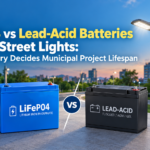
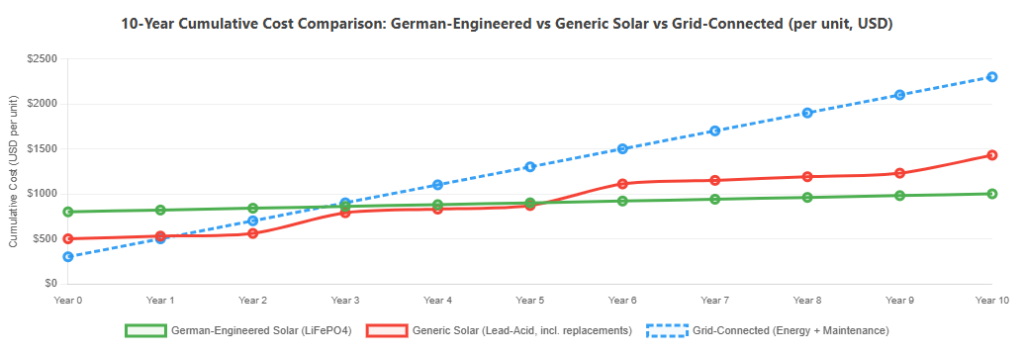
The most consequential difference lies in battery technology. German-engineered systems use LiFePO4 (Lithium Iron Phosphate) batteries with 2,000–3,000 charge cycles and a calendar life of 8–12 years. Generic competitors typically use lead-acid batteries (300–500 cycles, 2–4 year lifespan) or unspecified lithium chemistries with similar limitations. Over a 10-year lifecycle, this difference alone forces two to three complete battery replacements in generic systems, adding €400–€800 per unit in replacement and labour costs that are entirely absent from a well-specified German-engineered system.
Thermal management is the second major differentiator. LED junction temperature at 50°C ambient air temperature – common in Southern Europe during peak summer – is kept at or below 85°C in die-cast aluminium housings engineered to European standards. Generic systems using plastic or thin-metal housings frequently push LED junction temperatures above 100°C, accelerating lumen depreciation and shortening practical operating life well below the rated 50,000 hours. This is why independent verification – through TÜV Rheinland, TÜV SÜD, or equivalent accredited bodies – matters so much in European tender evaluation.
Monocrystalline solar panels achieving 21–23% efficiency versus 15–17% for polycrystalline alternatives mean that for the same power output, German-engineered systems require smaller panel footprints – a practical benefit in heritage city centres and areas with pole-spacing constraints.
From a total cost of ownership (TCO) perspective, the 10-year lifecycle cost of a German-engineered solar street light is substantially lower than either a grid-connected alternative or a generic solar unit. Grid-connected equivalents carry ongoing electricity and maintenance tariff exposure; generic solar units create replacement cycles that drive costs 2–3× higher over a decade. Explore the full total cost of ownership analysis for EPC projects to build the financial case for quality procurement.
Compare German-engineered versus generic solar street lights directly with detailed side-by-side specification data.
Smart Technology Integration: IoT, Dimming, and the European Smart City Agenda
The convergence of solar street lighting with smart city infrastructure is reshaping how European municipalities approach outdoor lighting. In 2024–2025, IoT-enabled features – adaptive dimming, remote fault detection, real-time energy monitoring, and predictive maintenance – are transitioning from premium add-ons to baseline procurement expectations in major European tenders.
Adaptive dimming delivers energy savings of at least 30% on top of the baseline LED efficiency advantage, by reducing output to 30–50% during late-night low-traffic periods and restoring full brightness when motion sensors detect pedestrian or vehicle activity. For a typical 40W solar street light operating 11 hours nightly, intelligent dimming can reduce effective energy draw to under 20W for 5–6 hours per night – extending battery backup capacity and reducing panel sizing requirements.
Communication protocols used in European smart city deployments include LoRaWAN (effective range up to 10 km without cellular networks), 4G/LTE, and Zigbee mesh networks. A single LoRaWAN gateway can manage up to 100 luminaires, making city-scale rollouts cost-effective. Cloud-based dashboards enable facility managers to monitor battery state of charge, fault status, and cumulative energy output from any device – eliminating the need for costly physical inspection rounds.
A European pilot project deploying 2,000 solar streetlights equipped with smart controls demonstrated system-wide analytics that saved an estimated USD 1.5 million in operational costs over one year. While individual city results will vary, this pilot illustrates the order-of-magnitude operational savings that smart integration enables at scale.
The EU’s Ecodesign for Sustainable Products Regulation (ESPR), which entered into force in July 2024, also reinforces the smart technology agenda by promoting Digital Product Passports (DPPs). For solar street light manufacturers, DPPs will ultimately require documented performance data – battery chemistry, cycle life, carbon footprint – linked to individual product units, making certified, data-rich German-engineered systems significantly easier to procure compliantly.
For procurement teams integrating solar lighting into broader smart city frameworks, understanding remote control technology benefits and all-in-one street light technology advantages provides practical integration context.
Positioning Your Organisation for Europe’s Solar Lighting Transition
Three takeaways define the strategic picture for decision-makers in 2025–2026.
First, regulatory alignment is accelerating. The EU Energy Efficiency Directive, EN IEC 60598-1 Annex W, EU Battery Regulation 2023/1542, and ESPR collectively close the door on under-specified, non-certified products in the European market. Procurement officers who specify full certification stacks – CE marking, IEC 62133-2:2017 battery safety, verified IP67, and EN 13201 photometric compliance – are protecting both project quality and organisational liability.
Second, Germany leads and the rest of Europe follows. With a 24.2% share of the European solar lighting market and the strongest manufacturing base for precision LED and LiFePO4 systems, German engineering standards have become the practical benchmark for compliant European procurement. LiFePO4 batteries rated at 2,000–3,000 cycles, MPPT charge controllers, and independently verified IP67 ratings are not luxury specifications – they are the minimum required for long-term, cost-effective performance.
Third, the smart city dividend is real and measurable. IoT integration, adaptive dimming, and predictive maintenance are not features for the future – they are delivering verifiable operational savings in deployed European pilots today. Procurement officers who specify smart-ready solar lighting systems in 2025–2026 will be insulated from the retrofit costs that will face municipalities locked into legacy fixtures within the next five years.
Solar-led-street-light.com delivers German-engineered solar LED street lighting solutions that meet all applicable European standards, carry comprehensive certifications, and integrate seamlessly with smart city infrastructure. Contact our team today for a customised consultation, specification review, or project quote at solar-led-street-light.com.
Frequently Asked Questions
1. Which standard governs road lighting design in Europe, and does it apply to solar systems?
EN 13201 is the primary European standard for road lighting, covering performance requirements (Part 2), calculation methods (Part 3), measurement procedures (Part 4), and energy performance indicators (Part 5). It applies regardless of the power source – grid or solar – meaning solar street light designs must meet the same luminance, uniformity, and glare control requirements as conventional systems. Solar systems should be sized to maintain these photometric values through 3-7 days of battery backup, depending on local peak sun hour data.
2. What certifications are mandatory for solar street lights sold in Europe in 2025?
At minimum, European-market solar street lights require CE marking under the Low Voltage Directive (2014/35/EU) and EMC Directive (2014/30/EU). Battery packs must comply with EU Battery Regulation 2023/1542 (CE marking mandatory from August 2024) and pass IEC 62133-2:2017 safety testing. Luminaires must comply with EN IEC 60598-1, including the new Annex W requirements for battery-powered luminaires (mandatory from end-2025). EN 13201 photometric compliance should be independently verified for any public road application.
3. How do LiFePO4 batteries compare to lead-acid batteries in European solar street light projects?
LiFePO4 batteries rated at 2,000–3,000 cycles and 8–12 years calendar life dramatically outperform lead-acid batteries, which typically deliver 300–500 cycles and last 2-4 years under real-world charging conditions. In European climates, lead-acid performance degrades significantly below 0°C, creating reliability risks in Northern and Eastern European deployments. LiFePO4 chemistry also carries no acid spill risk and is fully CE-markable under the EU Battery Regulation, making it the only credible chemistry for compliant, long-life European deployments.
4. Does the EU provide grants or financing for solar street lighting projects?
Yes. The EU Recovery and Resilience Facility has channelled funding into municipal street lighting upgrades – a recent programme provided €69.6 million specifically for energy-efficient street lighting renovation. EU Structural Funds, ERDF grants (particularly relevant in Eastern European member states), and national green infrastructure programmes all provide financing routes. EPC contractors should also be familiar with the EU Green Public Procurement (GPP) criteria for road lighting, which can unlock preferential assessment scoring in public tenders.
5. What lux levels must solar street lights deliver for European pedestrian zones?
Under EN 13201-2, P-class pedestrian and cycle path lighting requires maintained average horizontal illuminance ranging from 7.5 lux (P6) for low-risk paths to 50 lux (P1) for high-risk conflict zones with significant mixed traffic. Semi-cylindrical illuminance – the measure relevant for facial recognition and personal safety – is separately specified. Procurement officers should request photometric simulation files (in .ldt or .ies format) from suppliers, verified under the maintenance factor and installation geometry of the actual project site.
6. How do MPPT charge controllers improve performance in European climates?
MPPT (Maximum Power Point Tracking) controllers continuously optimise the electrical operating point of the solar panel, extracting 25–30% more energy than PWM (Pulse Width Modulation) alternatives under partial shading or low-irradiance conditions – both common in Northern and Central Europe during autumn and winter months. In practical terms, on a 60W solar panel in a cloudy Central European climate, MPPT recovery can deliver 15–18 additional watts per hour of generation, directly extending battery backup days and maintaining photometric compliance through adverse weather periods.
7. Are solar street lights viable in Scandinavian or Northern European winter conditions?
Yes, with appropriate system design. The key is accurate solar resource modelling using site-specific peak sun hour data (typically 1.5–2.5 peak sun hours per day in Northern Europe in December), correct battery capacity sizing for up to 7 backup days, and in some cases hybrid grid-solar configurations for locations above 60° latitude. LiFePO4 batteries retain significantly better capacity at low temperatures than lead-acid alternatives. Several Scandinavian municipalities have successfully operated solar street light networks through full winter cycles using oversized panels and LiFePO4 battery banks. Explore solar park light installation guidance for sizing principles applicable to low-sun environments.
8. What is the typical payback period and 10-year ROI for solar street lighting in Europe? Payback periods vary by electricity tariff, installation complexity, and system specification, but typically fall in the range of 4–7 years for European municipal deployments when compared to grid-connected alternatives. Over a 10-year lifecycle, the near-zero operational cost of a correctly specified solar street light – no electricity tariff, no grid infrastructure maintenance, minimal lamp replacement – versus ongoing grid energy costs and two or more lead-acid battery replacement cycles in generic systems produces a total cost of ownership advantage of 40–60%. Review a detailed 5-advantage breakdown of solar light pole systems for a structured ROI framework.