
Choosing the right solar street light specification is one of the most important decisions you will make before installing outdoor lighting on any road, pathway, parking lot, or public space. It decides how long your fixture lasts, how reliably it performs through the seasons, and how much you end up spending over its lifetime. Getting the specification wrong is a costly mistake, since a poorly specified unit can mean dim light, short battery life, or a fixture that fails within a year or two.
If you are comparing options, it helps to start with a fully engineered unit such as the All in One Solar Street Light, which bundles the panel, battery, controller, and LED into a single housing built to a defined solar street light specification from the factory. Let’s walk through the elements that make up a strong solar street light specification, starting with the battery.
Battery specification
Your battery is one of the most critical parts of any solar street light specification. Solar panels charge the battery during the day, and the battery then powers the light at night. If your battery is undersized or built from the wrong chemistry, the rest of the fixture will not matter, since the light simply will not stay on when you need it.
A common recommendation is to pick a battery that can carry the light for about three days without direct sun, to cover cloudy stretches or bad weather. In practice, a stronger solar street light specification calls for a battery rated to last five years or more. This is not only better value for money, it also means you likely will not need to touch the battery again for the better part of a decade, since a five to seven year rating is typically a conservative guarantee rather than a hard ceiling.
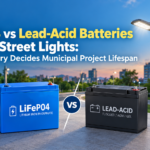
Most experienced buyers steer away from lead acid batteries when they write a solar street light specification. These are inexpensive and widely available, but they degrade quickly, lose capacity in temperature extremes, and rarely hold up to the demands of outdoor use. Lithium iron phosphate (LiFePO4) cells are now the standard choice in a modern specification, since they offer a far higher cycle life, better cold weather performance, and a safer chemistry overall. When you review a supplier’s solar street light specification sheet, check the battery chemistry line first.
LED or conventional fixtures
The next piece of any solar street light specification is the light source itself. Your budget plays a large role here. A larger budget typically points toward a more advanced LED system, while a tighter budget may call for a simpler fixture, and that is a perfectly reasonable place to start.
LED fixtures are usually the stronger choice for a few clear reasons. First, LEDs offer better directional control, so light is aimed precisely where it is needed instead of scattering in every direction. Second, LEDs are more efficient, delivering more usable lumens per watt than older technologies. When a solar street light specification pairs strong light output with low energy draw, that translates directly into a smaller, cheaper solar panel and battery, since the whole system needs less energy to run each night.
That said, if your budget cannot stretch to a full LED setup right now, you should not feel pressured. Conventional fixtures still do a reasonable job, and you can always revisit your specification later as budgets allow.
Integrated solar system or separate components
A major decision inside any solar street light specification is whether to choose an integrated (all in one) unit or assemble the panel, battery, and pole separately. Integrated designs carry real advantages. Installation is much faster, since most of the wiring and component matching that a separate build would require has already been done at the factory, following a fixed specification.
Integrated units are also more cost effective in practice. Components purchased separately usually need a technician to size, wire, and commission them correctly, which costs time or money, or both. A properly engineered solar street light specification removes that guesswork, because the panel, battery, controller, and LED are all matched to each other before the fixture ever leaves the factory. DEL Illumination’s All in One and All in Two solar street light ranges are both built this way. Whichever configuration you choose, matching it to a documented specification is what keeps performance predictable.
Pole height, mounting, and IP rating
A complete solar street light specification also needs to cover the pole and the enclosure, not just the electronics. Pole height should match the road width and the mounting spacing, since a fixture mounted too low or too high wastes light and creates uneven coverage. Most municipal roads call for poles between six and nine meters, while smaller paths and parking areas often work well with shorter poles.
Enclosure protection matters just as much. Look for an IP66 rating or higher in any serious solar street light specification, since this confirms the fixture is sealed against dust and heavy rain. An IK08 impact rating is another useful line item, showing the housing can withstand knocks from debris, branches, or vandalism without cracking. According to the International Energy Agency, solar generation continues to expand rapidly worldwide, which makes durable, well specified outdoor solar fixtures an increasingly important part of public infrastructure planning.
For a full walkthrough of the questions to ask before you sign off on a project, our solar street light FAQ guide covers pole height, panel wattage, battery chemistry, and warranty terms in more detail.
Choosing a manufacturer you can trust
Beyond the technical solar street light specification itself, the manufacturer behind the fixture matters enormously. A supplier who takes their solar street light specification seriously, tests it under real conditions, and stands behind it with certification and warranty support will save you far more money over ten years than a slightly cheaper unit from an unverified source.
Solar street light specification: conclusion
Solar street lighting is one of the more useful innovations to come out of the wider solar energy industry, and getting the most from it starts with a solid solar street light specification. That means understanding your battery chemistry, your fixture type, your mounting requirements, and your enclosure rating, then choosing a manufacturer who builds to that specification consistently rather than cutting corners on any single component.
If you would like help matching a solar street light specification to your project, reach out through our contact page and our team can walk you through the right configuration for your site.
Frequently asked questions
What is a solar street light specification?
A solar street light specification is the full set of technical requirements for a fixture, covering the solar panel wattage, battery type and capacity, LED lumen output, pole height, and enclosure ratings such as IP and IK. It defines how the light will perform and how long it will last.
What battery specification should I look for?
Look for lithium iron phosphate (LiFePO4) cells rated for at least five years of service, with enough capacity to run the light for two to three cloudy days without recharging. Avoid lead acid batteries, since they degrade quickly outdoors.
What IP rating does a good solar street light need?
An IP66 rating or higher is the general benchmark, since it confirms the fixture is sealed against dust and driving rain. Coastal or high humidity sites may warrant an even stronger rating.
How tall should the pole be?
Pole height depends on the road width and spacing between fixtures. Most municipal roads use poles between six and nine meters, while pathways and smaller lots typically use shorter poles.
Are integrated (all in one) solar street lights a better choice than separate components?
For most buyers, yes. Integrated units arrive pre matched at the factory, which removes the sizing and wiring guesswork that separate components require, and they are usually quicker and cheaper to install.