
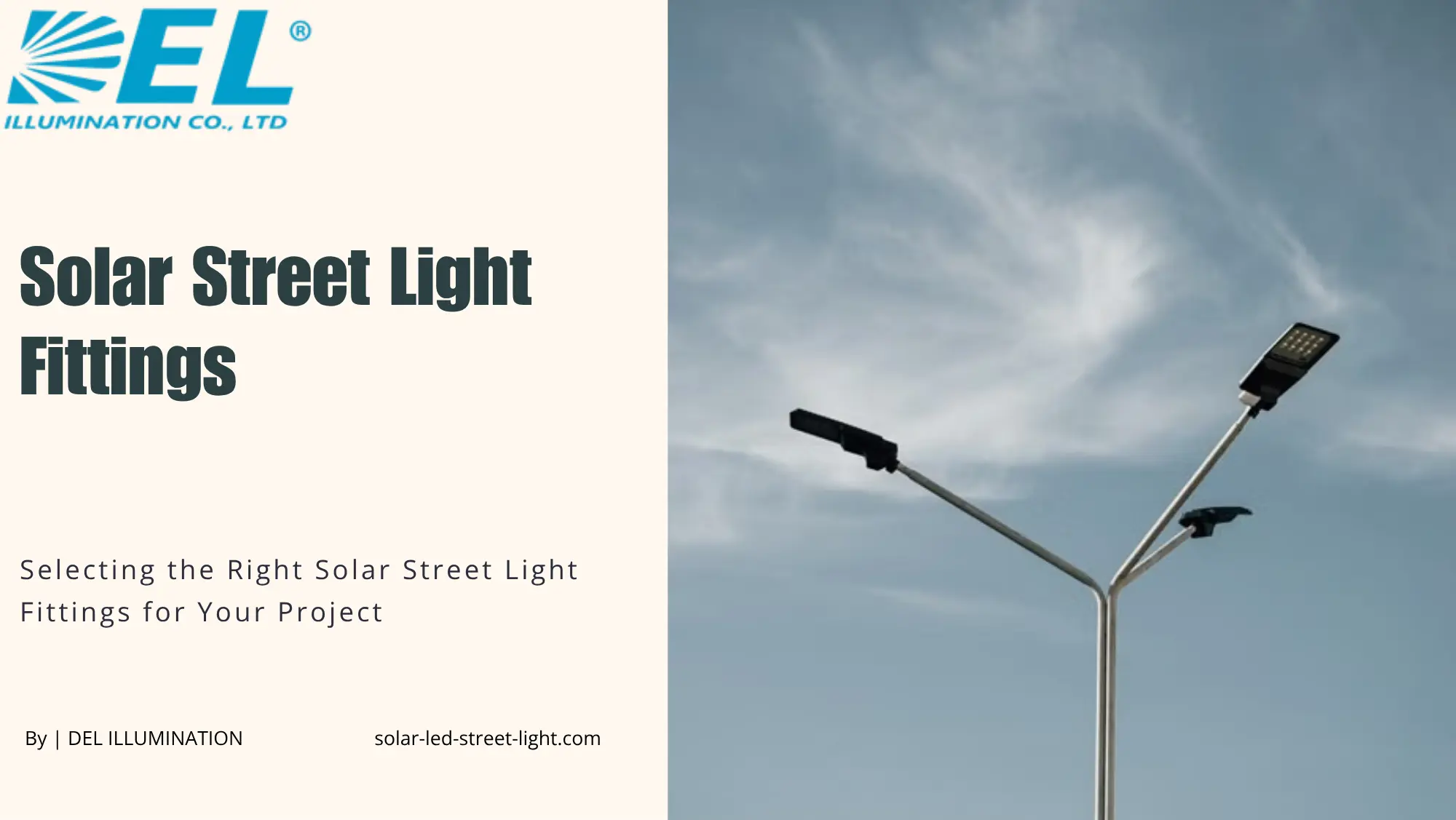
When you hear the phrase “solar street light fittings,” what comes to your mind? If you are thinking about solar street fixtures, luminaires, lamps, or lights, then you are right. Fittings have the same meaning as light sources.
Are you looking to light up a road, street, footpath, or an open area in a parking lot, garden, playground, driveway, residential yard, or highway? Selecting the right solar street light fittings should be easy once you know what to look for in a product.
The most common thing people do when selecting solar street light fittings for a project is to go straight for the electrical power to be precise, the wattage. The wattage of street lights varies from 9 to 100 watts, so you can’t miss a solution for your needs.
The rule of thumb for any lighting source is that the brighter the light, the more watts it will consume. However, some innovations tend to increase light intensity while reducing energy consumption at the same time. For more on this, see our innovative LED solar street light solutions.
How To Select The Right Solar Street Light Fittings
What should you consider when purchasing solar street light fittings for your system?
Calculated Power Requirements
Advances in LED technology provide lighting solutions with high luminous efficacy. Experts will start by calculating the amount of brightness needed for a selected area. Based on the results, they will then look for solar street light fittings with the required lumens.
You do not have to stress yourself with complex calculations. There are lumen calculators online that can help you determine the light intensity you need for the area of illumination. This information will help you determine the right fittings by considering the lumens per watt (lm/W) ratio of the available solutions. Our distance and spacing calculation guide makes this step easier.
Budget or Specifications
The right solar street light fittings can be chosen based on either lighting requirements or budget. If budget led, then you will have to consider the cost of the product. The cost is not only the initial price you should also factor in the installation and maintenance costs. Understanding the factors that affect solar street light price helps you judge true value.
If you wish to buy your solar street light fittings based on lighting requirements, then you’ll need to do your homework. Using this selection criterion might be more expensive, but you can be sure you will find a high quality product.
Your street light requirements mean you need to know:
- The area of illumination
- The brightness level of the light you need
- The type of bulb to use
- The features you need it to perform
- The weather conditions
Lighting Type and Design
There are fittings for different types of bulbs. Light emitting diodes (LED) and compact fluorescent lamps (CFL) are the most common lamps, replacing high pressure sodium (HPS) and low pressure sodium (LPS). Our comparison of HPS lights versus LEDs explains why LED has become the standard.
There is no single standard for solar street light fittings, but you will find common types such as the shoe box and the cobra head style. For urban and downtown areas, you will notice the use of architectural and decorative designs that are pleasing to the eye and match the surroundings.
In traditional solar street light lamps, the controller and battery are independent, and the sole purpose of the fixture was to produce light. The emergence of integrated luminaires has allowed different parts of the solar streetlight system to combine and form a single unit. You can learn more in our guide to all in one street light technology.
Conventional lighting fixtures are still available and are often useful with standard street light systems. When you opt for a full or semi integrated solar fitting, you don’t need to worry as much about the other components. The compact solution comes with high efficiency components loaded with advanced technology.
Extra Features
Inside an integrated solar street fitting, you should find an LED luminaire, a built in PIR motion sensor, a rechargeable battery, and solar panels. A useful fixture is one that can control the intensity of the light to ensure energy conservation and longer operation time. The standard lighting adjustment modes are usually three high, medium, and low (around 1/3 or 30 percent of the brightness level). In some fixtures, the PIR can be turned off. Our overview of solar sensor street light benefits covers these features in depth.
Most solar lights emit light in one direction. Choose one that produces a cool white light, which is always bright, clean, and less intrusive. Go for a solution that holds its charge all night, depending on where you want to use the fitting.
Maintenance free solar street light fittings have superior properties such as green energy savings, zero UV emissions, eco friendliness, long life, and durability. For additional efficiency gains, you should go for fittings that use motion detectors. These light sources require bulbs that have no warm up time.
As is common with street lights, insects like to swarm around lighting sources that produce infrared light. Therefore, you should go for a product that does not attract insects. Also, select the most suitable lens for the type of light distribution you need for your project.
The Environmental Factor
When selecting solar street light fittings, consider the environment in which you want to install them. You should ensure that the housing is made of high quality materials. Most suppliers use a material that makes the whole light fixture strong and lightweight.
These products usually come in metal, plastic, and glass construction. Select a finish that offers great heat dissipation and is dustproof, waterproof, and rust proof a strong IP65 weatherproof rating is ideal here. Some solar lighting systems offer a flexible clamp or bracket and rotatable lighting modules for easy mounting and installation.
Besides being easy to fit and install, the luminaire should be adjustable to ensure you get optimal daylighting during seasonal changes. Good solar street light fittings should last more than three continuous rainy days and produce ample light without flickering.
Right Solar Street Light Fittings: Conclusion
Custom made solar street light fittings will always solve your problem. The unique design takes into consideration all the requirements to make your project a success. However, these criteria come at a cost depending on the complexity of the design.
You will only feel satisfied with your purchase when you select the right solar street light fittings for your project. Apart from low costs and efficient use of energy, the right solution will give you a better service life, avoid all forms of light pollution, and provide excellent glare control. It is a one time investment visit solar led street light.com or contact us to do it right.
Frequently Asked Questions
1. What wattage do solar street light fittings come in? Solar street light fittings typically range from 9 to 100 watts, covering everything from small pathways and gardens to wide main roads. The right wattage depends on the area you need to illuminate and the brightness level required. Rather than choosing on wattage alone, focus on lumens delivered to the ground via the lumens per watt ratio.
2. What is the difference between integrated and split solar street light fittings? Integrated (all in one) solar street light fittings combine the LED, battery, controller, and solar panel into a single unit for fast, simple installation. Split type fittings mount the panel and sometimes the battery separately, which can aid heat dissipation and panel angling. Integrated fittings are popular for ease, while split types suit projects needing precise panel orientation.
3. What colour temperature is best for solar street light fittings? Cool white light is generally recommended for solar street light fittings because it is bright, clean, and improves night time visibility and safety. It is also less intrusive and provides good clarity on roads and in public areas. Warmer tones may suit decorative or residential settings where ambiance matters more.
4. How do I choose solar street light fittings for harsh weather? For harsh environments, choose solar street light fittings with a high quality housing that is dustproof, waterproof, and rust proof, ideally with an IP65 or higher rating and good heat dissipation. The fitting should also support at least three continuous rainy days of operation. Matching the housing material and battery autonomy to your climate is essential.
5. Why do some solar street light fittings include a PIR motion sensor? A PIR motion sensor allows the fitting to run at full brightness when activity is detected and dim to around 30% when the area is empty, conserving energy and extending battery life. This makes the fitting more efficient and able to run longer on a single charge. Most quality fittings offer high, medium, and low modes, with the PIR sometimes switchable.