
Two street lights can have the same wattage, the same battery and the same panel, and still light a road very differently. The reason is the light distribution: the shape in which the luminaire throws its light onto the ground. Choose the right pattern and the road is evenly lit with fewer poles. Choose the wrong one and you get bright pools, dark gaps and light wasted on fields, walls and the sky.
This guide explains the street light distribution types (Type I to Type V), how to choose between them, and why the choice matters even more for solar street lighting projects.
What Are Street Light Distribution Types?
Street light distribution types describe the footprint of light a luminaire creates on the ground when it is mounted on a pole. The most widely used system of street light distribution types comes from the Illuminating Engineering Society (IES) in North America. It groups luminaires into Types I to V according to how far the light spreads across the road, measured in multiples of the mounting height.
The type is set by the optics, the lenses or reflectors in front of the LEDs, not by the LED power. That is why the same LED module can be fitted with different optics for a footpath, a two-lane road or a car park.
The Five Street Light Distribution Types at a Glance
Type I
- Shape: a narrow, two-sided pattern that throws light up and down the path, with little spread to the sides.
- Width covered: roughly up to one mounting height.
- Typical use: walkways, cycle paths and narrow roads, often with the pole placed in the centre.
Type II
- Shape: a slightly wider, elongated pattern, usually from a pole at the roadside.
- Width covered: roads up to about 1.75 times the mounting height.
- Typical use: residential streets, wide walkways, entrance roads and on-ramps.
Type III
- Shape: a wider pattern that pushes more light forward across the road.
- Width covered: roads up to about 2.75 times the mounting height.
- Typical use: general roadways, main streets and larger parking areas with poles along the edge. It is the most common choice for roads.
Type IV
- Shape: a semicircular, forward-throw pattern with very little light behind the pole.
- Width covered: wide areas up to about 3.7 times the mounting height.
- Typical use: wide roads, the perimeter of car parks and yards, and sites where light must not spill onto neighbouring properties.
Type V
- Shape: a circular or square pattern, equal in all directions.
- Typical use: the centre of car parks, plazas, intersections and open areas where the pole stands in the middle of the space.
The widths above are general rules of thumb. The exact coverage of a specific luminaire is shown in its photometric file and checked in a lighting calculation.
Type 2 vs Type 3 Street Light: The Most Common Question
On most road projects, the real choice is between Type II and Type III, which is why “type 2 vs type 3 street light” is one of the most searched questions about street light distribution types. The deciding factor is the ratio between road width and mounting height:
- On a narrow residential street, a Type II pattern keeps the light on the road and the footpath, without spilling into gardens and windows.
- On a wider two-lane road with poles on one side, a Type III pattern reaches the far edge of the road, so the opposite lane is not left darker.
- If the road is wide and poles can only stand on one side, Type III (or sometimes Type IV) avoids having to add a second row of poles.
Choosing Type III where Type II would do can waste light outside the road. Choosing Type II on a road that needs Type III leaves the far side under-lit, and the usual fix is more poles, which costs more than choosing the right optics in the first place.
Why Street Light Distribution Types Matter More for Solar
With grid lighting, wasted light mainly costs electricity. With solar lighting, every watt of light that falls outside the road had to be collected by a solar panel and stored in a battery first. The right distribution therefore has a direct effect on the size of every system:
- Lower power for the same result: when light lands where it is needed, a lower-wattage LED can meet the required light level, which means a smaller panel and battery on every pole.
- Wider pole spacing: a well-matched pattern spreads light evenly between poles, so they can often be placed further apart.
- Better uniformity: even light across the road is a key requirement in road lighting standards, and it depends on the pattern as much as on the power.
- Less glare and light pollution: controlled optics keep light off homes, drivers’ eyes and the night sky.
On a project with hundreds of poles, the difference between a well-chosen and a poorly chosen distribution can mean dozens of extra poles, or lights that never quite meet the required light level.
How Distribution Relates to Mounting Height and Spacing
Distribution, mounting height and spacing work together. Raising the pole widens the footprint of any pattern; lowering it makes the light more concentrated. Spacing then decides whether the footprints of neighbouring lights overlap enough to avoid dark gaps.
That is why the three should always be chosen together, not one at a time. Our guide to solar street light poles covers mounting height by road type, and the lighting calculation brings height, spacing and distribution together for each road.
IES Types and EN 13201: Two Ways of Describing Light
The Type I to V system is a North American way of describing luminaires. European projects and many international tenders use EN 13201, which defines lighting classes for the road rather than types for the luminaire. Under EN 13201, the question is not “Is this a Type III light?” but “Does this luminaire, at this height and spacing, reach the required class on this road?”
In both cases, the answer comes from the same place: the luminaire’s photometric file (IES or LDT format), used in a lighting calculation for the real road. Street light distribution types are a helpful shorthand for choosing optics, but the calculation is what proves the design.
How to Choose Between Street Light Distribution Types
- Measure the road: carriageway width, number of lanes, footpaths and medians.
- Decide where poles can stand: one side, both sides, the median or the centre of an open area.
- Set the mounting height: based on road type and the light level required.
- Pick the candidate pattern: Type II for narrower roads and paths, Type III for most roads, Type IV for wide areas and perimeters, Type V for open central areas.
- Prove it with a calculation: run the luminaire’s photometric file in a lighting design for the actual road and check the result against the required class.
A DIALux lighting design does exactly this. DEL provides the design free with each project, together with the IES and LDT files for the luminaires used, so the result can be checked by consultants and tender evaluators.
Common Mistakes
- Choosing by wattage only: a brighter light with the wrong pattern still leaves dark areas.
- Using one optic for every road: paths, residential streets and main roads need different patterns.
- Ignoring the far side of the road: a Type II pattern on a wide road often leaves the opposite lane too dark.
- Forgetting neighbours: without a forward-throw or well-shielded pattern, light spills into homes and fields.
- Skipping the photometric file: without it, nobody can verify how the light really behaves on the road.
Matching Distribution to the Right Solar Street Light
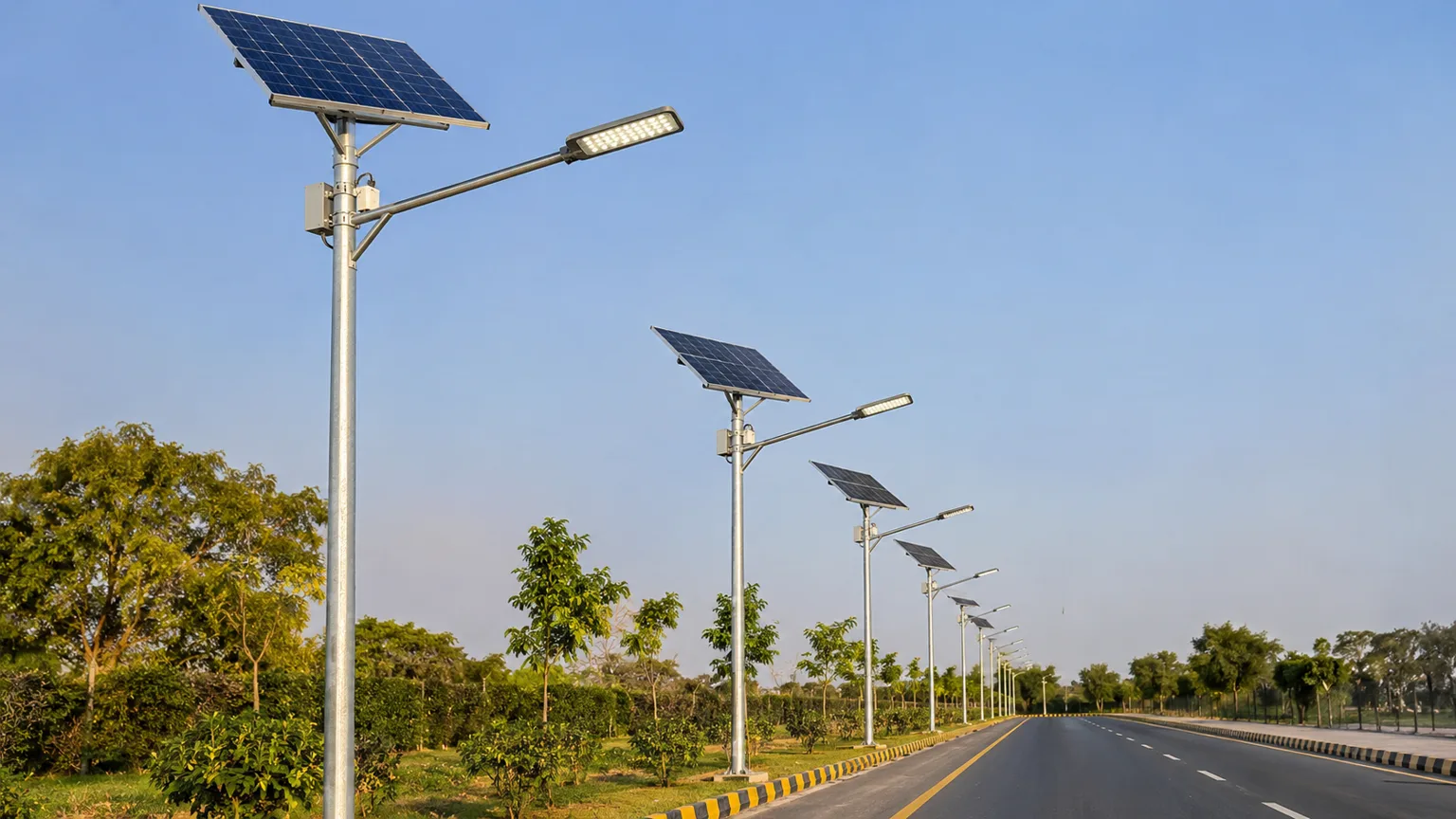
The distribution also guides the choice of product. Compact all-in-one solar street lights are popular on residential streets, paths and parks, where Type II and narrower patterns are common. Main roads and highways, which often need Type III patterns on taller poles and higher output, are usually better served by split type (all-in-two) solar street lights. DEL’s Split Type range, for example, uses a wide 80° by 150° beam suited to road lighting. For the differences between these designs, see our guide to 2 in 1 solar street lights.
Frequently Asked Questions
Which of the street light distribution types is most common?
Type III is the most common for general roadways, because it covers a typical two-lane road from a pole at the roadside. Type II is common on residential streets and wide walkways.
Type 2 vs type 3 street light: what is the difference?
Type II covers roads up to about 1.75 times the mounting height and suits narrower streets and paths. Type III covers roads up to about 2.75 times the mounting height and suits wider roads lit from one side.
Which street light distribution types are best for a parking lot?
Type IV is often used along the edges of a car park, because it throws light forward with little spill behind the pole. Type V suits poles placed in the middle of the parking area.
Do solar street lights come in different street light distribution types?
Many do. The distribution is set by the optics, so the same light can often be supplied with different lenses for different roads. Ask the supplier for the photometric file of the exact optic offered.
How do I know which type my project needs?
Start from the road width and pole position, then confirm the choice with a lighting calculation using the luminaire’s photometric file. A lighting designer or the manufacturer’s engineering team can run this for your roads.
Get the Light Where It Belongs
Choosing between street light distribution types puts light on the road, not around it, which makes every solar street light smaller, every project cheaper and every road safer. If you are planning a project and are not sure which pattern fits your roads, talk to a DEL project engineer for a free consultation and a DIALux design with the photometric files your evaluators will want to see.