
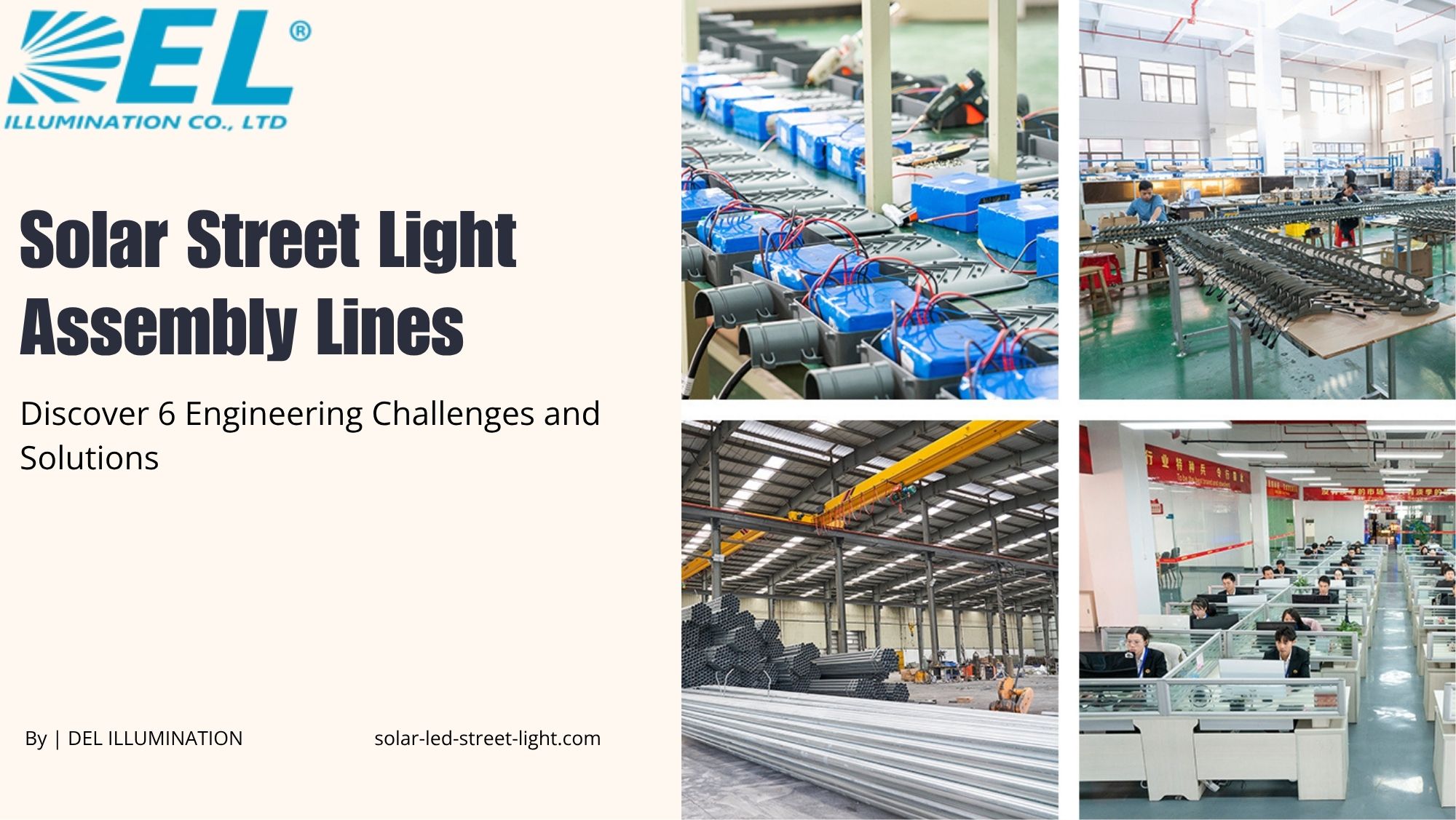
As a manufacturer, we have faced various challenges on our Solar Street Light Assembly lines and have had to innovate to remain competitive and on top of the game. This is nothing new: as customer demands evolve, so must we. In this fast paced world of renewable energy, staying stagnant is not an option. Let us explore the strategies we have adopted to tackle the challenges on our assembly lines, and share practical insight into how you can maintain your own competitive edge.
Challenges and Solutions on Solar Street Light Assembly Lines
What are some of the challenges you are sure to meet along the way? Below we break down six of the most common, with appropriate solutions for each.
Component Integration
Solar streetlights have many components that must work together seamlessly, and combining these elements often poses an integration challenge. One issue is ensuring compatibility among parts sourced from separate suppliers. Mismatched specifications or designs can lead to malfunctions or even complete failure of the solar street light assembly. To address this, establish stringent quality control through meticulous testing of components before integration to verify compatibility. Collaborate closely with your suppliers and conduct regular audits to maintain consistency in component quality.
Another challenge is the physical integration of all these components within the street light structure. You often have limited space, and specific design requirements demand precise placement. There are two easy fixes. First, use modular design principles so standardized components fit together smoothly. Second, standardize the manufacturing process, which reduces production time and minimizes errors during solar street light assembly.
Quality Control
You want to meet the quality expectations of your customers, and you achieve this only with a vigorous quality control mechanism on the solar street light assembly line. One major challenge is variability in the performance of different components. Test the solar panels for efficiency in converting sunlight into usable electricity. Test the batteries for reliability and durability in energy storage. Precisely calibrate any sensors and the controller for efficient operation, since slight variations in manufacturing can cause significant differences in performance. Be proactive and implement rigorous testing at multiple stages, including pre assembly testing of individual components and post assembly testing of the final product.
You should also set up a robust quality management system to improve control. A quality management system provides a framework for consistently producing high quality products by standardizing processes, documenting procedures, and regularly reviewing production methods. Certifications like ISO 9001 demonstrate your commitment to quality and help you build and retain a skilled workforce that values quality at every stage.
Supply Chain Management
The COVID 19 pandemic highlighted the critical importance of a stable supply chain. A key challenge lies in the sourcing and availability of components such as photovoltaic panels, batteries, and LED modules. These often come from suppliers around the globe, leading to potential delays and disruptions, which geopolitical tensions, trade restrictions, and logistical hurdles can worsen. Establishing long term partnerships and agreements helps ensure a more stable supply of critical components for the solar street light assembly. Diversify your supplier base to reduce dependency on any single source.
Another challenge is maintaining consistent quality across different batches of components. Variations in input quality lead to inconsistencies in the final product. To mitigate this, coordinate the various production stages precisely so each flows harmoniously. Encourage strong communication between production teams to improve morale and output, and use regular audits and inspections to catch issues early.
Energy Efficiency
To improve energy efficiency, start with the components used in the light. High efficiency photovoltaic cells, batteries, and LED modules are essential to reduce energy losses. Use monocrystalline panels for their high efficiency rates instead of polycrystalline, and choose lithium ion batteries for their storage capability and longer life cycles. Reserve funds for research and development, which can expose you to new materials and technologies such as perovskite PV cells, solid state batteries, and IoT integration that could transform how solar streetlights work.
We often overlook efficiency within the solar street light assembly line itself, focusing only on the end product. Identifying and addressing inefficiencies in the line is crucial. Some stages, like welding, consume substantial electrical energy, so techniques like pulse welding help avoid huge electrical bills. Optimize the design and layout of your line, and adopt Lean manufacturing principles to streamline production.
Cost Efficiency
Cost is always tricky in manufacturing. The goal is to minimize expenses across the solar street light assembly while maintaining a high quality product, and that needs a multi faceted approach. First, streamline the manufacturing process. Automation reduces labor costs and improves throughput by increasing the speed and accuracy of assembly tasks, which lowers per unit costs.
Next, optimize the streetlight components. Your engineering team can create designs that use cost effective materials without compromising durability or function. This may involve research into alternative materials that offer similar performance at lower cost. Simplify the design where possible to reduce manufacturing complexity and lower production expenses.
Scalability
We all dream of outgrowing our current line thanks to rising demand and growing margins. That dream turns troublesome if you cannot handle increasing production without compromise. First, optimize the solar street light assembly layout and workflow, because inefficient layouts, bottlenecks, or manual processes hinder the smooth flow of materials. Rearrange workstations for better flow and automate repetitive tasks.
Second, source components in large quantities while maintaining quality standards, since scaling up needs a constant supply of materials. Implement a robust supply chain system to keep a steady flow of high quality materials at competitive prices. Finally, reflect on your workforce. Ensure it is adequately trained, motivated, and equipped as production scales, and invest in training programs, cross training, and knowledge transfer. For proven, factory built systems, explore our All In One solar street lights range.
Conclusion
There is no way around optimizing your Solar Street Light Assembly line if you want to stay competitive. The six challenges covered here, component integration, quality control, supply chain, energy efficiency, cost efficiency, and scalability, are the core of a resilient manufacturing operation. Master them, and you build products that perform reliably in the field while protecting your margins. To see the standards these principles produce, review our completed projects, and contact us with any challenge we have not covered.
Frequently Asked Questions
What is a Solar Street Light Assembly line?
It is the production process where photovoltaic panels, batteries, LED modules, controllers, and sensors are integrated into a finished street light. A well designed line balances quality control, efficiency, and cost while allowing the operation to scale as demand grows.
Why is component integration the hardest step?
Parts often come from different suppliers with different specifications, so mismatches can cause malfunctions or system failure. Modular design and standardized processes let components fit together reliably within the limited space of the fixture.
How does a quality management system help production?
It standardizes processes, documents procedures, and drives continuous review so every unit meets the same standard. Certifications like ISO 9001 formalize that commitment and support a skilled, quality focused workforce.
What improves energy efficiency on the assembly line itself?
Beyond high efficiency panels and batteries in the product, the line benefits from techniques like pulse welding and Lean manufacturing. These cut electrical waste and streamline workflow without slowing output.
How can a manufacturer prepare an assembly line to scale?
Optimize layout to remove bottlenecks, automate repetitive tasks, secure bulk supply through strong supplier partnerships, and train the workforce ahead of demand. These steps let output rise without sacrificing quality.