
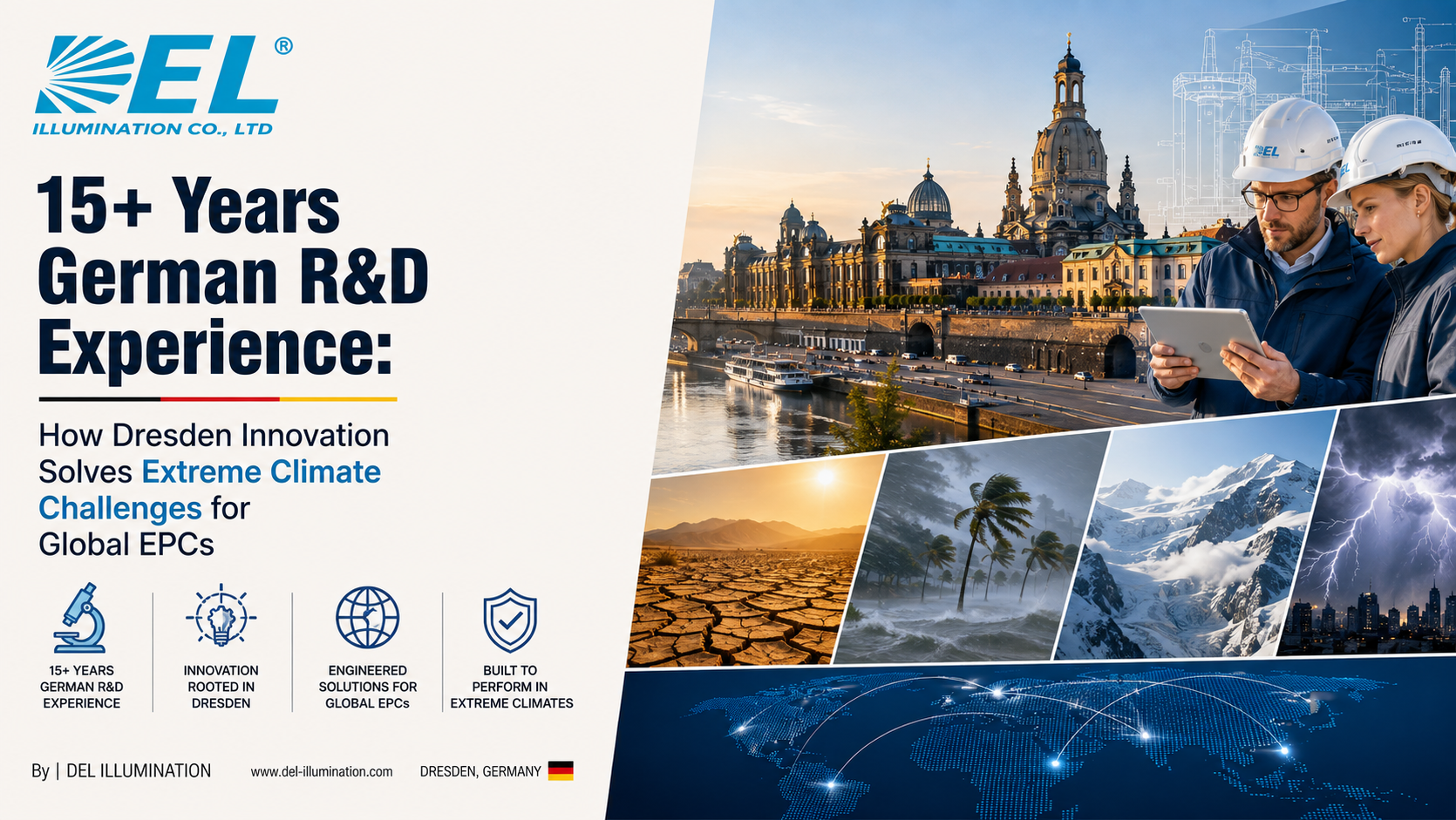
Across the world’s harshest deployment zones, a quiet failure repeats itself. In Egypt’s desert corridors, ordinary solar lights installed to withstand 45 to 50 degree Celsius heat and Khamsin sandstorms often fail within one to two years, undone by weak batteries and poor thermal protection. The lesson is uncomfortable for procurement teams: a solar street light that performs beautifully in a temperate lab can collapse in a real desert, a monsoon belt, or a sub zero winter.
This gap between catalogue promise and field reality is exactly where German R&D solar street lights have built their reputation over more than fifteen years of iterative engineering. The difference between a light that endures and one that fails is rarely luck; it is the accumulated discipline behind German R&D solar street lights.
For EPC contractors, city planners, and procurement officers managing infrastructure across dozens of climate zones, the stakes are financial as much as technical. A failed luminaire is not just a warranty claim. It is a truck roll, a re excavation, a reputational dent on a bankable project. This article explains how disciplined German engineering standards translate into measurable survival advantages in extreme climates, what specific technologies drive that resilience, and how to evaluate a supplier before a single pole goes into the ground.
The Real Cost of Climate Failure in Global Lighting Projects
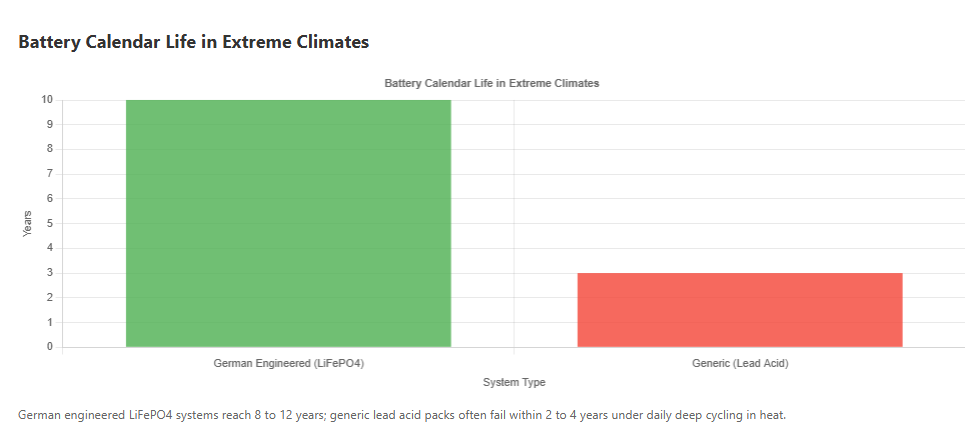
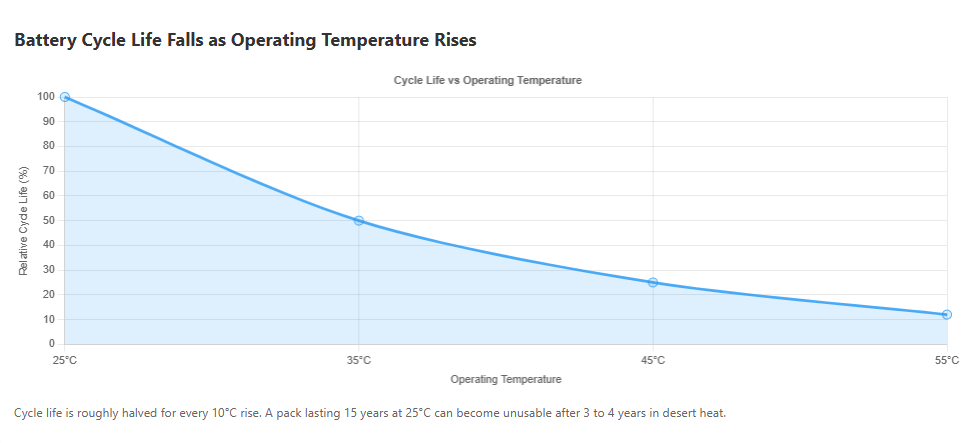
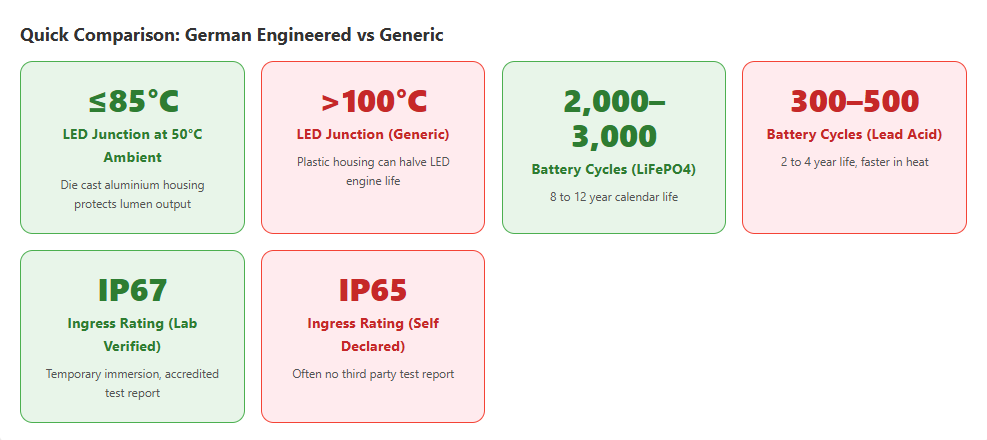
Extreme climates punish the weakest component first, and in solar lighting that component is almost always the battery. Field data is unforgiving: for every ten degree Celsius rise in operating temperature, the cycle life of a lithium solar battery is roughly halved. A pack rated to last fifteen years at twenty five degrees Celsius can become unusable after only three to four years in desert conditions. Generic lead acid batteries fare far worse, often surviving barely one and a half to two years under daily deep cycling in heat.
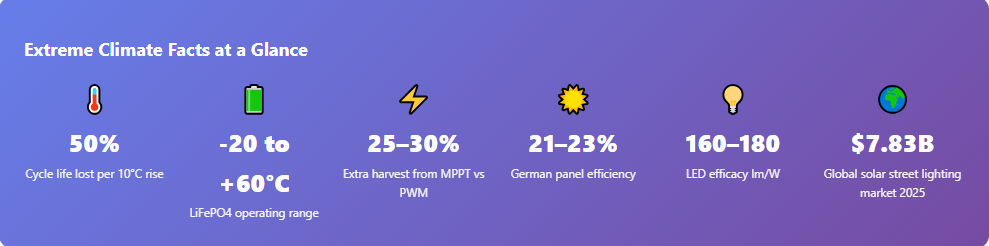
This matters because the Middle East and Africa outdoor LED lighting market alone was valued at around 1.45 billion US dollars in 2025, with Saudi Arabia, the UAE, and rapidly electrifying African nations driving demand. The global solar street lighting market reached roughly 7.83 billion US dollars in 2025 and is forecast to expand strongly through the next decade. In every one of these regions, temperature, dust, humidity, and salt air are silently deciding which installations last a decade and which need replacement before their first warranty cycle closes.
For a large EPC portfolio, premature failure across even a fraction of installed units multiplies replacement cycles, drives total cost two to three times higher than a properly engineered system, and erodes the near zero operational cost that made solar attractive in the first place. Climate resilience, in other words, is not a luxury specification. It is the foundation of project economics, and it is precisely the problem German R&D solar street lights were built to solve.
Thermal Management: Where German R&D Solar Street Lights Earn Their Reputation
Heat is the silent killer of solar lighting, and thermal management technology is where rigorous engineering separates itself from the crowd. The problem operates on two fronts simultaneously: the LED junction and the battery. At fifty degree Celsius ambient temperature, a well engineered German solar street light keeps its LED junction at or below eighty five degrees Celsius using die cast aluminium housings that pull heat away efficiently. Generic fixtures with plastic or thin metal housings frequently exceed one hundred degrees Celsius at the junction, which accelerates lumen depreciation and can halve the practical life of the LED engine.
The battery side demands equal discipline. German R&D solar street lights standardise on LiFePO4 (lithium iron phosphate) chemistry, which maintains stable performance from minus twenty to plus sixty degrees Celsius and resists the thermal runaway that causes fires in lesser lithium cells. Crucially, high performing systems pair this chemistry with active battery management and intelligent thermal design, because even LiFePO4 suffers electrolyte decomposition and capacity loss when left unventilated in extreme heat. The engineering answer is not simply a better cell. It is a system that protects the cell.
This is the core insight of extreme temperature performance engineering: resilience comes from integration, not from any single hero component. Panel efficiency of twenty one to twenty three percent, an MPPT (maximum power point tracking) charge controller that harvests twenty five to thirty percent more energy than basic PWM controllers, and climate specific backup sizing of three to seven days all work together to keep the system alive through the worst the environment can throw at it.
Certification and Ingress Protection: Proof Over Promises
In extreme environments, an unverified claim is worse than no claim at all. This is why German engineering standards lean so heavily on independent, accredited testing rather than self declaration. The relevant benchmarks are internationally recognised: IEC 60598 governs luminaire safety and testing, while IEC 60529 defines the ingress protection ratings that determine whether dust and water stay out of sensitive electronics.
The distinction between IP65 and IP67 is not marketing trivia in a sandstorm zone. IP65 protects against dust and low pressure water jets and works well for most roads and plazas. IP67, verified by an accredited laboratory, adds protection against temporary immersion, which matters on flooded roads, low lying coastal sites, and areas prone to standing water. German engineered systems typically carry IP67 confirmed through a certified lab, alongside an IK08 or higher impact rating that resists vandalism and debris. Generic products often claim IP65 on a self declared basis, with no third party test report to back it.
Certification bodies such as TÜV apply IEC 60598 and IEC 60529 methods with specific, documented conditions, issuing test reports that relate only to the object actually tested. For a procurement officer, the practical rule is simple: demand the certificate, demand the accredited lab name, and demand the test report. Genuine German R&D solar street lights make this transparency routine, because rigorous testing is the entire point of the discipline. Verified reliability is the difference between a warranty on paper and a warranty that holds.
Field Proven Across Deserts, Monsoons, and Cold Zones
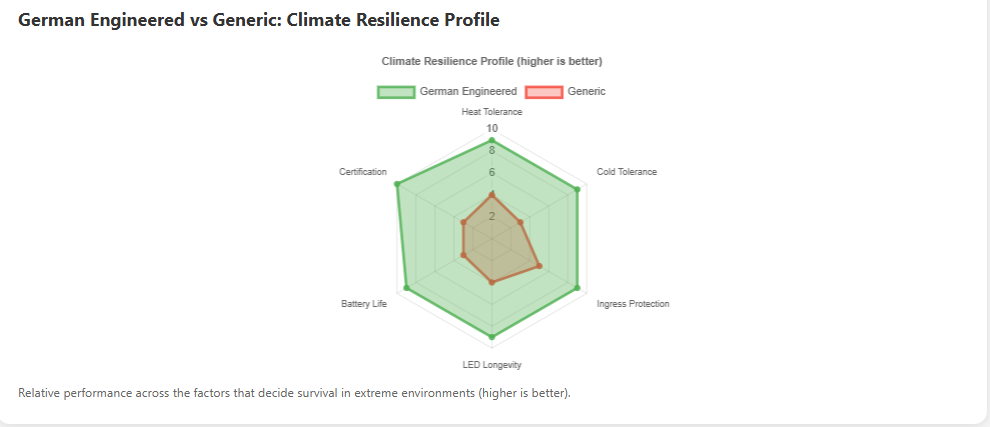
Fifteen years of field deployment produce something no laboratory can fully replicate: real world failure data that feeds back into design. This is the quiet advantage behind mature German R&D solar street lights. Each generation absorbs lessons from the previous one, tightening tolerances for the specific stresses of each climate band.
In desert conditions across the Middle East and North Africa, the design priorities that shape German R&D solar street lights are heat rejection, dust sealing, and sandstorm survival. Systems built for these zones combine IP67 sealing, corrosion resistant enclosures, and LiFePO4 packs rated to plus sixty degrees Celsius, precisely because ambient temperatures of forty five to fifty degrees Celsius are routine and standard batteries degrade within a single summer.
In tropical and monsoon environments across Southeast Asia and coastal regions, humidity ingress and salt corrosion dominate, so enclosure sealing and coating quality take precedence. In cold zones down to minus twenty degrees Celsius, LiFePO4 chemistry retains over eighty percent of its capacity where generic lithium loses thirty to fifty percent, and thermal design shifts toward charge protection.
The through line across all three is climate specific testing protocols. A supplier that has genuinely engineered for extreme environments does not offer one product for the world. It offers backup day sizing, battery chemistry, and ingress ratings matched to the actual conditions of the site, backed by the field history to prove those choices survive. That is what field proven technology means in practice, and it is the reason experienced EPCs increasingly specify German engineered systems for their most demanding projects.
Conclusion
Extreme climates expose every shortcut in a solar lighting system, and they do it on a timeline measured in months rather than years. The evidence is consistent: heat halves battery life for every ten degrees of rise, generic housings cook LED junctions past one hundred degrees Celsius, and self declared ratings collapse in the field. German R&D solar street lights answer these challenges through integrated thermal management technology, LiFePO4 chemistry engineered for minus twenty to plus sixty degrees Celsius, accredited IP67 and IK08 certification, and more than fifteen years of climate specific field data feeding continuous improvement.
For EPC contractors and procurement teams, the takeaway is clear. Climate resilience is an engineering discipline, not a marketing adjective, and it directly determines whether a project delivers near zero operational cost or drifts into repeated replacement cycles. Choosing verified, field proven technology protects both the installation and the bankability of the project behind it.
To specify solar LED street lighting engineered to survive your project’s toughest climate, visit solar-led-street-light.com for expert consultation or a customised quote tailored to your site conditions.
Frequently Asked Questions
How much does extreme heat actually shorten solar street light battery life?
Field data shows that for every ten degree Celsius rise in operating temperature, lithium solar battery cycle life is roughly halved. A battery rated for fifteen years at twenty five degrees Celsius may become unusable within three to four years in constant desert heat unless the system uses heat tolerant LiFePO4 chemistry and active thermal management.
Is IP67 always necessary, or is IP65 sufficient for hot dry climates?
IP65 is adequate for most roads and plazas where dust and rain are the main threats. IP67, verified by an accredited lab, becomes important for flooded roads, low lying coastal sites, and areas with standing water. In sandstorm zones, the dust sealing of both is strong, so the deciding factor is usually water exposure and whether the rating is independently tested rather than self declared.
Why does LiFePO4 matter more than standard lithium ion for extreme climates?
LiFePO4 maintains stable performance from minus twenty to plus sixty degrees Celsius and resists thermal runaway, the chain reaction that causes fires in some lithium ion cells. Standard lithium ion can lose thirty to fifty percent of capacity in freezing conditions and degrades far faster in sustained heat, making it a poor fit for desert, monsoon, or cold zone infrastructure.
How can a procurement officer verify climate resilience claims before ordering?
Request the accredited test reports for IP and IK ratings, confirm the testing laboratory is named and independent, and ask for the battery chemistry and its rated temperature range in writing. Genuine German engineering standards make this documentation routine, so reluctance to provide it is itself a warning sign.
What backup days should be specified for cloudy or monsoon regions?
Climate dependent sizing typically ranges from three to seven days of autonomy, meaning the system runs that many nights without meaningful solar charging. Monsoon belts and high latitude sites need the higher end of that range, while consistently sunny desert regions can often use fewer, provided battery temperature is managed.
Do German engineered systems cost more, and is the premium justified?
Upfront cost is typically higher, but the ten year total cost of ownership is usually lower because generic systems drive two to three times higher lifecycle cost through repeated replacements. In extreme climates, where generic units may fail within one to two years, the premium is often recovered well before the first replacement cycle a generic system would have required.
How does thermal management protect the LED, not just the battery?
At fifty degree Celsius ambient, die cast aluminium housings keep the LED junction at or below eighty five degrees Celsius, preserving lumen output over the rated fifty thousand hour life. Plastic or thin metal housings can push the junction beyond one hundred degrees Celsius, which accelerates light depreciation and can halve the LED engine’s practical lifespan.
Can one product line serve deserts, monsoons, and cold zones equally well?
No credible supplier offers a single unchanged product for every climate. Resilient design means matching battery chemistry, backup day sizing, ingress rating, and enclosure coating to the specific stresses of the site, backed by field history from comparable deployments. A supplier offering true climate specific configurations is a stronger partner than one selling a universal unit.
References
International Electrotechnical Commission. (2024). IEC 60598 Luminaires: General requirements and tests. https://www.iec.ch/
International Electrotechnical Commission. (2024). IEC 60529 Degrees of protection provided by enclosures (IP Code). https://www.iec.ch/
TÜV Rheinland. (2025). Lamps, luminaires and light components testing and certification. https://www.tuv.com/world/en/testing-lamps-luminaires-light-components.html
International Renewable Energy Agency. (2026). Renewable capacity statistics 2026. https://www.irena.org/
Mordor Intelligence. (2026). Middle East and Africa outdoor LED lighting market report. https://www.mordorintelligence.com/industry-reports/middle-east-and-africa-outdoor-led-lighting-market
Expert Market Research. (2026). Solar street lighting market size, share and growth forecast to 2035. https://www.expertmarketresearch.com/reports/solar-street-lighting-market
International Energy Agency. (2025). Renewables 2025: Analysis and forecast. https://www.iea.org/reports/renewables-2025
U.S. Department of Energy. (2024). Solid state lighting research and development. https://www.energy.gov/eere/ssl/solid-state-lighting
Disclaimer: This article is for informational purposes only and does not constitute professional engineering, installation, or procurement advice. Performance specifications and costs may vary based on project requirements, location, and local regulations. Always consult qualified solar energy professionals and legal advisors before making procurement decisions.
For expert consultation on solar LED street lighting solutions, visit solar-led-street-light.com or contact our team for a customised quote.