
A single missing certificate can sink a multi-million-dollar solar street lighting tender. Independent engineers reviewing utility-scale portfolios routinely reject entire shipments because a photovoltaic module carries an outdated standard, or because a “CE certificate” turns out to be a self-issued marketing document with no accredited test behind it. In practice, specifying uncertified hardware is not viable for any project seeking finance, because banks, insurers, and independent engineers treat certification as the minimum threshold for module acceptance during due diligence.
For city planners, facility managers, procurement officers, and EPC contractors, understanding bankable solar street light certifications is no longer optional paperwork. It is the difference between a financeable project and a stranded asset. This guide breaks down the CE, IEC, and LM-80 standards that lenders demand, explains how each is verified, and shows how German-engineered systems clear these hurdles where generic alternatives quietly fail. If you are still weighing suppliers, the German engineering standards applied by serious manufacturers set the benchmark this article measures against.
Why Certification Decides Bankability, Not Just Compliance
Bankability describes whether a financial institution is willing to fund a project or the factory behind it. In solar, that willingness collapses without proper certification, because financiers view uncertified modules as an unacceptable risk that no return can justify. A bankable product carries an independent, third-party guarantee that the hardware is safe, reliable, and will generate projected returns across its service life. Remove that guarantee and the equipment is effectively excluded from serious commercial, industrial, or utility-scale procurement. This is why bankable solar street light certifications sit at the centre of every lender conversation.
For EPC contractors, this reframes certification entirely. It is not a box-ticking exercise handled at shipping. It is a financial instrument that unlocks lender approval, insurance coverage, and government incentive eligibility. In markets such as India, for example, listing on the Approved List of Models and Manufacturers requires both IEC 61215 and IEC 61730 certification as prerequisites, and without that listing, national subsidy schemes remain out of reach.
The pattern repeats globally: no certification, no listing, no financing. This is also why multilateral lenders now weight technical documentation so heavily, as our guide to ADB and World Bank solar street light procurement explains in detail. Serious procurement teams therefore treat bankable solar street light certifications as the first filter applied to any supplier shortlist, long before price negotiations begin. This is exactly why understanding certification requirements for bankable EPC contracts belongs at the start of procurement, not the end.
CE Marking: What It Actually Certifies and What It Does Not
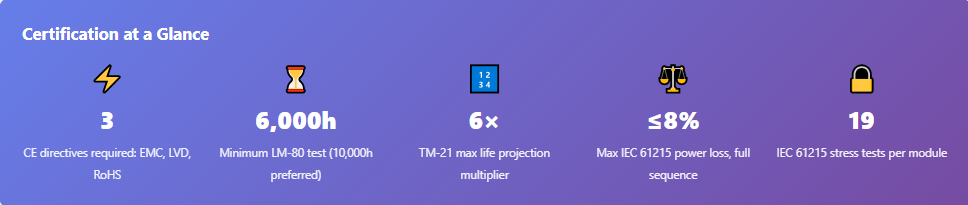
CE marking declares conformity with European Union safety, health, and environmental directives. For a solar street light, three directives typically apply: the EMC Directive (2014/30/EU) covering electromagnetic compatibility, the LVD or Low Voltage Directive (2014/35/EU) covering electrical shock protection, and the RoHS Directive (2011/65/EU) restricting hazardous substances such as lead, mercury, and cadmium. A CE mark that covers only EMC testing, without LVD and RoHS, is incomplete and should be rejected during verification.
Here the procurement officer must understand a critical nuance. The LVD permits self-declaration, meaning a manufacturer can perform its own conformity assessment without any notified body involvement. In a self-declared route, no certificate is ever issued by an external authority, so any document labelled a “CE certificate” for such a product is either a nickname for an in-house test report or, worse, a fabrication.
Most solar street lights operate below 50 volts and technically fall outside mandatory LVD scope, which is precisely why unscrupulous suppliers present impressive-looking paperwork that verifies nothing. German-engineered systems close this gap by commissioning accredited third-party laboratories to test electrical safety, EMC, and photobiological safety even where self-declaration would be legally sufficient, producing verifiable reports rather than bankable project documentation in name only. Genuine bankable solar street light certifications rest on accredited testing, not self-issued paper.
IEC 61215 and IEC 61730: The Non-Negotiable Module Standards
For the photovoltaic panel itself, two IEC standards form the bedrock of bankability. IEC 61215 is the design-qualification benchmark for crystalline-silicon modules, subjecting them to roughly 19 stress tests including ultraviolet exposure, thermal cycling, damp-heat, mechanical load, and hail impact. To pass, a module must lose no more than 5 percent of maximum power after any single test and no more than 8 percent across the full sequence, measured at Standard Test Conditions. IEC 61730 runs in parallel and addresses safety, covering electrical shock, fire, and mechanical hazard through construction requirements in Part 1 and testing protocols in Part 2.
A module without IEC 61215 is effectively unbankable, full stop. Lenders and independent engineers use it as the minimum acceptance threshold, and bankability assessments from organisations such as PVEL and DNV build additional stress testing on top of that baseline. Current EPC contract specifications increasingly demand the 2021 revision of these standards.
Australia now requires IEC 61215:2021 compliance for all new installations, and since April 2025 only panels meeting the updated standard qualify for government incentives, with non-compliant products removed from approved lists. Verifying CE IEC certification requirements therefore means checking not just that a certificate exists, but that it references the current standard version and the exact model being supplied. Our guide to street lighting standards comparison details how these thresholds differ across jurisdictions, and why they anchor bankable solar street light certifications everywhere lenders operate.
LM-80 and TM-21: Proving the LED Will Last
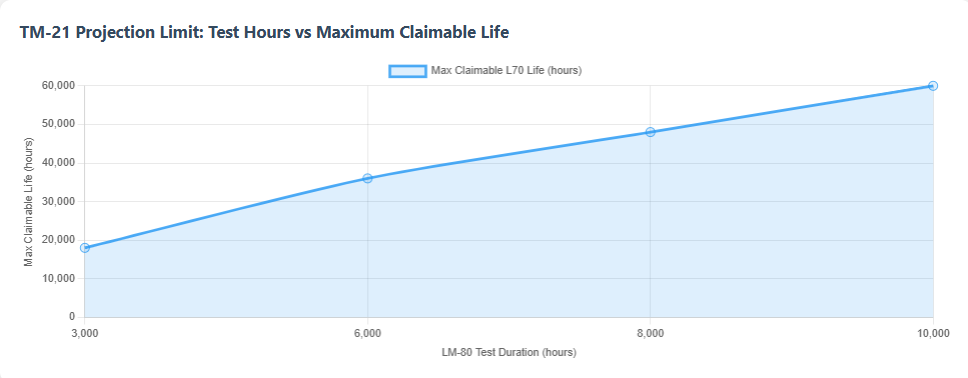
The LED engine carries its own certification chain, and this is where many generic products quietly fail. IES LM-80 is the measurement standard for lumen maintenance, tracking how much light an LED package loses over time. It requires a minimum of 6,000 hours of continuous testing, though 10,000 hours is preferred for accuracy, with packages measured at multiple case temperatures such as 55 degrees, 85 degrees, and a manufacturer-selected high temperature. LM-80 is strictly a test of the LED chip, not the whole fixture.
TM-21 is the companion mathematical method that projects service life from LM-80 data. It fits the measured decay to a curve and calculates L-values, where L70 marks the operating hours until output drops to 70 percent of original. Crucially, TM-21 caps projections at six times the tested duration, so a 10,000-hour test legitimately supports only a 60,000-hour L70 claim, no more. This single rule exposes inflated spec sheets instantly: any supplier claiming 100,000 hours from a 10,000-hour test is projecting beyond what the standard permits.
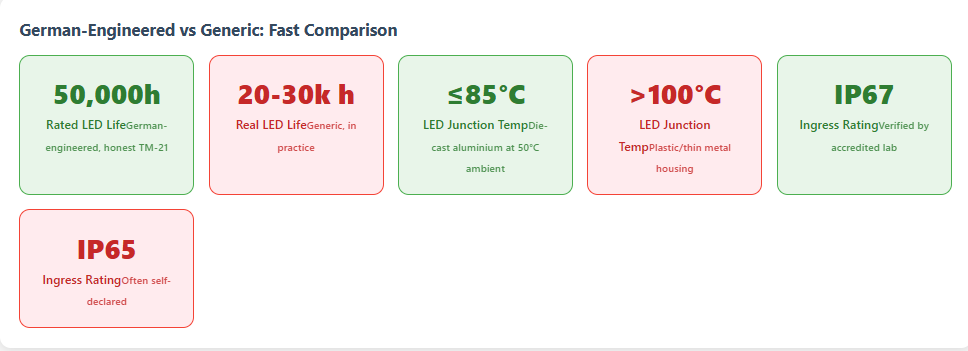
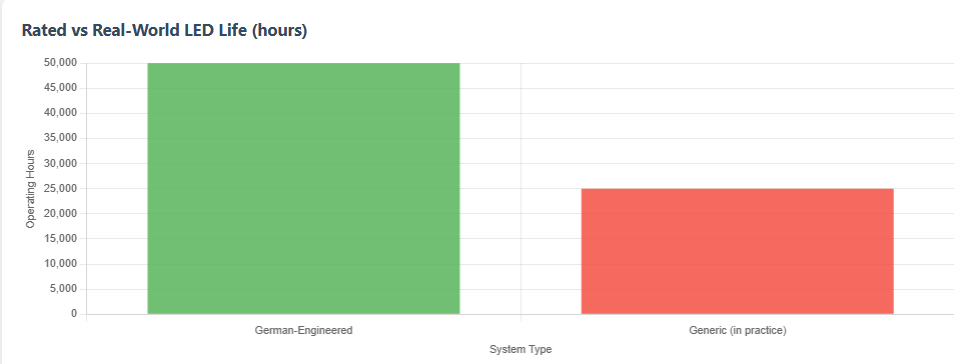
German-engineered luminaires publish full LM-80 reports with honest TM-21 projections and maintain low LED junction temperatures at or below 85 degrees in 50-degree ambient conditions, protecting the 50,000-hour rated life. Generic housings running above 100 degrees see real-world life collapse toward 20,000 to 30,000 hours regardless of the printed claim, which is why our IP65 solar street lights guidance stresses thermal design alongside ingress protection. LM-80 sits at the heart of any credible solar certification verification process and is a load-bearing element of bankable solar street light certifications.
How to Verify Genuine Certifications and Avoid Fabrications
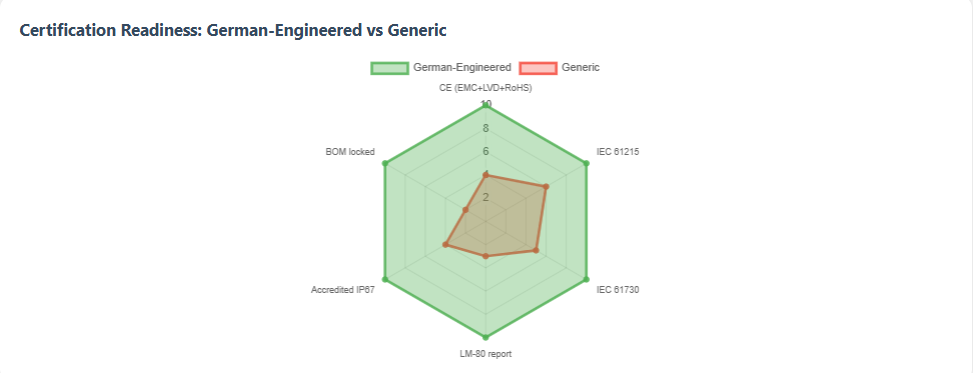
Possessing a certificate and possessing a valid certificate are different things. Effective third-party verification process discipline starts with matching the model. A certificate must reference the exact model number offered, because a certificate for “Model A” does not cover “Model A-V2” or “Model A-Pro,” and suppliers frequently present paperwork for discontinued models while claiming it applies to current stock. Next, read the scope: confirm CE paperwork covers all three directives, not EMC alone, and check that any component change has triggered re-testing, since a single altered driver or resistor voids the original report.
Bill-of-materials discipline matters enormously here. Because one component swap invalidates a test report, rigorous manufacturers lock the bill of materials and re-test after any change. Buyers should also confirm the issuing laboratory is genuinely accredited rather than a related trading entity, and request the underlying LM-80 and IEC test reports rather than accepting a summary certificate at face value. These certification authenticity checking steps form the core of professional bankable project documentation review.
When a supplier resists producing full reports, that resistance is itself the finding. Building these verification obligations into the tender itself, alongside the risk-allocation terms covered in our FIDIC EPC contract for solar street light guide, keeps the burden of proof upstream where it belongs. Robust bankable solar street light certifications verification protects the EPC contractor from carrying reputational and financial risk that properly belongs upstream, and complements the total-cost thinking in our total cost of ownership for EPC projects analysis.
Conclusion
Certification is the financial backbone of every serious solar street lighting project. Three takeaways should guide every procurement decision. First, treat bankable solar street light certifications as a lender filter rather than shipping paperwork, because without valid CE, IEC 61215, IEC 61730, and LM-80 documentation, a project cannot reach financial close.
Second, verify rather than trust: match certificates to exact models, confirm CE covers EMC, LVD, and RoHS together, and reject any TM-21 lifetime claim that exceeds six times the LM-80 test duration. Third, recognise that German-engineered systems clear these standards by design, publishing honest test data where generic alternatives rely on self-declared marketing documents. For expert help specifying verifiable, lender-approved solar lighting, visit solar-led-street-light.com for a customised consultation and quote.
Frequently Asked Questions
Is CE marking alone enough to make a solar street light bankable?
No. CE marking addresses EU safety and environmental compliance, but bankability additionally requires IEC 61215 and IEC 61730 for the photovoltaic module and LM-80 data for the LED. A valid CE mark must also cover EMC, LVD, and RoHS together; a partial CE claim covering only EMC is incomplete and should be flagged.
How can I tell if a CE certificate is genuine or self-declared?
Check whether an accredited notified body issued it and whether accredited-laboratory test reports support it. Under the Low Voltage Directive, manufacturers may self-declare without any external certificate, so a document simply titled “CE certificate” may be an in-house test report. Always request the underlying EMC, LVD, and RoHS reports.
Why does the TM-21 six-times rule matter for procurement?
TM-21 forbids projecting LED life beyond six times the LM-80 test duration. This lets you instantly detect inflated claims: a 100,000-hour lifetime advertised from only a 10,000-hour test breaches the rule. Ask for the LM-80 test hours and the TM-21 worksheet to confirm the stated L70 figure is legitimate.
Do IEC standard version numbers actually affect financing?
Yes. Lenders and incentive programmes increasingly demand the current revision. Australia has required IEC 61215:2021 since April 2025, removing older-standard panels from approved lists. A certificate referencing a superseded version can disqualify a module from subsidies and lender approval even if the panel is otherwise sound.
What happens to certification when a supplier changes a component?
Any component change, even a single resistor or driver swap, voids the associated test report and requires re-testing. This is why disciplined manufacturers lock the bill of materials. A certificate issued before an undocumented component change no longer describes the product you are actually buying.
Which certifications should an EPC contractor request first?
Start with IEC 61215 and IEC 61730 for the module, LM-80 and TM-21 documentation for the LED, and a full CE file covering EMC, LVD, and RoHS. For batteries, request UN38.3 transport safety documentation. Confirm every document references the exact model number quoted in the tender.
Are IP and IK ratings part of bankable certification?
They support it. An IP rating verified by an accredited laboratory, such as IP67, and an impact rating such as IK08 confirm the enclosure withstands weather and mechanical stress. Self-declared IP claims carry little weight in due diligence, so request the underlying ingress-protection test report alongside the electrical certifications.
References
International Electrotechnical Commission. (2021). IEC 61215: Terrestrial photovoltaic (PV) modules – Design qualification and type approval. https://webstore.iec.ch/publication/61345
International Electrotechnical Commission. (2023). IEC 61730: Photovoltaic (PV) module safety qualification. https://webstore.iec.ch/publication/61761
Illuminating Engineering Society. (2021). IES TM-21: Projecting Long-Term Lumen Maintenance of LED Light Sources. https://www.ies.org/standards/
European Commission. (2025). Low Voltage Directive 2014/35/EU and CE marking requirements. https://single-market-economy.ec.europa.eu/sectors/electrical-and-electronic-engineering-industries-eei/low-voltage-directive-lvd_en
International Energy Agency. (2025). Solar PV. https://www.iea.org/energy-system/renewables/solar-pv
PV Evolution Labs. (2025). PV Module Reliability Scorecard. https://www.pvel.com/pv-module-reliability-scorecard/
DNV. (2024). PV module bankability and technical due diligence. https://www.dnv.com/services/solar-photovoltaic-services-88178/
Clean Energy Regulator, Australia. (2025). Solar panel validation and IEC compliance requirements. https://cer.gov.au/
Disclaimer: This article is for informational purposes only and does not constitute professional engineering, installation, or procurement advice. Performance specifications and costs may vary based on project requirements, location, and local regulations. Always consult qualified solar energy professionals and legal advisors before making procurement decisions.
For expert consultation on solar LED street lighting solutions, visit solar-led-street-light.com or contact our team for a customised quote.