
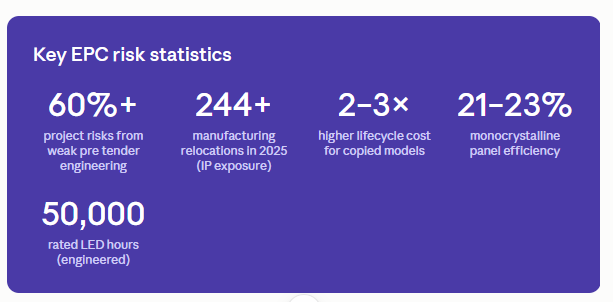
More than sixty percent of solar street light project failures trace back not to installation errors but to what was specified before the tender closed. In distributed manufacturing, one number frames the stakes for procurement teams: in 2025 alone, more than 244 major manufacturing relocation decisions were announced worldwide, and with every shift, copied and unlicensed product designs multiplied across low cost workshops.
For an Engineering, Procurement and Construction (EPC) contractor, this is not an abstract legal concern. When a copied model built around a generic reference design fails after year two, the contractor absorbs the mobilisation cost, the acceptance delay, and the reputational damage. This blog explains why patent design solar street lights lower EPC project risk, how exclusive technology differs from copied models in measurable terms, and what procurement officers should verify before signing a bankable contract.
What a Patent Design Solar Street Light Actually Means
A patent design is a legally registered, exclusive technical and visual configuration of a product. In solar lighting it covers the thermal housing geometry, the optical lens arrangement, the battery integration method, and the controller architecture. This matters because a patent design solar street light is engineered as one coordinated system rather than assembled from interchangeable parts sourced by lowest bid.
The distinction is not cosmetic. A copied model typically reverse engineers the outer shell of a proven product while substituting cheaper internal components the copier never validated. The die cast aluminium housing may become thin stamped metal or plastic. The Lithium Iron Phosphate (LiFePO4) battery becomes an unspecified lithium cell or lead acid. The Maximum Power Point Tracking (MPPT) controller becomes a Pulse Width Modulation (PWM) unit that harvests twenty five to thirty percent less energy.
For EPC teams, exclusive technology means the manufacturer controls the full design chain and can guarantee performance because they own the intellectual property behind it. A patent design solar street light carries traceable engineering accountability. When a fault appears, there is a single responsible party with documented specifications, not a chain of anonymous component suppliers pointing at each other. That accountability is the first layer of project risk reduction.
The Hidden Cost of Copied Models in EPC Projects
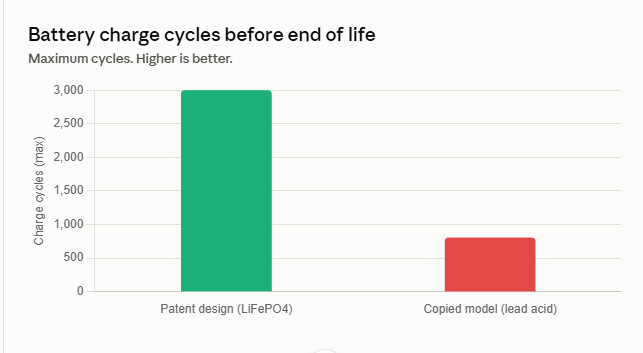
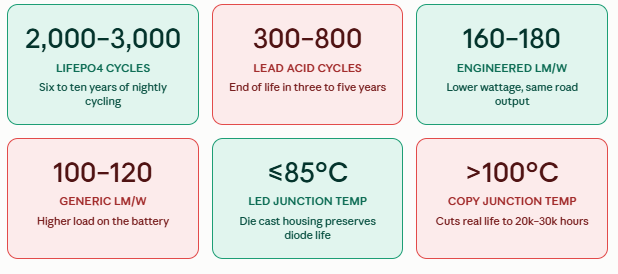
Copied models look attractive at the bidding stage because they undercut engineered systems on upfront price. The risk surfaces after contract award, which is precisely where EPC contractors are most exposed. Industry field analysis shows that low cost units using legacy lead acid batteries degrade rapidly above forty degrees Celsius ambient temperature, delivering only 300 to 800 charge cycles before capacity collapse.
Compare that to a patent design solar street light using LiFePO4 chemistry, which sustains 2,000 to 3,000 cycles and often more, retaining above eighty percent capacity for six to ten years. The arithmetic is unforgiving for the contractor who chose the copy. A lead acid pack cycling nightly reaches end of life in three to five years. For a remote installation, the cost of a single maintenance mobilisation to replace one dead battery can completely wipe out the initial capital savings that made the copied model look cheaper.
There is a second hidden cost that procurement officers frequently miss: patent exposure. When a supplier sells a copied design that infringes a registered patent, enforcement actions can disrupt imports and product availability. A patent dispute that halts shipments mid project leaves the EPC contractor holding a signed delivery obligation with no compliant product. Resolving patent exposure after the fact is almost always more expensive than identifying the risk during planning, and the contractor rarely has visibility into the supplier’s freedom to operate.
How Exclusive Technology Protects Project Timelines and Bankability
Bankable EPC projects funded through development finance require documented, verifiable compliance. Patent design solar street lights built to German engineering standards typically carry TÜV verification, ISO 9001 quality management, and testing against DIN and International Electrotechnical Commission (IEC) standards. These are not marketing badges. They are the evidence a lender or municipal auditor uses to accept the installation.
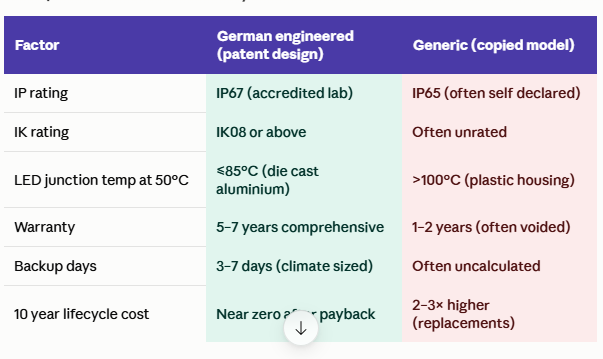
Copied models often self declare ratings. A generic unit may claim an Ingress Protection rating of IP65 with no accredited laboratory report behind it, while an engineered system provides IP67 verified by a recognised lab, along with an IK08 or higher impact rating that copies frequently leave unrated entirely. During acceptance testing, a self declared claim that fails re verification triggers rejection, and rejection means the EPC contractor rebuilds or re sources under a live deadline.
Exclusive technology protects timelines in a more direct way as well. Because the manufacturer owns the design, they can supply matching photometric files, Dialux simulation data, and consistent Bill of Quantities documentation that survives audit. When every unit is built to one controlled specification, uniformity of illumination holds across the whole installation, avoiding the dark spots and failed uniformity ratios that sink acceptance reports. Predictable documentation and predictable performance are what make a project bankable, and both depend on owning the design rather than copying it.
Measurable Performance Differences That Reduce Risk
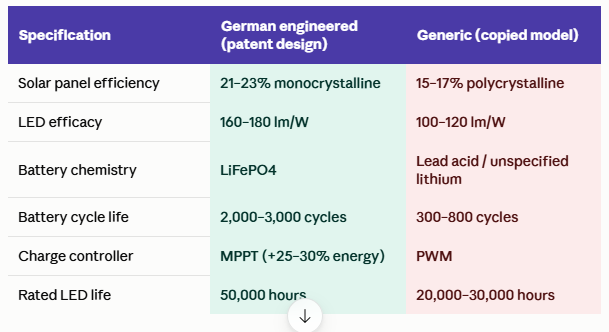
Risk reduction becomes concrete when you place the numbers side by side. A patent design solar street light built to German engineering standards uses monocrystalline panels at twenty one to twenty three percent efficiency, against fifteen to seventeen percent for the polycrystalline panels common in copied units. Higher panel efficiency means the system charges fully even during shorter winter days, sustaining the three to seven backup days that climate dependent sizing demands.
The LED module in an engineered system delivers 160 to 180 lumens per watt, compared with 100 to 120 lumens per watt in generic modules. That efficacy gap means a lower wattage engineered fixture produces the same usable road illumination as a higher wattage copy, cutting the load on the battery and extending autonomy. Rated LED life reaches 50,000 hours in a properly cooled die cast housing that holds junction temperature at or below eighty five degrees Celsius in fifty degree ambient conditions. Copied plastic housings let junction temperature climb past one hundred degrees, cutting real world life to 20,000 or 30,000 hours.
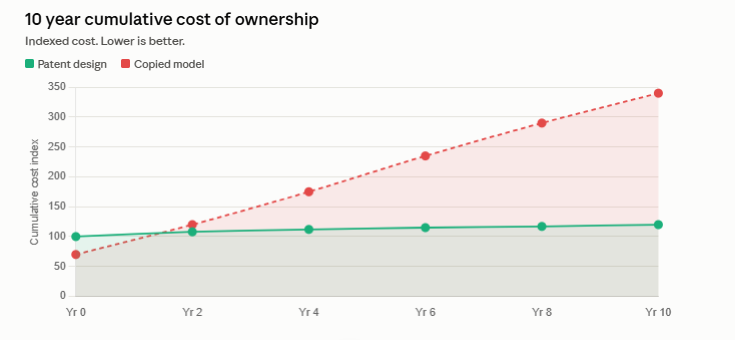
These are not isolated specifications. They compound. A ten year lifecycle comparison shows the engineered system reaching near zero operational cost after payback, while copied models drive replacement cycles that push total cost of ownership two to three times higher. Warranty exposure tells the same story: engineered systems carry five to seven year comprehensive coverage with performance guarantees, while copies typically offer one to two years, frequently voided by the very weather conditions the light was meant to endure. For an EPC contractor whose margin lives or dies on post installation maintenance, these measurable differences are the difference between profit and loss.
How Procurement Teams Can Verify Exclusive Technology
Verification is straightforward once a procurement officer knows what to demand. Request the accredited laboratory reports behind every ingress and impact rating rather than accepting a datasheet claim. Ask for the battery cell specification and cycle life test data, confirming LiFePO4 chemistry and a documented cycle count. Require a Dialux photometric simulation matched to the actual road width, pole height, and spacing of the project, not a generic brochure figure.
Then verify the design ownership itself. Ask whether the manufacturer holds registered design or utility patents on the housing, optics, and integration method, and whether they can supply freedom to operate assurance. A supplier that owns its intellectual property will answer directly; a workshop selling copied models will deflect. This single question separates an engineering partner from a reseller of unvalidated hardware, and it is the cheapest risk mitigation available to any procurement team.
Finally, align the documentation package to the tender before award. Confirm the supplier can deliver datasheets, IES or LDT files, drawings, Bill of Quantities notes, and tender clarification documents. When the paper trail is complete and the design is owned rather than borrowed, the EPC contractor inherits a defensible, auditable, bankable project rather than a liability that surfaces at year two.
Conclusion
Three takeaways should guide every EPC procurement decision. First, patent design solar street lights reduce project risk because a single accountable party owns the full engineering chain, from the verified IP67 housing to the LiFePO4 battery rated for 2,000 to 3,000 cycles. Second, copied models transfer risk onto the contractor through unvalidated components, self declared ratings, and patent exposure that can halt shipments mid project. Third, the price advantage of a copy is an illusion that a two to three times higher total cost of ownership erases within the first replacement cycle.
Exclusive technology is not a premium indulgence. It is the mechanism that keeps timelines, budgets, and acceptance reports intact. For expert consultation on patent design solar street lights engineered to German standards, and for verified documentation that survives audit, visit solar-led-street-light.com to request a customised quote for your next EPC project.
Frequently Asked Questions
Does a patent design solar street light always cost more upfront than a copied model?
Usually the engineered system carries a higher initial price, but the comparison that matters is ten year total cost of ownership. Because copied models trigger replacement cycles that copied warranties rarely cover, they commonly cost two to three times more across the project lifecycle. The upfront premium is recovered well before the first battery replacement on the cheaper unit.
How can an EPC contractor prove a supplier’s design is genuinely patented and not copied?
Request the registered design or utility patent numbers and ask for a freedom to operate statement covering the manufacturing jurisdiction. Genuine IP holders provide this readily, while workshops selling copies deflect or supply nothing. Cross checking patent numbers against a national patent office database gives independent confirmation.
What happens to a project if a supplier’s copied design is found to infringe a patent mid contract?
Infringement enforcement can trigger import restrictions or exclusion orders that halt shipments of the affected product. The EPC contractor is then left with a live delivery obligation and no compliant hardware, forcing emergency re sourcing under deadline. This exposure is a core reason bankable tenders increasingly require IP assurance.
Are self declared IP ratings acceptable for a bankable EPC project?
Development finance and municipal audits generally require ratings verified by an accredited laboratory, not manufacturer self declaration. A self declared IP65 claim that fails re verification during acceptance testing causes rejection and rework under a live schedule. Always request the underlying test report before award.
Why do copied models fail faster in hot climates specifically?
Copies frequently substitute lead acid or unspecified lithium cells that degrade rapidly above forty degrees Celsius, delivering only 300 to 800 cycles. Their thin plastic or stamped housings also allow LED junction temperatures to exceed one hundred degrees, shortening diode life. Engineered LiFePO4 systems in die cast aluminium housings tolerate the same heat while sustaining thousands of cycles.
Does owning a patent design guarantee better illumination uniformity across an installation?
Ownership means every unit is manufactured to one controlled specification, so optical performance is consistent from pole to pole. That consistency is what holds uniformity ratios above the acceptance threshold and eliminates dark spots. Copied models assembled from mixed component batches often show variable output that fails uniformity testing.
What documents should a procurement officer collect before awarding a solar street light contract?
Collect accredited IP and IK test reports, battery cell specification with cycle life data, a project specific Dialux simulation, and the full technical package of datasheets, IES or LDT files, drawings, and Bill of Quantities notes. Confirming design ownership and freedom to operate completes the risk review before signature.
———————————————————————————————————————References
- International Electrotechnical Commission. (2025). IEC standards for LED lighting and photovoltaic systems. https://www.iec.ch/
- International Energy Agency. (2025). Renewables 2025: Analysis and forecast. https://www.iea.org/reports/renewables-2025
- United States Patent and Trademark Office. (2025). Design patents: Overview and application guidance. https://www.uspto.gov/patents/basics/types-patents/design-patent-application-guide
- World Intellectual Property Organization. (2025). Understanding industrial designs and their protection. https://www.wipo.int/designs/en/
- TÜV Rheinland. (2025). Photovoltaic and lighting product testing and certification. https://www.tuv.com/world/en/photovoltaics.html
- International Organization for Standardization. (2025). ISO 9001: Quality management systems. https://www.iso.org/iso-9001-quality-management.html
- Asian Development Bank. (2025). Procurement guidance and standard bidding documents. https://www.adb.org/who-we-are/departments/opsf/procurement
- World Bank. (2025). Procurement framework and standard procurement documents. https://www.worldbank.org/en/projects-operations/products-and-services/procurement-projects-programs
Disclaimer
This article is for informational purposes only and does not constitute professional engineering, installation, or procurement advice. Performance specifications and costs may vary based on project requirements, location, and local regulations. Always consult qualified solar energy professionals and legal advisors before making EPC procurement decisions.
For expert consultation on solar LED street lighting solutions, visit solar-led-street-light.com or contact our team for a customised quote.