
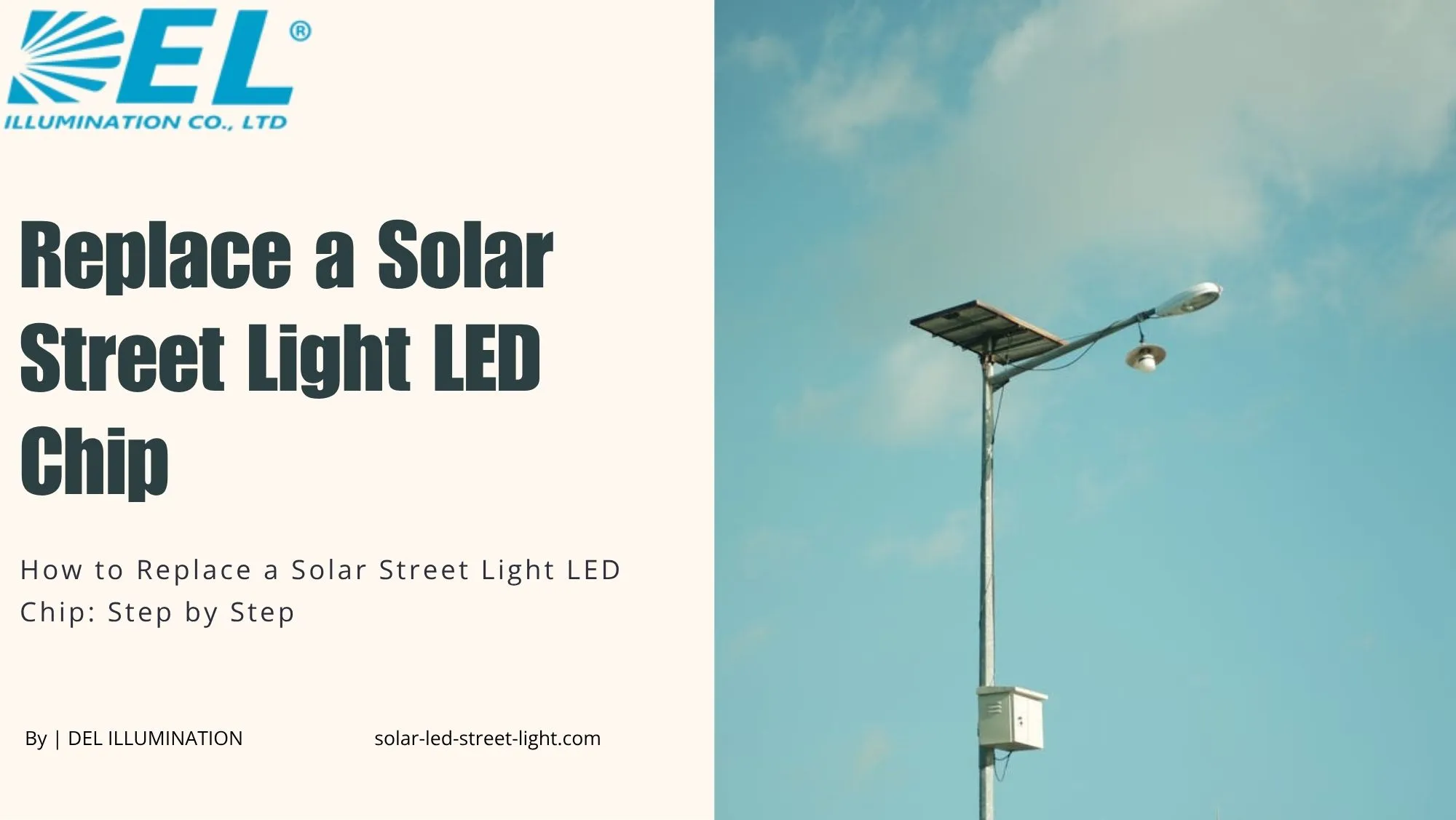
Up to 30% of solar street light field failures stem directly from LED module degradation not battery failure, not charge controller faults, but the light source itself. Yet in most cases, the entire luminaire is discarded when only the LED chip or PCB module needs replacing. For city planners managing thousands of units, facility managers overseeing industrial parks, and EPC contractors responsible for long term project performance, understanding how to replace a solar street light LED chip is not merely a maintenance skill it is a cost control strategy with measurable impact on total project ROI.
This guide walks through the complete process: how to diagnose chip failure, select the correct replacement module, execute the swap safely, and verify performance post installation. Where relevant, it highlights the engineering differences between German engineered systems and generic alternatives differences that directly affect how straightforward (or frustrating) this procedure will be in the field.
Understanding LED Chip Failure: Why It Happens and What It Looks Like
Before opening a luminaire head, it is worth understanding what actually causes LED chip failure in solar street lighting applications. The primary culprit is thermal stress the accumulated effect of heat on the LED junction (the semiconductor layer where light is produced).
Industry research confirms that at a junction temperature of 25°C, a well specified LED can deliver 60,000+ hours of rated life. Once that junction temperature rises to 85°C, the same chip may reach its L70 lumen depreciation point where light output drops to 70% of initial output in under 25,000 hours. Above 100°C, significant lumen degradation can begin within just a few thousand operating hours. In solar street lights deployed in tropical, desert, or equatorial climates where ambient temperatures regularly reach 40–50°C, thermal management becomes mission critical.
Generic solar street lights, which commonly use thin metal or plastic housings, often allow junction temperatures to exceed 100°C under 50°C ambient conditions. German engineered systems using die cast aluminium housings and precision heat sink architectures maintain junction temperatures at or below 85°C even under the same ambient conditions a difference that translates directly into the chip’s service life.
The most common signs of LED chip failure include:
- Partial or full blackout one or more chips no longer illuminate at all
- Colour shift light output appears yellowish or shifts noticeably from its original colour temperature (typically 4,000–6,000K for road lighting)
- Flickering the chip oscillates between states due to solder joint fatigue or driver current instability (see our detailed guide on solar street light flickering)
- Lumen degradation overall brightness falls below acceptable lux levels for the road class, detectable with a portable lux meter
- Hot spot discolouration visible browning or darkening of the chip’s encapsulant, often visible when the luminaire is opened
If you are also experiencing issues with the light not activating at all, the root cause may lie elsewhere refer to our troubleshooting guide on solar street light not turning on before proceeding with a chip replacement.
Tools, Safety Requirements, and Pre Work Checklist
LED chip replacement on a solar street light is an electrical and photonic task. Proper preparation prevents both personal injury and secondary component damage.
Mandatory tools and materials:
- Insulated screwdrivers (Phillips and flathead, rated to 1,000V)
- Torque wrench or driver with settings to 0.5–2 Nm (for terminal screws)
- Replacement LED module or PCB board (matched to original wattage, chip type, and forward voltage)
- Soldering iron (25–40W) with rosin core solder, if chip level replacement is required
- Thermal compound paste (silicone based, ≥1 W/m·K conductivity)
- Digital multimeter for voltage and continuity checks
- Anti static wrist strap
- UV stable, IP rated silicone sealant for re sealing the luminaire cavity
- Portable lux meter (for post installation verification)
- Ladder rated to IK08 impact resistance or cherry picker for pole mounted fixtures
Safety pre work checklist:
- Confirm the solar charge controller is in maintenance mode or the light is fully powered down. On German engineered systems with MPPT controllers, use the dedicated maintenance lockout function.
- Cover or disconnect the solar panel to prevent current generation during the procedure. Even in overcast daylight, a monocrystalline panel rated at 21–23% efficiency will generate measurable voltage.
- Place traffic safety barriers around the work zone for any road or public area installation.
- Check local electrical work permit requirements. In many jurisdictions, replacing luminaire components on public infrastructure requires a licensed electrician.
- Document the original lux level, wattage, and chip specification before disassembly using the product label or technical datasheet.
Step by Step: How to Replace the LED Chip or PCB Module
The industry approach to LED chip replacement in solar street lights divides into two levels of intervention: full PCB module swap and individual chip level replacement. For most field technicians and facility managers, module level replacement is recommended it is faster, reduces on site soldering risk, and maintains manufacturer warranty compliance. Chip level replacement is viable for experienced technicians with proper soldering equipment and is most appropriate for high volume fleet maintenance programmes.
Step 1 Access the luminaire head Lower or access the fixture. Unscrew the luminaire housing using the manufacturer specified fasteners. Most IP67 rated units use stainless steel Torx or hex bolts; generic units often use standard Phillips screws that strip easily in humid environments. Carefully peel back any residual silicone sealant around the housing perimeter.
Step 2 Disconnect the LED module Locate the LED driver and identify the output wires running to the LED PCB. Note wire colours and connection sequence (photograph before disconnecting). Disconnect the LED module from the driver output these are typically push in or screw terminal connectors. Do not pull on the wire itself; grip the connector body.
Step 3 Remove the existing PCB The LED PCB is typically secured to the heat sink with two to four M3 or M4 screws. Remove these and lift the PCB clear. In thermally well designed units, the PCB will be bonded to the heat sink using thermal compound. Use a plastic spudger to break the bond gently avoid metal tools that can crack the PCB substrate.
Step 4 Verify the replacement module specification Confirm the replacement LED module matches the original in:
- Wattage (e.g., 30W, 50W, 100W)
- Forward voltage (typically 24–36V DC for high power arrays)
- Chip type (SMD 3030, SMD 5050, or COB)
- Colour temperature (match the original CCT road lighting is typically 4,000K–5,700K)
- Efficacy (German engineered modules specify 160–180 lm/W; generic modules often range from 100–120 lm/W installing a mismatched lower efficacy module will reduce overall system output and shorten battery autonomy)
High performance SMD 3030 chips, which are standard in quality solar street lights, deliver 120–190 lm/W at 1W per chip. SMD 5050 chips can reach up to 230 lm/W at 5W. Using an incorrect replacement module type can alter the driver’s operating point and cause premature failure.
Step 5 Prepare the heat sink surface Clean the heat sink contact surface thoroughly with isopropyl alcohol (IPA ≥99%). Apply a thin, even layer of fresh thermal compound across the full contact area. In die cast aluminium housings standard on German engineered systems this step is particularly important because the aluminium’s high thermal conductivity (approximately 150 W/m·K) is only fully utilised when the interface is compound bonded.
Step 6 Mount and connect the new module Position the replacement PCB on the heat sink, aligning the mounting holes. Torque the mounting screws evenly in a cross pattern to 0.8–1.2 Nm to avoid warping the aluminium core PCB substrate. Reconnect the driver output wires to the correct polarity terminals. Double check with a multimeter: forward bias resistance on the LED circuit should read between 2–50 ohms depending on the array configuration.
Step 7 Seal and close the housing Apply fresh UV stable silicone sealant around the housing perimeter before reassembly. Allow a 10–15 minute skin forming period before fully closing. Re tighten housing fasteners to the manufacturer’s torque specification. The restored IP67 seal is critical any ingress point will allow moisture to attack the PCB traces, a primary cause of secondary failure within 12 months.
PCB Module vs Individual Chip Replacement: Choosing the Right Approach
One of the most common decisions field teams face is whether to replace the entire LED PCB module or attempt individual chip level desoldering and replacement. Both approaches are valid, but they carry different cost, time, and risk profiles.
Full PCB module replacement costs approximately USD 15–60 per unit depending on wattage (30W–100W range), compared to the USD 1–5 per individual SMD 3030 or 5050 chip. However, module replacement takes 20–40 minutes per unit versus 45–90 minutes for chip level work, eliminates the risk of collateral pad damage from heat, and restores the entire optical array to factory condition. For fleet operators managing 500+ units, the time saving at module level typically more than offsets the component cost differential.
Individual chip replacement is appropriate when only one or two chips have failed on an otherwise sound PCB, the module is a proprietary design with long lead times, or the operation is a specialised workshop with reflow soldering equipment. When reflowing SMD chips, the solder profile matters: standard SAC305 lead free solder requires a peak temperature of 245–260°C. Exceeding this for more than 10 seconds risks delaminating the aluminium core PCB substrate and destroying adjacent chips.
Generic solar street lights frequently use non modular designs where the LED PCB is permanently bonded to the housing or integrated into a one piece moulded assembly. This design choice eliminates field replaceability entirely, forcing full luminaire replacement a hidden lifecycle cost that procurement officers should factor into total cost of ownership evaluations. German engineered systems, by contrast, prioritise modular architecture: driver, LED module, and battery are all independently serviceable, a key feature for projects seeking bankable EPC contract compliance.
Post Replacement Verification and Performance Testing
Replacing the LED chip or module is only complete once the restored fixture is verified against its original performance specification. Skipping this step risks deploying a luminaire that appears functional but delivers substandard lux levels or draws excessive current both of which shorten system life and create safety gaps on the road.
Electrical verification:
Power up the system by uncovering the solar panel in daylight or connecting a bench DC supply at the rated battery voltage (typically 12.8V or 25.6V for LiFePO4 systems). Measure the LED module current draw using a clamp meter or inline ammeter. It should match the driver’s rated output current within ±5%. A significantly higher current draw indicates a forward voltage mismatch between the replacement chip and the original driver set point consult the driver datasheet and adjust the output current trim potentiometer if accessible.
Photometric verification:
Using a portable lux meter, measure illuminance at ground level directly below the fixture and at the design spacing distance (typically 20–30 metres for road lighting, depending on pole height and beam angle). Compare readings against the original design specification commonly 15–30 lux for secondary roads and 30–50 lux for primary roads under EN 13201 European road lighting standards. If the restored fixture delivers lux levels more than 10% below the original design value, the replacement module’s efficacy or optical distribution may be mismatched.
For projects that were originally commissioned using DIALux or similar simulation software, a field re measurement confirms whether the replaced module restores the as designed lighting distribution. Our DIALux simulation methodology guide covers the exact verification process for EPC project handback.
Thermal spot check:
After 30 minutes of continuous operation, use a non contact infrared thermometer to measure the luminaire housing surface temperature near the LED mounting point. On a properly serviced German engineered unit with die cast aluminium housing, this reading should remain below 65°C at 35°C ambient confirming that the thermal compound interface is performing correctly. Readings above 80°C indicate inadequate thermal compound coverage and require the housing to be reopened and the compound layer reapplied.
When Chip Replacement Is Not Enough: Recognising System Level Issues
LED chip replacement resolves the immediate failure, but experienced maintenance teams treat it as an opportunity to assess the wider system condition. A chip failure that occurs at fewer than 20,000 hours of service is an early failure indicator the LED’s rated life should reach 50,000 hours in a correctly managed system. Early failure almost always points to an underlying condition that the chip swap alone will not fix.
Check the LED driver output: An unstable driver delivering current spikes will destroy a replacement chip within weeks. Use an oscilloscope or ripple meter to confirm the driver’s output ripple is below 10% a standard requirement for quality LED drivers. A defective driver in a generic system costs USD 8–25 to replace but is far less frequently diagnosed as the root cause.
Inspect the MPPT controller: An underperforming charge controller may allow the battery to discharge excessively, forcing the driver to operate outside its input voltage range. German engineered MPPT controllers provide 25–30% more energy harvest than PWM alternatives the efficiency difference directly affects how deeply the battery cycles, which in turn affects driver stress. Learn more about how MPPT controllers affect overall solar street light performance.
Assess the battery state of health: A degraded LiFePO4 battery delivering only 60–70% of its rated capacity will force the driver to operate at lower voltages in the final hours of the night, increasing current demand on the LED chip. If the battery is more than 8 years old on a generic system (or more than 12 years on a German engineered LiFePO4 pack), simultaneous battery replacement alongside the LED chip swap will prevent recurrence.
If the system shows signs consistent with a broader fault condition, a full diagnostic sequence is advisable before committing to component level replacements.
Conclusion: LED Chip Replacement as a Lifecycle Strategy, Not Just a Repair
Replacing a solar street light LED chip is a measurable, field executable procedure that, when done correctly, restores a fixture to full performance without the cost of full luminaire replacement. The key takeaways are:
First, diagnose before you replace thermal degradation, driver failure, and battery under voltage are all conditions that will destroy a replacement chip if left unaddressed. A 30 minute diagnostic check before ordering parts prevents wasted expenditure and repeat failures.
Second, match the replacement module precisely wattage, forward voltage, chip type, and colour temperature must all align with the original specification. For procurement officers and EPC contractors managing large fleets, working with a single manufacturer whose parts inventory supports field level module replacement dramatically reduces maintenance complexity and lead times.
Third, verify performance after every replacement an electrical current check and a ground level lux measurement together take under 15 minutes and confirm that the restored fixture meets the design standard. Without this step, degraded performance may go undetected for months.
The modular design philosophy embedded in German engineered solar street lights where driver, LED module, and battery are each independently serviceable makes chip level maintenance economically viable over a 10–15 year system life. Generic alternatives with bonded or non modular designs eliminate this option, forcing full luminaire replacement at 3–5 times the cost.
For expert consultation on solar LED street lighting systems designed for field serviceability, or to obtain replacement LED modules matched to your existing fleet, visit solar led street light.com or contact our engineering team for a customised maintenance and procurement quote.
FAQ
Q1: Can I replace a single LED chip without replacing the entire PCB module? Yes, individual SMD chip replacement is technically possible if you have a soldering iron, flux, and the correct chip specification but it requires skill. The main risk is pad damage from excessive heat during desoldering; a standard reflow iron should not exceed 260°C at the pad for more than 10 seconds. For field maintenance without workshop equipment, full PCB module swap is almost always the faster and lower risk choice.
Q2: How do I identify the correct replacement LED module for my solar street light? Check the product label on the luminaire housing or the original installation datasheet. Key parameters are wattage (e.g., 50W), forward voltage (typically 24–36V for high power arrays), chip type (SMD 3030 or SMD 5050), and colour temperature (usually 4,000K–6,000K for road use). If the documentation is unavailable, measure the original module’s forward voltage and chip count with a multimeter and count the chip matrix before ordering.
Q3: How long does an LED chip replacement typically take in the field? A full PCB module swap, including disassembly, cleaning, thermal compound application, reconnection, and resealing, takes an experienced technician approximately 20–40 minutes per unit at pole height. Allow additional time for bucket truck or cherry picker positioning on taller poles (8–12 metres), and for traffic control setup on roadside fixtures.
Q4: Will replacing the LED chip void the product warranty? This depends entirely on the manufacturer’s warranty terms. Premium manufacturers with comprehensive 5–7 year warranties typically specify that maintenance must use manufacturer approved replacement modules to remain valid. Always confirm with your supplier before proceeding. Generic systems with 1–2 year warranties often become out of warranty before chip replacement is necessary, so this is less of a concern on those products.
Q5: Why do LED chips in solar street lights fail earlier in hot climates? In climates where ambient temperatures regularly exceed 40–45°C, the thermal path from LED junction to ambient air is under extreme stress. If the luminaire housing cannot dissipate heat efficiently a particular weakness of thin metal or plastic generic housings junction temperatures can exceed 100°C, at which point lumen degradation accelerates sharply. In such environments, die cast aluminium housings, properly applied thermal compound, and correctly sized LED drivers are non negotiable. This is a major consideration for solar street light projects in the Middle East and similar high temperature regions.
Q6: What is the difference between SMD 3030 and SMD 5050 chips, and does it affect replacement? SMD 3030 chips (3mm × 3mm package) run at approximately 1W per chip and deliver 120–190 lm/W. SMD 5050 chips (5mm × 5mm package) run at approximately 5W per chip and can reach up to 230 lm/W. They are not interchangeable each requires a specific driver set point and PCB pad layout. Fitting a 5050 chip to a 3030 driver circuit will damage the driver. Always match the replacement chip type exactly to the original specification.
Q7: Is it safe to replace an LED chip on a solar street light without switching off the solar panel? No. Even in overcast daylight conditions, a monocrystalline solar panel with 21–23% efficiency generates measurable open circuit voltage typically 18–45V depending on panel size. This is sufficient to cause electrical shock and may damage sensitive driver components during connection work. Always cover the panel fully with an opaque cloth or disconnect the panel cable before beginning any work on the luminaire circuitry.
Q8: How often should LED chips or modules be proactively replaced in a large fleet? Rather than time based replacement, industry best practice for large fleets (500+ units) is condition based monitoring: track lux levels annually using portable meters, and flag units that have dropped below 80% of their design lux as candidates for module inspection. LED chip replacement on German engineered systems with 50,000 hour rated modules should not typically be required before year 10 of deployment if thermal management is correct. Generic systems with 20,000–30,000 hour practical ratings may require module attention from year 5 onward.
References
- International Electrotechnical Commission. (2019). IEC 62717: LED Modules for General Lighting Performance Requirements. https://webstore.ansi.org/standards/iec/iec62717ed2019
- International Electrotechnical Commission. (2022). IEC 62722 2 1: Luminaire Performance Part 2 1: Particular Requirements LED Luminaires. https://www.iec.ch/homepage
- Unibox Lighting. (2026). Why Thermal Management Matters in LED Lighting: A Guide for Designers, Contractors, and Sustainability Experts. https://unibox.co.uk/blog/led thermal management heat sinks
- Inlux Solar. (2026). Thermal Management & Lumen Depreciation: Solar Street Lights. https://www.inluxsolar.com/solar street light/guides/thermal management lumen depreciation/
- Lighting Europe. (2025). Evaluating Performance of LED Based Luminaires Guidance Paper. https://www.lightingeurope.org/images/guidelines/LightingEurope_ _Guide_ _Lifetime_Metrics_ _WG_APPROVED_ _20250107.pdf
- Distrelec KnowHow Hub. (2024). Thermal Considerations for LEDs. https://knowhow.distrelec.com/energy and power/thermal considerations for leds/
- ADNLITE Solar. (2026). All You Need To Know About LED Chips In Solar Lights. https://adnsolarstreetlight.com/blog/all you need to know about led chips in solar lights
- Haichang Light. (2026). Solar LED Street Light Complete Guide 2026: All in One vs Split, LiFePO4 Battery. https://www.haichanglight.com/solar led street light complete guide 2026 all in one vs split system lifepo4 battery rainy day performance/
- Quenen Lighting. (2025). Solar Street Light Costs: Design, Manufacturers & Procurement Guide 2024. https://www.quenenglighting.com/guides/solar street light cost design procurement guide.html
- ZGSM China. (2026). Light Output of LED Solution and Its Degradation IEC 62717 and LM 80. https://www.zgsm china.com/blog/light output of led solution and its degradation 62717 and lm80.html
Disclaimer
This article is for informational purposes only and does not constitute professional engineering, installation, or procurement advice. Performance specifications and costs may vary based on project requirements, location, and local regulations. Always consult qualified solar energy professionals and legal advisors before making procurement decisions.
For expert consultation on solar LED street lighting solutions, visit solar led street light.com or contact our team for a customised quote.